Seeking Whiteness: For Asian Women Only?

by John Wang

As Ashikari (2005) mentions in “Cultivating Japanese Whiteness: The ‘Whitening‘ Cosmetics Boom and the Japanese Identity”, in contemporary Japanese society, the strong preference for light complexions and skin tone was actually expressed as a dichotomy of ‘white’ and ‘black’. Another interesting result coming from the survey she conducted was that although in contemporary Japan the dark skin was spoken of negatively, “many informants, both men and women, insisted that white skin was the ideal only for women, and that dark skin was the ideal for men.” I found similar arguments in many Chinese media, although recently I was actually against this argument since I felt that seeking whiteness is no more a social phenomenon, which just limited to the Asian women. Asian men are also gradually involved.

According to International Enterprise (IE) Singapore, the sales of skin care products for men increased 30 percent to over $280 million in China. Some industry giants including L’Oreal from France and Shisedo from Japan are looking forward to the boost of their business in China. China is going to account for half of the global growths in the men’s skin care market within the next five years.

Personally I did not realize this tendency until I met one of my roommates in my high school. In the first day of entry, the small bags he brought to the dormitory surprised all of his roommates, including me. There were so many bottles of cosmetics that we had never heard about and there were also some foreign cosmetics. He was always the last to go to class since he usually spent around twenty minutes to put on makeup. We were even more surprised that after a month, some female students started to ask him for advice on choosing the right white-lightening cosmetics. His skin was truly lighter compared to most male students, due to long-term use of different kinds of cosmetics. After I came to study in Japan, I also found male students using white-lightening cosmetics in order to keep their skin looking good and white. Some of my classmates in my high school have also started to use whitening cosmetic products.

So question here is whether lightening cosmetics are also “must-haves” for Asian men?

Research conducted by Zheng (2010) shows that the main reason for the increase in men’s use of cosmetics is that cosmetic use has become a symbol of men who care about their appearance, while previously this use had been regarded as feminine. Zheng argues that this change is due to the influence of mass media and advertisements. Meantime, rapid economic development has made cosmetics affordable for more men. Being able to using cosmetics is also one way to show one’s social status. These factors have made whiteness more appreciated. However, Zheng also pointed out that this tendency does not challenge the idea that tanned skin is a proper skin color for males. These two standards have become parallel in Asian countries.

The spread of whiteness as a standard of beauty seems unstoppable in Asian countries. With globalization and the spread of western aesthetics, whitening cosmetics are becoming must-haves for both men and women. It is creating massive business chances as well as changing people’s taste of aesthetics. I feel it is interesting if Ashikari can do her survey again, this time focusing on the opinions of Japanese men. They result might be similar as it was for women in contemporary Japan.

References

Ashikari, Mikiko. 2005. Cultivating Japanese Whiteness: The ‘Whitening’ Cosmetics Boom and the Japanese Identity. Journal of Material Culture, 10 , 73-91.

Cosmetic market for men in China booming – Media Centre – International Enterprise Singapore (2011). Retrieved from International Enterprise (IE) Singapore, Web site: http://www.iesingapore.gov.sg/Media-Centre/News/2011/2/Cosmetic-market-for-men-in-China-booming

Zheng, J. (2012). 男士护肤品掀起热潮. 日用化学品科学, 10 10-16.

Progress and Subjugation

Trafficking of women, children and men

Trafficking of women, children and men (Photo credit: Wikipedia)

by Michael McDonnell

The introduction to the 2008 Trafficking in Persons Report notes, “The common denominator of trafficking scenarios is the use of force, fraud, or coercion to exploit a person for profit. A victim can be subjected to labour exploitation, sexual exploitation, or both”. In Illicit Flirtations: Labor, Migration, and Sex Trafficking in Tokyo, Rhacel Parreñas explains the identification of the majority of Filipino women working as hostesses in Japan as victims of trafficking, and how the clampdown in visa sponsorship that resulted has in fact been detrimental to their freedom overall. According to Parreñas, the women she encountered who came to Japan to work, came of their own free will and many already knew what to expect from having spoken to women who have previously made the journey. They enter Japan with legitimate entertainer visas and employers willing to sponsor them.

She states that rather it is the restrictive conditions of these visas that make women more susceptible to forced labour and exploitation. For example, in order to be granted a permanent spouses visa, the applicant has to remain married to a Japanese citizen for five years creating a situation where the wife is indebted to the husband. If an employer asks a worker to do a job she is not comfortable with for whatever reason she cannot leave the job without becoming an undocumented illegal worker, becoming reliant on an employer to provide both work and protection from being found out. These unbalanced relationships are, according to Parreñas, what increase the likelihood of forced labour and abuse, not the position as a Hostess itself.

This exploitation of vulnerable workers exists all around the globe. In Bangladesh, workers, more than 85% of whom are female, in clothing factories many making goods on behalf of international sportswear companies are still paid below the minimum wage, are forced to work overtime, and are sometimes verbally and physically abused. Attempts to protest or strike are met with police brutality. Their dependence on this money to support their families prevents them from leaving.

HK Victoria Park Philipino Migrant Workers

Photo credit: Wikipedia

The anti-poverty charity War on Want, who are involved in ending the exploitation of Bangladeshi workers in the clothing industry, advise against boycotts of the goods produced in these factories as it could lead to job losses for the people they are trying to protect. War on Want are instead pushing for a change in the practices of these sportswear companies and the guarantee of improved pay and conditions for the workers.

The labeling of migrant workers from the Philippines as victims of trafficking by TIP led to a 90% drop in women being sponsored to work in the hostess industry further reducing their options for advancement. The answer to this problem is not to crack down on the employment of foreign workers in this industry but, much like in the case of the Bangladesh, to improve the conditions for the workers. By giving more control to the women working in the hostess industry to choose their own employers and to change jobs if they want the likelihood of exploitation would be greatly reduced.

References

Parreñas, Rhacel. 2011. Illicit Flirtation: Labor, Migration, and Sex Trafficking in Tokyo. Stanford: Stanford University Press.

War on Want. (2012). Race to the Bottom. Available: http://www.waronwant.org/attachments/Race%20to%20the%20Bottom.pdf

Exploring Japanese Whiteness

Photo by Robert Moorehead

by Wang Xinyi

美白 (bihaku) is a Japanese commercial term that refers to beauty products with functions of skin whitening or brightening. Aiming at prevent or reverse skin imperfection and provide a clean and fair complexion, bihaku has becoming very desirable among Japanese women since the late 1980s. I’m very surprised to find out that the skin-whitening market in Japan essentially is way more massive than I had thought. Products are comprehensive from head to toes. Regardless of using cosmetic products such as BB cream to create a lighter skin, Japanese women have been also purchasing whitening skin-care products like whitening toner and cream that not constrained to target on face but also other parts of body. Despite of that, quasi-drugs that contain vitamins and other ingredients to promote skin regeneration are also very popular. Japanese women will also go to clinic for whitening their skin. What’s more, with newly developed technologies, nowadays people can also do whitening injections either in a clinic or by themselves.

Just by walking into any drug stores in Japan, it won’t be hard for you to find skin-whitening products. Therefore people start to question why Japanese women have been so obsessed with a lighter complexion? Some people claimed admiration for Caucasians should be the vital factor, whereas objection voices argued ‘white’ has been a significant standard of beauty historically.

Ashikari (2005) pointed out, such a Japanese whiteness idea which based on Japanese identity as a race should not be devalued simply as a beauty issue nor as western mimicry. First and foremost, throughout the whole representation by mass media including tv programs, idol image-building, magazines, etc., light skin tone has become an important feature for defining beauty.

Secondly, Japanese people turn out to believe that they originally share a special Japanese skin that is soft, resilient and slightly moist, which is highly related to racial factors. Therefore, they consider people without that kind of skin are either of other races or are Japanese who have been tanned by sunshine. In this sense, white skin tone then works as one medium to express and represent Japaneseness. By being a “proper” Japanese, you need to have a light skin tone, and the same goes for being beautiful in Japan. Hence, to be a pretty and proper Japanese woman, light complexion turns out to be crucial.

Nevertheless, why is that the consumption of whitening cosmetics boomed around the late 1980s? From my perspective, it could be linked with Japanese political as well as economical conditions at the time. After the economic bubble burst, the Japanese government decided to be more liberal and international, both politically and economically. This means that cross-cultural communication had been also stimulated. Is it possible to say that, by sensing so numerous foreigners Japanese people then gained a crisis awareness of their own culture so that began to cultivate tons of “Japanese uniqueness” to separate themselves with others? If that could be taken into account, in such a globalized world how long can Japan maintain such a unique Japanese whiteness concept without being influenced by global trends?

Another question is that, why there is only a “Japanese whiteness” which is marked as unique from all other types of whiteness? As a Chinese, I don’t think there is anything specifically defined as “Chinese whiteness”. Or I’ve also never heard people talk about “special Korean whiteness”. Why do we only see this in Japan?

Reference

Ashikari, Mikiko. 2005. “Cultivating Japanese Whiteness: The ‘Whitening’ Cosmetics Boom and the Japanese Identity.” Journal of Material Culture 10(1):73-91.

White Skin Covers The Seven Flaws

photoby Nana Tsujimoto

The old Japanese proverb “white skin covers the seven flaws [iro no shiroi wa shichinan kakusu]” means that a fair-skinned women looks beautiful even if her features are not good enough. As this proverb describes, Japanese women have been passionate about getting fair skin throughout the centuries. In addition, in contemporary Japan bihaku [beautiful and white] skin should be moist, elastic, smooth, free of blemishes and wrinkles. In the article “Cultivating Japanese Whiteness”, Mikiko Ashikari (2005) argues that the white skin is represented as a symbol of beauty and that of Japaneseness; moreover, this is authorized in public in contemporary Japan.

photo2The custom of face-whitening in Japan goes back to Nara period (710–794). At that time, women belonging to the upper class started to put white powder called oshiroi on their faces due to be more beautiful. According to research conducted by Miho Sato (2002), a professor of the Human Science department of Waseda University, compared to people in other countries, Japanese prefer whiter colors. Sato pointed out that Japanese people have seen the color white as holy [shinseina] and mysterious [shinpiteki] for a long time. Therefore, Japanese women’s preference for a white face was not constructed by westernization but it was emerged from inside of Japanese culture. Experiencing globalization, a white face became not only a Japanese standard of beauty but also an international standard. White skin has been a symbol of beauty for Japanese women. Actually, that is why many Japanese women avoid getting tanned.

Ashikari (2005) says that the dichotomy of white and black leads to division of people: “us” and “others”. She also mentions that Most Japanese unconsciously believe that they are members of Japanese group (racial group) and they share the same skin that is white skin (this differs from the white skin that white people describes). This leads people to have a membership of “us” and also this is linked to the exclusion of people with different skin color as “others”. However, in my opinion, skin color does not help distinguish Japanese people from other people; for example, I cannot say whether my skin looks like Japanese skin or Chinese one. The reason why Japanese think that they have the same skin and other racial groups do not is that Japanese have not enough opportunities to meet someone from other countries or they merely go abroad not just for trip. I think white skin is not so important to examine people’s Japaneseness.

It is common for women in other Asian countries such as the Philippines to bleach their skin due to get more whiter skin. However, in Japan, Japanese women do not try to do that but they use various skin-whitening stuffs including bihaku cream. Do you think agree that Japanese women practice skin-whitening to keep their white face that is a symbol of beauty and Japaneseness? Japanese whiteness is quite complex, but it is really interesting to think about this topic.

References

Ashikari, Mikiko. 2005. “Cultivating Japanese Whiteness: The ‘Whitening’ Cosmetics Boom and the Japanese Identity.” Journal of Material Culture 10(1):73-91.

Shikisaishikou to kokorono kankeiwo gakusaitekina shitende tuikyu [Pursuing the link between color preferences and heart from interdisciplinary perspective](April18, 2002). Kenkyusaizensen [the forefront studies]. Retrieved on Oct 30, 2014. Retrieved from http://www.waseda.jp/student/weekly/contents/2002a/960o.html

The Fair Face of Japanese Beauty (Oct 31, 2013). Nippon.com. Retrieved on Oct 30,2014. Retrieved from http://www.nippon.com/en/views/b02602/

The fallacy of Japaneseness identity through the ideal of “white” Japanese skin 

by Agathe Schwaar

For the four years I have been living in Japan, I have never felt attracted to Japanese cosmetic products, and for many different reasons. First of all, the TV commercials. They always show beautiful Japanese ladies with perfect skin, they would compliment the effect of their “whitening lotion”. They also would have this strange way to play with their skin as it was some British jelly and cry out how their skin is soft after applying the product. Second, I had never been able to find my skin tone among all the Japanese makeup available in the drug store. The foundation creams in Japanese are so pale that I would have looked sick if I had tried to wear some.

To remedy this situation, every time I go back to France I buy all the products that I need from face cleansing to shampoo and conditioner (for thin hair, which is not like Japanese hair). By being a western women in Japan, I clearly felt the assumption that Japanese people consider their skin tone as unique and specific to their “people”.

clipimage_21In her research on Japanese whiteness, Mikiko Ashikari (2005) tries to explain where the idea of a specific white skin among the “Japanese race” comes from. According to Ashikari, it seems less likely to be from Caucasians’ influence, since Japanese women considered Caucasian skin as “rough, aged quickly and had too many spots” (Ashikari 2005:82). The idea of white skin in the Japanese society is even more specific than any other features that could define the idea of being “Japanese”. Although Japanese change their hair color with dying products, their eye color with contact lenses, and their physical features with plastic surgery, they would never change their skin color because “the notion of Japanese skin works as one medium to express and represent Japaneseness” (Ashikari 2005:76). As Ashikari notes, by defining a specific skin color to their race, Japanese people are even able to reject the Okinawan people as a “second-class citizens” (Gibney quoted by Ashikari, 2005, p. 80).
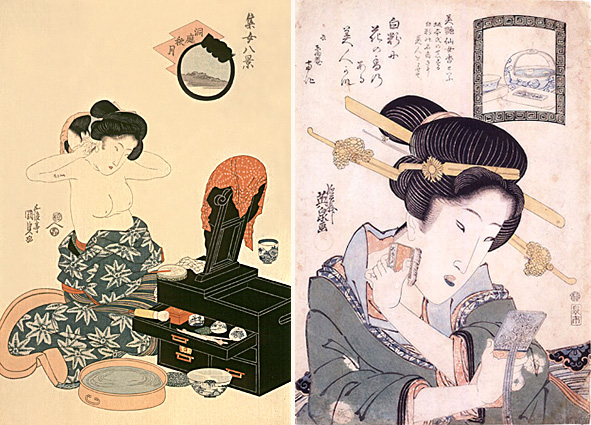
b02602_ph02Actually, Japanese whiteness has its roots even before the Black Ships arriving in Japan during the 16th century. It is said that during Nara Period (710–94) and Heian Period (794–1185), Japanese women were already using diverse products to light their skin tone (Kyo 2012). The ideal of white skin is also found in a lot of literature of this period such as the Diary of Lady Murasaki and Tale of Genji (Kyo 2012). Back in the Heian Period, women would blacken their teeth and shave their eyebrows. Nowadays nobody would shave their eyebrows as a sign of beauty but the idea of white skin as the ideal of beauty among Japanese women is still a recurrent topic in Japanese society.

In the case of Japan, we are actually not facing an issue of white supremacy on a “secondary” race, but the emergence of the uniqueness of a specific and idealised race through notions of a Japanese race. The idea of a race is still a controversial subject in scientific research, and I think that the Japanese people’s attitude toward their own skin as a part of their own race should be also considered as controversial. If we follow the idea that whitening one’s skin in order to follow an old tradition that dates back to the 10th century, then the “French race” also should wear white makeup in order to respect the traditions from the 15th century.

The commerce of whitening products in Japan is not an issue of how much Japanese people spend on those products, it is an issue of how it feeds the Japanese mentality on their own uniqueness. As Ashikari (2005) explains, white skin in Japan is not only a beauty feature among Japanese women, it idealises the white face as a symbol of the “Japanese identity as a race and therefore very different from — and even “superior” — to western whiteness” (p.89). The marketing is using a single element to increase the belief of a unique race in order to make more profits. With these actions, they instill in Japanese people a fallacy of their identity and create an idea of a skin superior to any other white skin and so superior to any other kind of “white race”.

Reference

Ashikari, Mikiko. 2005. “Cultivating Japanese Whiteness: The ‘Whitening’ Cosmetics Boom and the Japanese Identity.” Journal of Material Culture 10(1):73-91.

Kyo, C. (2012). Search for the Beautiful Woman: A Culture History of Japanese and Chinese Beauty (Asia/Pacific/Perspectives). Rowman & Littlefield Publishers.

Japanese Whiteness and Bihaku Products: Media Influence on Aesthetic Values of Japanese Skin

by Rena Shoji

Japanese model Chie Kumazawa in an interview for an online fashion magazine For F

Bihaku (skin-whitening) products are “must-haves” in Japan. I think using those products is almost considered as etiquette to avoid getting sun tanned to keep your skin tone “appropriate”. The market size is huge in Japan. In 2012, study shows that bihaku products consist of over 210 billion yen in the domestic market (TPC Bibliotech 2014). However, it is not that Japanese women have color complexes or feel inferior to the skin tone of Caucasians. They seek “Japanese whiteness”, which they claim a “traditional” aesthetic value in Japan. In “Cultivating Japanese Whiteness” (2005), Mikiko Ashikari argues that Japan has its own skin identity and aesthetic values, in which whiter skin is preferred.

First, Japanese people tend to think that they have a distinct skin tone (Ashikari 2005). Despite individual differences, people with darker skin by nature (jiguro), are seen as different or unusual. For example, people from Okinawa are likely to be considered as different from “usual (futsuno)” Japanese because they share different historical backgrounds. Their darker skin is distinguished from ordinary Japanese. As a result, darker skin generates “otherness”. It reminds me of a friend of mine, who has relatively darker skin. She is often teased about her skin tone. “You don’t look like Japanese.” Her darker complexion makes her look like non-Japanese in the Japanese society. Therefore, Japanese people tend to think that they have “unique” and “traditional” skin identity and aesthetic values.

Second, with regard to Japanese skin identity, the author’s survey illustrates that Japanese women claim that they have “traditional” aesthetic values in terms of whiteness. Their Japanese whiteness, they think, is even superior to the skin of White people. Thus, skin-whitening in Japan is not mimicry of Caucasians. In addition, skin-whitening products are widely spread and its market scale is huge. However, the purpose of using those bihaku products is not to make their skin tone lighter than their “innate” complexion. Rather, skin-whitening in Japan are used to regain youth on their skin. It implies that the consumers think that they naturally have lighter skin and can regain youth and whiteness with those products. Many Japanese women try to avoid sun tanning in order to “protect their whiteness”.

Kumazawa in a SHISEIDO’s advertisement

Kumazawa in a SHISEIDO’s advertisement

However, I argue that the skin identity and aesthetic values, which Japanese think they traditionally have, can be questioned. Also, I would say that these ideas are strongly influenced by beauty companies in Japan because of its market size and the regulations on the advertisements. As mentioned above, bihaku products are very popular, or sometimes considered as “necessary”, and used by the majority of Japanese women. It can be said that those products, in part, influence the beauty standard of Japanese women. What are the media messages of the products through selling them? In fact, Japan Cosmetic Industry Association (JCIA) prohibits advertisements of cosmetic products from claiming skin-whitening effects (JCIA 2012). The recovery and prevention from san tanning are the only things that are permitted in cosmetic advertisements. The regulations would certainly affect the content of the advertisements. It also should be noted that even under the regulations, the models for the skin-whitening products actually show whiter skin than they really have.

Given both of Ashikari’s arguments and these two factors above, it can be said that the Japanese “traditional” aesthetic values are, in actuality, constructed by media messages. That is, in order to pass through the regulations and still create a demand for skin-whitening products, cosmetic companies claim Japanese women’s “innate” whiteness on their skin. Reciprocally, the media message from those prevalent market products influence on the aesthetic values of Japanese women. Furthermore, its influence is so huge that the consumers strongly believe in their “natural” light skin tone. Therefore, I argue that Ashikari’s arguments about Japanese skin identity and female aesthetic values are strongly influenced by bihaku products in Japan.

Many women enjoy using cosmetic and skincare products, but applying and consuming products can be an obsession if the society creates the specific beauty standard. In the case of Japanese skin-whitening, the products themselves and the media message create the social norm and aesthetic standard. We, consumers of these products, have to be aware of the impacts of media influence from cosmetic advertisements.

References

Ashikari, Mikiko. 2005. “Cultivating Japanese Whiteness: The ‘Whitening’ Cosmetics Boom and the Japanese Identity”. Journal of Material Culture 10:73-91.

Japan Cosmetic Industry Association. (2012). Guidelines for fair advertising practices of Cosmetics, 2012 Edition. Retrieved from http://www.jcia.org/n/all_pdf/gul/JCIA2012_ADguide.pdf

TPC Bibliotech. (2014). The market analysis and research of skin-whitening products. Osaka: Total Planning Center Osaka Corp.

Migration and the Philippines

Anonymous student post

Recently we read an article by Rhacel Parreñas and her experience working as a hostess in Japan. When I hear migration and the Philippines the first few things that come to my mind are nurses, domestic helpers or construction workers in the Middle East. Growing up in the Philippines I used to hear a lot of stories about working “that kind” of job in Japan. Although I think nowadays it’s very rare for Filipinas to leave the country and work as entertainers in Japan. Instead, they study nursing in the Philippines and apply for nursing positions in the US or elsewhere. Some end up working as caregivers. Filipina domestic helpers are quite common in places such as Hong Kong, Saudi Arabia, and some European countries.

Although it may seem that the Philippines is a very poor country with little opportunity for people to provide better a life for their family the reality is a bit different. Indeed we are a third world country, but that does not mean that every single Filipino is poor. There are jobs especially for those with college degrees and those who are desperate for work end up in call centres. Whether you are a professional or a call centre agent, wages are enough to provide for your families. A lot of Filipinos often believed that working abroad would gain them more money. True, however they only think that they can gain money because the exchange rate between currencies is high and fail to realise that they work in countries with a much higher cost of living and that their wages are enough to cover for their living expenses. So they end up exactly in the same situation as they where when working in the Philippines.

So then why do we leave our country? For some Filipinos, especially those who did not finish school, they do not see these opportunities, think that there is no chance of earning money in the Philippines and only see migration as the answer for a better life.

Personally I think the reason is a lot more than that. It’s because of bad governance and corruption from the government.There’s very little care from the government that we receive that some us are forced to migrate. Even though there are jobs as I mentioned there are some benefits such as healthcare that are not properly provided by the government. The fact that there is little support from the government is a reason why Filipinas from poor families in particular are forced to work as domestic helpers and endure the harsh working conditions and abuse of their employers. Wealth distribution is not fair – the rich get richer while the poor remain poor. If the distribution of wealth is fair and equal and there is good governance, then maybe there wouldn’t be a need for Filipinos to leave.

Reference

Illicit Flirtation: Labor, Migration, and Sex Trafficking in Tokyo, by Rhacel Salazar Parreñas. 2011. Stanford University Press.

The Meanings of Lightness

productsby Lin Tzu-Chun

In “Consuming Lightness,” Evelyn Nakano Glenn discusses how skin lightening products and the value of lighter skin are different in various regions around the world. Based on that, different marketing strategies may be planned because of the different formations of the ideology of beauty and the meaning of lighter skin. In Glenn’s work, we can find that among the regions that have a history of colonization, for example Africa, Latin America, and India, lighter skin is recognized as the representation of the elite, higher social capital, and education. Besides skin tone, the people also migrate to regions with more light-skin people to be socially whiter.

In Asian areas, the Philippines is an example of a colonized country. However, instead of taking white people as the beauty standard, people tend to make themselves like Japanese or Koreans, as the standard of beauty. For Japan, makeup has become a basic manner for woman, and some men also use cosmetic products.

In the following part, I will discuss specifically my observations of what whiteness means in China. To end Glenn’s work here, I want to mention that as a whole, Glenn argues that the ideology of “white is right” is due to “the workings of the Western-dominated global system”.

The very first reaction of my friends from China or Taiwan when visiting a Japanese drug store is “How could these brands sell in a drug store at such a cheap price?” These similar reactions told me that this brand must be more expensive and may not be simply found in drug stores like in Japan, which is actually true. Back before I came to Japan, I actually held an image of Sekkisei or KOSE as luxury goods, but now I have gotten used to seeing them in every drug store and seeing them as normal goods with a little bit higher price but still goods that everyone may consume. That is a dramatic transition in my values.

products2In China, for example, you have to go find some exclusive shops to buy a KOSE products, but here in Japan they are put at the entrance of many drug stores. This different marketing strategy reminds the Chinese phrase “Bai, fu, mei” or “White, Rich, Beauty”, is that white means you are rich because you are able to consume expensive lightening products. Does that mean that the products might be more effective? If we compare the income difference, it may be true that you really need money to buy expensive cosmetics but there is no guarantee they will be effective. For whiteness, I refer to a common saying in China, “one white covers hundred (three) ugly”, which means that if you are white and make it the focus point of people’s sight, people won’t care much about your other problems.

In conclusion, whiteness seems the representation of education, status, beauty, wealth, and more. But it is nearly impossible to stop the lightness consuming as long as the huge profitable industry still runs, argues Glenn.

Reference

Glenn, Evelyn Nakano. 2009. “Consuming Lightness: Segmented Markets and Global Capital in the Skin-Whitening Trade.” In Shades of Difference, edited by Evelyn Nakano Glenn. Stanford, CA: Stanford University Press.

“People want to watch people who look like them”?

From the Japanese television program “Takeshi’s Castle”

by Robert Moorehead

I’m quoted in a French news article on the limited appeal of Japanese television programs in Western countries. The journalist, Mathias Cena, questions the answer Japanese producers gave him as to why many Japanese programs are popular in Asia, but not in the West.

The producers claimed that audiences want to watch people on TV who look like them. But is that true? Isn’t the appeal of some shows due to the fact that the characters are different from us? Don’t we watch the super-wealthy, the beautiful, the glamorous because we want to be like them, but currently aren’t? What about shows like Jerry Springer? In The Money Shot: Trash, Class, and the Making of TV Talk ShowsLaura Grindstaff argues that part of the appeal of shows like Springer is that audiences feel that they’re better than the losers on the show.

Some Japanese shows are popular in part because the shows are Japanese. Shows like Iron Chef and Takeshi’s Castle fit the stereotype of Japan as a wacky, zany, crazy country—a stereotype routinely nurtured by Western press’s penchant for articles about Japan as inscrutable and bizarre.

It’s great to have a journalist seeking out a sociological perspective. Now if only someone writing in English could show sociology some love …

“Whitening” manga figures?

by Lyu Dian

mangaIt is easy to recognize Japanese Manga characters from their exaggerated round eyes, small nose, spindly legs and colorful hair. These features that are generally common for most Japanese readers confuse Western readers sometimes because in their eyes Manga characters look like Caucasians but Japanese. In Kawashima’s article, many Westerners consider stylized Manga figure as an expression of “trying to be white” and the idea of “becoming white” is a product of cultural imperialism since the white people were historically dominant in the world. They even express their sympathy to “Asian people” who try to become white by stating that their should stay who they are but not constrained to racial hierarchy thinking. In fact, the thought of regarding Manga figures as white or trying to be white is a symptom of visual production of race and racial privilege thinking.

Different from Western viewers, Japanese readers naturally regard Manga figures as Japanese, blonde hair and round eyes are nothing more than exaggerated factors of Manga, as well as spindly arms and legs. In addition, colorful hair and round eyes are widely used for highlighting distinct personalities and showing emotional performance in artistic works, same as characters in Disney cartoon who usually have oversized head (eyes too) and disproportioned body. As a Chinese reader, it never occurs to me that these characters look more Caucasians since they do not even look like man in reality with their unbelievable shape of hair and limbs thin as stick. The reason why Western viewers especially tend to think Manga characters as white, as Kawashima pointed out, is that they usually hold stereotype of “Asian look” in their mind. In their and mass media’s views, Asian look should be flat face, small and slanted eyes, yellow skin and straight black hair which are actually not correct (see the Disney movie Mulan as a example). In the American drama, The Big Bang Theory, when Sheldon’s mother carved a smiling face on a pancake she said “his eyes are little thin but pretend him to be Chinese”. It is really common to see stereotype of “Asian looking” face in mass media, thus it would not be surprise to understand why Westerner viewers cannot accept Asian face with round eye and lighten hair naturally because that against their typical expectation of Asian people. Exactly as Kawashima discussed, the idea of “Asian looking face” or “what Asian people should look like” is a process of picking and ignoring certain features as standards to create and evaluate race. This fixed mind-set is artificially and socially constructed, rigid characters in films, cartoons, dramas are outcome of it and also reinforced it. Even though, mass media are far less racial than in the past but stereotype still exists.

References

Terry Kawashima. 2002. Seeing Faces, Making Races: Challenging Visual Tropes of Racial Difference. Meridians 3(1):161-190.

Matt Thorn. The Face of the Other.  http://www.matt-thorn.com/mangagaku/faceoftheother.html

How come Japanese cartoon do not look like Japanese people. http://boards.straightdope.com/sdmb/archive/index.php/t-77407.html