 by Belle Pancharoen
There is a joke that my friend once told. “How do you blind an Asian?” she asked, to which we gave her a confused look. She grinned and answered, “With dental floss!” All of us got the joke right away and I’m guessing you did too. Almond shape eyes that almost appear to be tiny slits on the face when smiling is one of the stereotypical facial characteristics plastered on Asians. We use these visual characteristics to label people into different racial category at a glance, thus it can be said that race is not only socially constructed like many scholars say but race is also visually constructed.
In her article “Seeing Faces, Making Races: Challenging Visual Tropes of Racial Difference”, Terry Kawashima mentions that Sailor Moon looks “white” to some viewers and “Japanese” to others. She concludes that the reason why this is the case is because “we are culturally conditioned to read visual images in specific racialized ways” (Kawashima 2002, p.161). In other words, Sailor Moon looks just as “white” as she does “Japanese” and how we interpret her is based on our own cultural context.
Though, the fact that some people read Sailor Moon as white is understandable considering that her character design consists of the Western trademark blonde hair and blue eyes. Even in an anime where the hair and eye colors of the characters ranges from one end of the color spectrum to the other, when a Western character is put on the screen more than half the time he or she will have that exact hair and eye color combination. Take for example, the Western characters from Free! Eternal Summer. The Japanese characters have hair colors ranging from yellow to black, but all the Western character hair colors are limited to different shades of yellow and brown. How about comparing the facial features of Alex Louis Armstrong to Ling Yao from Fullmetal Alchemist? Isn’t it clear that Armstrong is drawn to represent your typical Western face and Ling as Asian? Why are we so fixated on these stereotypical appearances that they are also reflected in art and media?
Kawashima says that “certain features are highlighted and others suppressed or ignored to ensure a coherent result” (2002, p.164). Perhaps this highlighting of specific facial features and simplifying them is true. Perhaps this is the reason why we tend to say “they all look alike” when we talk about people from different races. I have lost count of the number of times when my friends look at a Korean idol group and say that they can’t tell the members apart. “The other race affect” says that we can recognize diversity in our own race but not with others. Daniel Levin, a cognitive psychologist at Kent State University, says that “the problem is not that we can’t code the details of cross-race faces—it’s that we don’t.”
Let’s face it, despite the fact that we know that these stereotypes exists some of us, for example, don’t like being told that all East Asians look the same. So just because “we don’t” doesn’t meant that we can’t try.
References:
Kawashima, Terry. 2002. “Seeing Faces, Making Races: Challenging Visual Tropes of Racial Difference.” Meridians 3(1): 161-90.
Pomeroy, Steven Ross. “‘They All Look Alike’: The Other-Race Effect.” Forbes. http://www.forbes.com/sites/rosspomeroy/2014/01/28/think-they-all-look-alike-thats-just-the-other-race-effect/


 by Kiho Kozaki
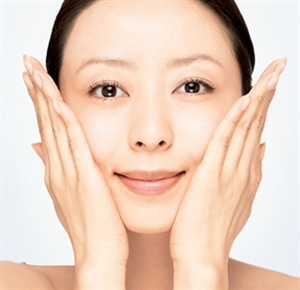 In her research on Japanese whiteness, Mikiko Ashikari (2005) tries to explain where the idea of a specific white skin among the “Japanese race” comes from. According to Ashikari, it seems less likely to be from Caucasians’ influence, since Japanese women considered Caucasian skin as “rough, aged quickly and had too many spots” (Ashikari 2005:82). The idea of white skin in the Japanese society is even more specific than any other features that could define the idea of being “Japanese”. Although Japanese change their hair color with dying products, their eye color with contact lenses, and their physical features with plastic surgery, they would never change their skin color because “the notion of Japanese skin works as one medium to express and represent Japaneseness” (Ashikari 2005:76). As Ashikari notes, by defining a specific skin color to their race, Japanese people are even able to reject the Okinawan people as a “second-class citizens” (Gibney quoted by Ashikari, 2005, p. 80).
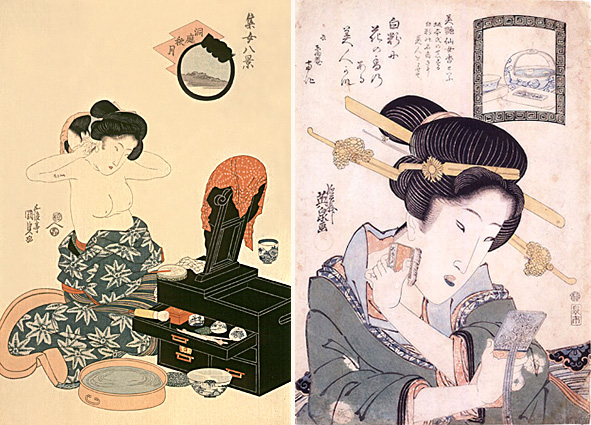 Actually, Japanese whiteness has its roots even before the Black Ships arriving in Japan during the 16th century. It is said that during Nara Period (710–94) and Heian Period (794–1185), Japanese women were already using diverse products to light their skin tone (Kyo 2012). The ideal of white skin is also found in a lot of literature of this period such as the Diary of Lady Murasaki and Tale of Genji (Kyo 2012). Back in the Heian Period, women would blacken their teeth and shave their eyebrows. Nowadays nobody would shave their eyebrows as a sign of beauty but the idea of white skin as the ideal of beauty among Japanese women is still a recurrent topic in Japanese society.



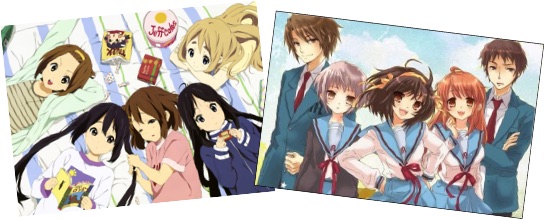 It is easy to recognize Japanese Manga characters from their exaggerated round eyes, small nose, spindly legs and colorful hair. These features that are generally common for most Japanese readers confuse Western readers sometimes because in their eyes Manga characters look like Caucasians but Japanese. In Kawashima’s article, many Westerners consider stylized Manga figure as an expression of “trying to be white” and the idea of “becoming white” is a product of cultural imperialism since the white people were historically dominant in the world. They even express their sympathy to “Asian people” who try to become white by stating that their should stay who they are but not constrained to racial hierarchy thinking. In fact, the thought of regarding Manga figures as white or trying to be white is a symptom of visual production of race and racial privilege thinking.
 JAPANsociology