How do US teachers’ stereotypes of Asian students affect performance?

by Akimi Yano

A stereotype that some teachers hold of Asian American students is “model minorities.” Teachers‘ expectations for Asian students are higher than those for White students, Hispanic students, and Black students. Teachers tend to have higher standards and more positive perceptions of the social, emotional, and academic characteristics of Asian students than they do for other students of different race, which affects Asian students’ performance in the classroom and on the standardised tests in a positive way. Further, higher standards and higher expectations for Asian students learning play an important role in their positive self-perception.

Sirota and Bailey do not mention the fact that stereotypes do not always function in a positive way. Teachers having high expectations and standards could imply not only that Asian students get motivated by them but also that those students who are not able to meet the high standards could feel inferior. If the standards are so high, there must be some Asian students who could not live up to the expectations of teachers, their parents, their friends, and their community, which results into their negative self-perception.

Moreover, not all Asian American students are academically successful. The levels of educational achievement of Asian American students vary. Lee roughly divided Asian students into two groups: high achievers and low achievers. As for high achievers, they responded to teachers’ high expectations by having a fear that they would get categorised into low achievers if they do not fit the stereotype of the “model minorities” and responsibility to their family which motivated them to make efforts to live up to the high standards. As for low achievers, they reacted to high expectations of teachers by feeling embarrassed about revealing their academic difficulties and keeping them inside, and teachers take a laissez faire attitude towards those students who do not reach out for academic support.

Lee does not talk about any case where Asian students are motivated to study harder as a result of positive feelings made by teachers’ continuous high expectations for Asian students’ learning; however, there must be some Asian students who are motivated to do well at school since teachers give them more attention, more positive perception of them, and higher expectation than they do to other students of different race.

Sirota, Elaine, & Lora Bailey. (2009). “The impact of teachers’ expectations on diverse learners’ academic outcomes.” Retrieved June 3, 2014, from http://www.thefreelibrary.com/The+impact+of+teachers’+expectations+on+diverse+learners’+academic…-a0198931267

Lee, Stacey J. 1994. “Behind the Model-Minority Stereotype: Voices of High- and Low- Achieving Asian American Students.” Anthropology & Education Quarterly 25(4):413-429. Retrieved June 3, 2014, from http://searchuci.files.wordpress.com/2014/01/week-3-lee-1994-behind-the-model-minority.pdf

Enhanced by Zemanta

How to Educate Foreign Children

by Yutaro Nishioka

Robert Moorehead‘s research, “Separate and Unequal: The Remedial Japanese Language Classroom as an Ethnic Project,” addresses education for immigrant children in a Japanese elementary school. He examines the connection between the Japanese as a second language (JSL) classroom and the school’s homeroom classes, as well as the impact of the JSL class on immigrant children’s academic development.

The teachers of the elementary school claim that the JSL classrooms not only help the immigrant students to learn the Japanese language but also enable them to relax from challenging situations in an effort to adapt to the Japanese culture and language. The research reveals that although professional norms in Japanese education value equality, collectivity, and mutual interdependence, the JSL classrooms separate those immigrant children from the regular Japanese students in the homeroom class, by which the gap between the immigrant children and regular children never disappears.

Is this an effective way of educating the immigrant children? I don’t think so. In this blog post, I’d like to discuss the experiences of my friend (fully Japanese) who moved abroad and received education in a context outside Japan at the age of 7, and argue that the way the JSL program attempts to educate immigrant children is not effective.

My friend was born and raised in Japan until the age of 7, when she moved to Switzerland due to her mother’s job. Like a normal Japanese child, she had gone to a Japanese kindergarten and elementary school. Since she had had no previous English education, she initially had an extremely hard time learning English to understand her teachers. Unlike the immigrant children that learn Japanese outside their homeroom classes, she was in the ESL (English as a second language) class only for the first 3 months, and after the 3 months she was treated the same way as the other students. She also went to a Japanese school every Saturday to maintain and improve her Japanese.

The reason why she was in the ESL class only for the first 3 months is that the level of English used in the ESL class was not much different than that of other students because they were only 6-7 years old. She also reports that whenever she was pulled out of the class, she felt “embarrassed and isolated.” She doesn’t know whether the teachers sensed her feelings, but she is glad that she quit taking the ESL so that she stopped feeling uncomfortable any more. After leaving the ESL class, she learned English ‘naturally’ on her own just by studying with the other students without being isolated.

Those who believe in the effectiveness of the JSL program in educating immigrant children in Japan would have to say that she could not have learned English to reach the regular students’ standards. However, the fact is that she quickly learned English to the point where the others would not be able to tell she was not a native English speaker, and she was doing just as well as the other students whose native language was English. In fact, she says she now speaks English even better (or more comfortably) than her Japanese. She not only moved on to high school but also to a university in Canada. I have a few other friends that went through a similar situation as hers, and they all learned English without being isolated from the native students and brought their English to the native level.

Moorehead’s study mentions that while 97 percent of Japanese youths aged 15-18 are in high school, only 42 percent of Brazilians and less than 60 percent of Filipinos go to high school. In contrast, all of the friends of mine that went abroad and acquired English are now in university. This clearly implies the ineffectiveness of the present JSL program.

Reference

Moorehead, Robert. (2013). “Separate and Unequal: The Remedial Japanese Language    Classroom as an Ethnic Project.” The Asia-Pacific Journal 11(32):3.

Enhanced by Zemanta

English Education and Preservation of Ethnic Diversity in Singapore

English: National Institute of Education, Sing...

English: National Institute of Education, Singapore (Photo credit: Wikipedia)

Anonymous student post

Large numbers of Singapore’s population are immigrants. Since the country got its independence in 1965, there have always been new immigrants coming in from all over the world who become members of the community. As a result, it has become very ethnically and culturally diverse. Just looking at its population, according to CIA World Factbook, there are 74.2% Chinese, 13.3% Malay, 9.2% Indian, 3.3% other (2012 est.) Some scholars believe that this cultural diversity brought by immigrants is what has made Singapore so economically successful. (Yin, 2013)

Adjusting to this type of diverse environment, Singapore sets four different languages for its official use. So when I was there, I could see many public signs, written in those four when I was there. It was certainly a surprising experience for someone who has been lived in Japan, which only has Japanese as its official language.

Following this astonishment, a new question came up to my mind as a student who was studying in a university in Singapore; that is, how do the educational institutions deal with this diversity?

In this blog post, I would like to see the current language education system in Singapore and observe the outcomes.

Firstly, the Singaporean government heavily focuses on education as it contributes to economic development and unification of the people. They decided to offer basic education in two languages, one is English, other is their ethnic mother tongue languages from where their roots are from, such as Chinese, Malay or Tamil. The reason is that government believes educating people in English will be useful in the process of future economic development foreseeing the globalization; and other languages to preserve their cultural identities. (Nakamura, 2009)

This has worked out successfully for the first aspect. English has contributed Singapore becoming the hub of Southeast Asia. It also has become the symbol of nationwide unity that connects people with different cultures and enabled them to communicate with each other. Now they even created so-called “Singlish” (Singapore-English; mixture of English and languages of different ethnic groups exist in Singapore), which could also be considered as part of their national identity.

However, for the second aspect of preserving diverse cultures through learning non-English languages, is not functioning as it was expected. As a matter of fact, less people are using their ethnic mother tongues in Singapore as they no longer use them outside their communities. Because cultures could not be transmitted onto next generation without the languages, it has become a problem. This is also leading to the changes in individual’s identities. As their language ability for non-English languages declines, their identity as a member of each community declines, too. Thus, this is now seen as a challenge how to keep their languages and cultural diversity in this country (Nakamura, 2009).

In addition, there is an issue that social mobility in the society is somewhat depending on their English ability. I will further discuss this point in the later blog post.

In conclusion, through this outcome of bi(multi-)lingual language education in Singapore, we could observe the difficulty of uniting people with different cultural backgrounds under one national identity whilst preserving the cultural diversity. This type of phenomenon is what many nation states would be expecting to see in their countries as more and more international migration occurs in the world. How to protect the cultures and languages while adjusting to the flow of globalization is a difficult question to find a solution.

Reference

Nakamura, M. (2009). Shingaporu ni okeru kokumin togo. Kyoto: Horitsubunkasha.

Singapore. (2014, May 1). Central Intelligence Agency. Retrieved May 25, 2014, from https://www.cia.gov/library/publications/the-world-factbook/geos/sn.html

Yin, D. (2013, June 6). Singapore Needs Immigrants, Says Jim Rogers. Forbes. Retrieved May 25, 2014, from http://www.forbes.com/sites/davidyin/2013/06/06/singapore-needs-immigrants-says-jim-rogers


Enhanced by Zemanta

Skin Whitening as Social Uplifting and Achieving the Ideal “beauty”

by Moe Miura

There are many skin-whitening products in global markets today. One can easily purchase skin-whitening products even without knowing it, because whitening one’s skin tone is already a big phenomenon in the 21st century all over the world. However, South Africa has significant story about its history of the phenomenon of skin whitening.

In Evelyn Nakano Glenn’s Shades of Difference: Why Skin Color Matters (2009), author Lynn M. Thomas focuses on the history and the use of skin lighteners in South Africa. Today, 35% of the South African women are said to be using the skin-whitening products. Then these questions pop up: why do South African women try to whiten their skin tone? Is there a history behind it?

South Africa is widely known for its history of apartheid, where black and colored people did not have the same political or economic rights as white people, and also were forced to live separately from white people. This policy led to the further discrimination of black and colored people, segregation, and the skin color preferences influenced by the European colonialism (Thomas, 2009). Thus it created the idea of lighter skin equals more liberty and less/no discrimination. Historically, the use of skin whitening products had a lot to do with the fact that there was a significant racial discrimination against black and colored people.

pictureAnother reason of using the skin lighteners was “technology of the self”, meaning people decorate themselves to transform themselves, so that they can achieve happiness or perfection. This can range from concealing blemishes to bleaching their faces. Advertisements have played a big role in informing people about this idea that whiter is more beautiful, using musical stars and beauty contest winners. Capitalism also pushed this idea because the more difficult the thing to achieve, the harder people try; concealing flaws and having lighter skin was difficult thus people would purchase more stuff to achieve this “ideal beauty”. The market of skin lighteners had become multimillion-dollar-per-year endeavor.

As it can be seen, reasons of South African women purchasing skin whiteners ranged from racial uplifting, capitalist commerce, to making themselves look better as a “technology of the self”.

Reference

Thomas, L. M. (2009). Skin Lighteners in South Africa. In Shades of Difference: Why Skin Color Matters, edited by E.N. Glenn. Stanford, CA: Stanford University Press.

Enhanced by Zemanta

Skin Lightening in South Africa

by Yutaro Nishioka

The trend of skin lightening, especially among women, is getting increasingly common all over the world, including South Africa, where the major part of its population is black. According to a study from the University of Cape Town, as many as one in three African women use bleaching products to lighten their skin.

Skin lightening products often create serious medical complications; many patients suffer from diseases caused by a combination of use of lightening products and sunlight (africa.com).
The World Health Organization (WHO) has also mentioned the negative effects of some skin lightening products. Mercury, one of the common ingredients in lightening creams, is said to have harmful effects and could also lead to kidney damage, as well as other side effects such as “skin rashes, skin discoloration and scarring, as well as a reduction in the skin’s resistance to bacterial and fungal infections” (africa.com).

Why is skin lightening becoming so common in South Africa despite its negative health effects? Professor Lynn Thomas, co-author of the book Shades of Difference: Why Skin Color Matters, mentions the history of South Africa being colonized by Europeans. The Europeans and South Africans were not treated equally, and there was the notion that light skin was somehow better, not much unlike Hitler’s idea that Jews were inferior. More recently, apartheid, the government policy of racial segregation against black Africans in South Africa, was renounced officially only in 1992.

The effects of the history of discrimination can still be seen in the current South African society. For example, Nomoto “Mahoza” Mnisi, a famous South African musician, is known for her extensive use of skin lightening products. She says, “I just want to be light skinned… I was tired of being ugly.” She is assuming that dark skin is “ugly” and light skin is not.

People that have heard of this news have reacted differently, but the majority of the comments on the internet do not seem to approve of her changed appearance: “she was so much prettier before; her husband must be blind”, “God created her black and she looked so pretty. She looks pretty now but she looked better before”, “She is insecure and that’s bad.”

As there is a difference between Mahoza’s view and that of her fans, it is questionable to say that the history of the colonization and discrimination is the sole cause of the contemporary trend of South Africans’ skin lightening, but it is probably one of the factors that have contributed to the trend.

Reference

“Not Happy Being Black?” – Posted by Africa.com Editorial Staff. http://www.africa.com/blog/not-happy-being-black/

Thomas, Lynn M. 2009. “Skin Lighteners in South Africa: Transnational Entanglements and Technologies of the Self.” Pp. 188-210 in Shades of Difference: Why Skin Color Matters, edited by E. N. Glenn. Stanford, CA: Stanford University Press.

Enhanced by Zemanta

Color complexes in the Philippines

by Lulu Maginde

In ‘Filipinos and the Color complex,’ Joanne Rondilla questions the reader, especially readers here in Asia, what the ‘ideal’ concept of beauty is, and how different people within Asia perceive beauty. As Rondilla focuses specifically on the Philippines and how skin whitening is utilized, or rather highly emphasized, it was interesting to find how skin-lightening products are marketed and sold as well as what these products are saying about beauty.

Rondilla claims that this concept of having a fairer complexion/lighter skin, stemmed from the Philippines’ deep history of colonization, after having been occupied by Spanish for over 300 years. This history most indefinitely influenced the way of life, culture and traditions, not to mention language and the concept of what is deemed beautiful.

After the departure of the Spaniards, then came the Americans, and many Filipinos will claim that until present, the Philippines is still a colony of the US, as most of the way of life in the Philippines has been greatly structured around a more Western way of life. Of course the country still has its rich culture and heritage, as well as its strict religious value system, however it is not hard to deny that US presence has greatly affected life in the Philippines.

This ties in perfectly to my next point of how Rondilla compares standards of skin color between Asian immigrants to the US to Asian Americans born and raised in the US. The main difference between these two groups is that while Asian Americans chose to tan, as it symbolizes wealth and a more luxurious life, Asian immigrants, for instance the Filipinos who immigrate to the US, are more likely to use skin lightening products in order to assimilate  into society. In the Philippines, having darker or more of a tanned complexion immediately reflected what social class one belonged to. If one had a fairer or lighter complexion, they belonged to an a higher social class, simply because they were not as exposed to the sun as working-class laborers.

This notion of a ‘relatable ideal’, or the claim that a certain type of beauty is the shared/common ideal amongst women in the Philippines is what is striking. Consciously or unconsciously, these women buy into an industry, in conjunction with certain media institutions, that greatly influences what may be deemed as beautiful. Thus, they buy into the idea that, due to capitalism, ‘everything can be bought and exchanged’.

Reference

Rondilla, Joanne L. (2009). “Filipinos and the color complex.” Pp. 63-80 in Glenn, E. Shades of Difference: Why skin color matters. Stanford, CA: Stanford University Press

Enhanced by Zemanta

Beauty Standards in the White Imagination

by Shinoko Itakura

The phenomenon of changing skin color has been happening all over the world. Some attempt to get lighter skin and some attempt to get tan skin. The reasons behind those two attempts seem opposite yet, the purpose is the same, “high class”. The symbol of high class depends on where you are, and how the standard of the beauty has been created in your society, because the standard of beauty  includes class status.

But who created the standard of beauty and how? We tend to describe people who have straight jet-black hair, and large, double lidded, almond-shaped eyes as “Asian beauty”. Even though we are Asian, whenever we see people who have those facial features, we say, “You are beautiful like Asian beauty!” In fact one of my colleague just described another colleague as an “Asian beauty” the other day. It just feels weird when Asian people describe another Asian as an “Asian beauty”. This is because the idea of Asian beauty has been created in the white imagination. We do not say European beauty or Latin beauty, because the standard of beauty is already based on European (white) features. What is more, something which is called a “universal standard” or “universal beauty” is just not universal. It always based on physical features of white people.

The standard of beauty seems to be controlled by mass media and the marketing of cosmetic products. Cosmetics companies use many strategies to gain more and more profits. “Relatable” is one of the important key concepts; if consumers find any similarity to the advertising models, for example “Asian-ness”, they believe that they can achieve those models’  look, and the universal standard of beauty. Those advertisements do not directly say “you guys can be like this model, if you use this products!” yet they are implying this by using racially ambiguous models. In order to sell the products, they also give us images of dark skin as dangerous, unhealthy, bad, and wrong by using terms such as aging or skin cancer. But what really matters is “skin color”.

I feel wrath about how skin-lightening products are marketed. It is so depressing that somehow we have to feel pressure of skin color or looking, and have to try to look like someone else, just because we are not white. This situation must be stopped and there should be the world which do not judge you by your skin color.

Enhanced by Zemanta

From Ebony to Ivory: Colorism in the Philippines

by Jiyang Shin

The ever-expanding skin whitening market in the Philippines seems to have distinctive characteristics compared to the markets of other countries that also value lighter skin tones. In the discourse of colorism, many tend to conclude that the phenomenon of skin whitening obsession is largely due colonization by European conquistadors; however, that is not always the case in the Philippines.

I would like to raise an example of skin whitening advertisement, featuring Jinky Oda, an African American comedian in the Philippines. The advertisement is composed of before-and-after pictures of Oda. On the left hand side is Oda’s torso before she went on the skin whitening pill. She is in a white tank top, wears gold hoop earings, and has her natural curly hair all swept back with bandana like hair band; a casual style of a typical African American woman that we can easily relate to.

On the right hand side is Oda after finishing the pill, in her brand new bleached-up skin. However, that is not the only significant difference that one can tell from the picture. Other noticeable features are that her attire is considerably more dressy than the left side (you can notice it although the ad only shows down to her chest), but even more importantly, the texture of her hair has turned silky and straightened like the East Asian look that a vast number of Filipino women crave.

One can observe sinister motives behind this marketing. In the book Shades of Difference, Joanne L. Rondilla argues that there are generally three major messages that are conveyed in skin whitening advertisement in the Philippines:

1. Darkening can and must be stopped.

Why? Because having dark skin does not make you good enough.

2. Lightness comes from “within”.

This message misleads people into thinking that their natural color is lighter than they expected, thus their desire to turn white is achievable.

3. Lightening can happen instantly.

The advertisement that featured Oda is unethical because it links having darker skin with wrongness by dressing up her in casual attire. In addition, she seems to have more weight in her before picture, implying she was sloppier when she had a darker skin tone (fatness is often linked to laziness). Such indirect messages have the great potential of stirring up or further encourage racism and discriminations against certain groups of people.

As for why many women in the Philippines opt for a Chinese or Korean look, I argue that it is due to racial hierarchy that exists among Asian countries. For example, in South Korea, people of Southeast Asia origin encounter difficulties renting rooms and searching for jobs. Moreover, in Japan, Filipino people are often referred to as “Pina”, which is a derogatory term used against women who perform in sex-related work. Such unequal treatment might have gradually developed a sense of inferiority towards people of lighter skin color in East Asian countries. I argue that people attempt to escape from such discriminations by assimilating into those who discriminate against them.

Enhanced by Zemanta

Selling whiter skin for beauty

by Kohsei Ishimoto

In Evelyn Nakano Glenn’s Shades of Difference: Why Skin Color Matters (2009), Joanne L. Rondilla looks at the different techniques are used in the cosmetics industry. When looking at the Philippines, advertisements focus on ‘whitening’ the skin, because the people in the country tend to have darker skin. On the other hand, when looking at European countries, advertisements look at ‘brightening’ the skin, for there is the idea that people in these countries naturally have light skin.

When looking at these advertisements, it can be seen that to be beautiful, you must have white skin. Rondilla explains that there are many people in the Philippines who buy skin-whitening products to look beautiful, but is being ‘white’ really being beautiful? The main answer to why ‘white’ is thought to be ‘beautiful’ is colonization. To the countries that had been colonized, the European countries had been superior, fixing the image that ‘whites’ are ‘better’.

When reading Rondilla’s chapter, however, it can be seen that there are various ‘types’ of white skin. One is the European beauty that was mentioned earlier, and the other the ‘Asian beauty’. This refers to East Asian countries, such as China and Japan. Filipinos are actually looking at ‘Asian beauty’, possibly because these countries are closer to them. In Japan’s case, the country looks at being ‘white’, trying to achieve the European look. This statement can be said to be wrong however, for recently Japanese people want to be seen as individuals.

When looking at various advertisements, it can be seen that models of different skin tones are used. For advertisements that use ‘white’ women, companies state that they are the ‘result’ of the product. On the other hand, companies that use models of a darker tone state that it does not look ‘right’, telling the consumers to change by buying the product. It is a fact that many purchase skin-whitening products to gain their ‘beauty’, but exactly how close are they to their ideal image? Will consumers ever believe that they are beautiful enough? The answer to this is probably no. The cosmetics industry has control over the consumers, by selling only a small portion of a product, or changing advertising techniques to trick us into believing that our images are not yet satisfactory. When thinking about this, it is interesting to wonder why people use cosmetics in the first place. Can not having any make-up on be considered beautiful? The answer to this can be explained through society; how people see you, and how you want to be seen.

Enhanced by Zemanta

“Making a choice” or “forceful separation”?

by Kyungyeon Chung

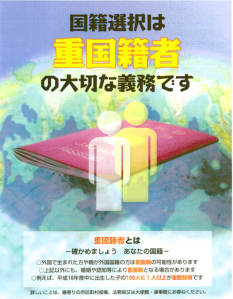
On the walls of immigration bureau offices in Japan, one can easily spot posters regarding dual citizenship. As the Japanese government does not recognize dual citizenship of its citizens, these posters usually say something along the line of  “let’s make it clear: choose your nationality,” “make a choice: no more duality.” Somehow, the rhetoric of posters seems to suggest that dual citizenship is unclear, undesirable, and duplicate, and thus a negative thing.
Today, in the face of increasing immigration and the growing flow of goods, services and persons across state borders, the concept of dual citizenship has arisen as a politically hot topic. While some argue that the recognition of dual citizenship is simply a legislative act that allows freedom, many believe it means more than granting of an extra passport. Opponents for the recognition argue it will complicate bureaucratic administration for the government. However, the most prominent argument behind the opposition is that the concept is not compatible with what “citizenship” entails. Citizenship has long been associated with state-control over its people – ‘citizenry’ – and, as T.H. Marshall defined, “a claim to be accepted as full members of the society” (Bloemraad, Korteweg & Yurdakul, 2008). Dual citizenship effectively challenges this idea of state-control as it allows the person to be a member of two separate societies, eligible for two separate sets of privileges, and obligated to two separate sets of duties.

Screen Shot 2014-05-26 at 1.17.07 PMThe confusion it causes is understandable. However, forcing one to choose one citizenship over another – the father’s over mother’s, the birth country over the country of residence, or vice versa – is this reasonable? In an opinion article from the New York Times, Mark Krikorian, the executive director of the Center for Immigration Studies argued that, for US nationals, engaging in dual citizenship basically means renouncing US citizenship, and is an absurdity that should be prohibited (2014). However, having two passports cannot possibly mean that one is betraying their ‘native’ country. For many immigrants, their children, and expatriates around the world, dual citizenship is about having freedom of association. Just because a person has moved from his/her native country to another, it does not mean he/she automatically renounces, forgets, or even wants to distance from the past. As time passes their emotional attachment and/or political participation can grow in both countries. In such situations, denying the chance of dual citizenship forcefully imposes what a person’s identity should be or where his/her allegiance should lie – does this not qualify as an infringement on freedom of personal choice? It effectively forces them to officially renounce their past so that they can be ‘loyal’ citizens of the present country of residence. If that’s what opponents want to achieve by invalidating dual citizenship, how effective could this possibly be anyway in forming allegiance?

It is more likely that dual citizenship is an irreversible and unavoidable occurrence in the face of globalization. Multiple national, racial and ethnic identities will continue to grow unabated no matter what governmental policies are in place. Recognizing multiple nationalities may be a nuisance for many governments, especially the ones who believe in their perceived ‘homogeneity’. Yet, eventually, the time will come that they have to admit the presence of diversity within the artificially set state borders.

References

Bloemraad, I., Korteweg, A., & Yurdakul, G. (2008). Citizenship And Immigration: Multiculturalism, Assimilation, And Challenges To The Nation-State. Annual Review of Sociology, 34(1), 153-179.

Krikorian, M. (2014, January 30). An exclusive relationship. International New York Times. Retrieved May 18, 2014, from http://www.nytimes.com/roomfordebate/2012/05/14/can-dual-citizens-be-good-americans/citizenship-should-be-an-exclusive-relationship

法務省 (The Government of Japan Ministry of Justice). (n.d.). 国籍選択について (About choosing nationality). Retrieved May 18, 2014, from http://www.moj.go.jp/MINJI/minji06.html