Blackness in Brazil: ancestry, skin color, and race

by Hiroki Matsuyama

In today’s modern world, there are many types of injurious racisms all over the world. However, the elements to discriminate against people are different, and they are depending on countries. There are several interesting aspects in terms of the way to distinguish people in Brazil according to ‘The social consequences of Skin Color in Brazil’ by Edward Telles.

On the one hand, people in the U.S tend to discriminate against those who are black, on the other hand, people in Brazil do not distinguish people depending on their race, but they do depending on situation, classifier and region. In other words, skin color is more commonly used than race in terms of distinguishing people. The most interesting point in this reading to me is that some U.S blacks may be seen as white in Brazil, only people having very dark skin are considered black. In fact, there are Brazilians who call themselves white, have non-white ancestry, and the numbers of those people is not small surprisingly. In spite of the fact that the U.S does have the ‘one drop’ rule  to discriminate against blacks, you would not be considered black in Brazil if you do not have black ancestry. From this point of view, it can be said that miscegenation tends to whiten the population in Brazil, which is totally opposite idea of the U.S. This is because Brazil was the colony of Portugal, and Brazilian people were born between Portuguese males and African or indigenous females.

Honestly, racial discrimination in Brazil did not seem to be worse than it in the U.S as my first impression. However, there is severe discrimination depending on their skin tones in Brazil. Although, in the U.S, there are color differences within races of Black and Latino, not among white people, there are color differences within the entire population in Brazil. It means that job wage or opportunities in Brazil depend on skin color. Hence, there is the difficulty for policymakers to define racial boundaries, and decide who should benefit from affirmative action even though they try to make a move for low-income citizens.

There are totally different notions between two countries, the U.S and Brazil in terms of discrimination. I would not say which is in better or worse situation; people in both countries are struggling in different ways. As I am an Asian person, I would like to research how Asian people in Brazil are considered. If people in Brazil discriminate against people depending on their skin tone, Asian people might not be discriminated because so-called ‘yellow color’ is close to white color.

How do US stereotypes of Asian girls affect students’ school performance?

by Akimi Yano

According to Pyke and Johnson (2003), Asian American girls feel that they behave differently, depending on if they are with Asian Americans or with non-Asian Americans. It is because white society has created stereotypes of Asian Americans connoting that whites are more egalitarian than Asians, and has expected Asian Americans to act in a certain way, which affects how Asian Americans think about themselves. Therefore, they feel the necessity to differentiate their behavior, depending on if they are with Asian Americans or they are with non-Asian Americans. Because of the stereotypes, they feel like they are expected to act that way by both Asian Americans and by non-Asian Americans. At the same time, Asian American girls think that Asian femininities are inferior to white femininities. Therefore, some Asian American girls distance themselves from other Asians by following not Asian femininities but white femininities.

According to what I can interpret from the article, there are at least three possible ways of Asian girls’ performance in the classroom:

  • first, being active in the classes because they do not want to be categorized as stereotypical Asian girls;
  • second, being quiet because they feel the pressure to follow the stereotypes of Asians as passive, shy, and quiet;
  • finally, being quiet because they know that a professor would not have them talk in front of the class, by being told by the professor that it is okay if they does not want to talk in front of the class, so they take advantage of it.

However, the authors did not summarize what makes the female Asian students make decisions for their performance in detail. The differences in their performance in the classroom leads to diverse levels of educational achievement as well. In the first pattern, they speaks their minds because they do not want to be labeled as typical Asian girls, which in itself shows that they are not submissive people, in contrast to the stereotypes of Asian girls. This kind of person could do well at school.

In the second pattern, they feel the expectations of being quiet in the classroom by both Asian Americans and by non- Asian Americans, and they are afraid of others’ reactions against them being active in the class, therefore they comply with the expectations. This kind of student might not do well at school.

In the third pattern, they are vocal people but they act as if they were quiet people in order to make use of the opportunity of not having to talk in front of the class. This kind of student could do poorly if they do not start being active in the class. In all these three patterns, they act the way they do since the action leads them to a profitable or at least harmless outcome.

Moreover, in this article, teachers’ stereotypes of Asian Americans such as being passive, shy, and quiet could contradict with their more common stereotypes of Asian American students being “model minorities“; however, the authors did not explain it. Therefore, I analyzed it by myself. Since the targeted Asian American students are second-generation, they are to some extent assimilated into American society, where Asian students think being typical passive Asian is a negative thing when they interact with non-Asian Americans. Therefore, those female Asian students who live up to the standards to be “model minorities” might have intentionally disobeyed the expectations to be stereotypical passive Asian girls differentiating themselves from other Asians in order to be successful in the U.S. society, where white society implies that following white people’s norms is the only way to become successful in the U.S.

Finally, the authors also mentioned as an example of Asian girls feeling that they do not fit the stereotypes of Asian girls “some claimed that because they are assertive or career oriented, they are not really Asian”, yet I think being career-oriented fits the stereotypes of Asian American girls, considering the fact that it it is well known that Asian parents constantly encourage their kids to do well at school and to obtain a good occupation as they did in their country of origin; thus there must be a stereotype of Asian American girls as career-oriented, which the authors did not point out, either.

Reference

Pyke, K. & Johnson, D. 2003. Asian American Women and Racialized Femininities: “Doing” Gender across Cultural Worlds. Gender and Society 17(1):33-53. Retrieved June, 1, 2014, from http://links.jstor.org/sici?sici=0891-2432%28200302%2917%3A1%3C33%3AAAWARF%3E2.0.CO%3B2-5

The consequences of blackness in Brazil

by Saki Miyata

Brazilians from the end of the 19th century to...

Brazilians from the end of the 19th century to the very begining of the 20th century. First roll from left to right: A Portuguese-Brazilian woman, a German-Brazilian boy, an Italo-Brazilian man, an Arab-Brazilian and a Japanese-Brazilian woman. Second roll from left to right: an Afro-Brazilian man, a Cafuzo girl, a Mulatto woman, a Caboclo man and an Indian woman. (Photo credit: Wikipedia)

In “The social consequences of skin color in Brazil”, Edward Telles describes how people perceive skin color and race differently in the Brazil, compared to the United States, as well as the current inequalities caused by skin color. How Brazilians determine their identity or how they classify themselves, skin color is the main focused element. On the other hand in the United States, elements such as ancestors and “blood” determines one’s identity and race. Telles described that this is due to the difference in the laws that were made during slavery. In the United States, there was a law which described that if a person has a black ancestor, he or she is considered black; even though it was only 1/10th. However, in Brazil, this person might be considered “brown” or even “white”, according to his or her skin color. This seems very interesting, since one could change their class and “race” depending on the country.

After reading this chapter, I found an interesting blog about the consequences of “blackness” among the Brazilian people. Although more than half of the population is black descended or mixed race, the inequality and discrimination that dark skinned people receive are surprisingly high. However, according to the study, the “awareness of the importance of African culture in Brazilian history and Brazilians’ pride in their black origins has increased in recent years” (Global voices, 2011). On the other hand, another article showed that a famous funk star changed her skin color to a lighter complexion and became famous (Watts, 2013). In the discussion during class, our team shared our opinion toward this controversy. Although more and more people identify themselves as “black” or partially “black”, people still want to achieve whiteness. In our discussion, we concluded, that people who have dark or tanned skin wanted to have some sort of confident and pride towards who they are even though the society prefers whiter skin for success.

Through the past classes, it sees that throughout the world, the conscious of “white is beautify and successful” seem to be connected. Even in a country like Brazil, where enormous numbers of the population is mixed, and claims diversity, the inequality still exists. This fact questions me why does the “white as dominant” does not change over history? Even though the colonialism and slavery did end in most of the countries?

References

Global voices, 2011. Brazil: Census “Reveals” Majority of Population is Black or Mixed Race. Global voices. Retrieved from http://globalvoicesonline.org/2011/11/29/brazil-census-black-mixed-population/

Watts, J. 2013. Brazilian funk star Anitta sparks new debate about skin whitening and race. The guardian. Retrieved from http://www.theguardian.com/world/2013/sep/08/brazilian-funk-anitta-debate-race

A counter-narrative to the Chinese exclusion policies of the US

English: Racist US political cartoon: Uncle Sa...

Racist US political cartoon: Uncle Sam kicks out the Chinaman, referring to the Chinese exclusion act. image published in 19th century (Photo credit: Wikipedia)

Anonymous student post

During the late nineteenth century, immigration to the United States from East Asia, particularly China, saw a massive influx, much to the surprise and eventual dismay to the American white population. For a population that were also inherently immigrants, built on the foundations of native population extermination before and after independence from the British, their indignation could be seen as quite hypocritical and in some sense, ironic. At the time, the Chinese were seen as a threat to ordinary, hard-working US citizens and “overlapped with domestic fears about American race, class, and gender relations and helped fan the fires of organized anti-Chinese sentiment … Chinese workers were blamed for competing unfairly with white workers. Chinese as a race were charged with being inassimilable, inferior, and immoral” (Lee, 2007, pp. 546-547).

Different states had different laws regarding the Chinese, and it is important to realise that at this time racism was rife in the country with the black population facing the brunt. In 1854, the State of California recategorised the Chinese to the same level as black and Native Americans, which meant that they did not have the right to testify against a white man in a court of law (Bancroft, 2005). In 1882, the infamous Chinese Exclusion Act was passed, country-wide, which severely prohibited the movement of Chinese citizens to the US, a law which was only repealed in 1943.

As all this went on in the foreground, there was other events taking place in the background. Seemingly at odds with the official stance of the US being “anti-Chinese”, there was however a few openings on the education front. Hsu (2014), in her work on educational exchange during this period of exclusionary policies, highlights what she calls a “counter-narrative” (p. 315) to the prevailing view of this time. She writes that “… even in the depths of restrictive fervor, Chinese students—seen as a leadership class that eventually shaped the future of modern China—were not only welcomed in the United States, but funded and protected by powerful American and Chinese interests”.

English: Editorial cartoon showing a Chinese m...

Editorial cartoon showing a Chinese man being excluded from entry to the “Golden Gate of Liberty.” (Photo credit: Wikipedia)

Previous historical circumstances had made China wary of foreign influence, encapsulated by the “Boxer Rebellion”, a strong backlash against western Christian missionaries and foreigners in general. (At the time, China was the predominant country for US missionary work). In the Qing dynasty, there were worries that students sent abroad would become “denationalized” and China would see no benefit (Hsu, 2014, p. 319). Through the creation of the China Institute, however, the US saw a climb in foreign students from China, as well as an acceptance that China would face an inevitable decline if they did not attempt to familiarise themselves with Western education. Even during the height of exclusion, Chinese students made “were among the most numerous of foreign students on U.S. campuses” and such a exchange managed to persuade “Americans not only to invest in positive experiences of the United States for Chinese, but also to rethink racialist ideologies of exclusion against Asians.” (Hsu, 2014, p. 322). In essence, student exchange helped to counter-balance xenophobic attitudes towards China.

The Cold War threatened to undo most of these relations, however, with a communist China considered a threat. Plus that to today, with increasingly paranoid US afraid of losing their Number 1 status, economically and politically, could there be similar sentiments rising? This video echoes of the late nineteenth century. And the US currently operate an anti-Chinese exclusion policy for NASA, and do not forget the Huawei “national security concerns” story. Will more Chinese students studying in the US help to ease tensions, or have times changed too much?

References

Bancroft. (2005). ‘Anti-Chinese Movement and Chinese Exclusion’, Bancroft Library, The Regents of University of California. Retrieved from http://bancroft.berkeley.edu/collections/chineseinca/antichinese.html on 8 June 2014.

Hsu, M, Y. (2014). Chinese and American Collaborations through Educational Exchange during the Era of Exclusion, 1872–1955, Pacific Historical Review, Vol. 83, No 2, pp. 314-332. Retrieved from http://www.jstor.org/stable/10.1525/phr.2014.83.2.314 on 8 June 2014.

Lee, E. (2007). The “Yellow Peril” and Asian Exclusion in the Americas, Pacific Historical Review, Vol. 76, No. 4, pp. 537-562. Retrieved from http://www.jstor.org/stable/10.1525/phr.2007.76.4.537 on 8 June 2014.

“Making a choice” or “forceful separation”?

by Kyungyeon Chung

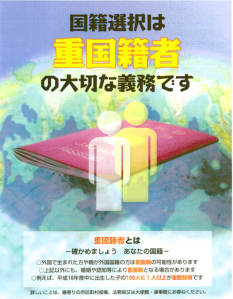
On the walls of immigration bureau offices in Japan, one can easily spot posters regarding dual citizenship. As the Japanese government does not recognize dual citizenship of its citizens, these posters usually say something along the line of  “let’s make it clear: choose your nationality,” “make a choice: no more duality.” Somehow, the rhetoric of posters seems to suggest that dual citizenship is unclear, undesirable, and duplicate, and thus a negative thing.

Today, in the face of increasing immigration and the growing flow of goods, services and persons across state borders, the concept of dual citizenship has arisen as a politically hot topic. While some argue that the recognition of dual citizenship is simply a legislative act that allows freedom, many believe it means more than granting of an extra passport. Opponents for the recognition argue it will complicate bureaucratic administration for the government. However, the most prominent argument behind the opposition is that the concept is not compatible with what “citizenship” entails. Citizenship has long been associated with state-control over its people – ‘citizenry’ – and, as T.H. Marshall defined, “a claim to be accepted as full members of the society” (Bloemraad, Korteweg & Yurdakul, 2008). Dual citizenship effectively challenges this idea of state-control as it allows the person to be a member of two separate societies, eligible for two separate sets of privileges, and obligated to two separate sets of duties.

Screen Shot 2014-05-26 at 1.17.07 PMThe confusion it causes is understandable. However, forcing one to choose one citizenship over another – the father’s over mother’s, the birth country over the country of residence, or vice versa – is this reasonable? In an opinion article from the New York Times, Mark Krikorian, the executive director of the Center for Immigration Studies argued that, for US nationals, engaging in dual citizenship basically means renouncing US citizenship, and is an absurdity that should be prohibited (2014). However, having two passports cannot possibly mean that one is betraying their ‘native’ country. For many immigrants, their children, and expatriates around the world, dual citizenship is about having freedom of association. Just because a person has moved from his/her native country to another, it does not mean he/she automatically renounces, forgets, or even wants to distance from the past. As time passes their emotional attachment and/or political participation can grow in both countries. In such situations, denying the chance of dual citizenship forcefully imposes what a person’s identity should be or where his/her allegiance should lie – does this not qualify as an infringement on freedom of personal choice? It effectively forces them to officially renounce their past so that they can be ‘loyal’ citizens of the present country of residence. If that’s what opponents want to achieve by invalidating dual citizenship, how effective could this possibly be anyway in forming allegiance?

It is more likely that dual citizenship is an irreversible and unavoidable occurrence in the face of globalization. Multiple national, racial and ethnic identities will continue to grow unabated no matter what governmental policies are in place. Recognizing multiple nationalities may be a nuisance for many governments, especially the ones who believe in their perceived ‘homogeneity’. Yet, eventually, the time will come that they have to admit the presence of diversity within the artificially set state borders.

References

Bloemraad, I., Korteweg, A., & Yurdakul, G. (2008). Citizenship And Immigration: Multiculturalism, Assimilation, And Challenges To The Nation-State. Annual Review of Sociology, 34(1), 153-179.

Krikorian, M. (2014, January 30). An exclusive relationship. International New York Times. Retrieved May 18, 2014, from http://www.nytimes.com/roomfordebate/2012/05/14/can-dual-citizens-be-good-americans/citizenship-should-be-an-exclusive-relationship

法務省 (The Government of Japan Ministry of Justice). (n.d.). 国籍選択について (About choosing nationality). Retrieved May 18, 2014, from http://www.moj.go.jp/MINJI/minji06.html


My Future, My Nationality

Note from Editor: Students are reading Anne Allison’s book Precarious Japan, and sharing their thoughts on how their own future plans are impacted by the instability and insecurity that Allison describes.

by Tomoki Bischel

When we students think about our future, we tend to think about graduating school, job hunting, or other facts. I too also think about these facts and feel worried. However, when I think about my future, the first thing that comes in mind is about choosing my nationality. I was born and grew up in Japan, but since I was born half American and half Japanese, I have both nationalities. In Japan, the ministry of justice requires citizens who have a dual nationality to choose either one by the age of 22. Since I will be 20 this year and I only have 2 years left to decide, I am starting to think about this seriously. When thinking about which nationality I should choose, the word ibasho which we discussed in our class came to my mind.

I believe there are many definitions for the word ibasho. For me, ibasho is a place where you feel secure and happy; like when you’re with your friends or family, and I believe our nationality is also one of them to us. Although I was rose in Japan, I had many chances to go to America to meet my relatives. So, for me, not only Japan but America is also one of my ibasho. So, when it comes to have to choose my nationality, it sometimes feels like I have to choose my ibasho and feels almost impossible to choose only one. Some may say that choosing your nationality may not be the same as choosing your ibasho, since you don’t need a nationality to go to a country. However, not having a nationality can narrow choices that you have. For example, if I decide to choose America as my nationality, I won’t be able have suffrage in Japan even though I was born and grew up in this country.

I only have two years left to choose my nationality, and as I have mentioned, this would probably be one of the biggest choices that I will make in life. Having have to choose a nationality, I have a sort of fear against how the other country will look once I choose a nationality. Anyhow, I hope to be able to make a choice that I won’t regret in the future; a choice that will most help me in the future. For me, a nationality isn’t just a passport, it’s my ibasho.

Symbiosis in the World of Beauty: The Cosmetics Industry and the Western Beauty Ideal

English: Super Skin Lightener skin lightening ...

English: Super Skin Lightener skin lightening cream (Photo credit: Wikipedia)

by Kyungyeon Chung

Upon walking into a drug store in Japan, one will find an array of cosmetic products that promises hopeful transformation into what today’s Japanese society perceives as beauty. These end results the products promise – fairer, whiter skin, brighter teeth, bigger eyes, and longer eye lashes – all embodying the ideal that originated from the Western, Caucasian-centric beauty standards.

The cosmetics industry, even on a global scale, operates on the platform provided by Western standards of beauty, and especially by the colorism ideology that has penetrated into deep corners of modern society. At the same time, the beauty ideal and colorism are not self-sustaining. Their presence and growing prevalence are made possible by numerous industries that profit from the growth, with the cosmetic industry being a major stakeholder in play. By constantly being made to consume products designed with a limited set of objectives and outcome, the consumers are constantly reminded of the beauty ideals behind the products. The global cosmetics industry and the Western beauty standards based on colorism, mutually reinforce each other’s existence and influence.

In order to fully understand the core of modern society’s beauty standards, it is imperative to know the colorism ideology that frames the entire discourse. Colorism refers to “the preference for lighter skin and social hierarchy based on skin tone”, and has been widely expanding throughout the globe (Glenn, 2009, p.166). Being one of the main axes behind inequality today, it occurs at societal, systemic level through social structure that permits systematic discrimination towards darker skinned people. In many different regions and nations around the world, light skin tone has historically been preferred to dark skin tone, and given higher social status and easier access to social and economic resources (Keith, 2009, p.25). Although the beauty ideal does include other phenotypic aspects than skin complexion such as desirable weight, body shape, and facial structures, skin tone does hold significant importance, if not the most.

This ideology of colorism has been directly translated into the Western beauty ideals. Up high on the list of what composes the ideals is ‘fair’ skin. Having lighter, fairer, and whiter skin gives a great advantage in one’s life, and is central to the very definition of beauty. Having been spread as part of the ideological rationale for slavery and colonial imperialism of the European powers (Keith, 2009, p.27), the “white is better” or “white is right” idea still pervades modern societies thanks to mass media. Today, these ideologies are strongly embedded in ways we admire, desire, and look upon fair skin. Its importance can be easily understood and highlighted by the popular practice of skin whitening, which will be elaborated further later. It is also important to note here that females are subjected to these standards much more frequently and strictly than males (Keith, 2009).

In modern societies with capitalist economic system, the beauty standards manifest themselves as profitable industries whose products promise the achievement of ideal beauty via consumption. As societies are deeply instilled with consumerism, selling and buying beauty have been a huge, popularly sought-after business than ever. Plastic surgery is one of the most common and provocative examples. Cosmetic surgeries have spiked up in number and scale around the world: 14 million surgery procedures were performed in the US in 2011 (American Society of Plastic Surgeons, 2012); close to 7% of the population has undergone knife in South Korea in 2010 (Bates, 2013). A wide range diet-support programs, machines, and food products are readily available to help people lose weight.

Among many industries that thrive on our search for beauty, the cosmetics industry deserves particular attention. For instance, unlike plastic surgery, which may seem invasive, dangerous and rather extreme, putting on makeup is seldom-questioned practice for women. While showing up at school after a holiday with larger breasts may cause a stir, putting on mascara would hardly be an issue. For many, it is a daily routine, an ordinary and even expected behavior. It is also continuous – women who use skin care products will probably continue to do so for years to come. While it may seem trivial at first, considering the commonality and regularity of skin care and makeup, the cosmetics industry is massive, universally pervasive, and commercially successful.

The cosmetics industry owes much of its existence and enduring popularity to the beauty standards. An impressive array of products is available to help people achieve beauty as prescribed by the Western ideal. Eye makeup products are a great example. A dozen different types of products are readily available to make one’s eyes look bigger and more defined: mascara, eyeliner, eye shadow, eyelash curler, eyebrow shaper, highlighter, etc. In East Asia in particular, the desire to have the Western look has also led to the popularity of double eyelid (Bates, 2013). In Korean and Japanese cosmetics shops, one can easily find glue or sticker-like products that hold the skin of upper eyelid together, creating an illusive double-lid. For those unwilling to undergo surgical procedures to create double eyelids, those products are a way to go.

Yet, the segment within the cosmetics industry that is perhaps the most influenced by, shaped by, and reflective of the Western ideals, is skin whitening products. Colorism has effectively produced a social view that associates whiteness with superiority and darkness with primitiveness, something to be avoided and fixed. In her book Shades of Differences, Evelyn Nakano Glenn argues that light skin has come to hold symbolic capital that furthers one’s life chances (2009, p. 166). This relates to the concept of beauty queue in society, whereby the level of beauty and social status are judged by the shades of complexion, the lightest at the top and the darkest at the bottom. For such reason, men and women from all parts of the world have strived for lighter complexion by consuming copious amounts of skin whitening products, supporting a multibillion-dollar global industry.

In the Asia Pacific region, the skin lightening market was valued at over US$13 billion in 2012 (Tan, 2012). In African continent, studies have found that up to 50% of population use skin lightening products in Dakar, Senegal; and even up to 77% in Lagos, Nigeria (Ntambwe, 2004). Almost all major cosmetic brands have a product line specifically dedicated to brightening care: Estée Lauder’s ‘CyberWhite’, Shiseido’s ‘White Lucent’, Clarins’s ‘Bright Plus’, Vichy’s ‘BiWhite’, Chanel’s ‘Le Blanc’. The list is endless. The prevalence and magnitude of the industry indicate how the widespread Western ideal of beauty and reverence for lighter skin tone has led to increasing demand for skin whitening products. The unabated expansion of the skin whitening products is a clear manifestation of colorism in action.

The highly interrelated relationship between the cosmetics industry and the Western beauty ideal can also be traced back from the other way around. The cosmetics industry work to constantly and persistently reinforce the ideal into the mindset of people, making it into an accepted social norm. Commercials by cosmetic firms continuously remind the consumers of what they should look like, and thus eventually what they should consume in order to achieve the said goals. These commercials tactically employ models that will spark the feeling of desire, which make the viewers think the goal – of looking like the model – is attainable. In essence, the models will look Caucasian enough to fit the White beauty standard, yet still possess enough ‘local’ features not to alienate the viewers too much. For instance, in Japan, half-Japanese and half-Caucasian models have rose to prominence for such reasons, brining the ‘ha-fu boom’ in entertainment and media (Krieger, 2010). In such manner, the constant bombardment of strategically produced advertisements on TV, magazines, and in shops, works to ensure the beauty ideal is here to stay.

As seen in the case of skin whitening products, the industry ushers consumers to fix their blemishes and dark spots, to get rid of undesirable features, and to become closer to the ideal beauty. Prominent cosmetic manufactures reveal supposedly bettered, new products every season. The products are ‘upgraded’ in a sense that they claim to produce better results, such as longer eyelashes, darker eye lines, more durability, brighter effects, to name a few. Consumers absorb such ideas: those results are good; those results are better; those results are what they should seek after. Through this process, the beauty standard gets repeatedly ingrained in the subconscious of society as a whole.

There is a wide range of factors at play that help maintain the global obsession with the White ideal of beauty, and especially that of light skin tone. One of the perpetuators is the cosmetics industry. In modern capitalist economy in which consumerism has become the social norm, the cosmetics industry prospers, thanks to the consumers’ ceaseless quest for beauty as dictated by the Western ideal. The quest for fairer skin, in particular, embodies the reality of colorstruck world – to borrow Verna Keith’s words – where colorism is firmly established as part of social structure.

The cosmetics industry and the White beauty ideals function as lifeline to each other. The ideals condition society for the industry to profit from, while the industry works to reinforce the ideals. It is a mutually interdependent, symbiotic relationship. If we want to start tackling the racially charged foundation behind the White ideal of beauty, we must first understand how it is perpetuated and internalized by consumption of products that cement the said ideal. Only when both ends are understood and questioned, can the process of deconstructing the colorstruck world begin.

References

  1. American Society of Plastic Surgeons (2012, September 2). 13.8 million cosmetic plastic surgery procedures performed in 2011. Retrieved from: http://www.plasticsurgery.org/News-and-Resources/Press-Release-Archives/2012-Press-Release-Archives/138-Million-Cosmetic-Plastic-Surgery-Procedures-Performed-in-2011.html
  2. Bates, C. (2013, January 31). 15 million people worldwide had plastic surgery in 2011. Daily Mail Online. Retrieved from: http://www.dailymail.co.uk/health/article-2271134/15million-people-plastic-surgery-world-just-year–SOUTH-KOREA-leading-way.html
  3. Glenn, E. N. (2009). Consuming lightness. In Glenn, E. N. (Ed.), Shades of difference: Why skin color matters. (pp. 166-187). Stanford, CA: Stanford University Press.
  4. Keith, V. (2009). A colorstruck world. In Glenn, E. N. (Ed.), Shades of difference: Why skin color matters. (pp. 25-39). Stanford, CA: Stanford University Press.
  5. Krieger, D. (2010, November 29). The whole story on being ‘hafu’. CNN. Retrieved from: http://travel.cnn.com/explorations/life/whole-story-being-hafu-722376
  6. Ntambwe, M. (2004, March). Mirror mirror on the wall, who is the fairest of them all? Science in Africa. Retrieved from: http://www.scienceinafrica.co.za/2004/march/skinlightening.htm
  7. Tan, D. (2012, September 18). Who’s the fairest of them all? Asian Scientist. Retrieved from: http://www.asianscientist.com/features/skin-whitening-products-asia-2012/ 
Enhanced by Zemanta

Oldness is goodness: Is it truly a tradition?

by Sheena Sasaki

What is Japanese traditional food? What is Japanese worldwide known food? I am sure some people would tell me the answer sushi. However, sushi (vinegar rice topped with piece of raw fish), famous Japanese food, began to be eaten since Edo Period. Compared to relatively new nations such as the United States, 400 years of history for food may be long “tradition.” However, compared to Japanese history, which lasts since era of B.C., it is not significantly long. More important, sushi had been eaten only in limited areas of Japan since it uses fresh fish. Referring to Japanese geography as a mountainous land, it is impossible for some parts of Japan to come up with food such as raw fish. However, as the nationalization and globalization have taken place in Japan, sushi has become domestically and internationally known as a ‘traditional’ food of Japan. Thus, nationalization and internationalization have played a significant role in the invention of tradition in Japan.

This invention of tradition is becoming an issue in Japan today. In September 2013, the Japanese Supreme Court finally accepted that the law that limited  children born outside of marriage to inheriting only half the amount of “legitimate” children, as discrimination and a violation of Japan’s Constitution. Japanese denial and rejection of “illegitimate” children, adopted children, divorce, and married couples having different surnames is quite strong even now. It is not surprising to hear that children born outside of marriage were bullied in the school they attended during their youth. Also, some parents tell their children not to play with such children just because they lack real parents or their parents use different surnames.

Why do Japanese citizens strongly oppose different styles of family? Many people answer: “Because we do not want to destroy the traditional family system of Japan.” This traditional system of family is based on “ie (家)” and “koseki (戸籍)” which respectively mean house and family legislation. Thus, many Japanese citizens resist changing what is written on their koseki, with the exception of when a woman is married. However, the history of koseki is not so long as to be called traditional.

Influenced by Germany, Japan created the koseki system during the Meiji Period, the era of Japanese nationalization. The system was to support one royal family, imperial family of Japan. The imperial family is unchangeable, meaning one single bloodline is considered to be imperial. Thus, for this family to hold stronger and more important meaning, member of one koseki was also to pass down one blood. The Meiji-era civil code also stated that an ie must consist of single surname, single koseki, and single bloodline. Here, we see the family system putting an emphasis on one bloodline, which is considered as tradition today. In opposition to the word “tradition,” before the Meiji Period and the creation of koseki system, it was common to see adopted children reign as the head of the household. Compared to the ie system today, the family system used to emphasize more the surname of the household rather than bloodlines. Therefore, what is said to be the traditional family system in Japan has existed for only 100 years.

There is Japanese phrase “furuki yoki (古き良き)” which means that “old is good.” However, the invented tradition of the Japanese ie system does not seem to bring good anymore. Year by year, there is an increase of divorce, child adoption, and single parenting. These shapes of family are not considered proper families, and are targets of discrimination. Although the Japanese government has admitted that the law discriminates against certain children, the law itself has still not changed. The curse of “furuki yoki” still dominates the sense of discrimination.

Some links to news reporting issues of rights for illegitimate children

“家族とは?親子とは?揺らぐ法制度” http://www9.nhk.or.jp/gendai/kiroku/detail_3408.html

“婚外子差別の撤廃へ 民法改正案を閣議決定、戸籍法の改正は見送り” http://www.huffingtonpost.jp/2013/11/12/kongaishi-minpo-_n_4258246.html

Enhanced by Zemanta

How could social media transform racism?

by Miho Tanaka

Could internet communications change the structure of race? The revolution of media has changed how people communicate and connect with the others, and forms of media have been constantly changing as internet technology has been developed. Internet communications have enabled us to communicate each other without borders. In other words, people have gotten unrestricted tools to get to know the others having far different cultures and backgrounds.

In this post, I attempt to discover the relevance between media and race and how the emergence of social media could make changes, especially in the United States. Therefore this post looks first at the development of media from tangible products to intangible services, secondly how race awareness or consciousness has been transforming as the forms of media have been changing, and thirdly some expectations that could positively or negatively influence race structure in relevance to the changes of media.

Development of media: Imagined communities

Media is one of the strongest tools to foster and penetrate some ideas, biases and stereotypes to its viewers and construct their perception toward their world. Newspapers, magazines and printed advertisements were the major media for the last centuries, however new types of media such as online media, social media and so forth have appeared in the last decade and these dynamically influence people’s lives. Jessie Daniels (2013) posted on Racism Review that newspapers used to play a role to function for creating “imagined communities” among those who engage with the communities. However Joanne L. Rondilla (2009) argues that globalization and technological advances have changed the formation of imagined communities (p.64-65). Rondilla borrows Hall’s description of globalization and cites that globalization is:

the process by which relatively separate areas of the globe come to intersect in a single imaginary “space”; when their respective histories are convened in a time-zone or time-frame dominated by the time of the West; when the sharp boundaries reinforced by space and distance are bridged by connections (travel, trade, conquest, colonization, markets, capital and the flows of labor, goods and profits) which gradually eroded the clear-cut distinction between “inside” and “outside.” (p. 64-65)

Online media has enabled us to shorten our communication style and has released the West-dominated time-frame. An imaginary space platform, in the case of online media, works as an intersection of people in different areas. She concluded that “globalization involves the flow of ideas, products, images, and so forth, that, through technological advances in the media, closes the gap between perceived differences among people” (p. 65). Considering how media has been changing especially in the 21st century the range of imagined communities must have expanded. Now social media has started to function just like newspapers, as people go to online in order to affirm their racial identity and to seek community around that identity (Daniels, ibid).

Media’s objectives

Popukin, Kabashima, and Taniguchi (2008) point out that public media controlled by national institution and private media owned by private companies take different roles (p.71). Public media seeks societal objectives including political and national purposes, since it considers the viewers or listeners as voters for next elections, while private media seeks profit since it considers the customers as buyers (ibid). As Harris (2009, p. 1) insists, racism is constituted through “economies of difference.” In other words, “economies of color” have great power over market capitalism. Before the emergences of social media, the messages of media were always sent from companies or institutions to consumers based on the senders’ objectives, which are often “selling more products and increasing revenue” or from public organizations to the supporters to achieve some kinds of political goals.

However social media totally broke the previous rule and now the senders of message also include individuals or users on the internet. They do not have to seek certain outcomes because they can send any messages even if they are not tied from some groups, therefore their messages might be sometimes emotional. Racial minorities also got a chance to speak out their feelings and experiences on the internet.

Changes of race awareness

Daniels clarified the fact that “people go online to affirm their identity and to find community, often along racial lines.” In 2009 the chart of popular social network sites shows BlackPlanet.com was ranked in as 13th (Daniels, 2013). There are further more social networking sites focusing on the encouragement of African Americans and the other minority groups in the U.S. For instance, Atlanta Blackstar is one of the media which strives for becoming the central voice in black media. It applauds black peoples’ achievement and self-esteem, and simultaneously analyzes and reflects black culture or its representation in societies, which is often considered as a negative phenomenon.

Especially some media focusing on encouragement of isolated minorities such as BlackPlanet.com and Atlanta Blackstar are considered an enhancement of self-esteem among them. According to Verna Keith, self-esteem is defined as “the evaluative dimension of the self” (2009, p.33) and borrowing Porter and Washington’s definition, it is “feelings of intrinsic worth, competence and self-approval rather than self-rejection and self-contempt” (ibid). Among black people in the United States, media would be used for both sides, in negative and positive ways. In negative ways it is used for accelerating black culture and its representation, and the images are often applied to all black people without considering characteristics of the individuals. However in positive way it could be used for encouraging themselves and applauding black culture and its experiences. In this case the idea of “double consciousness” would be related.

Double consciousness is presented by W. E. B. Du Bois and according to Craig (2009), the concept “provides a useful way to think about the interrelationships between white and black systems of representation” (p.84). Double consciousness is two dimensions of how black see their world from their view. One dimension is that blacks have to see themselves and judge themselves as whites see them, which describes the internalization of racist systems of representation. Another is an internalization of dominant views of oneself and a critical awareness of the structure of racism along with an ability to recognize the presence of racism (ibid, p.84-85).

Until the emergence of social media, only the former dimension had covered people’s viewd, but social media gave them an opportunity to share their second insight, a critical awareness of the structure of racism. If it might have been the great chance to recall black consciousness and lighten their self-esteem, what kind of positive aspects would appear?

Positive and negative aspects

Now this paper will look at whether the emergence of social media is positive or negative. Grasmuck, Martin, and Zhao (2009) explored racial issues which often come along with injustice frequently included by the African American, Latino, and Indian students on their Facebook wall. The authors theorize that these wall postings accelerate “a sense of group belonging, color consciousness, and identification with groups historically stigmatized by dominant society” (ibid). That means racism still occurs in social media.
However Daniels also examined that some dominant groups rarely signed up as their racial categorized group and they foster an idea of “racelessness” through it. In addition according to Popukin, Kabashima, and Kawaguchi, the internet doesn’t work for erasing racism and even ignorance is very dominant on the internet (p.64). Though the internet has been penetrated and larger number of people now have access to talk openly about issue of racism, the open network works not only to improve the issue but also to foster blindness toward racism and colorism.

Through this post, I have looked at the relationship between media and racism and how it has changed. As media has been developing, the racial awareness and consciousness has changed, however media could not only influence racism in positive way. In social networking sites and social media, people have started to get around with the others belonging in the same group but simultaneously race blindness and racelessness have gotten bigger power than before. Whether the feud between more powerful voices and encouragements which minorities got in social networking and racelessness that racial dominant group of people often foster would weaken or not will be the next challenge of racism we will face.

References

  1. Craig, Maxine Leeds. (2009). The color of an ideal negro beauty queen: miss bronze 1961-1968. In Glenn, E. N. (Ed.) (2009). Shades of difference: why skin color matters. Stanford, CA: Stanford University Press (pp.81-94).
  2. Daniels, Jessie. (March 2nd, 2013). Race, Racism & Social Networking Sites: What the Research Tells Us. Retrieved on December 23, 2013 from http://www.racismreview.com/blog/category/social-networking-sites/
  3. Gordon, T., Jones, J. & Morris, S. (2014) Atlanta blackstar: about us. http://atlantablackstar.com/about-us/
  4. Glenn, Evelyn Nakano. (Ed.) (2009). Shades of difference: why skin color matters. Stanford, California: Stanford University Press.
  5. Harris, Angela P. (2009). Introduction. In Glenn, N. E. (Ed.) (2009). Shades of difference: why skin color matters. Stanford, CA: Stanford University Press.
  6. Keith, Verna M. (2009). A colorstruck world: skin tone, achievement, and self-esteem among African American women. In Glenn, E. N. (Ed.) (2009). Shades of difference: why skin color matters. Stanford, CA : Stanford University Press.
  7. Popukin, L. S., Kabashima, I., & Taniguchi, M. (Eds.) (2008). Changing media, changing politics. Tokyo: University of Tokyo Press.
  8. Webb, L. S. (n.d.). How colorism affects light skinned girls and women. Retrieved on December 21, 2013 from http://www.npr.org/2012/09/13/161082306/william-julius-wilson-ending-poverty-is-possible
Enhanced by Zemanta

Globalization of Names

by Aki Yamada

Have you ever heard English names for non-English speakers? Or, have you ever introduced your friends like “Here are my friends, Christine, John, Sophia and Mason. They are all from China!!” Actually, this was my experience when I studied abroad in America and I wanted to introduce my friends to other friends. I did not feel strange about their names at that time, however, now I think it was greatly impacted by globalization. Globalization is the emergence of worldwide markets and communications that increasingly ignore national boundaries. As one of its influences, globalization has made huge impacts in cultural areas in countries, such as music, movies, radio, books, and also people’s and companies’ names. Therefore, I want to discuss why people (especially Chinese) can change their names to English names, and to compare to the Japanese case.

Firstly, in Japan, it is quite rare for Japanese people to change their names by themselves because Japanese names are so simple and easy to remember for English speakers. Thus, they do not feel necessity to change their names. In addition, if you want to change your name, it is possible, but you need to go to a domestic court to get permission for that. However, usually it is difficult to go through these processes because you need a clear reason to change your name. As another reason why Japanese keep their name is that they have own pride and honor of their names. We think this name was given from my parents so we should keep our name carefully.

On the other hand, in China, there are some reasons that why it is easy to change their names into English names. First, for English speaker, it is really tough to read and pronounce Chinese names such as Yeo Wern Xin and Yanxiao. Second, changing their names is a right and duty of Chinese people, which is defined by the Chinese constitution, article 99. They only require doing some paper work to change their name. So, I can say it is much easier and carefree things to change their names. Third, people change their names for their job hunting, which is deeply related to the tough pronunciation of their names. Above, those reasons, compared to Japanese, it is quite common to change their name in global society. And, possibly, it is good way to change their name to get used to global (English speaking) society sometimes. However, as Japanese, to know real name is most important thing to communicate other culture in global world.