Changes in the beauty standard for men and women

by Satona Kato

Jyotsna Vaid’s research shows us that lighter skin is a requirement for marriage. We learned many people think lighter skin is better and is one of the conditions of beauty in various countries.

However, it is also true that the standard of beauty varies by regions or countries. In Japan, it also has changed depend on the generation. There was the time when the skin browned by the sun was seen as more beautiful. For example, in the ‘ganguro’ boom or ‘komugihada’ boom, people preferred dark skin and many people went to tanning salons. When I was 3 or 4 years old, many Japanese high school girls made their skin dark and I longed for their skin and I wanted to be like them. In that time, the models who had sunburned skin were popular and that was the standard of ‘kawaii’ for young girls. But when I became a high school girl, there were no girls who made their skin dark and the standard of “kawaii” was having white skin. Most advertisements of cosmetic products also uses models with white skin.

More and more people come to think we want white skin, not only girls, but also boys. Surprisingly, recently the boys who have white skin are increasing. In the Japanese drug store, there are many sunscreens or whitening lotion for men and many men use that, especially young boys between the ages of 15 and 30. Nippon TV interviewed 55 boys whether use whitening lotions, and 33 boys answered “Yes”.

Then, which do women like better, white skin boys or sunburned boys? The answers about this question were different depending on the women’s age. Young girls (10~30) tend to like boys who have white skin better, but most of women over 30 years old like boys who have sunburned skin. The reason why that difference exist is the influence of media. Today, many young actors and models have white skin. But, it was different 20 to 30 years ago. You can see this difference if you compare the popular actors 5 to 10 ago with actors who are popular now.

As you can see, the trend of skin color has changed. In Japan, both boys and girls become to more and more like the white skin. Last year, we were surprised the publication of the popular young men’s magazine “Men’s Egg” was suspended. When I was a junior high school student, many young boys read this and tried to be “Gyaru-o” by having browned and meshed hair, and tan skin. The reason for suspending the publication was that young people’s trend were changing. Today, most Japanese people like white skin better, and use whitening lotion. But there are possible that standard of beauty “white skin is beautiful’ will change in the future in Japan.

Are such changes in views toward skin color occurring in countries that have a connection between skin color and social status?

Enhanced by Zemanta

“Gaijin” to Japanese: What Japanese Often Expect from Foreigners

by Satona Kato

comediansTerry Kawashima argues that people have a consciousness about race, and this consciousness depends on their background. We can see this by comparing various ways of thinking about shojo manga characters by Western people and Japanese people.
In Japan, many people put the people who are not Asian (Japanese, Korean, Chinese, South East Asian) into one category called “gaijin”. Many Japanese people do not think about the country where the “gaijin” were born. Furthermore, they tend to stereotype that sort of people have specific skills. In Japan, some of the people who are unilaterally labeled as “gaijin” have experiences that they are wounded or feel alienated, especially the people who are multiracial or who were born and grown up in Japan.

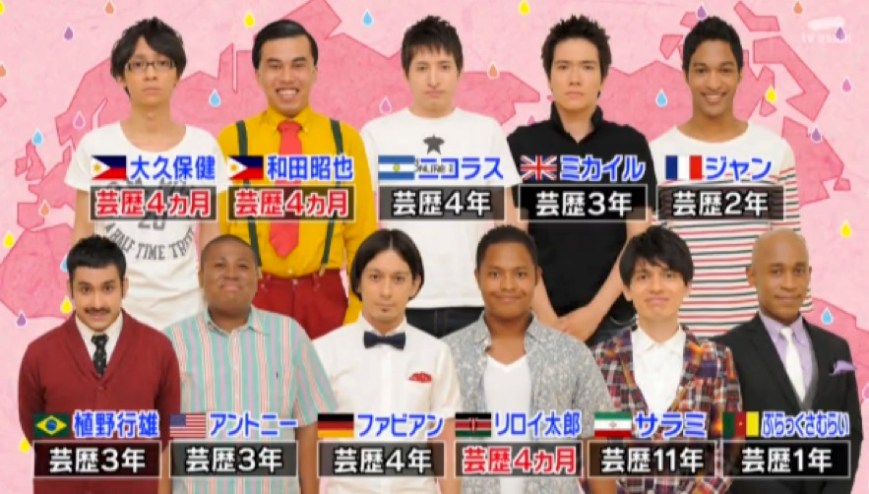
As you know, in Japan, multiracial models on TV have been popular. Recently, multiracial comedians become popular as well. They do not act like fashion models. They make people laugh by talking the story about the incident happened around them only because they are multiracial. First, Japanese are surprised that they can speak fluent Japanese and cannot speak English or another foreign language. Japanese also laugh at the characteristics the multiracial comedians share with other Japanese.

They had had many troubles and unique experiences which happened just because they are “hafu.” If we listen to their stories, we can know how hafu people are treated by Japanese. For example, Anthony, he is one of the ‘hafu comedians’. He is American and Japanese. People laugh at the fact that his hometown is Tokyo and his father managed a Sushi shop. He has knowledge about sushi because his home is sushi shop, but when he goes to a sushi shop, the master of sushi shop offered him ‘California roll’ and he was surprised. He has had other interesting experiences. He is bad at English, and when he was an elementary school student, he decided to go to English conversation school. On his first day of English conversation school, when he entered the classroom, other students misinterpreted him as an English teacher and they said “Hello, how are you?” to him.

I want to tell you about one more ‘half comedian’, Ueno Yukio. He was laughed at because of his obvious Japanese name. He is Brazilian and Japanese. When he plays soccer, the opposing team judged Yukio was a good soccer player by his appearance and many defenseman surrounded him. The opportunities to watch TV programs in which many ‘half comedians’ gather and talk about the things often happen around them are increasing. According to them, following things often happen: 

  • are judged to be foreign people
  • are often stopped by the police 
  • are asked by Japanese to sing foreign songs 
  • are laughed at by Japanese when they sing Japanese songs
  • are often expected to have high athletic ability
  • have difficulty getting a part time job
  • are invited to BBQ parties or Halloween parties
  • are called ‘Bob’ or ‘Michel’ 
  • are treated as tourists everywhere

Of course their nationality is Japanese and most of their hometown is Japan. Why they are laughed? Why do Japanese people stereotype their abilities? When Japanese look at people who look like “gaijin’’, Japanese often expect some specific skills because they have some assumptions. They think that people who have white, black, or other foreign appearance have foreign names and can speak foreign languages, and cannot speak Japanese at all.

It is true that hafu people are not a majority in Japan and many Japanese have little familiarity with thinking about race. That’s why people have expectations about the skills hafu people have. If hafu do not have these skills, Japanese laugh at them and hafu are unilaterally discouraged. 

Mimicking the non-existent

Anonymous student post

Body alterations are a strange thing. Just the words themselves—“body alterations”—make them seem so foreign to our lives, like they’re not something natural. Yet looking at people throughout my life has made me realize that body alteration has become the norm for many people, and desired by, perhaps, many more. If we were to look at how many people use make-up, have surgery, aim for a different body weight/composition, or even just get a piercing, we would see just how widespread this notion of changing our bodies is.

Yet, after reading Terry Kawashima’s (2002) article on racial indicators, I find body alterations strange in another sense. Kawashima discusses this idea of mimicry, in particular the mimicry of “white” traits by Japanese people, arguing throughout her paper that this is not the case for most of Japanese society. But it raised an interesting question about mimicry in relation to body alterations for me: When someone aims to alter their body, is it because they are trying to mimic something or someone else?

This can be a tricky question to navigate, as some will find it too broad a question while others will point out that there are as many reasons for changing one’s body as there are people. Despite this, I can’t help but feel that, at least from what I’ve seen and read, the answer just might be yes, but not in the way that the question is worded. The cautious reader will be skeptical, and thus, I suppose, explanations are in order.

Part of my answer is reinforced by some particular experiences of mine. Growing up with sisters can be difficult, especially when they are constantly attempting to put make-up on and dress fashionably, even when it makes you late for school. Anxiety, I learned, fueled my sister’s actions; she wanted to look “normal”, and thus she would groom herself constantly. For her, body modification was a way of becoming invisible. This resonates with my own experience growing up with raised bumps on my back. My mother, in all honesty, was more worried about them than I; she blamed them for the way I dressed and the activities I gave up when I was older, as well as for my shy and withdrawn personality. She went so far as to offer me a chance to have plastic surgery. Unable to explain to her (or myself) why my scars were not a problem to me, I consented.

After having plastic surgery on only two bumps, and after having grown up with more time to mull over that experience, I’ve realized that my mother believed I couldn’t think of myself as “normal” while I had something “subnormal”, especially when she saw the anxieties my sister held. Body modification, in this context, meant to her an attempt to elevate myself back to “the standard”.

Broadened to a larger scope, we can see in other’s experiences through things like blogs and academic literature that body modification extends across the board. It affects how people relate their body to race, gender, age, culture, health, and all these other touchy subjects that people seem afraid to address sometimes. And—again, from what I’ve seen and read—I think that all these changes that we make to our bodies has something to do with trying to obtain an ideal. In the end, it’s difficult to say that there’s some definitive “real” thing that people try to mimic, because most of the things I’ve listed are just social constructs. Race doesn’t biologically exist, health is relative, and age is reliant on different perceptions of time. In the end, perhaps all people are really trying to do is aim for something that’s not really obtainable because it does not exist in any measurable way. So in a way, we are trying to mimic something; it’s just not something that we can point to and say “there it is”.

Tanned skin: the new look?

by Kyungyeon Chung

clarinsToday, open up any international beauty magazine – you will find models that are dominating the colorful pages are not all so pale boasting ‘porcelain’ complexion. Instead, beauty sites and entertainment pages have been filled with new trend – tanning. Just take a look at some gossipy newspaper articles based on curious speculation how Mitt Romney, who must have been so busy at the time, maintained the glowing tanned skin throughout his presidential campaign. Kate Middleton and her sister Pipa Middleton also captured the gossip followers with their bronzed skin complexion. Whether it happens on the stunning Greek beach, or while backpacking in Vietnam, or in a sunbed salon in New York, the result, tanned skin has become the new trendsetting skin complexion.

Among those who can afford and dream of tanned skin, the darker complexion comes with numerous labels: sun-kissed, glowing, bronze, naturally tanned… If you examine, all these words used to describe tan, entail a deep implication that tanned skin is healthy; that it is a product of healthy practice, perhaps swimming in the open ocean, hiking under the sun, or out playing by the beach. No long ago were these associated with toiling in farms under the sun, a mark of laboring, lower class. Yet in 21st century when most of people in industrialized countries, people are usually spending most of their days in their offices, then on cars or public transports, then in shops and their homes, all under the fluorescent lights and hardly under the natural sun rays. And that is exactly why “sun-kissed’ skin is glorified and sought after.

clarins2Popular legend holds that Coco Chanel first initiated this world-wide boom of tanned skin, which she got while vacationing in the Mediterranean in the 1920s. It was a look that signified health and vitality. From then on, tanned skin became associated affluence and luxury of, in short, having enough money to go on holidays and lay under the sun. This was also in such direct contrast with ‘others’ who were unfortunate and had neither time nor money to enjoy such holiday.

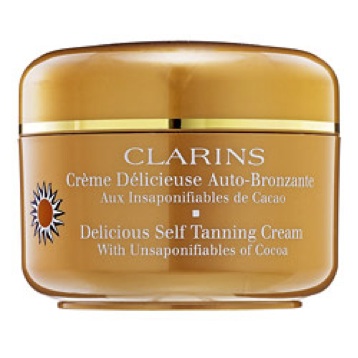
However, as mounting medical and scientific studies find the clear link between sun exposure and skin cancer, the trend did not end – instead, it simply turned from ‘natural’ to fake. Today at cosmetics shops, one can find an array of products that promise you evenly tanned skin and beautiful glow. So many different types of products are used to serve different purposed, from tanning lotion to bronzer powder, and fake sprays to imitate tans. You can walk into aesthetic shops and salons in your natural skin color then walk out a few shades darker in a matter of few hours and days of efforts.

The important thing about the logic behind the popularity of tanning, is that, it has fundamentally the same idea as skin brightening. It is the idea that skin complexion is a mark of certain class or socio-economic status, and that can be bought and fixed with money. The idea that beauty queue exists based on skin complexion, and consuming certain products will make you move up along the ladder. So at the end, who ‘wins’ at this game? Think about it – the same company that produces tanning creams and bronzers have different lines for skin brightening and whitening. Whether light skin or tanned skin is the trend of the year, they will never have a problem marketing either product.

Bigakuseizukan – Who Are the Beautiful Students?

by Lilia Yamakawa

A friend asked me to go with her to a party sponsored by a website called Bigakuseizukan, Picture Book of Beautiful Students. Both the photographers and the “beautiful” students they photograph are students from Japanese universities. Since have been talking about people’s concepts of “beauty” in our Race & Ethnicity class, I thought this would be a good opportunity to do fieldwork and see what this group considers attractive, what the trends are, why students agree to be posted on the website, and why this website is popular.

In class, we discussed what beauty is and found that a majority considers one type of appearance as beauty. Like the contestants in the Miss Korea contest that we saw in class, I expected most of the students at the party to be similar: skinny chins, double eyelids, small noses. I thought there would be many people with the Japanese kawaii style, with the same brown hair, same length bangs, and wearing the fluffy white and pink cutie skirts.

It turned out not to be what I expected! Most of the people there had different styles: many different hair colors and styles, different facial characteristics, many different body types, with totally different styles of clothes. Kawaii wasn’t especially big. I was both disappointed and relieved by what I actually saw. I was in a way disappointed that I couldn’t see an expected trend with my own eyes, and also relieved to find that there were many kinds of beautiful students there.

I think this has something to do with the popularity of the Picture Book of Beautiful Students website. The models are students who might actually go to your school, and they all look different. When you look at their snapshots, you might feel that they are close to you and possible to reach. This sense of closeness would be hard to have if you are looking at a model of a magazine or on TV. Bigakuseizukan’s uniqueness is that it doesn’t show only one type of beauty considered as perfect. It really shows lots of different types of students.

Another question I had in mind was why do people say yes to being photographed and having pictures posted of them online? And why do they attend such a gathering? I had a chance to ask around yesterday. I got a lot of answers, but basically they fall into three categories. In the first category, there were many students who were running for beauty contests, such as Miss Ritsumeikan, Mr. Japan and Miss Universe. These types of people answered they did it to get their name out and remembered through the Bigakuseizukan. The second group said they tried it for their personal record and their future career. It will look good when applying for a job, which might have a lot to do with your appearance, such as newscasters and announcers. The third group was more vague, and they said there was no reason not to try it or that they just enjoyed modeling for fun. One girl said, “Well, everybody posts their selfies on Twitter and other sites like that, so why not post a better picture of yourself taken by a photographer with a real camera?”

One more thing I expected to find was that everyone would be outgoing. Instead, there seemed to be all sorts of types of personalities at the gathering, and some people seemed very quiet and reserved. I think you could probably say that they all had some sense of confidence in the way they look, though.

This fieldwork only lasted three hours, but if you were interested in finding out why people in a certain group are judged to be attractive, I think studying a group such as the Bigakuseizukan would be a good method. It would be necessary to find more things that the models have in common and to question both the beauties and the photographers in more detail.

Color complex and constant degradation

Sign for "colored" waiting room at a...

Sign for “colored” waiting room at a Greyhound bus terminal in Rome, Georgia, 1943. (Photo credit: Wikipedia)

by Miho Tanaka

In our class on racism and colorism, we have been talking about how light skin is considered as one of the crucial elements of beauty in and how the idea is fostered all over the world. Not only people with dark skin but also all people, especially women, try to lighten or whiten their skin color without any specific necessaries and reasons to be light. Overall the main issue is how the idea of colorism is getting fostered then racism has taken its place on this capitalism world. As everything can be bought by money, wealth is literally measured by how much economic power people have. “Power of consumption” (Rondilla 2009, p.78) is then directly connected to “economies of color” (Harris 2009, p.1).

Under this condition, people with dark skin would try to be lighter by consuming skin lighteners if they had money to consume these. Therefore impoverished people would stay in a lower status since they wouldn’t be able to buy skin lighteners, and it is the problem that people with dark skin are often needed to stay in poor communities where many problems such as crimes, drugs or robberies exist. According to Rondilla (ibid), “controlling images are designed to make racism, sexism, poverty and other forms of social injustice appear to be natural, normal, and inevitable parts of life” (p.65). Regarding African American communities in Detroit, I’ve heard from my friend the images are so natural that even inhabitants of the community cannot get rid of them. “People are so caught with personal aesthetic and social positions, than actually embracing their own features, cultures and talents” (Brandosoul 2013), and I would call it a “constant degradation of certain racial people.” As Atlanta blackstar (2013) shows, unfortunately it might be true that young African Americans are often targeted as people who resort to violence but the system in which they are stuck should be transformed.

As Angela Harris explains in the introduction to the book Shades of Difference, “[o]ne of the challenges for scholars and activists concerned with colorism is thus to disrupt―and if possible prevent―’Latin Americanization,’ in which color hierarchy is pervasive yet its relationship to racism denied” (Harris, 2009, p.5). Racism exists and the first step we could take is not to deny it and not to be ignorant.

References

Atlanta blackstar. (2013). 5 reasons young black men resort to violence. Retrieved on November 29, 2013, from http://atlantablackstar.com/2013/11/26/5-reasons-young-black-men-resort-violence/2/

Brandosoul. (2013). Colorism: the jaded mystery of race and skin color. Retrieved on December 9th 2013 from http://misedublack.wordpress.com/2013/12/11/colorism-the-jaded-mystery-of-race-and-skin-color/

Harris, A. P. (2009). Economies of color. In Glennn, N, E. (Ed.) (2009). Shades of difference: why skin color matters. Stanford University Press.

Rondilla, J. L. (2009). Filipinos and the color complex : ideal Asian beauty. In Glennn, N, E. (Ed.) (2009). Shades of difference : why skin color matters. Stanford University Press.

Skin Color and Beauty in Japan

by Miyu Fujino

Compared to other countries, there is less racial diversity in Japan. Non-Japanese people who live in Japan for a long time will notice that there are many implicit customs which follow an old Japanese tradition. One of the traditions is to try to be same as people around us and not out stand too much from them. Many Japanese people believe that if they follow the custom, they can live peacefully in the society. This is an element of Japanese culture, and there are many sayings which are related to this idea.

  • 和して同ぜず (washite dou zezu) -coordinate with other people but not do immorality thing or loose independence.
  • 出る杭は打たれる (deru kui ha utareru) -if you stand out too much, people will accuse you.
  • 付和雷同 (fuwaraidou) -do same thing as others

Therefore, for a long time, Japanese people have tended to follow and be normal and try not to stand out. I think that is one of a reason why Japanese people do not prefer dark skin because dark skin is unusual in Japan.

In Japanese society, for a long time, having white skin is one of the features of beauty and regarded as a good thing for women. There is an old proverb (色の白いは七難隠す iro no shiroi wa shichinan kakusu) which translates to “white skin covers the seven flaws,” meaning a fair-skinned woman is beautiful even if her features are not attractive.

However, there was a period when this idea didn’t fit. Ganguro: An opposition to the idea of fair skin beauty grew. This subculture appeared in the 1990s but died out in the early 2000s. Young girls preferred to be tanned and wore unique makeup and clothes. This Ganguro was started as an anti-tradition movement among young people. Young people challenged to Japanese traditional society and the stereotype that women have light skin, black hair and stay calm and not stand out.

Recently, white skin has been strongly supported by women again. I’m sure you have seen women who wear sunscreen, umbrella, gloves, sunglasses, big hats, spray, and powder. They are trying hard to protect their skin from the sun. But the reason why they are doing is because everybody is doing. Now, the word ‘bihaku’ is getting attention from women. Bihaku is a Japanese marketing term and often used for representing skin whitening products and cosmetics. Bihaku products are highly popular among women. They are also popular with teenage girls and those in their twenties who strongly affected by the information from the internet and media.

Japanese media and cosmetic industries install in women the idea that only small amount of sunshine can damage their skin. Therefore, Japanese women try to avoid to be exposed to sunshine even a few seconds. Many beautiful actress and models who have white and clean skin appear on the TV and that’s also a reason why people use bihaku cosmetics which is advertised by those beautiful famous people. Japanese TV often broadcast many programs to introduce UV care goods and suggest people to avoid sunshine. Media is helping to plant the thought in people’s minds that they should avoid sunshine and should use bihaku products.

Media often make people believe lighter skin is more beautiful by using white skin beautiful actresses or models. And use them to advertise bihaku cosmetic products as if by using the products, people can be like them. As media has a power to affect people (especially young people) strongly, they have to have an awareness and responsibility for their influence and try hard to give correct information to people.

Face lotions and creams from 8brand from kanebo have caused accidents. (September 2013) People who used these got white spots in their skin. All of the products contain skin lightning component called Rhododenol which is treated as a medicine and effective to control melanin in skin. Kanebo is the 3rd highest earning company in Japanese cosmetic industry and most people know the name. Many TV commercials were broadcasted and the company had a pretty high reputation among women. Therefore, people who trusted the brand got damaged both physically and mentally. More than 10,000 people got the white spots.

It is a normal thing for women to try hard to be more beautiful and that means to have lighter skin in Japan. People’s willingness to have lighter skin is one of a reason why this company to cause this accident. In Japan, skin color does not affect social status or salary. People want white skin just because they believe lighter skin is more beautiful and that is what other people say. However, I think Japanese people have to rethink what beauty is for each of them but not only following other people.

Women’s Consciousness of Skin Lighteners in Japan

by Mai Kusakabe 

In South Africa, there are a lot of women who want to make their skin color lighter because they try to get better status and become more attractive. Then, how about Japanese women? What are they thinking about their skin color? Actually, we can see a lot of cosmetics and drugs to make their skin lighter in pharmacy. So in order to reveal what they are thinking, I did questionnaire about skin color, and ask ten Japanese girls answer it.

girls


The first question of my questionnaire was which girl do you prefer, and which is more attractive for you? And why do you feel the girl is more attractive?

Nine out of ten girls answered that they like or want to be a girl on the left, who looks Caucasian. Another girl said she liked the middle one, who looks more Japanese. She said middle one seems the healthiest of the girls. Most girls have the same answer, and the reason why they choose left girl is almost the same, because she has white skin! She looks Caucasian! So she looks beautiful!

The second question was have you ever used skin lighteners? And do you do any efforts to make your skin lighter?

To this question, every one answered Yes. This result is kind of interesting. Every girl seeks to get lighter skin somehow, for example, using face lotion and take a supplement including a component to make skin white and using sunscreen to prevent their skin from ultraviolet rays. Thus usually Japanese girls do something to keep or improve their skin color.

The third one is do you use a sunscreen? Yes or No. And for the person who answered Yes, is it for which reason, for health or for keeping lighter skin? Two girls answer No, and the rest answer Yes. Five of them said it is for keeping lighter skin, two of them said for both and one said for health.

The fourth one is why do you do such efforts? Why do you want to be lighter skin? There are two types of answer of this question. First type is that they think or believe white skin is beautiful. Second type is that they said everyone insist white skin is beautiful, so I think so too. The biggest differences between two are their opinion influenced by others or not.

So what kind of factors influence Japanese girls’ opinions of skin color? The options are TV, advertisements of cosmetics, magazines, the Internet, status, public opinion and other. The choice which attracted most votes is TV (six points), following public opinion, magazines (four points), advertisements (three points), the Internet (one point). And there is no vote to status. From this result, we can understand that most people don’t realize that there is connection between skin color and status in Japan, for example trying to get lighter skin is to become more attractive, this is kind of trying to get better status. In addition their idea that white skin is beautiful is mostly influenced by media. One girl said my favorite model has white skin, so I want to get white skin like her. Indeed popular models and actress have lighter skin, and many girls long to be like them. Lighter skin has come to one of major factors to be like admired woman.

Thus, as we can see from this questionnaire, Japanese girl prefer lighter skin. And most of them do some efforts to make their skin lighter, for example, about 70% of girls use sunscreen for keeping their skin color lither. They don’t think it’s for their health, just for their own beauty. They regard white skin as beautiful. The biggest factor of their preference of skin color in Japan is media which give us images of popular models and actress who have lighter skin that makes us long to be like them, and give us impression that lighter skin can get more popularity and attractiveness. The important thing is that it is not always right. Sometimes it makes us wrong decision. So we need to judge whether it is right or not.

Manipulation by Cosmetic Companies Changing Habits towards Skin Lightening

yes, men need whitening lotion, too.

(Photo credit: Sophiakristina)

by Naresh Kumar

People around the world are constant consumers of skin whiteners and different cosmetic products. Even if the products have harmful effects, the consumption of these products is rising day by day. Large cosmetics companies around the world make billions of profits and it is not hard to see how they are using different sources to promote their products and make people use them. The media plays a vital role. The interesting thing is that whatever comes up in mass media, most of it is in favor of these companies. They are profit-motive companies and are strongly engaged into making more profits. It is interesting to see different beliefs in different communities around the world. People relate light skin with social status, money, education, pleasure, wealth, winner, etc. We talk a lot about western ideologies that “white is right”, but the fact is that its us who want to have a peace of that lightness. People like to consume more western culture and products, ignoring their own. More and more emphasis is given to light skin.

Currently the world market is dominated by skin lightening products with billions of dollars of transactions happening each year. Multinational companies are manipulating the market by using media. More and more ads are shown according to different  locations and cultures. The interesting thing is that very less is shown in media about the bad effects and negative side of skin whiteners. If we look at India, it is not hard to see that youths specially women are being obsessed by light skin. In cities like Mumbai and New Delhi, people are trying to accept their natural color tone. They are promoting things such as “dark is beautiful” and “beauty beyond colors”. This is a very slow action but definitely, people are starting to realize that “white is right” ideology is a complete myth.

It seems that people are not just making their face and arms light, but they are going beyond. The intimate skin lightening creams and other cosmetic things are becoming popular. People are going for their intimate areas and are being extreme. Bleaching one’s skin is becoming a common practice.  I wonder how will be the skin lightening trade after 5 or 10 years. Those who are more concerned about racism and discrimination are acting to solve the problems but that is not enough. We need to embrace and appreciate who we are, rather than trying to be who we are not. We need to see the problem from a different side. With the increase in intimate skin whitening, I wonder what will be the next, would it be lightening of your eyeballs or feet or something else.

Mzungu and Colorism in Africa

by Miho Tanaka

Reading “Skin Lighteners in South Africa: Transnational Entanglements and Technologies of the Self (2009)” by Lynn M. Thomas, I was reminded of and reflected on my experiences in Africa. It was inconsiderable that South African care so much about their skin color even though skin lighteners sometimes bring problems to their skin.

However it is true that the people I met in Kenya put value on light skin and they connect it with high social status very much. The other internship students from Europe, the United States, and Asia and I were called Mzungu by Kenyans. I saw Malaysians, Indonesians, Singaporeans, Americans, Brazilians, Swedes and Germans all called Mzungu. Mzungu is the Swahili word that describes rich and White people from African people’s perspectives. More specifically, not only Caucasians but also people from developed countries with light skin of color are Mzungu. It seems that many Swahili-speaking countries use the term Mzungu, as some websites and blogs show on the internet (Hoff n.d.; Duara 2008). Both Hoff and Duara write that Mzungu is used in central and Southern Africa. When I visited Rwanda this summer Rwandan also called us Wazungu, the plural way to call Mzungu.

Interesting are those African people who are eager to have networks or connections with Mzungu people. For instance, while I and the other internship students were in a community in Kenya and belonged to a Community Based Organization, some Kenyans suddenly joined the organization and many HIV-positive people started to attend our meetings as well. However according to local members in Kenya, they began to be absent from meetings after all of the Wazungu left. However, some of them have tried to maintain their connections with Wazungu. Most importantly, they strongly connect idea of economic and social status mobility with being Mzungu. If they could have been married with a Mzungu woman or man, they would not have to be in trouble of impoverished in Africa anymore. They would be able to get out of their homeland and have a better life.

Considering the case of South Africa, the tendency that they would like to have lighter skin color must be much higher than the other countries since they were harshly segregated by skin color during the period of apartheid. Even though they might have skin troubles from using skin lighteners, upward mobility would be more important for them since it would determine their entire life and success. Therefore, they care more about their skin tone rather than their health. However the status in South Africa must be changed since the abolition of apartheid. Nowadays there are poor Whites going begging in South Africa, and it also might be a factor that changes preference of white or light skin. I suppose the tension between Mzungu and Black Africans, which connects social upward mobility with light skin color, would not change because Black Africans regard Mzungu as coming from totally different background and statuses. However, it might create new black movement as their economic status changes with economic growth.

References

Duara, D. (July, 19th 2008). The Mzungu term : get it right! Retrieved on November, 22nd 2013 from http://pernille.typepad.com/louderthanswahili/2008/07/the-mzungu-te-1.html

Hoff, W. (n.d.). Mzungu Design. Retrieved on November 22nd 2013 from http://www.mzungudesign.com/welcome/

Thomas, M. L. (2009). Skin lighteners in South Africa: transnational entanglement and technologies of the self. In Glenn, N. E. (Ed.), Shades of difference: why skin color matters. Stanford, California: Stanford University Press.