
 by Umene Shikata
When you walk around Japan in the summer time, no matter whether it is in the city or rural areas, you will see women wearing long sleeves, hat, sunglasses, or long gloves that reach their elbows. You may also see those ladies (most of the time above their 20s) using a parasol also on a sunny day. These behaviors of Japanese women are understood as an indication of their preferences for white skin.
Ashikari Mikiko, a social anthropologist who studied at Kenbridge University, argues that the Japanese white-skin preference does not have anything to do with being like westerners, but rather cultivate “a Japanese form of whiteness which is based on the Japanese identity as a race” (2005:73). This means that she does not think Japanese people have this tendency for white skin because they have a complex towards their ‘yellow’ skin (since Japanese are often seen as a yellow-skinned race), neither do they have a desire to get westerners’ white skin. They want to be white because being white is a demonstration of belonging to ‘us’, which in this case means ‘being Japanese’.
I agree that Japanese people do not try to be western through whitening their own skin. However, the relation between white skin preference and sense of belonging to the ‘us/Japanese’ remains unclear to me. I asked my Japanese friends (a total of 15 people, both men and women, 20 to 22 years old) what they thought about Ashikari’s connection of being white and belonging to ‘us’, and all of them thought it was not fully explaining their feeling towards whitening their skin.
Then, to understand better what they are actually thinking and feeling, I made further question whether they prefer white skin or black skin, the reason of feeling in such way, whether white skin preference was based on admiration for westerners and, in the end, what is a ‘beautiful skin’ for them. All of them answered me that, as Ashikari mentioned in her article, their, or Japanese people’s white skin preference has nothing to do with westerners’ skin color, neither with a race issue. Rather, all of them answered that people doing whitening care are doing so for their own preference and happiness, in the other words, to be “cute” (kawaii) or “beautiful” (kirei). What should be underlined, however, is the fact none of them brought up ‘white color’ or ‘white skin’ to their idea of ‘beautiful skin’ image.
Their concept of beautiful skin, including boys’ opinions as well, could be divided in three categories; smooth (nameraka na hada, sube sube shita hada), no skin trouble (hada are no nai hada) such as acne, dry skin, and blotches, and finally transparency (toumeikan no aru hada). If you research ‘essences for beautiful skin’ (bihada no joken) on the internet, the results are the same.
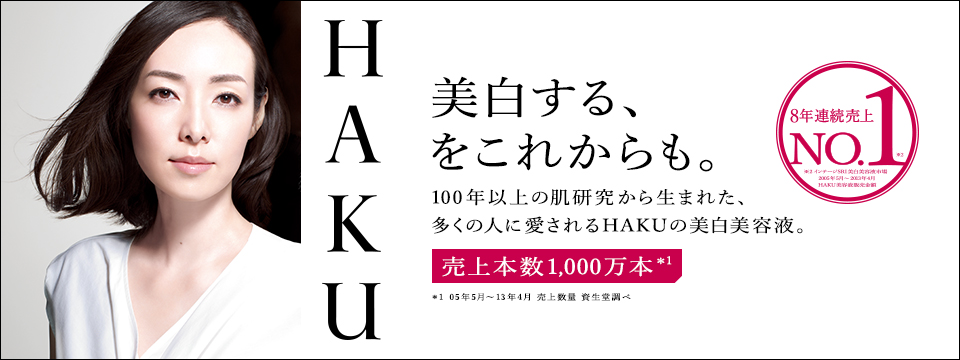
It seems that Japanese people, both women and men, put skin condition above actual skin color. Some of my friends who answered me mentioned that they do not really care whether the skin is rather white, yellow, or well-tanned as long as it is healthy looking with no skin troubles. For instance, if you read Shiseido’s whitening product haku’s promotion page you may realize they are talking more about how to avoid blotches, or to make smoother skin condition rather than to actually having white-colored skin.
Moreover, Shiseido’s answer to the question “what is the containment of skin whitening products” is “active ingredient which suppresses the generation of melanin and prevent a blotches or freckles”. This means that when Japanese says white skin, they are not talking about actual skin color. However, they are talking about skin without any blotches, clean and beautiful skin condition.
If you take this assumption as the real fact, then it might be easier to understand Japanese women’s preferences, opinion and behavior. They prefer “white” skin, because it is clean, literally beautiful in the way there is no skin problem, and also shows they care about their own selves which in Japan is considered as a “high womenness” (joshi ryoku ga takai). They try to avoid being tanned because with the sun, tan skin tend to have more blotches and is drier (kasa kasa). It also may cause skin problems. This is why many people, including my own self, felt the reason of whitening as demonstration of belonging not appropriate to explain their tendencies and feelings.
Indeed, there may be some culture which considers blotches as a good thing, or something that has no importance. However, in this case we are talking more about cultural differences to see the world. However, it can be said that, at least Japanese whitening tendencies are not related to racial issues or belonging to us/Japanese, but rather to a pure cultural beauty concepts.
References
Ashikari, Mikiko. 2005. “Cultivating Japanese Whiteness: The ‘Whitening’ Cosmetic Boom and the Japanese Identity”, Journal of Material Culture 10(1):73-91.
Watashi by Shiseido, Questions and answers: https://www.shiseido.co.jp/faq/qa.asp?faq_id=1000000335
Watashi by Shiseido, Shiseido no bihaku tokusyuu: https://www.shiseido.co.jp/beauty/bihaku/

 by John Wang


 In her research on Japanese whiteness, Mikiko Ashikari (2005) tries to explain where the idea of a specific white skin among the “Japanese race” comes from. According to Ashikari, it seems less likely to be from Caucasians’ influence, since Japanese women considered Caucasian skin as “rough, aged quickly and had too many spots” (Ashikari 2005:82). The idea of white skin in the Japanese society is even more specific than any other features that could define the idea of being “Japanese”. Although Japanese change their hair color with dying products, their eye color with contact lenses, and their physical features with plastic surgery, they would never change their skin color because “the notion of Japanese skin works as one medium to express and represent Japaneseness” (Ashikari 2005:76). As Ashikari notes, by defining a specific skin color to their race, Japanese people are even able to reject the Okinawan people as a “second-class citizens” (Gibney quoted by Ashikari, 2005, p. 80).
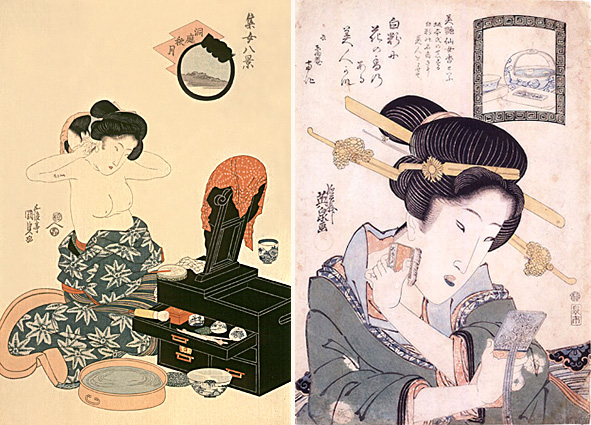 Actually, Japanese whiteness has its roots even before the Black Ships arriving in Japan during the 16th century. It is said that during Nara Period (710–94) and Heian Period (794–1185), Japanese women were already using diverse products to light their skin tone (Kyo 2012). The ideal of white skin is also found in a lot of literature of this period such as the Diary of Lady Murasaki and Tale of Genji (Kyo 2012). Back in the Heian Period, women would blacken their teeth and shave their eyebrows. Nowadays nobody would shave their eyebrows as a sign of beauty but the idea of white skin as the ideal of beauty among Japanese women is still a recurrent topic in Japanese society.

 JAPANsociology