“Gaijin” to Japanese: What Japanese Often Expect from Foreigners

by Satona Kato

comediansTerry Kawashima argues that people have a consciousness about race, and this consciousness depends on their background. We can see this by comparing various ways of thinking about shojo manga characters by Western people and Japanese people.

In Japan, many people put the people who are not Asian (Japanese, Korean, Chinese, South East Asian) into one category called “gaijin”. Many Japanese people do not think about the country where the “gaijin” were born. Furthermore, they tend to stereotype that sort of people have specific skills. In Japan, some of the people who are unilaterally labeled as “gaijin” have experiences that they are wounded or feel alienated, especially the people who are multiracial or who were born and grown up in Japan.

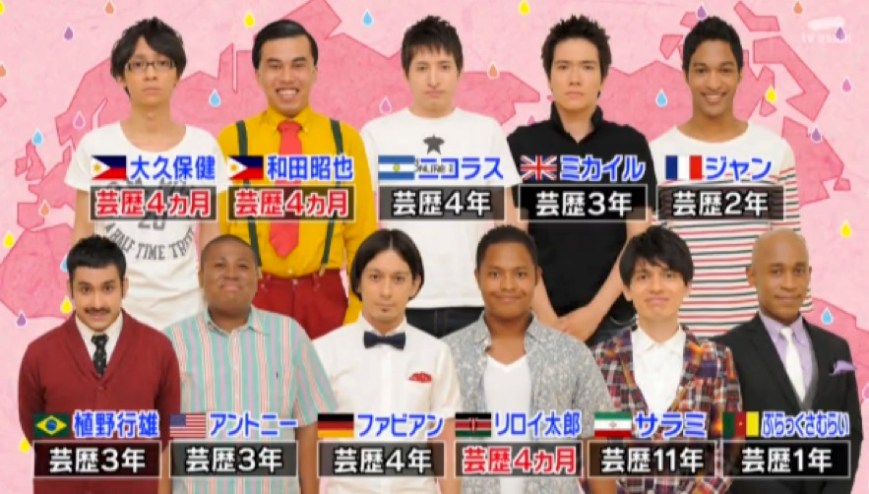
As you know, in Japan, multiracial models on TV have been popular. Recently, multiracial comedians become popular as well. They do not act like fashion models. They make people laugh by talking the story about the incident happened around them only because they are multiracial. First, Japanese are surprised that they can speak fluent Japanese and cannot speak English or another foreign language. Japanese also laugh at the characteristics the multiracial comedians share with other Japanese.

They had had many troubles and unique experiences which happened just because they are “hafu.” If we listen to their stories, we can know how hafu people are treated by Japanese. For example, Anthony, he is one of the ‘hafu comedians’. He is American and Japanese. People laugh at the fact that his hometown is Tokyo and his father managed a Sushi shop. He has knowledge about sushi because his home is sushi shop, but when he goes to a sushi shop, the master of sushi shop offered him ‘California roll’ and he was surprised. He has had other interesting experiences. He is bad at English, and when he was an elementary school student, he decided to go to English conversation school. On his first day of English conversation school, when he entered the classroom, other students misinterpreted him as an English teacher and they said “Hello, how are you?” to him.

I want to tell you about one more ‘half comedian’, Ueno Yukio. He was laughed at because of his obvious Japanese name. He is Brazilian and Japanese. When he plays soccer, the opposing team judged Yukio was a good soccer player by his appearance and many defenseman surrounded him. The opportunities to watch TV programs in which many ‘half comedians’ gather and talk about the things often happen around them are increasing. According to them, following things often happen: 

  • are judged to be foreign people
  • are often stopped by the police 
  • are asked by Japanese to sing foreign songs 
  • are laughed at by Japanese when they sing Japanese songs
  • are often expected to have high athletic ability
  • have difficulty getting a part time job
  • are invited to BBQ parties or Halloween parties
  • are called ‘Bob’ or ‘Michel’ 
  • are treated as tourists everywhere

Of course their nationality is Japanese and most of their hometown is Japan. Why they are laughed? Why do Japanese people stereotype their abilities? When Japanese look at people who look like “gaijin’’, Japanese often expect some specific skills because they have some assumptions. They think that people who have white, black, or other foreign appearance have foreign names and can speak foreign languages, and cannot speak Japanese at all.

It is true that hafu people are not a majority in Japan and many Japanese have little familiarity with thinking about race. That’s why people have expectations about the skills hafu people have. If hafu do not have these skills, Japanese laugh at them and hafu are unilaterally discouraged. 

Behind the Trend of Huge Eyes in Japanese Anime

by Yukako Ikezoe

There have been controversial debates going on about why characters in Japanese manga have huge eyes. Do such huge eyes in Manga mean that Japanese people are craving for them?

Having read Terry Kawashima’s piece, “Seeing Faces, Making Races: Challenging Visual tropes of Racial Differences”, I also started wondering why the eyes of characters in Japanese manga are big, even though I had never strongly questioned that before. Readers from Western countries might have wondered about the looks of characters in Manga because the characters’ features are similar to the features Caucasians have, including round eyes or blond hair.

Thinking about the real purpose of this kind of trend from the perspective of Japanese myself, I would say that is not because Japanese strongly desire to get big eyes like Caucasians, but rather because big eyes are one of the most important techniques to express characters’ minds and make it easier for readers to observe its minute movements, since only iconography and visual languages are used to let readers read what characters are thinking. Therefore readers can easily read characters’ thoughts by looking at their facial expressions with unique movements of their eyes.

There is a proverb “目は口ほどにものを言う” ,meaning that “the eyes are the window of the mind”, or “the eyes say more than the mouth” in English. This thinking also makes us consent to the trend of large eyes in Japanese Manga. Making up for sounds or animation which enable us to understand situations and feelings of characters more easily, various movements of eyes are also a center tool for writers as well as for readers. Using large eyes can be considered as one of the essential tools or techniques to add affluent expressions on characters.  Inspired by Disney cartoons, Osamu Tezuka known as a talented Japanese manga writer, also started using that technique in order to emphasize greater expressions of characters. His works then have been the basis for all manga today. In spite of the fact that the way of drawing characters was also influenced from the West, a reason is not always the strong desire of Japanese towards Caucasians, but rather Japanese manga writers adopt the Western styles into their drawings.

I am always amazed by that technique when reading manga since characters with various expressions on eyes give plenty of punches and enable me to empathize with the manga world in which only visual languages and pictures are used. Japanese writers uniquely use huge eyes as a technique to add greater emotions on characters, which is still putting many manga fans from all over the world into a trance today.

References

Tabatha Butler.(2013). How Walt Disney Influenced Anime. Retrieved from http://themovieblog.com/2013/how-walt-disney-influenced-anime/

Mimicking the non-existent

Anonymous student post

Body alterations are a strange thing. Just the words themselves—“body alterations”—make them seem so foreign to our lives, like they’re not something natural. Yet looking at people throughout my life has made me realize that body alteration has become the norm for many people, and desired by, perhaps, many more. If we were to look at how many people use make-up, have surgery, aim for a different body weight/composition, or even just get a piercing, we would see just how widespread this notion of changing our bodies is.

Yet, after reading Terry Kawashima’s (2002) article on racial indicators, I find body alterations strange in another sense. Kawashima discusses this idea of mimicry, in particular the mimicry of “white” traits by Japanese people, arguing throughout her paper that this is not the case for most of Japanese society. But it raised an interesting question about mimicry in relation to body alterations for me: When someone aims to alter their body, is it because they are trying to mimic something or someone else?

This can be a tricky question to navigate, as some will find it too broad a question while others will point out that there are as many reasons for changing one’s body as there are people. Despite this, I can’t help but feel that, at least from what I’ve seen and read, the answer just might be yes, but not in the way that the question is worded. The cautious reader will be skeptical, and thus, I suppose, explanations are in order.

Part of my answer is reinforced by some particular experiences of mine. Growing up with sisters can be difficult, especially when they are constantly attempting to put make-up on and dress fashionably, even when it makes you late for school. Anxiety, I learned, fueled my sister’s actions; she wanted to look “normal”, and thus she would groom herself constantly. For her, body modification was a way of becoming invisible. This resonates with my own experience growing up with raised bumps on my back. My mother, in all honesty, was more worried about them than I; she blamed them for the way I dressed and the activities I gave up when I was older, as well as for my shy and withdrawn personality. She went so far as to offer me a chance to have plastic surgery. Unable to explain to her (or myself) why my scars were not a problem to me, I consented.

After having plastic surgery on only two bumps, and after having grown up with more time to mull over that experience, I’ve realized that my mother believed I couldn’t think of myself as “normal” while I had something “subnormal”, especially when she saw the anxieties my sister held. Body modification, in this context, meant to her an attempt to elevate myself back to “the standard”.

Broadened to a larger scope, we can see in other’s experiences through things like blogs and academic literature that body modification extends across the board. It affects how people relate their body to race, gender, age, culture, health, and all these other touchy subjects that people seem afraid to address sometimes. And—again, from what I’ve seen and read—I think that all these changes that we make to our bodies has something to do with trying to obtain an ideal. In the end, it’s difficult to say that there’s some definitive “real” thing that people try to mimic, because most of the things I’ve listed are just social constructs. Race doesn’t biologically exist, health is relative, and age is reliant on different perceptions of time. In the end, perhaps all people are really trying to do is aim for something that’s not really obtainable because it does not exist in any measurable way. So in a way, we are trying to mimic something; it’s just not something that we can point to and say “there it is”.

Skin Color and Beauty in Japan

by Miyu Fujino

Compared to other countries, there is less racial diversity in Japan. Non-Japanese people who live in Japan for a long time will notice that there are many implicit customs which follow an old Japanese tradition. One of the traditions is to try to be same as people around us and not out stand too much from them. Many Japanese people believe that if they follow the custom, they can live peacefully in the society. This is an element of Japanese culture, and there are many sayings which are related to this idea.

  • 和して同ぜず (washite dou zezu) -coordinate with other people but not do immorality thing or loose independence.
  • 出る杭は打たれる (deru kui ha utareru) -if you stand out too much, people will accuse you.
  • 付和雷同 (fuwaraidou) -do same thing as others

Therefore, for a long time, Japanese people have tended to follow and be normal and try not to stand out. I think that is one of a reason why Japanese people do not prefer dark skin because dark skin is unusual in Japan.

In Japanese society, for a long time, having white skin is one of the features of beauty and regarded as a good thing for women. There is an old proverb (色の白いは七難隠す iro no shiroi wa shichinan kakusu) which translates to “white skin covers the seven flaws,” meaning a fair-skinned woman is beautiful even if her features are not attractive.

However, there was a period when this idea didn’t fit. Ganguro: An opposition to the idea of fair skin beauty grew. This subculture appeared in the 1990s but died out in the early 2000s. Young girls preferred to be tanned and wore unique makeup and clothes. This Ganguro was started as an anti-tradition movement among young people. Young people challenged to Japanese traditional society and the stereotype that women have light skin, black hair and stay calm and not stand out.

Recently, white skin has been strongly supported by women again. I’m sure you have seen women who wear sunscreen, umbrella, gloves, sunglasses, big hats, spray, and powder. They are trying hard to protect their skin from the sun. But the reason why they are doing is because everybody is doing. Now, the word ‘bihaku’ is getting attention from women. Bihaku is a Japanese marketing term and often used for representing skin whitening products and cosmetics. Bihaku products are highly popular among women. They are also popular with teenage girls and those in their twenties who strongly affected by the information from the internet and media.

Japanese media and cosmetic industries install in women the idea that only small amount of sunshine can damage their skin. Therefore, Japanese women try to avoid to be exposed to sunshine even a few seconds. Many beautiful actress and models who have white and clean skin appear on the TV and that’s also a reason why people use bihaku cosmetics which is advertised by those beautiful famous people. Japanese TV often broadcast many programs to introduce UV care goods and suggest people to avoid sunshine. Media is helping to plant the thought in people’s minds that they should avoid sunshine and should use bihaku products.

Media often make people believe lighter skin is more beautiful by using white skin beautiful actresses or models. And use them to advertise bihaku cosmetic products as if by using the products, people can be like them. As media has a power to affect people (especially young people) strongly, they have to have an awareness and responsibility for their influence and try hard to give correct information to people.

Face lotions and creams from 8brand from kanebo have caused accidents. (September 2013) People who used these got white spots in their skin. All of the products contain skin lightning component called Rhododenol which is treated as a medicine and effective to control melanin in skin. Kanebo is the 3rd highest earning company in Japanese cosmetic industry and most people know the name. Many TV commercials were broadcasted and the company had a pretty high reputation among women. Therefore, people who trusted the brand got damaged both physically and mentally. More than 10,000 people got the white spots.

It is a normal thing for women to try hard to be more beautiful and that means to have lighter skin in Japan. People’s willingness to have lighter skin is one of a reason why this company to cause this accident. In Japan, skin color does not affect social status or salary. People want white skin just because they believe lighter skin is more beautiful and that is what other people say. However, I think Japanese people have to rethink what beauty is for each of them but not only following other people.

Women’s Consciousness of Skin Lighteners in Japan

by Mai Kusakabe 

In South Africa, there are a lot of women who want to make their skin color lighter because they try to get better status and become more attractive. Then, how about Japanese women? What are they thinking about their skin color? Actually, we can see a lot of cosmetics and drugs to make their skin lighter in pharmacy. So in order to reveal what they are thinking, I did questionnaire about skin color, and ask ten Japanese girls answer it.

girls


The first question of my questionnaire was which girl do you prefer, and which is more attractive for you? And why do you feel the girl is more attractive?

Nine out of ten girls answered that they like or want to be a girl on the left, who looks Caucasian. Another girl said she liked the middle one, who looks more Japanese. She said middle one seems the healthiest of the girls. Most girls have the same answer, and the reason why they choose left girl is almost the same, because she has white skin! She looks Caucasian! So she looks beautiful!

The second question was have you ever used skin lighteners? And do you do any efforts to make your skin lighter?

To this question, every one answered Yes. This result is kind of interesting. Every girl seeks to get lighter skin somehow, for example, using face lotion and take a supplement including a component to make skin white and using sunscreen to prevent their skin from ultraviolet rays. Thus usually Japanese girls do something to keep or improve their skin color.

The third one is do you use a sunscreen? Yes or No. And for the person who answered Yes, is it for which reason, for health or for keeping lighter skin? Two girls answer No, and the rest answer Yes. Five of them said it is for keeping lighter skin, two of them said for both and one said for health.

The fourth one is why do you do such efforts? Why do you want to be lighter skin? There are two types of answer of this question. First type is that they think or believe white skin is beautiful. Second type is that they said everyone insist white skin is beautiful, so I think so too. The biggest differences between two are their opinion influenced by others or not.

So what kind of factors influence Japanese girls’ opinions of skin color? The options are TV, advertisements of cosmetics, magazines, the Internet, status, public opinion and other. The choice which attracted most votes is TV (six points), following public opinion, magazines (four points), advertisements (three points), the Internet (one point). And there is no vote to status. From this result, we can understand that most people don’t realize that there is connection between skin color and status in Japan, for example trying to get lighter skin is to become more attractive, this is kind of trying to get better status. In addition their idea that white skin is beautiful is mostly influenced by media. One girl said my favorite model has white skin, so I want to get white skin like her. Indeed popular models and actress have lighter skin, and many girls long to be like them. Lighter skin has come to one of major factors to be like admired woman.

Thus, as we can see from this questionnaire, Japanese girl prefer lighter skin. And most of them do some efforts to make their skin lighter, for example, about 70% of girls use sunscreen for keeping their skin color lither. They don’t think it’s for their health, just for their own beauty. They regard white skin as beautiful. The biggest factor of their preference of skin color in Japan is media which give us images of popular models and actress who have lighter skin that makes us long to be like them, and give us impression that lighter skin can get more popularity and attractiveness. The important thing is that it is not always right. Sometimes it makes us wrong decision. So we need to judge whether it is right or not.

Japan reaches top rank – in gender inequality

by Michelle Liebheit

As The Mainichi reported last month, Japan has been slipping down on the gender gap ranking for the last couple of years. This year it finally reached the lowest rank in gender equality within industrialized countries. We talked about this topic various times in class too, but most of our discussions were based on perception rather than data. I was therefore interested how gender equality in Japan is really doing and the data I found was still surprising.

First, the gender gap report shows some interesting numbers. Whereas the unemployment rate is very low for both genders in Japan (women 4%, men 5%), we see a huge difference in the type of employment. 35% of the female labour force works part-time. If we compare this to their male counterparts, of which only 10% are part-time employees, the difference is clearly visible.

Other major points for Japan’s bad performance are due to a lack of political empowerment (ranking 118 out of 135 in the subindex). In the current diet, only 8% of the parliament seats are hold by women. Moreover, Japan has had no female head of state since the establishment of a parliament in the late 19th century.

This numbers seem quite shocking, but actually Japan has established a very good basis for empowerment in all areas of life for women. A high number (56%) of women is attending tertiary education such as universities and specialized schools. Japanese women are more educated and skilled than ever before. They hold their own bank accounts and have good health. However, at some point most of the female population drops out of the system and their potentials are being overlooked.

So what is still hindering Japanese women from becoming more equal to their male peers?

The major changing point in the life of a Japanese women is having children. Women’s maternity leave is from 6 weeks before childbirth to up to 8 weeks after childbirth. The (expecting) mother will be receive at least 2/3 of her last salary and other benefit, during this time. After childbirth both parents are eligible to take 12 month parental leave each with receiving 50% of their last earnings. However, a survey (2008) found at that only 1.23% of male employes take parental leave, compared to 90.6 percent of mothers. Only receiving half of one’s income can be a huge burden to families. Since the father’s income is likely to be higher than the mother’s, he will keep his job in order to financially secure his family. However, because kindergarten placements are very scare and difficulties in re-entering the job market, childcare often becomes the mother’s task only.

OECD’s studies have shown some further indicators of Japan’s gender gap. Japanese women spend around 270 minutes per day on domestic work, whereas Japanese men are spend around 60 minutes for housework per day (the OECD average being 131 minutes!). Housework clearly seems to be a female task. Moreover, childcare seems to be a female task too, since many women are only employed part-time. Only 28% of Japanese children under three are enrolled in a childcare institution, this meaning that the rest are being cared for most likely by their mothers. In comparison with other OECD countries, Japan ranks fourth lowest when it comes to public spending on childcare and preschool services.

Once women dropped out of the workforce due to maternity and childcare, it becomes very difficult for them to get a similar position afterwards. What the job market offers mothers will be most likely temporary, low paid, non-regular and part-time. Japanese mothers earn on average 61% less than men (full-time workers between 25 and 44) and even the total average income gap of the working force is still nearly 30%, without taking children into account. Due to this fact many Japanese mothers would rather stay at home than work, if their husband’s income can allow it. Additionally, the Japanese tax system actually disfavors married couples with two full-time incomes.

Creating more opportunities for mothers to re-enter the job market would have a huge impact on Japanese economics. Solving this problem and creating work possibilities for these women would rise Japanese GDP by 16% as the gender gap reports states (2010). Moreover, a change in Japanese society‘s perception of motherhood is urgently needed, if Japan wants to stop its population declining and create a more friendly atmosphere for women.

References

The Mainichi. Japan slips further to 105th in gender equality ranking. 10/25/2013. http://mainichi.jp/english/english/newsselect/news/20131025p2g00m0dm026000c.html

The World Economic Forum. The Global Gender Gap Report 2013. http://reports.weforum.org/global-gender-gap-report-2013/

OECD Better Life Index. Work-Life Balance (Subindex). http://oecdbetterlifeindex.org/topics/work-life-balance/

The Japan Times. Pay gap worst for Japan’s mothers. 12/19/2012. http://www.japantimes.co.jp/news/2012/12/19/national/pay-gap-worst-for-japans-mothers/

The Japan Times. Parental leave still finds dads in huge minority. 06/02/2010. http://www.japantimes.co.jp/news/2010/06/02/news/parental-leave-still-finds-dads-in-huge-minority/

“Recognizing” and “Understanding” Ikumen

by Chihiro Kobayashi

My mother and father both work as middle school teachers. Even though they engage in the same job, their life styles are very different. My mother’s day starts from cooking a breakfast for the family and making a lunch box for me. One hour later, my father wakes up and starts eating it as if it were air. As soon as my family finishes eating them, my mother washes the dishes and then starts hanging out the cloths to dry. After she finishes her paid work, she comes back to home earlier than my father to cook dinner for us.

Even though my mother works as same paid job as my father, she engages in much more unpaid housework than father. Since my grandmother has very strict and traditional idea toward gender role, my father is not allowed to enter the kitchen to help cooking and washing. My mother often told me that housework should not be the role of only women.

Recently, more and more Japanese women work outside to make money since only husband’s salary is not enough to support their family. Also, Japanese society itself wants to increase the working women because aging society will leads the less working generation. Even though the number of full-time housewife is decreasing and working women is increasing, the idea that housework is a role of women is still remained. As a result, women are struggling with the double burden of paid labor work and unpaid housework.

Since 2010, Ministry of Health, Labor and Welfare has started Ikumen project (育メンプロジェクト) which has established for the purpose of increasing the social momentum of male participation in child care.

Thanks to this project and other effects by mass media, the “recognition” of child caring father has widespread certainly. For example, the cooking book targeting men, Ryori Danshi (料理男子), is very popular and the number of cooking shows by men is increasing. Also, the drama and books talking about Ikumen is popular among women.

However, when I see around myself, there is not so many or no Ikumen yet. I wonder whether Ikumen really exist or are they just a fantasy made by mass media and government. I guess even though the “recognition” of Ikumen has widespread, the “understanding” toward Ikumen is not spread yet and that is why there is not so many or no Ikumen.

For example, I read an article about Ikumen and it described how Ikumen are seen from the Japanese society. When one guy brought his child to the hospital, the doctor asked him “Where is your wife?” Also, when he brought his child to the park, other mothers were talking that his wife depends on her husband, does not take care children and does not play a role as a housewife. Most of the Japanese people know and “recognize” the word Ikumen, but they, even women, still have traditional idea of gender role, and “understanding” of the Ikumen has not spread yet.

Though I do think Ikumen will play an important role in the Japanese future, I do not want to pressure and force every father to be an Ikumen. There is no correct one answer of the way father care their child. Some fathers prioritize their career up and get a better position, while others want to balance their work and housework. I can say the same thing to the women.

I think how parents share their work and housework should be depended on their choice, environment and values. Therefore, I think it is important to make a society which both women and men can share and choose their work and housework flexibly. To attain that society, I think one of the important first steps is to spread the “understanding” of Ikumen among Japanese society. If society flexibly accepts both shufu (主婦) and shufu (主夫), and people recognize and understand both of them, I believe Japanese traditional gender role will be changed.

“Ikumen”: challenges and support of new generation of Japanese fathers

by Dina Akylbekova

For many years Japan was famous for the social phenomenon of workaholics but last few years the new concept of “ikumen” has gotten attention from both domestic and foreign press.

What does this “mysterious” concept of ikumen mean? The word “ikumen” is a word combination of the Japanese “ikuji” (child care) and the English “men” (Koh, 2010). Ikumen is officially defined as a “men who enjoy parenting and grow through parenting or those who wish to do so in the future” or just basically a stay-at-home dad (MHLW, 2012).

It is interesting that there is media interest in such a thing as a stay-at-home dad. The stay-at-home dad is nonsense for Japanese society with the strong traditional family model, in which men are workaholic “breadwinners” and women are caring mothers and good wives. The average Japanese man, who follows canons of traditional family model spends only 30 minutes per day for care work, including child care (MHLW, 2011). The rate of fathers’ care leave of 2.63% (among all working men with children) also shows the low level of fathers’ engagement into child bearing process (MHLW, 2011).

However, a recent survey revealed that more than a half of Japanese men want to spend more time with their children (Benesse, 2011). There are many factors hindering male family engagement, the most concerning ones are overwork and social pressure. Japanese workers, who prioritize the family over work and neglect overwork “tradition”, can be considered as irresponsible, incompetent and selfish workers. Moreover, many employers consider fathers’ parental leave as the end of the professional career’s end. Japanese men, who are willing to be engaged more into family issues, face many social and professional challenges.

Fortunately, the Japanese government has started a large-scale policy towards the improvement of gender equality, which includes the promotion of father’s family engagement. The policy includes a social campaign “Ikumen Project”. The campaign consists of seminars, events promoting father’s participation in child bearing, moreover supporting websites are created.

Additionally, there is an on-going media campaign, which includes the production of dramas and TV-shows about ikumen, for instance, a popular movie “Usagi drop”. Moreover, some politicians joined the promotion by taking parental leave: the governor of Hiroshima Hidehiko Yuzaki and the mayor of the central Bunkyo ward Hironobu Narisawa (Koh, 2010).

Maybe, the social campaigns and famous people’ role models will make the society to accept father’s childcare leave and promote new values to the young generations. Finally, Japanese society has to face many challenges before reaching gender equality and forming new family model. The emerging “ikumen” phenomenon supported by the government is giving a hope for more positive changes in Japanese families and society.

References

The Ministry of Health, Labour and Welfare of Japan http://www.mhlw.go.jp

Koh Y., 2010. “Japan’s Next Big Thing: Stay-at-Home Dads?”, Japan Times.

Benesse Institute for Child Sciences and Parenting “Wishing to be ikumen: The Ideal and Reality of Young Japanese Fathers