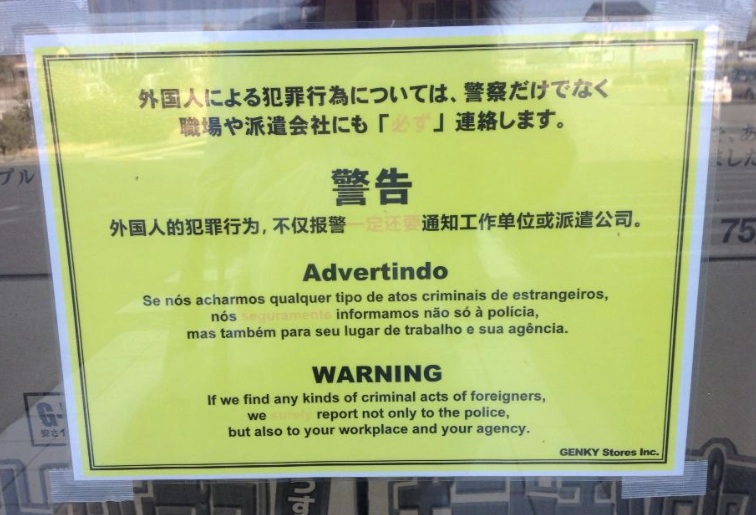
“WARNING If we find any kinds of criminal acts of foreigners, we SURELY report not only to the police but also to your workplace and your agency.” – GENKY Stores Inc (a drugstore in Kani-shi, Gifu-ken, dated February 28, 2013, taken by HSD, courtesy of shared links on Facebook through SM)
by Robert Moorehead
Arudō Debito posted the above picture on his blog, debito.org, as another example of the persistent stereotype that connects foreigners with crime. As other posts on my blog have shown, this stereotype is not unique to Japan and is inaccurate. Simply put, foreigners are no more likely to commit crime than the native-born are. Debito’s blog points out that instances of shoplifting are increasing in one demographic group: elderly Japanese are committing shoplifting in increasing numbers. However, their crimes are often depicted in much nicer ways, as crimes of loneliness.
As a foreign resident of Japan, shouldn’t I also be on the lookout for crime? And shouldn’t I be looking out for all crime, and not just the tiny percentage committed by the country’s tiny foreign population? If non-Japanese are less than two percent of the population, shouldn’t we really be focusing on the other 98 percent? Something tells me they’re committing way more crime. Drawing on the Occupy Movement, maybe foreigners’ rallying cry should be “We are the 98 percent.”
When I lived in the city of Kasugai, in Aichi prefecture, most homes in my quiet suburban neighborhood were decorated with crime-watch signs in Chinese. The fact that there was no crime wave, Chinese or otherwise, was irrelevant, as was the fact that this supposed threat made up only 0.5 percent of the city population. Rumor had it that years earlier, someone had their home had broken into, and the alleged perpetrator was Chinese.
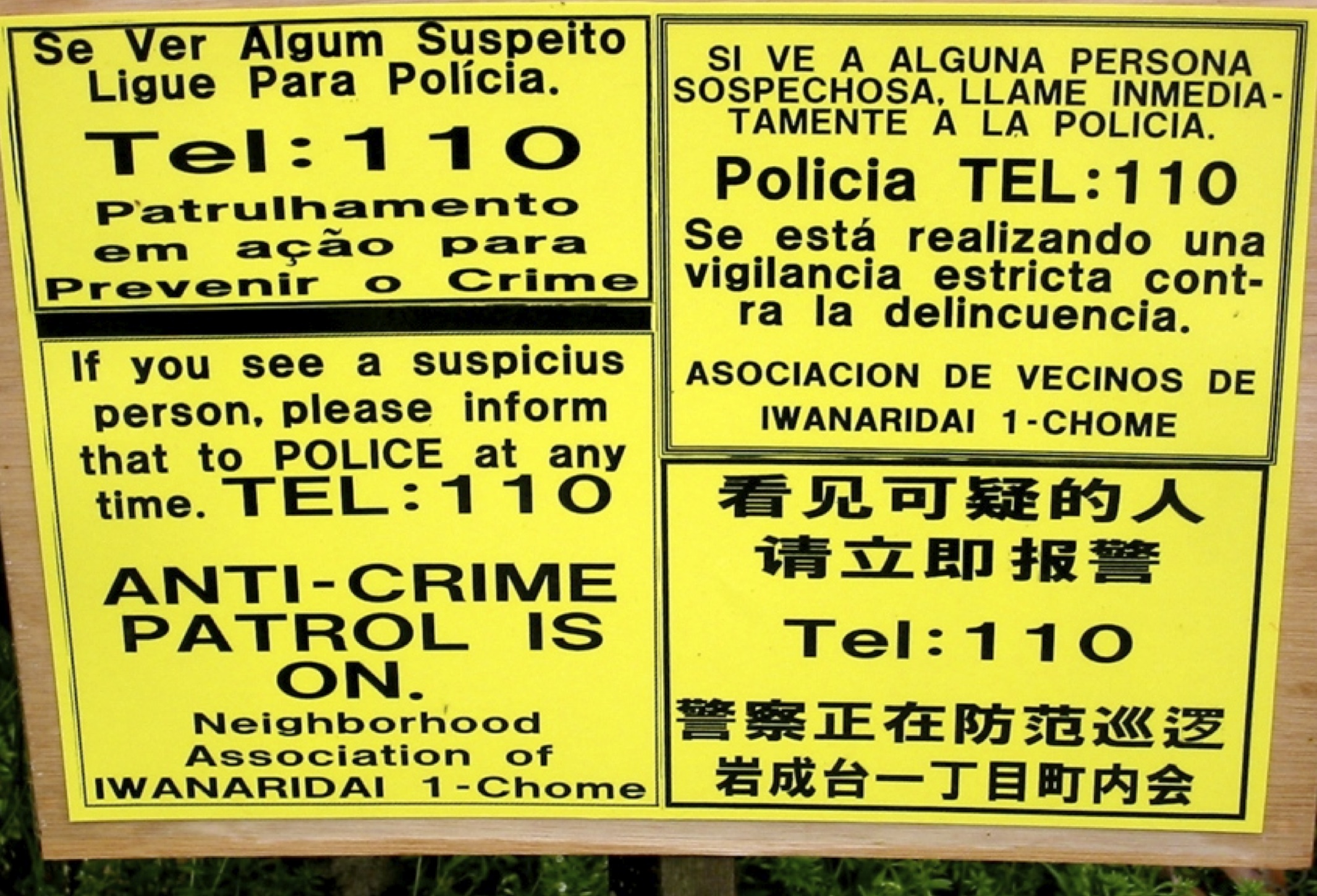
Following the logic that if one is guilty, all must be guilty, many homes in Kozoji New Town were festooned with signs in Chinese from their neighborhood associations, warning that residents would report anyone who looked suspicious (and Chinese) to the police. While an occasional sign was in Japanese, most were not. The enterprising neighborhood association of Iwanaridai cast a broad net over most foreigners in the area, putting up crime multilingual watch signs in Portuguese, Spanish, Chinese, and English.
Beyond perpetuating stereotypes that foreigners are somehow more likely to commit crime, these signs equate not being Japanese with crime and being Japanese with being law-abiding. They warn Japanese to be on the lookout for foreigners, and they warn foreigners that they’re being watched. They’re also an affront to our (shared?) humanity.
Update: The issue has prompted a video response on YouTube:
Last year, I published a chapter in the book Language and Citizenship in Japan. The fine folks at Routledge released the book in hardcover and Kindle formats, and now we’d like to see the book in paperback. Why? Because the hardcover book costs $116, and the Kindle edition $100. Only libraries will purchase the book at that price, and I’d like to see the book on more people’s shelves. We do this work not for book royalties, but to spread and share ideas.
Routledge generally sells paperbacks at a fraction of the the cost of hardcovers, and a paperback edition would likely bring the price of the Kindle edition down, also. The lower the price, the more likely people will buy the book and order it for classes—and the more our ideas will be part of the debates.
To get the magic paperback edition released, Routledge first needs to sell 200 copies of the hardcover. We can get there if more libraries purchase the book. So, if your library doesn’t already have it, then please encourage them to order it. This link gives you the information your library will need to order the book from Routledge: http://www.routledge.com/books/details/9780415897228/
Here’s a blurb about the book:
The relationship between language and citizenship in Japan has traditionally been regarded as a fixed tripartite: ‘Japanese citizenship’ means ‘Japanese ethnicity,’ which in turn means ‘Japanese as one’s first language.’ Historically, most non-Japanese who have chosen to take out citizenship have been members of the ‘oldcomer’ Chinese and Korean communities, born and raised in Japan. But this is changing: the last three decades have seen an influx of ‘newcomer’ economic migrants from a wide range of countries, many of whom choose to stay. The likelihood that they will apply for citizenship, to access the benefits it confers, means that citizenship and ethnicity can no longer be assumed to be synonyms in Japan.
This is an important change for national discourse on cohesive communities. This book’s chapters discuss discourses, educational practices, and local linguistic practices which call into question the accepted view of the language-citizenship nexus in lived contexts of both existing Japanese citizens and potential future citizens. Through an examination of key themes relating both to newcomers and to an older group of citizens whose language practices have been shaped by historical forces, these essays highlight the fluid relationship of language and citizenship in the Japanese context.
It’s an excellent book, with engaging chapters written by leading scholars that are appropriate for general and academic audiences. If I weren’t already in the book, I’d definitely buy it—in paperback. And if my library didn’t have it, I’d push them to order it.
I’ll avoid for now any existential whinging about the fact that we can’t even sell 200 copies of a fine book. It’s depressing, and I’d rather not think about it. But this is a reflection of the tight market for academic books, where good books don’t get ordered because of shrinking budgets. Less expensive editions of books don’t get published because the more expensive editions didn’t sell, thereby discouraging people even more. It’s a downward spiral. But we can try to stop this downward trend by promoting each others’ books, and by gently nudging our librarians toward the texts that we want to read.
Miki Dezaki, who first arrived in Japan on a teacher exchange program in 2007, wanted to learn about the nation that his parents had once called home. He taught English, explored the country and affectionately chronicled his cross-cultural adventures on social media, most recently on YouTube, where he gained a small following for videos like “Hitchhiking Okinawa” and the truly cringe-worthy “What Americans think of Japan.” One of them, on the experience of being gay in Japan, attracted 75,000 views and dozens of thoughtful comments.
Dezaki didn’t think the reaction to his latest video was going to be any different, but he was wrong. “If I should have anticipated something, I should have anticipated the netouyo” (spelling corrected from original post), he told me, referring to the informal army of young, hyper-nationalist Japanese Web users who tend to descend on any article — or person — they perceive as critical of Japan.
But before the netouyo put Dezaki in their crosshairs, sending him death threats and hounding his employers, previous employers and even the local politicians who oversee his employers, there was just a teacher and his students.
Dezaki began his final lesson with a 1970 TV documentary, Eye of the Storm, often taught in American schools for its bracingly honest exploration of how good-hearted people — in this case, young children participating in an experiment — can turn to racism. After the video ended, he asked his students to raise their hands if they thought racism existed in Japan. Almost none did. They all thought of it as a uniquely American problem.
Gently, Dezaki showed his students that, yes, there is also racism in Japan. He carefully avoided the most extreme and controversial cases — for example, Japan’s wartime enslavement of Korean and other Asian women for sex, which the country today doesn’t fully acknowledge — pointing instead to such slang terms as “bakachon camera.” The phrase, which translates as “idiot Korean camera,” is meant to refer to disposable cameras so easy to use that even an idiot or a Korean could do it.
He really got his students’ attention when he talked about discrimination between Japanese groups. People from Okinawa, where Dezaki happened to be teaching, are sometimes looked down upon by other Japanese, he pointed out, and in the past have been treated as second-class citizens. Isn’t that discrimination?
“The reaction was so positive,” he recalled. For many of them, the class was a sort of an a-ha moment. “These kids have heard the stories of their parents being discriminated against by the mainland Japanese. They know this stuff. But the funny thing is that they weren’t making the connection that that was discrimination.” From there, it was easier for the students to accept that other popular Japanese attitudes about race or class might be discriminatory.
The vice principal of the school said he wished more Japanese students could hear the lesson. Dezaki didn’t get a single complaint. No one accused him of being an enemy of Japan.
That changed a week ago. Dezaki had recorded his July classes and, last Thursday, posted a six-minute video in which he narrated an abbreviated version of the lesson. It opens with a disclaimer that would prove both prescient and, for his critics, vastly insufficient. “I know there’s a lot of racism in America, and I’m not saying that America is better than Japan or anything like that,” he says.
Also on Thursday, Dezaki posted the video, titled “Racism in Japan,” to the popular link-sharing site Reddit under its Japan-focused subsection, where he often comments. By this Saturday, the netouyo had discovered the video.
“I recently made a video about Racism in Japan, and am currently getting bombarded with some pretty harsh, irrational comments from Japanese people who think I am purposefully attacking Japan,” Dezaki wrote in a new post on Reddit’s Japan section, also known as r/Japan. The critics, he wrote, were “flood[ing] the comments section with confusion and spin.” But angry Web comments would turn out to be the least of his problems.
The netouyu make their home at a Web site called ni channeru, otherwise known as ni chan, 2chan or 2ch. Americans familiar with the bottommost depths of the Internet might know 2chan’s English-language spin-off, 4chan, which, like the original, is a message board famous for its crude discussions, graphic images (don’t open either on your work computer) and penchant for mischief that can sometimes cross into illegality.
Some 2chan users, perhaps curious about how their country is perceived abroad, will occasionally translate Reddit’s r/Japan posts into Japanese. When the “Racism in Japan” video made it onto 2chan, outraged users flocked to the comments section on YouTube to attempt to discredit the video. They attacked Dezaki as “anti-Japanese” and fumed at him for warping Japanese schoolchildren with “misinformation.”
Inevitably, at least one death threat appeared. Though it was presumably idle, like most threats made anonymously over the Web, it rattled him. Still, it’s no surprise that the netouyu’s initial campaign, like just about every effort to change a real-life debate by flooding some Web comments sections, went nowhere. So they escalated.
A few of the outraged Japanese found some personal information about Dezaki, starting with his until-then-secret real name and building up to contact information for his Japanese employers. Given Dezaki’s social media trail, it probably wasn’t hard. They proliferated the information using a file-sharing service called SkyDrive, urging fellow netouyu to take their fight off the message boards and into Dezaki’s personal life.
By Monday, superiors at the school in Japan were e-mailing him, saying they were bombarded with complaints. Though the video was based almost entirely on a lecture that they had once praised, they asked him to pull it down.
“Some Japanese guys found out which school I used to work at and now, I am being pressured to take down the ‘Racism in Japan’ video,” Dezaki posted on Reddit. “I’m not really sure what to do at this point. I don’t want to take down the video because I don’t believe I did anything wrong, and I don’t believe in giving into bullies who try to censor every taboo topic in Japan. What do you guys think?”
He decided to keep the video online, but placed a message over the first few sentences that, in English and Japanese, announce his refusal to take it down.
But the outrage continued to mount, both online and in the real world. At one point, Dezaki says he was contacted by an official in Okinawa’s board of education, who warned that a member of Japan’s legislature might raise it on the floor of the National Diet, Japan’s lower house of parliament. Apparently, the netouyu may have succeeded in elevating the issue from a YouTube comments field to regional and perhaps even national Japanese politics.
“I knew there were going to be some Japanese upset with me, but I didn’t expect this magnitude of a problem,” Dezaki said. “I didn’t expect them to call my board of education. That said, I wasn’t surprised, though. You know what I mean? They’re insane people.”
Nationalism is not unique to Japan, but it is strong there, tinged with the insecurity of a once-powerful nation on the decline and with the humiliation of defeat and American occupation at the end of World War II. Japan’s national constitution, which declares the country’s commitment to pacifism and thus implicitly maintains its reliance on the United States, was in some ways pressed on the country by the American military government that ruled it for several years. The Americans, rather than Japan’s own excesses, make an easy culprit for the country’s lowered global status.
That history is still raw in Japan, where nationalism and resentment of perceived American control often go hand-in-hand. Dezaki is an American, and his video seems to have hit on the belief among many nationalists that the Americans still condescend to, and ultimately seek to control, their country.
“I fell in love with Japan; I love Japan,” Dezaki says, explaining why he made the video in the first place. “And I want to see Japan become a better place. Because I do see these potential problems with racism and discrimination.” His students at Okinawa seemed to benefit from the lesson, but a number of others don’t seem ready to hear it.
Here’s my response: I applaud Dezaki-sensei for his efforts to raise students’ awareness of issues of racism and discrimination in Japan. In my classes at Ritsumeikan, I’ve found students very open to learning about Japan’s modern history, of which they are unfortunately often ignorant. Students have told me that they have gone home after class and asked their parents about the Burakumin, Zainichi Koreans, and other groups. The fact that many of these students grew up in the Kansai area, which is home to many Burakumin and Zainichi, shows how students in high school are not being taught even local history, let alone national history. Of course, many of my students also pass as mainstream Japanese, preferring to conceal their ethnic ancestries rather than constantly out themselves as non- or mixed-Japanese.
As for present-day issues of discrimination, we should not confuse the absence of slurs with the acceptance of minorities. Buraku children still face low expectations and stereotypes from teachers. They are also less likely to attend high school, to graduate from high school or university. They are also more likely to receive government welfare benefits. Plus, groups such as the Zainichi, South Americans, Chinese, and Filipinos routinely face discrimination in employment, education, and other realms of social life. Much of this happens discretely, but it still happens. And let’s not forget the right-wing sound trucks and Zaitokukai protests against Zainichi and other non-Japanese.
I also applaud Desaki-sensei for bravely not giving in to the netouyo. Like Desaki, I’m an American teaching in Japan and I consider this place home. And just like sometimes you have to tell to a friend or family member something they don’t want to hear, Japan needs to hear about problems it would rather ignore. As a country with the third-largest economy and tenth-largest population in the world, Japan is not a child that needs to be protected. It can handle the truth, even if the netouyo would rather avoid it.
The parents of a 13-year-old Pakistani junior high school student in Takamatsu have filed a criminal complaint with police, accusing their son’s classmates of bullying and injuring him.
A male Pakistani student at a public junior high school in a town in Kagawa Prefecture was bullied and seriously injured by his classmates, his parents alleged in a complaint filed on Feb. 18 with prefectural police.
The parents requested on the same day that the town’s board of education investigate the case and take measures to prevent a recurrence as they claim the student has been racially abused by four of his classmates since last spring. However, the education board denies bullying took place at the school.
According to the parents who held a news conference, the student was verbally bullied about the color of his skin by four of his classmates ever since he entered school last April. The parents claim that the students would make racist comments that their son’s skin was “dirty” and that they told him to “go back to his home country.”
The student was also physically bullied repeatedly by his classmates. Last November, one of the four classmates tripped him over when he was running in the hallway, severely injuring his legs and face. Since that incident, the student reportedly has to use crutches to walk.
The student’s 41-year-old father said, “We asked the homeroom teacher and vice principle multiple times to improve the situation but they failed to take any action.”
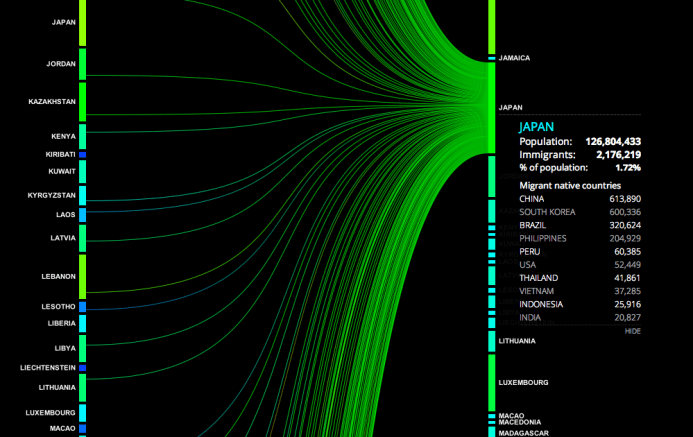
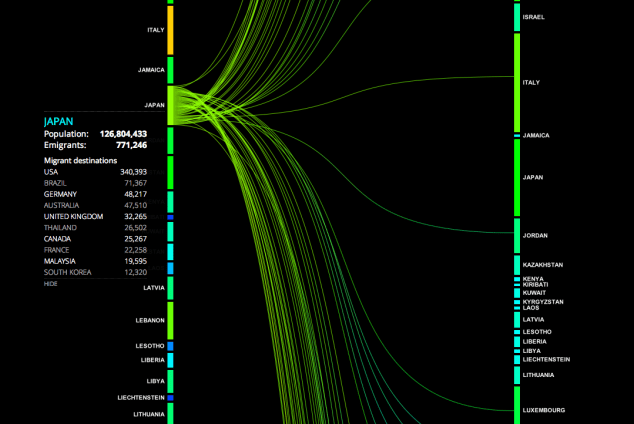
This is a short post that’s a heads-up to check out the site peoplemov.in, which provides visualizations of global migration. You can see data from 2010 on emigration and immigration flows for countries around the world. (Clicking on the pictures in this post will take you to the site.)
Migration into Japan
The top five source countries for immigrants to Japan are China, South Korea, Brazil, and the Philippines, and Peru. For Japanese emigrants, the site shows the top five destinations are the US, Brazil, Germany, Australia, and the UK.
I’ll leave the debate as to whether those “in-migrating” are “immigrants” or something else for another post. For now, emigrants are those going out, and immigrants are those going in. I know many in Japan say that Japan is not a country of immigration, and thus has no immigrants. Rather, it has “foreign workers,” “migrant workers,” dekasegi, etc. “A rose by another other name would smell as sweet.”
As we studied about the undocumented immigrants, I learned that there are various kinds of undocumented immigrants in the world. Firstly, undocumented immigrants in Japan and the current situation of illegal entrance to Japan will be described. Secondly, undocumented immigrants in the United States and the current situation of the country will be described as well. Thirdly, solutions for illegal entrance and the conclusion will be written. This essay focuses on undocumented immigrants who were brought to other countries when they were children
The number of undocumented immigrants in Japan is increasing and in 2008, there were over 20 thousand illegal immigrants. There are many illegal immigrants whose visa had expired and overstaying in Japan, however, in recent years, the number of immigrants who entered the country with fake passports are increasing. As we learned about the case of “Noriko” whose parents were from the Philippines and used fake passports to get in the country in order to have better lives in Japan, we need to rethink how difficult it is for undocumented children to deal with the problem.
There are over a million people who are entering in the United States illegally per year and its 80 % are from Mexico. As I lived in Southern California for a year, I know some undocumented people who are from Mexico. One of my classmates was child when she came to America and she did not have any idea that she was undocumented until she applied for a driver’s license. I did not have much knowledge about illegal immigrants at that time; however, I realized that this is one of the most serious problems in the United States. I could not do anything for her and it was depressing for both of us. When I studied about undocumented children in the class, I instantly thought of her. I learned that there are many undocumented children like her in the United States and they are dealing with the problems that were caused not by their choice.
In order to reduce the number of illegal immigrants, as for Japan, since it is not connected with any other countries by land, I think it is important to strengthen passport check at the airport because most of undocumented people who intentionally enter Japan illegally have fake passports. I do not know how it is difficult to make fake passports or to recognize them; however, I think it is the fastest and easiest ways to eliminate illegal entrance to Japan.
As for the United States, I think it is more difficult to decrease the number of undocumented immigrants because it is next to other countries like Mexico and Canada. People could just walk or drive illegally into the United States. In order to decrease the number of illegal immigrants who enter the nation from neighbor countries, the government should double the guards of border crossing. I think this is the only solution to eliminate illegal entrance to the U.S.
The biggest problem of all is that how should the government treat the undocumented people who entered the country when they were children and brought to another country by their parents choice. I personally think that the governments should give some kind of legal status to the children because they did not have any idea when they were brought to the other countries. Some people might say that this system increase the number of undocumented immigrants in order to provide their children with legal status, however, I do not think there are better solution for undocumented children. I think they have the right to live equally and right to receive the opportunities in order to enjoy their lives.
“Issue of undocumented immigrant” – the American society is now facing with this problem. In this paper, I focus on this “undocumented immigrant problem” of America at first, and then consider the situation in Japan compared with the United States.
In America today, 11.2 million undocumented immigrants are estimated to live in the country. It includes the largest number is Hispanics, Asians, Muslims and Europeans. It is the problem whether people view undocumented immigrants in a positive or negative way. People who affirm claim that undocumented immigrants are an important part of the U.S. society’s workforce even though they are “illegal.” In fact, many workers who work on a large farm are undocumented immigrants who come from Mexico and some other countries. While on the other hand, people who oppose argue that undocumented immigrant could disturb the social order, concerning that American citizens have to pay for undocumented immigrant’s medical-care cost or unemployment insurance, or undocumented people deprive American citizen of their employment opportunity. Also, it is the problem that young generation of “undocumented immigrant” are innocent because they were brought to the country by their parents.
The problem about undocumented immigrant was a controversial issue in the recent U.S. presidential election, in which Obama was reelected.
The undocumented immigrant’s issue about what to do with their visa status has been the one of big tasks of American politics. In the previous presidential election, Obama made a granting of a path to legal status for undocumented youths a campaign promise, and has been aimed to realize the enactment of the DREAM Act. However, the DREAM Act is still invalid because of the criticism from the opposition Republicans. Therefore, last June (before the election), Obama announced a new policy of undocumented immigrant. He took measure to grant temporary residential status to undocumented youths by executive order, which does not require congressional action. Young undocumented immigrants can get the status if they come to America before age of 16 years; are 30 or younger; have lived in America since 15 June 2007; graduated from or are currently in high school, or are an American soldier; have no previous records of committing crimes. It is presumed that about 0.8 to 1.7 millions of undocumented youths would be blessed with this new policy. In the recent election, Obama did not directly win the vote from them as they did not have the vote right.
However, he gained support from Hispanic-American those close to undocumented people. According to New York Times report, 71% of Hispanic-American voted for him. Attention is currently focused on future moves of Obama administration.
In contrast to sign of improvement of undocumented immigrant in the U.S., Japan’s situation is getting worse. On July 9, 2012, foreign resident registration system was abolished, due to the revision of the immigration law. Legal residents get “resident card”, meanwhile, illegal residents cannot gain it. There is fear that undocumented residents become lack of access to essential administrative services without public identification. Also, it will become more difficult for them to find employment. A Ministry of Justice view these detriments as natural result because law revision is to regulate illegal stay.
It is surprising to see the difference about policy toward undocumented people between the United States and Japan. Even though America is nation of immigrant and Japan is not, Japanese policy seems to me too harsh for those people. Illegal residents in Japan are undeniably labors who prop up the Japanese economy. Therefore, Japanese government should offer minimum services (education to medical treatment and social insurance).
References
27 November, 2012. Education Week. “Undocumented Youths Will Not Be Deported”. http://blogs.edweek.org/edweek/learning-the-language/2012/06/undocumented_youths.html
7 November, 2012. New York Times. “A Record Latino Turnout, Solidly Back Obama and Wield Influence”. http://www.nytimes.com/2012/11/08/us/politics/with-record-turnout-latinos-solidly-back-obama-and-wield-influence.html?_r=0
6 July, 2012. The Japan Times. “New Rules Put Scare Into Illegal Immigrants”. http://www.japantimes.co.jp/text/nn20120706f1.html
In the US, there are 1.2 million illegal migrants. 70% of them came from Mexico and other Latin American countries to earn better wages. In the class, especially we’ve learned about undocumented migrants who were brought by parents when they were children.
They go to local school and learn local language. They grow up same as other children. However, they notice the fact that they are undocumented migrants when they need identification. They can’t drive because they can’t get driver’s license. They can’t go abroad because they can’t get passport. Also, sometimes they can’t get job because of the lack of identification.
There are two opinions about undocumented migrants. One opinion affirms the stay of undocumented migrants because they contribute to the development of the country as one people. Also, these migrants didn’t commit a crime. They were just brought by parents. The other opinion denies the stay of undocumented migrants because they increase the country’s burden of social security. Also, admitting the stay of undocumented migrant would promote the illegal immigration.
The U.S. president Obama is the former. He declared “DREAM act” which helps undocumented migrants. This law admits less than 30 year-old undocumented migrants who were brought by parents when they were less than 16 years old. They have to be enrolled or graduated from high school in the US, and also they mustn’t have been arrested. If this law is carried out, these undocumented migrants won’t be forced repatriation in two years.
I agree with “DREAM act”, because these migrants should be admitted as American. In Japan, there are many Korean residents. After the WWII, many Korean people smuggle themselves into Japan to escape from the fires of the Korean War. Their descendants go to Japanese school, and grow up as Japanese. I have many such friend, however, I can’t distinguish whether they are Korean or not until they tell it to me because they are totally Japanese. I think environment where they grow is the most important matter when we think about identity, because people can grow up only by being influenced by the environment. They learn their language, common sense, culture, and behavior by the environment. Only the environment can makes people’s character. Therefore, even if the parents are illegal migrants, their children shouldn’t treat as illegal, and they should be given the right to reside.
Today, migration is becoming a serious problem that is unavoidable. In Japan, that problem barely has been spoken about because the Japanese government has taken a restricted approach to immigrants for a long time, but this Japan’s case is relatively rare compared with other countries. For example, in the case of the US, this country consists of immigrants from a historic point of view, and now the US is facing that problem. As we can see the election, the immigrant’s problem was an important issue, and eventually Obama showed citizens a tolerant policy, but the problem concerned with American unemployed remains there. Japan will be facing this problem as well as the US. In that case, I think Japanese government should take more immigrants. I am going to argue that reason in the next paragraph.
First of all, I’d like to see the present Japan’s situation. Some companies changed an official language from Japanese to English, and also are about to adopt more foreigners. That means they have to spread the market to global areas, so they decided to take more foreigners and bring up global people who are having recent widespread values. This may be the time to be ought to accept more immigrants. However, that is not easy because there is a problem about unemployed as well, and the population is occupied by almost all the same race, Asian. That’s because Japanese still keep having a thing like a single nationalism, and also they have a prejudice against foreigners because many crimes by them are often taken up by the media, but Japanese should understand that is a merely part of all of crimes.
On the other hand, I believe immigrants give us some benefits such as, different values, ways, thoughts and something. Japanese absorb these factors, and should be more tolerant toward everything that happened in the world, but that does not mean all of immigrants can be admitted by the government because Japan has a capacity, so has to choose. Concretely it’s better to do the test to confirm their abilities, for example, communication ability, mathematics, flexibility and something moral. This way will be able to relate to their motivation.
From these reasons, Japanese government should accept more immigrants, but it can be gradually carried out because it’s an important issue, so they need do think a system seriously. Also, successful applicants will be acquired to be motivated, and if possible experienced. I think this way I mentioned above will be able to lighten Japanese future.
In March 11, 2011, a huge earthquake and tsunami occurred and wide range of Tohoku was damaged. Those damages were mostly due to the enormous tsunami, but there was another big problem. It is the Fukushima Daiichi nuclear disaster. It was a series of equipment failures, nuclear meltdowns, and releases of radioactive materials at the Fukushima 1 Nuclear Plant, after the disaster of Tohoku earthquake and tsunami. It is said that it is the largest nuclear disaster since the Chernobyl disaster, which happened in 1986. Because of this nuclear problem, anti-nuclear movements occurred not only in Japan, but also in all over the world. People all over the world once again recognized the danger of the nuclear plants and the risk that they have toward citizens. On March 12, 2011, about 60,000 Germans lined up on the street, forming a human chain that is about 45-km long, from Stuttgart to the Neckarwestheim power plant. Also, on March 14, 2011, about 110,000 people protested in 450 German towns. During this social movement, opinion poll was conducted and it indicated that 80% of Germans opposed the extension of nuclear power by the government. There are many other anti-nuclear social movements all over the world, such as the ones by 2,000 anti-nuclear protesters in Taiwan and Switzerland. Of course, this is only few cases of anti-nuclear movements, and there are a lot other ones also around the world.
Although the fact that this many people all over the world protest against nuclear power plants, the reality is that we need to depend on nuclear power. That is because it is able to generate big amount of power and if we are not able use nuclear power, there might be a lack in power. Right now, all the nuclear plants in Japan are stopped, but it took long time to stop it, because Tokyo Electric Power Company hesitated to stop it.
I think that almost all the people around the world oppose or have a negative image towards nuclear power plants. However, it seems like those voices are weaker than government’s and companies’ voices, despite the fact that there are way more number of people. Since government and big companies have authorities and powers, it may be a natural thing. However, it is very unfair because unclear power problem is an issue that is deeply related to our life. So I strongly think that our voices need to be heard more. And I hope that government, electric power companies, and other top authorities will compromise and work together with citizens, and we all should seek for our bright future.
References
The New York Times March 8 2012, “Japan’s Nuclear Energy Industry Nears Shutdown, at Least for Now” http://www.nytimes.com/2012/03/09/world/asia/japan-shutting-down-its-nuclear-power-industry.html?ref=energyandpower&_r=0
BBC News, March 26 2011, “Germany stages anti-nuclear marches after Fukushima” http://www.bbc.co.uk/news/world-europe-12872339


 JAPANsociology