Social Movement in Japanese Society after March 11

After March 11 crippled nuclear power plant accidents in Fukushima, there have been many social movements against nuclear power plants. On September 19, about 50000 people gathered in Tokyo for antinuclear demonstration. It was the largest demonstration since the 1960’s when the students’ activities against Anpo (Treaty of Mutual Cooperation and Security between the United States and Japan) occurred. Not only this demonstration, there are many movements of farmers who had big damage on their products, and mothers who live around crippled nuclear power plant who are afraid of the effect of radiation on their children. However, it seems that these demonstrations attract little attention, and have little effect on government’s policies so far. Why have these demonstration not been successful enough to change the Japanese society which heavily relies on nuclear energy and is facing a crucial moment to think about our energy policy in the future?

Some people argue that Japanese society has less characteristic which try to change society with demonstration. Basically people leave their decision to upper class people such as politicians and obey them. There is little initiative that trying to change the society compared to other country such as U.S and European countries. Is it true? Yes, actually Japanese people tend to rely on decision of politicians and obey it. But, after the massive earthquake and tsunami which caused serious nuclear accident, and under the situation which we are facing fears of radiation from nuclear power and government unable to progress policies on compensations for victims and new energy policy, lots of Japanese people feel the neediness of some kinds of big change in our society.

I think the first reason why these social movements have not been successful in Japanese society is these movements fail to involve people who live far away from crippled nuclear power plant. Around the nuclear power plant such as Fukushima, Ibaraki, antinuclear power plant is growing because they live with some fear of radiation every day. However, we cannot see such movements in Osaka, Kyoto, and Kagoshima where is more than 1000 kilometers away from Fukushima. Since we do not have nuclear power plants close to our town, we do not care about radiation so much. Maybe most Japanese people who live away from Fukushima think like that. Furthermore there is some ironical fact. Although farmers around Fukushima nuclear power plant had big damage on their products, farmers far away from Fukushima such as Kyushu area had some advantage, because they had more demand for their products after the nuclear power plants accidents in Fukushima. Therefore, even people around Fukushima make demonstration for stopping nuclear power plants, they will attract little attention from people who do not have to care about radiation so seriously now. Of course, even if people who do not live around Fukushima, this accident is very crucial for them. We do have lots of nuclear power plants all over the Japan, and also there is possibility that we have big earthquake which can cause serious accident like Fukushima nuclear power plant. Nuclear power plant does matter for all of Japanese people. So, people who are taking part in antinuclear demonstrations have to take some actions not only in Tokyo but also in Osaka, Kagoshima where people less fear about radiation. For instance, they can hold some lectures on how nuclear accident had changed their life and what we need to in our society. It will be necessary that social movement makes all people concerned and aware that this accident is very crucial for all of us and have to take some actions.

In addition to the lack of involvement of people, I also think the goal of these demonstrations is vague. Though lots of people are taking part in demonstrations for expressing their anger caused from nuclear accidents, their goal is diversified so far. Farmers are demonstrating against Tepco for compensating its damage from radiation. Residents who had lived around nuclear power plant are demonstrating against government for guaranteeing their shelter. Currently many people are holding demonstration in a different ways based on their interests. However, to make demonstration successful, they have to corporate with each other and they have to make clear one goal of the demonstration. If people make one big demonstration which people who have different interests gather together and have a clear goal for them, it is more probable that antinuclear demonstration will be successful.

The key thing to make the social movement successful is to involve all people concerned and make clear one goal for them. If we can achieve it, antinuclear movement will be successful and be able to change our society.

by Shunsuke Ochi

Muslim in America, Muslim in Hip Hop

It is said that in some parts of America, people got to recognize Muslim people as a habitant having evil and dangerous trait after 9/11. Then many Muslim people still hold unclear feeling due to this America’s ‘change’.

However, there are also some conscious men who are against this current situation. According to the first article, one Muslim American rapper (23), who “went through their adolescence and early adulthood post-9/11”, “speaks about his personal struggles and the political and social issues that resonate in him the most.” He tries to change people’s wrong recognition of Muslims through hip-hop music, which history was also shaped in confronting racial, social and political injustice.

‘Capital D’ is a Chicago rapper who criticizes America with the modern capitalism and the war in Iraq. He said that recently American Muslims has been taking hip-hop music into their culture, and that ‘Islam hip-hop’ is very young in its process. However as he says, I think this movement will be expanding more.

Today, many Muslim rappers succeeded in surviving through the game of hip-hop, and the number of them has been increasing. Lupe Fiasco is one of them.

Lupe (Wasalu Muhammad Jaco), a conscious rapper from Chi-town, is very explicit to proclaim that he is Muslim and talks lots of things how he thinks about Islam. In his song“Words I Never Said” (2011), he emphasizes “Murdering is not Islam!” to make people change their conception about Islam. He also criticizes (Muslim?) people who don’t take their voice out to say the truth, saying;

Now you can say it ain’t our fault if we never heard it.
But if we know better than we probably deserve it.

Since his debut in 2006, Lupe has cemented his position in hip-hop with his incredible lyrical skill. Now, he became the representative of Muslim in America and hip-hop, and became the voice of them. I’m sure we can say that hip-hop, to some extent, made it possible for American Muslims to state their social and political intentions.

This culture called hip-hop seems to have a very unique religious perspective. It has a root in Gospel, at the same time; it had a great influence of Nation of Islam and also had important support by Jewish people to become economically independent. I think this trait made it possible for Muslim people to fight the situation through hip-hop. The main thesis of hip-hop, I guess, is to do the right thing. This means to tell people the truth, removing all the inconsistency, with positive vibration.
Reading each report, I feel that Muslim are fighting their situation in America through hip-hop.

by Yuki Atsusaka

References

Madeline, D. (2010, August 17). Muslim American rapper growing up in post-9/11 America. Common Ground News Service.
Retrieved November 30, 2011, from
http://www.commongroundnews.org/article.php?id=28315&lan=en&sp=0

n.d. (2005, November 24). Muslim rappers combine beliefs with hip-hop. Associated Press.
Retrieved November 30, 2011, from
http://today.msnbc.msn.com/id/6576281/ns/today-entertainment/t/muslim-rappers-combine-beliefs-hip-hop/

n.d. (n.d.). 10 Most Successful Muslim Rappers. Islamoblog.
Retrieved November 30, 2011, from
http://islamoblog.blogspot.com/2008/11/10-most-successful-muslim-rappers.html

What are the Responsibilities of Developing and Developed Nations for World Wide Environment?

On December 11, COP 17 (the 17th Conference of the Parties to the U.N. Framework Convention on Climate Change), which was held in Durban, South Africa ended with little outcome. Since Kyoto Protocol which requires developed nations to cut green house gas emissions will be expired by 2012, it was supposed to be made new framework to reduce green house gas emissions in this conference. (Actually, COP started negotiating new framework from several years ago, but it failed to settle in one conclusion.) However, they concluded that they will extend the Kyoto protocol with several revisions, and they will start a new framework which involves the U.S and China by 2020.

The most controversial issue among negotiating new framework was whether developing countries should have the responsibility to reduce emissions (Of course the involvement of the U.S was also controversial). Under the Kyoto protocol, the developing countries have no obligation to reduce emissions. However, since climate change, which probably caused by GHG emissions, has getting more visible and the necessity of cutting GHG has been growing, it is required to involve big developing countries such as China, India which do not have obligation so far but emitting many GHG. Responding to such requirement, China and India opposed to the new framework by saying that it would slow their economic growth. They also argued that since developed countries deteriorated worldwide environment, it is their responsibility to reduce it. So how can we make one solution?

To tell the truth, the amount of GHG emissions of countries, which have obligation under the Kyoto protocol, is only 26% of all emissions in the world. That means the much of GHG is emitted from other countries. Considering this situation, we cannot overlook the country which are emitting large amount of GHG without any obligation. But it is also true that a lot of developing nations are facing more severe environmental impact which is caused by GHG emissions. Developed nations have degraded the environment to grow its economy, and ironically developing nations have been facing more severe environmental damage than developed nations. We can stay without thinking about environmental effect from GHG emissions so much, however, some developing country are suffering from more environmental degradation such as sea water rising, which is threatening some whole nation, and sever climate change, which is spoiling its agriculture. Developing country is more vulnerable to environmental impact because of its weak economy and weak political system to tackle with. Therefore, we need to support them so that they can overcome these severe situations by offering knowledge and technologies, and of course we should have more responsibility to reduce GHG emissions to ease environmental degradation.

When the new framework is negotiated by 2020, the situation of world economy will be different from now days. It is possible that more developing countries will be a big economic country and have more impact on environmental degradation by emitting more GHG. It will be inevitable that such new big economical countries have obligation to reduce GHG emissions, however, developed country should have more obligation not just reducing more GHG but also supporting developing country by offering knowledge and technology so that we can create environmentally friendly country world widely.

by Shunsuke Ochi

Nation? Nationalism? Not necessary anymore?

Ernest Gellner (1983) defined nationalism as follows. “”Nationalism is primarily a political principle that holds that the political and the national unit should be congruent”. He argues nation or nationalism was invented merely because of a sociological necessity created by the birth of industrialisation. Since industrial economies continually make and put into practice technical and organizational innovations, rulers need homogeneous workers who share the same culture acquired by uniform education.

Likewise, Benedict Anderson (2006) argues nationalism or the sense of belonging to nation is just imagined. Nation is merely an imagined community, where people can feel the sense of unity with someone whom they will never meet. Nation was imagined as the movement to abolish the ideas of divine rule and monarchy, as well as the emergence of the printing press under a system of capitalism.

I apologise if I misled their arguments or my English above doesn’t really make sense, but I could find those books only in Japanese. Anyways, the important thing here is to recognise that nation or nationality is a modern creation (invention, imagination), thus it is not universal at all. I totally agree with those arguments. In Edo period of Japan, for example, no one would have recognised themselves as Japanese.

Nation or nationalism has been under severe criticism for a long time, since it has created horrible conflict between nations. Scholars tend to regarded nationalism as an inclusion of the people of the same culture, at the same time, an exclusion of the “different” people. For me, nationalism is not the best idea to represent a diverse range of people living within “nations”. However, liberal form of nationalism is necessary to maintain our democratic states (especially the welfare states). David Miller (1995) criticises both what he calls “conservative nationalism” and “radical multi-culturalism” and insists on the necessity of liberal nationalism. He argues that nation is a community comprised of people who wish to be self-determined politically. Individual identity is plural. For instance, I can call myself a Japanese person, but at the same time I am an Asian, a male, a baseball fan, a beer lover or whatever I wish to be. Nation is only one of those plural identities. What makes nation different from the other sources of identity is its political will to be self-determined. I agree with him in that without nation and nationalism, it will be much harder to achieve social justice (mainly redistribution of wealth) and individual liberty and the base of rights. Who would be willing to share the burden without common sense of unity?

In conclusion, we don’t have to blindly admire nation or nationalism, since it is a modern creation, invention or imagination. However, I think it is necessary to maintain liberal form of nationalism to some extent for our own sake. Probably.

by Yuki Sugiyama

Living With Family

    In Japan, almost people have an own family and many families also live together. It is happy for us to live with our families. On the other hands, there are many who take up posts in another city, leaving their families behind in their hometown too. I think that it is very sad even if they can meet frequently. However, in case of immigrants or migrant workers, they cannot meet them families for a long time. How do they feel like the situation.

     Actually, it will not be long before I become similar situation. One of my valuable person leave to Australia to study abroad. I fell very lonely just imagine about we will separated. Of course, we can make contact with each other on e-mail, and talk on the phone. If we use a videophone like skype, we can see our faces. It seems like to meet by the side of him. Although, the fact is we are still separated, so we cannot meet each other whenever we want and touch each other. The technologies take our mind off, but once we find the truth, it made us sadder. I want to beside him ever after.

     When we are separated from valuable people, just like families, we feel very miserable and miss them. I think that it is not enough for us to make contact or talk with the people. The more important thing is living with families. I am sure that almost all people want to live with valuable people, mother, father, brothers, sisters, lovers and so on. However, many immigrants and migrant workers are in difficult situation to live together because of strict regulation for them. The strict regulation need them too much money to get them visas, but it is hard for them, because they have only few money and no sponsors. That is why many of them cannot live with family. I know it is important to save safety and profit from visas. However, I also want to little revision the strict regulation, because families should live together if they want to do so. I wish the day coming soon.

by Erina Hayashi

What Made the Immigrants Youth Explode with the Anger? –about the 2005 riots in France

The 2005 riots in France were sparked by the deaths of two teenagers who were electrocuted during a police chase in the Paris suburb of Clichy-sous-Bois. Hundreds of youth roared with anger because a police chase had gone too far, and incited a riot that included attacking the police and vandalism in poor suburbs that were inhabited largely by immigrants from Maghreb, Algeria, and Morocco. Most of rioters were second generation Muslim immigrants. The riots had quickly spread to other towns. During the riots, more than 8973 cars were set on fire and 2888 people were arrested. In general, France was thought to tolerate ethnic minority. However, the riots forced France to confront the anger building for decades among Muslim immigrants who complain of discrimination and inequality.

After two world wars, France opened the door aggressively to greater numbers of immigrants with a great demand for labor, especially from Maghreb. Since the 1970s oil shock, however, its economic situation worsened and the government has started to support tighter immigration measures. Especially, since the 1980s extreme rightists have promoted anti-immigrants sentiments that claim that immigrants have a propensity for violent and that they steal jobs from French people. In addition, since the September 11th terrorist attacks, Muslim immigrants have been considered as a terror and people are concerned about public boundaries. Even though France has the largest Muslim population in Europe, the animosity regarding Muslim immigrants is increasing in the society.

Under the hostile circumstances towards immigrants, they feel socially isolated. The French government constructed housing projects in suburbs while increasing the immigrant population, but those areas became something of a ghetto where low-income immigrants live together. As the segregation between immigrants and mainstream society is becoming worse over time, they really feel frustrated economically and socially. Separating them from the society has led to discrimination and inequality against them. Immigrants who live in suburbs of Paris have, on average, lower incomes, education levels and employment rates than French people.

They are desperately underprivileged and outside mainstream society, and complaints and racial troubles caused by discrimination and inequality have been building up. Above all, while the second generation of Muslim immigrants who are born in France and are provided French education do not feel that they are belonging to a homeland, they cannot integrate into French society while being treated differently because they are an immigrant. It makes youth bear enmity towards French society. In the end, the deaths of two immigrant boys triggered the 2005 riots. They exploded with the anger of social and economical inequalities.

The French suburban riots in 2005 are painful moans and cries to be heard from immigrant youth who are the poorest and least powerful in French society. They have no hope or possibilities for the future in suburbs where youth unemployment, crime, and violence thrive. It is not just a problem in France. There have been similar riots across Europe, like in Greece, Italy and the UK. If immigrants are excluded from the mainstream of society and economically discriminated, riots will continue to occur. They should be accepted as real members of society and given fair opportunities and hope.


by Jeawon Moon

Immigration problem of decrease in the birthrate age in France ~Should Japan accept the immigration?~

  “Although I am disagreeable, there is only this.” The young man who caused the riot by the young men of immigration system of France was talking like this on television. To accept immigration in France starts age of independence of African countries. Why does France have much immigration? The answer is in history. After World War Ⅱ finished, the population decreased sharply. France government decided to accept a lot of immigration to solve worker insufficient problem. The cause which this riot broke out is an economical blunder of second and third immigration by Vietnam War and Algeria war of independence.

Immigration has great influence on the country. After World War Ⅱ finished, a lot of  black persons came to America and black culture was spread by them. Rhythm and blues, lap music and reggae became famous by them. In addition, after Vietnam War finished, a lot of the Puerto Rico system immigration came to New York and Salsa music was spread by them. If Japanese government decides to accept immigration, our culture may change. For example, many Japanese people may speak English fluently.

A decrease in the birthrate appears in advanced nations recent years and a main subject of many development countries government will be immigration problem like an American popular rights movement and the young man riot of France. According to the date “present condition of a decrease in the birthrate and future prospect” of National Institute of Population and Social Security Research, Japanese population of over age 65 will be 20 percent in 2006, it will be 25 percent in 2014 and it will be 30 percent in 2033. In the future, Japan will be the most age people around the world. Cultural communication will become important for Japanese people, because a decrease in the birthrate is progressing in Japan and immigration may be accepted in order to obtain workers. Do you think should Japan accept immigration more?

http://janjan.voicejapan.org/world/0511/0511115020/1.php


by Sunao Tanaka

The Homi housing development

In recent years, Japanese population is decreasing due to declining number of children, so there are many people who claim Japan should accept immigrants to get the workforce.  However, accepting immigrants have not only good points but also bad points.  For example, there are many problems between Japanese and Brazilian immigrants in the Homi housing development.

The Homi housing development was built in time of rapid economic growth in Toyota city in Aichi.  Many Brazilian came to Tokai district as immigrants, because there are many manufacturing industry such as auto industry in Aichi.  In 2010, about 9,000 people live there, and 4,000 of whom are Brazilian immigrants.  Many Brazilian has been lived there, so there are many posters which are written in Portuguese.  However, there are many problems which were caused by difference between Japanese culture and Brazilian culture.

Most of Japanese who live there claimed Brazilian people’s manner is very bad.  For example, illegal parking is increasing, they do barbecue at veranda, they often drink and make merry at night and so on.  Many Japanese said “Brazilian immigrants shouldn’t move into here anymore” because Brazilian behaviors make Japanese angry.  On the other hand, Brazilian also complained against Japanese who live there.  Of course, Japanese and Brazilian hope that the Homi housing development become comfortable place for them.

I think they should promote exchanges between Japanese and Brazilian.  Brazilian may not know about Japanese low, so they do illegal parking, and they may not know about Japanese culture, so they think “our manner isn’t bad.”  Japanese also should understand Brazilian culture to make good relation.  I think self-governing body have to hold exchanging party, and they can introduce each other’s culture there.  However, in case of this situation, I felt Brazilian immigrants need more effort to adjust Japanese life style.  There is a proverb such as “When in Rome do as the Romans do.”  They should not only tell about Brazilian culture but also learn about Japanese culture.  Now, most of Japanese approve accepting immigrants, but there are problems such as the Homi housing development.  Should we accept immigrants? What do you think?

by Mari Honda


Migrant Worker and Education in China

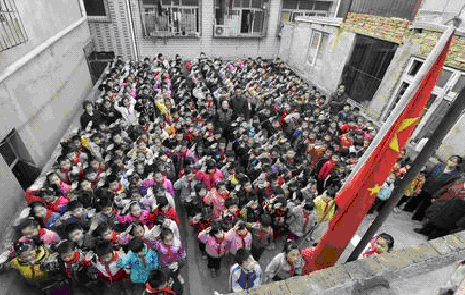
Do you recognize what it is? Many children are gathered at small rooftop, and the national flag of China is hoisted in front of them. People call it “the roof top elementary school”. There is no schoolyard, gym and even roof, but children study here every day. Many people are interested in the school.

This school is one of the elementary school for migrant worker. Children of migrant workers from farm village go to this school. This type of school always is in the big city in China, and children study under worse educational circumstance than public elementary school remarkably. The schoolhouse is a building which has four floors. There are many houses and buildings around the school, so it is difficult to find it. The entrance and door are narrow. The school has classrooms, dormitory, and lunchroom, but these are simple rooms which are for living. The schoolhouse is too small for 375 children to study.

Elementary schools for migrant worker in China are run differently, but the school that I told is a general type. It is said that their surrounding improved gradually. However big cities which continue economic growth need labor forces of migrant workers and security system do not reach to migrant workers and their children now. Elementary schools for migrant workers try to make interest of many people and get a lot of support. At present, the project of reconstruction of the elementary school which I told gets ahead surely. It needs three million yen or four million yen.

There are many children who want to study even under harsh condition like this school. My condition to study is not to be compared with them of children of migrant workers, so I think I have to study harder. I hope that reconstruction perfect safely and elementary school for migrant worker improves greatly.


reference:

http://hb.qq.com/a/20111124/000848.htm


by Ayako Ueda

Repatriation Program

Zainichi Korean (Korean Resident in Japan) has living in Japan since 1910.  In 1945, the emancipation of Korea from Japan after, a lot of Korean did back to motherland, however, about 600thousand Korean people had lived in Japan after emancipation.  They couldn’t went to motherland, because they don’t had a money what Korea – Japan ship had moved in a part of place, so they should needed go to where.  In 1948, two countries are found in Korean peninsula that is Democratic People’s Republic of Korea (D.P.R.K.) and Republic of Korea (ROK). They motherland was cut by cold war regime.

In 1954, D.P.R.K. government was announcement to Zainichi Koreans “You are our country citizen”.  At the next year, Chongryong (the General Association of Korean Residents in Japan) to be organization in Tokyo what support to D.P.R.K. as motherland.  In other side, some Korean made group of ROK supporting as motherland that is Mindan (the Korean Residents Union in Japan).  In 1965, ROK gave ROK citizenship to Zainichi Koreans by Treaty between ROK – Japan however, ROK did a few supports only to Zainichi Koreans.  D.P.R.K. was different.  D.P.R.K. sent money to Zainichi Korean for founding of Korean School.  And D.P.R.K. leader Kim Il-Sung encouraged repatriation to D.P.R.K.  A lot of Koreans had sympathy to D.P.R.K.  At the same time, Japan government disliked Korean, because they ware left wing and they had sympathy of communism.  GHQ (reigned over Japan for 1945 – 1951) had same opinion.

In 1959, D.P.R.K. – Japan negotiated on repatriation of Zainichi Korean, when D.P.R.K. and Japan agreed they opinion; Japan want removal Koreans, D.P.R.K. want manpower for country building. In this time, Repatriation Program was planning.  December 14th 1959, Ship of Repatriation departed from Nigata port that taken about 900 Koreans.  This time after, about 60thousand Zainichi Korean went back to “motherland”, however a lot of Zainichi Koreans real motherland was the present of ROK.  That was continued in 1980s.  Zainichi Korean had kept “Dream” and “Hope”, because D.P.R.K. government did statement “our country is a paradise on the earth”.  And, if they had continued living in Japan, they might have given discriminations from Japanese and Japan government.  Practice, a lot of Korean is giving discriminations from Japan.  In that situation, they thought dream and hope to D.P.R.K.

by Kazuki Baba