Western Culture Invention versus Japanese Society

by Ayaka Nakamura

Since Japan was defeated in World War II, Japanese society had been strongly influenced by the Western culture. Wearing Western clothes, following its fashion trend, putting on fake eyelashes, wearing high heels, and looking for love marriages, Japanese have imitated Western lifestyles. However, people could not simply get rid of their own cultures and identities, so that they have been struggling in a process of acceptation of a new lifestyle. Different social groups show different reactions to get involved in the Western culture invention.

Although globalization has enabled Japanese people to have access to greater information of what Western cool people wear, eat, and buy, their different financial levels caused various reactions to the Western lifestyle. For example, the rich could buy the exact same products that they saw in Western TV dramas, but the poor could not. Young Japanese women buy western trendy clothes and dye their hair in lighter colors following an influenced perception of beauty, but some of them cannot afford many new clothes and/or monthly hair care. It seems, in this westernized consumerist society, people who cannot follow the dominant lifestyle are marginalized and labeled as “different,” which often contains negative images.

However, the relatively poor also try to get involved in the Western lifestyle stream. Those who cannot afford expensive Western goods create new affordable products to still adopt the Western lifestyle. In Japan, many cheap fashion brands have been established, such as Honey’s, INGNI, earth music&ecology, moussy and so on. They retail around 5000 yen items that most of all Japanese can afford. Borrowing the essence of the high end fashion, a new fashion was produced for the relatively poor to follow new values.

Moreover, as to Western images of independent women and love marriages, few Japanese women can enjoy the Western career women life because the most of women are still valued within gender ideologies. Although Sex and the City got very popular, in reality around forty year old women who have not married yet are called makeinu (負け犬), losers, which goes back to an old-fashioned idea that women’s happiness is marriage. Yet, other groups of people have started opposing this, and cerebrated those independent unmarried women as ohitorisama (おひとり様), which simply means one person but without any miserable nuance. Japanese social structure had conflicts with the Western value of career women, but creating new norms the whole society are involved in the process of adaptation. Independent “makeinu” women gained new identities as ohitorisama.

All over, it is difficult to determine what is bad and what is good of Western cultures. Globalization brought many changes in Japanese society, and certain groups of people have struggled with them. However, the whole process of acceptation of new values rolled up all groups of people and produced various solutions to join in the Western lifestyle. Adding new Western cultures on existing Japanese cultures, society and people are getting culturally globalized.
Globalization and the image of success

by Asako Morita

Globalization brings us so much information by mass media such as TV and Internet. Historically, America and other western countries have led world economy and therefore they who have succeeded in business and living sophisticated life became the model of success. Whether they are actually happy or not, media especially TV dramas which shows how free city life were broadcasted all over the world and people tend to think this would be the life when they become rich. The scariest thing is globalization even change typical life style and people’s life aim.

Especially, I was interested in women’s global beauty. The globalization made the ideal women and people take it as a big market. This global market and the typical ideal beauty invades society and culture, and sometimes people think it can destroy tradition and originality, I think no one can stop it in this capitalism leading world economy and even it influences a lot, the basic identity and tradition would never change.

For instance, since pale became the image of success among worldwide women, whitening products were targeted by multinational companies and sold thousands of them. These advertisements such as TV commercials also created the image clear and even more penetrate in society.

Not only whitening products but also choice of clothes is influenced. When I visited India, I was so surprised when I saw TV programs. Most shows broadcasted totally western lifestyle. Women are dancing at dance club wearing sexy dresses. Even woman wear a sari which is a traditional Indian dress was exposing shoulder and the breast. It was like Indian actors and actresses imitate part of American culture. I remember that I felt so strange the pictures I saw on TV were completely different from what I saw on the street outside.

However the fact TV programs, other multinational products and other factors affect on different countries and culture, I think this is the result of globalization and capitalism. As long as America which is a capitalism country leads the world economy, we can never stop the image formation and marketing of multinational companies. It may influence on different cultures, but it does not ruin each culture. Traditions and basic cultural morals cannot be changed easily since they have taken over for long time. The western influence may create different life aims but culture and lifestyle have changed in each time and I think people are just adapting how to live the present age.

Three Questions of Cultural Globalisation

by Hiroki Matsukura

We have several issues around cultural globalisation, such as the conflict between globalism and localism. On this post, I would like to focus on three topics which cultural globalisation is facing, in my opinion. These three topics, or questions, challenge us on whether we continue to cope with cultural globalisation in the way we are doing at the present.

The first question about cultural globalisation is a suspicion on the equality of each culture in midst of the globalisation. In other words, when we treat cultures in globalisation, each of them has its own power to influence people’s lives in the world. Some are stronger and others weaker. For example, as we experience now, the American and the Western European cultures affect our lives around the world very much. They are so powerful that globalisation seems to mean the global access to the Western cultures. On the other hand, taking a look at the Bolivian culture, for instance, we notice the difference of treating between them. With an extreme strong expression, people perhaps will see globalisation as a Western non-territorial invasion. In international society, culture can be a form of soft power. Thus, cultural globalisation has a competitive nature among cultures as one of its characteristics. That may be associating to exclusiveness of one culture from others.

The second is the possibility to strengthen the situation in which culture leaves its essence. Cultures can be stated as consisting of the home land and/or ethnicity. However, because of the globalisation, cultures are leaving them. Last Christmas, I went to my Italian friend’s place in Rome, and experienced a traditional catholic Christmas. It was totally different from what I had imagined. In the dinner of Christmas and its Eve they did not eat meats, and the cake was not decorated. They visited churches in the night. They celebrated Christmas for almost whole a week since the Eve. They visited their kin and ate together. Actually, it was quite similar to the tradition of the Japanese New Year’s Day fiesta. There is a possibility that others’ cultures we got to know through globalisation are not genuine, or are faked. Moreover, when we read foreign books, see foreign films, and listen to music from overseas, we may face a difference of norms. We might get completely different feelings from the native people’s feeling while touching on the culture. Even though we do not notice the difference, the norms, the basis of culture, should be completely different from what we, outsiders to one culture, imagine about it. We possibly will misunderstand the cultures from others. Thus, the questionable point is whether the globalisation can transport real and genuine culture toward others.

The third is a point that cultural globalisation is not moral globalisation. Similarly to the difference and gap of each cultural norm, the idea of morality on each culture is not same. Even if we would like to transport our moral idea to others, we might not know whether we could or not. Culture as form can be easily transported, but when it comes to think about the mentality on culture, the transportation will be not easy as the norms show us. Which side, left or right, of escalators standing on is still a cute matter. Probably, respect toward lives or the value of violence will be not same on each culture. This is not a small gap.

With these three questionable points, however, we cannot stop globalisation. It already has preceded our recognition. It cannot be helped as a fact though we have to try not to let the situation be. This is because the gap of recognition and the exclusiveness of our cultures might be leading us to much larger misunderstanding and turmoil. In the situation that the values and goals of each culture are different, the cultures are facing power-relationship and a sort of race now. Since our mixture and co-existing with others through cultural globalisation, we will need to strive to revise the influence of our cultures.

Recursion of ‘Japanese Beauty’ through Globalisation

by Eriko Maruyama

Back to ‘Japaneseness’

Since Japan opened its door to the world in the end of 19th century, Japan has been trying to surpass the Western world. In order to achieve modernisation, Japanese society copied Western style. As a result, from the 1960s and 1970s, Japan was successful in growing its economy and now, we are the one of the richest countries in the world. With economic modernisation, Japanese culture has been changing as well. I think that the Western culture has firmly established itself into Japanese society from late-1980s and 1990s. Simultaneously, the sense of beauty has changed as well. Through movies, TV dramas and fashion magazines, Japanese women were attracted to actresses and models in Western world, so they tried to copy the Western beauty. However, the more Japanese people imitate Western beauty, the more they realise the goodness of Japanese beauty. In this paper, I will argue how the sense of beauty has changed in Japanese women’s mind, and how they reinterpret the Japanese original beauty.

With the inflow of Western culture, traditional Japanese lifestyle disappeared and people adopt their lives into the Western style. From late 1970s, the ladies fashion changed dramatically in Japan. With the great trend of Twiggy’s mini skirt, Japanese women started to wear more Western fashionable clothes. In this period, Western TV dramas were broadcasted on TV in Japan, so there were more chances to get image of beauty in Western world. From 1990s, women began to imitate not only clothes but also making-up. Women yearned big eyes, long eyelashes, sharp nose and white and light skin of Western women. All cosmetic companies promoted the Western beauty and used Western women in advertisement and TV commercial. Moreover, when we open Japanese fashion magazines, there are many foreign models or half-western and half-Japanese models on the magazines. Cosmetic companies produced fake eyelashes and whitening skin care products and women buy them and ‘remake’ their faces into Western looking. Behind this trend, I think that Japanese women feel inferior to Western women. Thus, Japanese women have been influenced a lot by Western culture and they have been trying to get closer to the images of beautiful Western women.

However, this movement looks to have calmed down recently. Women look back at the goodness of Japan. This is because that the sense of Japanese beauty has been praised by people in foreign countries. For example, Kurara Chibana and Riyo Mori got Miss Universe. Some foreigners say that black hair, almond eyes and pure skin of Japanese women are so beautiful. Through these compliments, Japanese women realised the original beauty of Japan again. With this trend, some cosmetic companies changed the way of their promotion. Shiseido promoted ‘Tsubaki shampoo’, with the phrase ‘Japanese women are beautiful’. This marketing was successful. Thus, Japanese women have overcome the inferiority complex to Western beauty and begun to feel confidence as Japanese women.

In short, with globalisation, Western beauty came into the Japanese society and Japanese women copied the Western style. However, as globalisation proceeded further, the Western society realised the Japanese beauty and paid great attention to Japanese women. Japanese women are now able to notice the good points of their own beauty and feel confident as being Japanese women. Thus, globalisation changed the sense of beauty of Japanese women, but at the same time, thorough globalisation, Japanese women realise and reinterpret that traditional Japanese beauty is great.

Gender Norms and Sexual Minorities in Japan

by Akie Kuwano

Globalization has changed our lives in many ways. We now consume products imported from countries outside of Japan, while products “made in Japan” receive attention worldwide. Clearly, products are not the only thing that are exported and imported; we also trade values and norms at the same time. Gender norms are one thing that is deeply influenced by these exchanges of culture. In last few decades, gender norms in Japan have changed dramatically. More women are working outside, and still not many but more men are helping raising their kids compared to 1980s. However, when it comes to the debate of sexual minority, Japan is still conservative about their traditional sexuality of gender binary.

The recently elected and now the biggest political party in congress, “自民党” (jimin-toh) answered to a questionnaire made by a Japanese LGBT supporting group asking whether it is necessary to protect human rights of LGBT persons. Their answer was “it is important to set a law to protect transgendered persons, but not for homosexual and bisexual persons”. This idea seems somewhat radical, when thinking about the global trend of promoting rights of sexual minorities altogether, as the term LGBT is used in UN resolutions. However, the idea is widely prevailed in Japanese society at large.

One of the reasons why the Japanese people are more accepting about transgendered person than non-heterosexual is attributed to a character in famous TV drama “Kinpachi-sensei”. In the drama, the famous Japanese actress Aya Ueto performed the role of a transgendered female student suffering bullying in high school. This was shocking to Japanese viewers in two ways. In one way it was sensational that the drama openly talked about sexuality, which was usually regarded taboo in Japan at the time. In the other way it surprised Japanese people because the drama depicted the girl as having a gender disorder, and this created sympathy for the “poor girl.” From this drama, Japanese people became aware of the existence of transgendered persons, and at the same time became very sympathetic toward them.

After the hit of “Kinpachi-sensei,” transgendered people became active on TV shows in Japan, mostly in the fields of comedy. One of the famous figures of them all is Ai Haruna, who won Miss International Queen in 2009. Some TV shows featured and interviewed her suffering before she had sex reassignment surgery. This also gathered attention from Japanese people, and again created sympathy and understanding toward transgendered persons.

On the other hand, the Japanese are critical about homo- and bisexual persons. The former governor of Tokyo prefecture, Shintaro Ishihara, spoke to the media that homosexuals have something wrong with their genes and that they are defective in some way. Even some of the well-educated students studying around me openly say that homosexuals are disgusting that they don’t want those people around them. Japanese people have completely different feeling toward transgender people and toward homosexual people.

Now, we can see how countries are selective about accepting ideas from other cultures. Japanese gender norms have been changing, and we already became more open to transgendered persons while getting the information about values of other cultures where sexual minorities are respected. However, we still exclude homo- and bisexual persons. It is the same as the instance of Indian men, who welcome the imported image of men reinforcing his values, while complaining about the values liberating Indian women, although both of the values are from the same origin. From these instances, it is clear that the benefit of globalization is limited to some individuals. The influence from outside world is unstoppable, however, we can still be selective about which to take in and which to exclude.

REFERENCES

『「同性愛者への施策は必要ない」自民 アンケートに回答』2012年12月5日retrieved from http://www.sponichi.co.jp/society/news/2012/12/05/kiji/K20121205004710960.html

“UN issues first report on human rights of gay and lesbian people” Viewed on December 22nd, 2012. Retrieved from http://www.un.org/apps/news/story.asp?NewsID=40743

ゲイに優しい政党、嫌われる政党 Viewed on December 22nd, 2012. Retrieved from http://www.tokyo-sports.co.jp/nonsec/63855/

Bridging the digital divide

by Yurino Kawamura

The digital divide is creating a huge loss of opportunities for those without Internet access. As we have learned in class, or in fact, as we have been currently enjoying benefits from our PCs and mobile phones, access to the Internet enables people to stay in touch with the latest information throughout the world. Exposure to cultures from other countries would affect peoples’ lives and ways of living.

As we have learned, Internet access tends to be available only for residents of affluent countries, or to limited rich people in developing countries. The average citizen would be located on “the lower side” of the digital divide, unable to reach for latest news or cultures. To ensure all citizens high-speed Internet access, countries must possess enough budgets for investment. However, data indicate that the countries with a high percentage of Internet popularity tend to be affluent.

graph

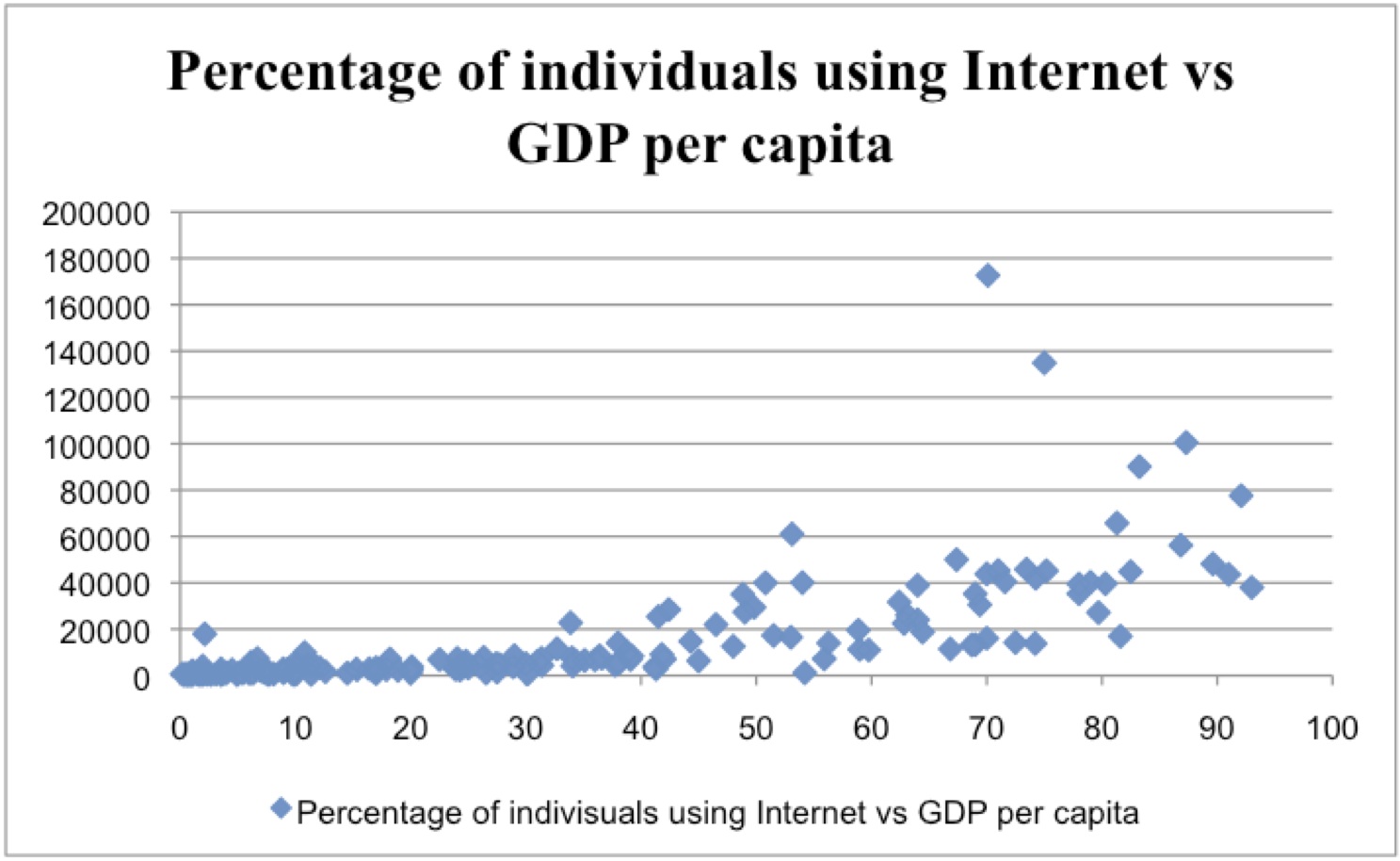
Figure 1. Relationship between percentage of individuals using the Internet and Gross Domestic Product per capita

Figures 1 shows the relationship between the percentage of individuals using the Internet (ICT, 2009) and the gross domestic product per capita (World Bank, 2009) of 204 countries worldwide. As seen in the figure, the more residents have access to the Internet, the higher GDP per capita a country holds. The correlation factor between them, which shows the relationship between the two factors, was 70.8%. This means that there is a strong relationship between the Internet access and GDP per capita. It is said that same kind of link exists between the literacy rate and GDP per capita, but according to a calculation, its correlation factor is only 36.6%. This indicated that the effect of the digital divide is stronger than that of illiteracy.

Establishing high-speed Internet access throughout a country is not an easy task. Developed skills and much investment would be required, which would be a tough burden for developing countries. What I am concerned about is that would lead to an even larger gap between the affluent countries and poor countries. Difference in economic power of the countries would enlarge the digital divide, which would make rich countries even richer.

It is easy to predict that this relationship will lead to very unfair opportunity for people within developing countries. Supports to build high-speed Internet infrastructure and teaching Internet literacy would be very important. The data indicates that its importance is equal to or even higher than that of elementary education. Although relatively high cost will be required for technology investments, strong support is required to maintain equal opportunity for people on the other side of the digital divide.

References:

ICT (2009). Free Statistics. Retrieved from http://www.itu.int/ITU-D/ict/statistics/

World Bank (2009). World Databank. Retrieved from http://databank.worldbank.org/ddp/home.do?Step=12&id=4&CNO=2

What is a “fair” society?

by Azusa Iwata

I was wondering if there is a real “fair” society in the world?  I think there are no answers to my question because how we feel about “fairness” is different, depending on the person. I would like to think more about following the question in terms of “fairness”: “your company has produced a successful product and more has ¥100,000,000 to distribute as bonus, how should you distribute it?”

At first, it seems that the successful product is the only achievement of the team that developed the product. In that sense, the company should distribute all bonuses to the team that developed the product. However I think it is unfair because the most important thing is that the company is supported by all workers. In that sense, the company should distribute the same bonus to all workers, which should be fair to all the workers. However, it also makes me feel unfair because the workers that produced the successful product spent a lot of their time to produce that successful product, compared to other workers. In terms of how much time they spent for the project, in my opinion, at first, the bonus should go to the team that developed the product like 50%. Then, CEO should get 25 % because CEO left the project up to the team that developed the product. I think CEO’s judgment was right, which deserves 25%. Finally all workers should be distributed 25% even though they were not involved in the developed team. It is because the workers are working for the company, which might have helped the team that developed the product indirectly. In this way, it is clear that all workers involve the team that developed the project not directly but invisible ways.

In conclusion, above the example of the way to distribute the bonus is just my opinion in terms of “fair” society. As it is clear, what the “fair” society is different depend on who we are. However, I think we need an undisputed “fair” society because there are a lot of social problems, such as big gaps between the rich and the poor.  I think there should be various ways to solve those problems, but a “fair” society is the first step to make the society better. In order to make a “fair” society, I think we should have the definition that can judge what “fair” in this situation is clearly. In short, we need the definition of “fair” in various situations. I hope the “fair” society that all people can admit will come in the future , which can make the society better.

Avoiding marriage in Japan

by Kaori Isobe

About a half of century ago, arranged marriages were very common in Japan. Before World War 2, most people got married through arranged marriages. However, after WW2, Western culture came into Japanese society and made the society change. Nowadays, it is very common that people often got married with someone who they really love. Arranged marriage in Japan is almost gone.

However, in recent years, there are a lot of sites about dating, and many people try to find new wife/husband. Also a town provides opportunities to set up machi-kon. Machi-Kon is what the town or city set up and give opportunities to single participants to get know each other. This is like Japanese arranged marriage, called omiai. Omiai is known as arranged marriage, the traditional system of formal introductions through family connections or third parties with a view to arranged marriage (The Japan times, Feb.21, 2010).  What is the difference from original omiai is that participants can meet many single people in one event. But machi-kon still has the principle of omiai, such as participants can meet someone like their favorite type of persons. Omiai sounds old-fashioned. However, as society changes, omiai system has been changing.

If the number of marriage opportunities increases, the number of marriages also increases. The number of marriage increases, the birth rate also increases. Then, the number of children increases, the number of employer will increases, then these processes and influence would make Japanese economy grow.

However, there is reality issue facing us, and making us avoid getting married. About 50% of thirties men who work as regular employees have a girlfriend or wife. However, on the other hand, in thirties men who work as contract employees, only about 20 % of them have a girlfriend or wife. This shows that work condition is very important for marriage. Some women do not get married because their boyfriends’ salary is very low. It’s very hard for men to get married if they are contract employees or something like it. First of all, the government should haves to change this Japanese employment structure, so that employees can live in a society which respects each employment. The government is working on welfare facilities but also basic, really needed condition such as employment condition.

In a conclusion, marriage is very important for life. Many scientists say that if the number of children will be decreasing much faster, Japanese economy will fall. To increase the number of marriages, first of all, the government has to fix this society such as over working, contractual and regular work system and so on. From omiai to the government, every single issue is related each other. Omiai would be one actor that will help Japanese society change to a good way.

References

NHK解説委員室 http://www.nhk.or.jp/kaisetsu-blog/400/124874.html

The Telegraph http://www.telegraph.co.uk/news/worldnews/asia/japan/9206205/Arranged-marriages-make-comeback-in-Japan.html

The Japan Times http://www.japantimes.co.jp/text/fl20100221x2.html

Thoughts on Inequality

by Kaoru Inoue

We live in a capitalist world – it is the world of winners and losers; it is the world of the rich and the poor; it is the world of developed countries and developing countries. Capitalists discuss people in developing countries like what we can do and should do; by fortune or not fortune, we tend to keep our thoughts with people in developing countries. This is done through media reports, education, bake sales, charities, and etc. Capitalists yet know themselves that they cannot connect people of developed and developing countries into one as a form of equality. Capitalism is something we have been enjoying and this will not disappear as long as we keep living in capitalism. Capitalism is the ideology which brought physical wealth in the form of money or say profit. As Christmas comes nearby, NGOs like World Vision have posted many posters to save children before Christmas. Keeping our thoughts with people in developing countries is not sustainable at this moment. A lot of people have tried to formalize an ideal form of society money-wise; however, those discussions have gone like daydreaming stories upon the reality. The discussion of equality is too idealistic and also not sustainable. Ideally everybody wants to have equality. However, inequality exists and people have tried to tackle this. Without being pessimistic, economic inequality is first of all, unavoidable. They are good at showing their first moves – they are good at getting information and give some thoughts. Taking an example of World Vision, how many of these people found touchy about a poster? How many of them decided to make a pledge? How many of them at least decide to learn more about those children? If capitalists consider people’s lives in developing countries, they shall know by now the limitations on discussions.

Is equality feasible in Japan? -from a perspective of election-

by Miki Imamura

Japan is supposed to be a democratic country. We choose our representatives by election; those who are elected decide how to carry our national policy and how to spend our tax. As a nation, we share equality in selecting our representatives by having a suffrage. (I would like to put the issues of suffrage for immigrants aside at this time; because it would be a long discussion.) However, I think equality is not feasible, or we are making it unfeasible in Japan. We have just finished our election for the House of Representatives. I saw unfeasible condition of equality in this election by two elements, which are nations not exercising equality of access and constituency system making our equality unfeasible.

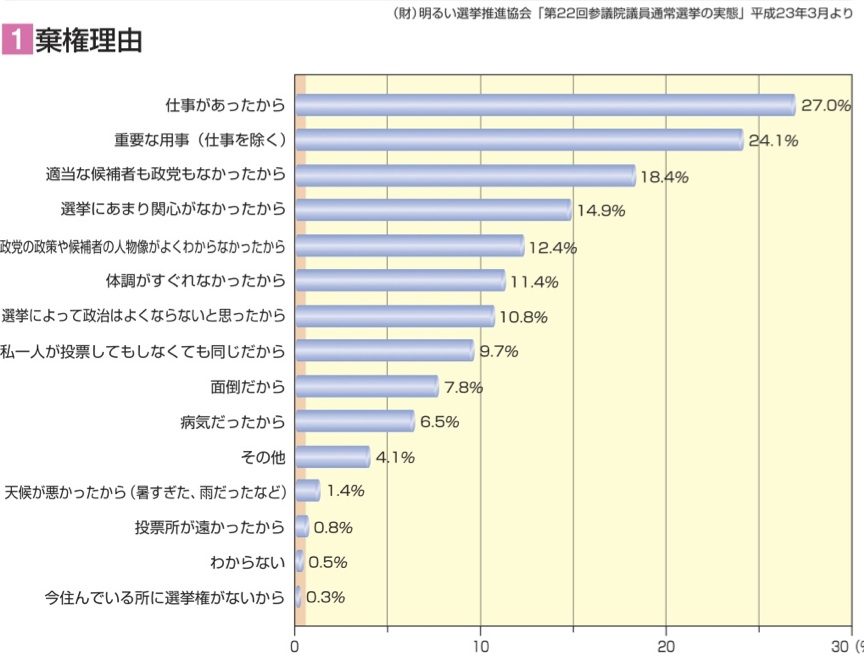
Election is the chance for nation to choose how we want Japan to be like. However, at the election we have just finished, only 59.32% of electors voted. According to the Ministry of Public Management, Home Affairs, Posts and Telecommunications, the most common reason for abstention is that election is not that important things for them. Personally, most of my friends who do not vote say that they do not know about politics and they think their absence of one vote would not be affect the results.

graph http://www.soumu.go.jp/main_content/000153570.pdf 目で見る投票率 総務省 選挙部

Including me, there are probably few people who has strong policy opinion about current political issues such as TPP, Nuclear power plant, and Japanese defense with full understanding of the issues. Some of them may think that making a decision is not their job, that is politician’s jobs. I think this is renounce of equality of access. Election is admirably access of equality for making our day life policy, however, more than 40% of population renounce it.

Secondly, Japanese constituency system creates quite a lot of wasted vote. Japanese constituency system is electoral system comprised of single-seat constituencies and proportionally represented multiple-seat constituencies. The numbers of seat for single-seat constituencies are 300, for proportionally represented multiple-seat constituencies are 180.


graph2http://www.yomiuri.co.jp/election/shugiin/2012/ 衆院選2012 YOMIURI ONLINE

As you can see that number of seats won by the Liberal Democratic Party at the proportional representation is about 30%. However, 80% of the seats had taken by Liberal Democratic Party at the single-member electorate system. In addition, only one candidate is elected in the single-seat constituency system, therefore there are full of wasted vote below second place. Approximately 37.3 million votes of all 300 single-member electorate system became wasted vote, which is 56% of all votes at the single-member electorate system. (時事通信, 2012) More than 50% of votes are wasted. Even though the single-member electorate system is effective to have stable political situation, ignoring more than 50% of votes are not feasible to exercise the equality of nations.

In conclusion, equality in Japan in its election matter cannot be said feasible. Nations make it feasible and system make it feasible. Nation has to improve its understanding level for national issues and consider its importance of being part of policy making. Constituency system should be changed to make sure that at least less than 40% of votes would be wasted. The majority of votes must not be wasted. Japan supposed to be a democratic country, however in its election matter, equality cannot be said it is feasible.

Works Cited

時事通信. (2012, 12 17). 死票率56%に上昇=民主は惨敗で8割超―衆院選【12衆院選】. Retrieved 12 20, 2012, from Yahoo!ニュース: http://headlines.yahoo.co.jp/hl?a=20121217-00000160-jij-pol