Anonymous student post
When I read the articles about assimilation and learned about assimilation in the class, I was recalling my experience in high school in the U.S. as a one-year exchange student, and try to consider assimilation issues based on that. However, as I try to compare a situation of second-generation immigrants and my case, I began to think my experience was totally different from that of second-generation immigrants.
In the U.S., I was called an “Asian” instead of Japanese, and Asian usually refers to East Asia. It did not take long for me to notice or feel what kind of stereotypes American people have for Asians. In general, Asian students in the U.S. were considered as studious, serious, geeks, etc. To be straightforward, as far as I felt, they found Asian students “boring” in general. Due to such stereotypes, they did not really expect me to say jokes or be athletic. When I said some jokes (even not really funny ones) or played sports better than normal students in the U.S., they were surprised and impressed, and gave me compliments. I assumed that this happened because they had a low expectation for Asian students in terms of humor or sports. I found it lucky to have sort of negative racial stereotypes because I can get attention and positive impressions just with little efforts. This actually motivated me to make efforts to be funny or popular in school.
I was then wondering if negative stereotypes could work positively for a certain race or ethnic of second-generation immigrants with negative impressions, and motivate them to succeed socioeconomically in a host county. However, while I was discussing this with professor Moorehead, I realized that negative stereotypes would work differently for second-generation immigrants from people who stay in a host country for a short period of time, like me.
It was completely a new experience for me to see people’s reactions when I did not meet their expectation of Asians. Thus, I was able to enjoy it. On the contrary, for second-generation immigrants, they have been dealing with such stereotypes repeatedly for their entire life. If they repeatedly felt that others are having a low expectation for them, they would be more likely to feel offended than be motivated.
In addition, I consider that these negative racial stereotypes would affect their performance more negatively if they felt they were “American”. In my case, I was nationally Japanese and considered myself Japanese, so did not really feel being offended being labeled as Asian, even when it was linked to some negative stereotypes. For those second-generation immigrants who considered themselves American, it would probably be more difficult to accept such stereotypes and fight them because they feel they identified less as Asians. Therefore, in my assumption, second-generation immigrants with a strong American identity would face more difficulty to fight their negative racial stereotypes and overcome them.

 I have been a big fan of Manga and Anime for as long as I can remember. I always admired how the Japanese style of drawing cartoon characters was different from that of popular western comics and animations. The characters in Manga and Anime have always stood out because they are unique. That is, many of them have exaggerated and flamboyant features and this always stood out for me and many other fans alike. Never did it ever occur to me that the way the Japanese creators illustrate their artistic work had significance on how race and ethnicity is viewed or construed in Japan.
 apparently) who is the leader of the Askari (Swahili word to mean soldier) which is an African revolutionary organization. Bugnug is first introduced to Crying Freeman manga readers when she launches a surprise attack on Yō Hinomura who is the main character. She is illustrated to look ‘exotic’. She is beautiful with long curly hair but is muscular and masculine in her behavior. It is impossible to compare her to the other Japanese females in the same manga as they seem more fragile and feminine.
 During the battle with Yō Hinomura (Crying Freeman), Bugnug is completely naked and only carries a blade. When she is finally defeated by Yō Hinomura, the two become allies and she later on gets his assistance to defeat a coup d’état in her organization. It seems as though the creators of this manga and anime went all out to display Bugnug’s supposed ‘Africanness’ by naming the character Bugnug which they go on to translate as Ant-Eater, having her fight naked, which I believe represents a kind of primitiveness and then including a coup d’état in her storyline which occurs within her revolutionary organization. So this leaves me to question why some characters of African ancestry are represented in this manner in manga and anime. Do all the people of African ancestry have these characteristics and why have these stereotypes been continuously perpetuated?
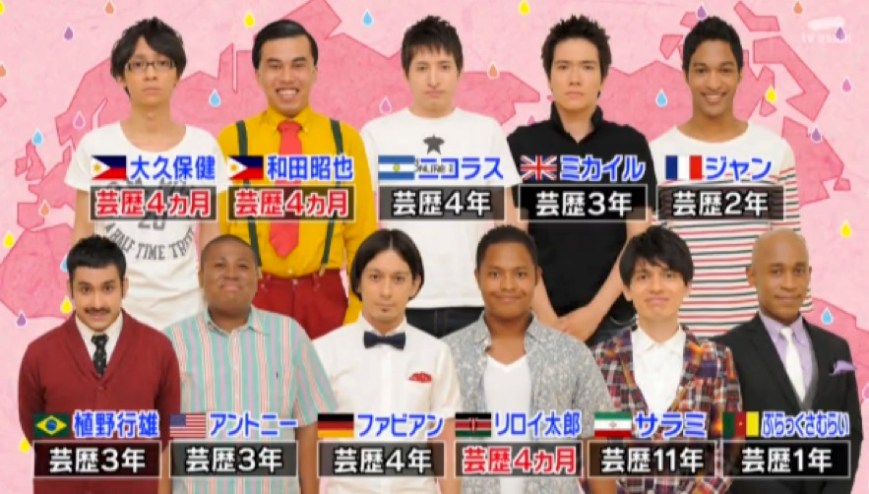
 This exposure has been both positive and negative in that it has opened up Japan to other cultures and has made the Japanese people more aware of the differences between their cultures, traditions and those of people from other parts of the world but has also promoted the adoption of negative stereotypes thus most of what the Japanese know are imagined racial distinctions that have been created and promoted by the western media.
 Terry Kawashima argues that people have a consciousness about race, and this consciousness depends on their background. We can see this by comparing various ways of thinking about shojo manga characters by Western people and


 JAPANsociology