
The Issue of Migrants in the EU

by Ryota Ochiai

Do you know “Roma”? Not Rome, but Roma. It might be confusing, so I write it as “Romani”. Romani are an ethnic group living mostly in Europe. They are also called and known as “Gypsies”, maybe you have been heard that word. In 2007, the EU expanded in Central Europe, and as you know Bulgaria and Romania also have joined the EU. At the same time, we are recognizing that the Romani of 9 million constitute a “Fourth World” in the area. Moreover, Romani living in the EU are forced to survive the life in lower than standard necessary to still maintain human dignity.

Rumanian and Bulgarian of the Romani native place come over to the French city and suburbs, and they set up camping as the temporary house at there. In addition, most of them have not received school education and become the victim of  human trafficking networks. Such networks let elderly person and children beg by the roadside and forces daughters to prostitution and expands by doing an illegal act. Much camping was removed by a policy of the French Government, and the Romani of several hundred returned to Romania independently. However, this let the EU highlight a problem of “freedom of movement” written in the Treaties of the European Union. However, France is a country making much of “freedom of movement” from other countries because of experience shut in the other side of the Iron Curtain. Therefore France supported Bulgaria and EU participation of Romania at the very beginning.

However, since the freedom of the movement is valuable simply, France wants to take measures to prevent the crime network taking advantage of the poverty of Romani. This is what written down in EU treaty Article 3, and it means that the freedom of movement is not unlimited and this is carried out on one of the cooperation with “destruction measures criminal with prevention of crime”. In other words, the freedom of movement can never become the large-scale emigrant incurrent excuse.

Afterwards, France visited to Romania and agreed that both found a solution jointly. From there, the French thought, it is the most important that Romania and Bulgaria take responsibility for the own nation, since EU member states have a duty to protect the nation from own country. It is written down in Treaties of the European Union Article 2.

This problem is world and our problem not just a problem of the whole Romania, France and EU now. Most of people are irresponsibility about the issue of emigrant, however it is same to what add a new chapter to the sad history of the emigrant who has been oppressed. So I will be glad if even slightly many people are interested about the issue of emigrant by reading my blog post. Thank you.

References

France Roma Camps Demolished, Gypsies Forced Into Hiding http://www.huffingtonpost.com/2012/08/15/roma-france-camps-demolished-gypsies_n_1778357.html

The Romani People and the Free Movement Directive http://www.legalfrontiers.ca/2010/10/the-romani-people-and-the-free-movement-directive/

The Roma in France: “Is Hollande going to expel us all?” http://www.newstatesman.com/blogs/world-affairs/2012/10/roma-france-hollande-going-expel-us-all

EU Treaties http://europa.eu/about-eu/basic-information/decision-making/treaties/index_en.htm
Evolution of gender and migration scholarship and its challenge

by Ayano Tsukada

Gender, the socially constructed role of and relationship between women and men, is deeply related to our lives. Our thoughts and our behavior are very affected by gender. Migration is not an exception here. In the article published in 2000, the sociologist Pierrette Hondagneu-Sotelo argues: “We now have a clear understanding that migration is gendered and that gender relations change with migration processes” (116). Women and men take different jobs in destination countries, use their money differently, and so on. Migration is also gendered and gendering. It is very important for researchers to know how and to what extent the lives of migrants are affected by gender. Without taking gender into account, we can easily misdescribe the whole picture of migration.

Sociological scholarship on gender and migration has a relatively short history.

In the late 1970s, women were depicted in the migration process and became a subject of many studies, however, scholars at the time only focused on women and men or only on the experience of women. They presented women migrants as a special case.

By the late 1980s, the evidence had grown large enough to require redrawing the map of gender and migration scholarship and then, theoretical formulation emerged. Scholars started to look at household economy as a critical site for revealing the relationship between migration and women, but still they were considering men as household heads and by doing so, they limited the data on women. At this point, the scholars studied men and women separately.

By the mid-1990s, the effective use of qualitative methods to understand the dynamics of gender and migration emerged and the new scholarship showed how migration processes are related to the social construction of gender.

From above, we can see the shift of sociological scholarship on gender and migration from the emphasis on documenting and explaining the gendered character of migration towards exploring its gendering effects.

In spite of this progress, many studies often degrade gender analyses to the level of the family or household and let scholars to ignore gender in other domains of the migration process.

There are still some parts that are missing in gender and migration studies. For instance, there are very few data on the consequences of women’s migration while there are many studies on the effect of men’s migration on their families, their communities, and on how gender is exercised in their home countries. What happens to the men and children who left behind when their wives or mothers migrate? Does women’s migration change the gender relationship of their countries? If so, how? Is it positive or negative?

Right now, the sociological scholarship on migration is more like gender-segregated rather than gender-integrated. It is necessary to look at gender as a central element to explore unexplained phases of migration. I hope that migration Studies in the 21st century will integrate gender more than it has done in the past 30 years.

Reference

Hondagneu-Sotelo, Pierrette. (2001). Doméstica: Immigrant workers cleaning and caring in the shadows of affluence. Berkeley, Los Angeles, and London: University of California Press.

Afsar, Risa. (2011). Contextualizing Gender and Migration in South Asia: Critical Insights. Retrieved from http://gtd.sagepub.com/content/15/3/389 on 25th May, 2013

Racial Stratification in Hong Kong

by Chris Leung

Latin Americanization means the phenomenon of racial stratification and the book Shades of Difference took the example in the United States. However, this term can also be applicable in other places. For instance, in my birth place, Hong Kong, racial stratification is also obvious. However, the situation is quite different from the States.

Since Hong Kong was colonized by Great Britain, racial stratification has already been installed into people’s minds. In terms of the strata, in the beginning of the colonization period, British people and other European were obviously in the top level, followed by East Asians especially Indians. Finally most of the Chinese were in the bottom of the strata. However, there were also some elite Chinese, who could manage to live in the same standard with the Europeans, most of them also discriminated against the collective Chinese with the Europeans. At that time, many luxurious restaurants and shops insisted “Not allowing dog and Chinese.”

This strata system lasted for a quite long period until there were more Chinese people started to work for the government. Nowadays, as Hong Kong has already returned back to China, the strata system has also changed drastically. As there are no more foreigners taking major role in the government, the Chinese could finally regain the position they used to have before colonization and the discrimination against races has a lot improved.

However, when I say Chinese, it only means those who born and grew up in Hong Kong, those who emigrated from the mainland China in this decade also face a huge discrimination by the local ‘Chinese.’ Since many of them are not well educated, they could only do low-paying jobs like cleaner or security guard. Further, there are many family issues among these immigrants, hence the area they live is always a big social concern to the government and there were few movies trying to describe the life in the area where many of the residents think that the movies tried to label their living place as the slum of Hong Kong.

In conclusion, the situation in Hong Kong is quite special. In general term, stratification and discrimination are always between races like in the States. However, in Hong Kong, such things are happening inside one race, which is the Chinese.

Peoplemovin – A Visualization of Migration Flows

by Robert Moorehead

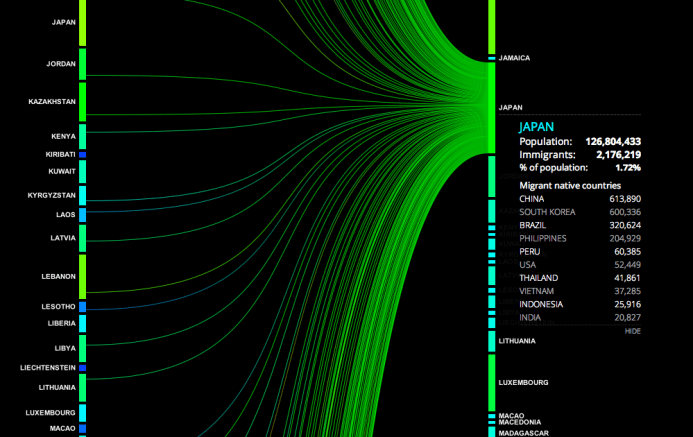
This is a short post that’s a heads-up to check out the site peoplemov.in, which provides visualizations of global migration. You can see data from 2010 on emigration and immigration flows for countries around the world. (Clicking on the pictures in this post will take you to the site.)

Migration into Japan

The top five source countries for immigrants to Japan are China, South Korea, Brazil, and the Philippines, and Peru. For Japanese emigrants, the site shows the top five destinations are the US, Brazil, Germany, Australia, and the UK.

I’ll leave the debate as to whether those “in-migrating” are “immigrants” or something else for another post. For now, emigrants are those going out, and immigrants are those going in. I know many in Japan say that Japan is not a country of immigration, and thus has no immigrants. Rather, it has “foreign workers,” “migrant workers,” dekasegi, etc. “A rose by another other name would smell as sweet.”

Migration out of Japan

Migration out of Japan

Great effects of second language

by Mayu Uehara

Language is one of a given tool for people to communicate. It can show our emotion, identify ourselves and also built relationship. First three months of my life in Canada, I had been stressful because only English was spoken there and couldn’t speak Japanese. Now I can speak English but this is because my friends and many people there tried hard to understand me and also taught me English. In Japan, there are lots kinds of immigrants who are struggling with their life. They are isolated and also tend to gather together with common race. There should be necessity of community project to teach people second languages for not only immigrants but also local people. There are three reasons for supporting my opinion. First, the numbers of immigrants has increased. Second, community should make better society for citizens. Third, bilingualism can make numbers of chances for every people.

In reality, globalization can’t be avoided. Now the numbers of immigrants has increased and as social changes in Japan, numbers of elderly people will be twice as much as youth, therefore we need more hands from overseas. In addition, in the aspects of business, it’s hard enough to pursue profit only inside of Japan so that there are lots of Japanese corporate progressing overseas and compete with global corporate. This means language especially English is important to success and also sustain Japanese society.

Second, though globalization is inevitable social change, local people is not used to be with immigrants yet. There are some racial difficulties such as Korean resident in Japan, Brazilian workers in Japan and so on. There are Korean or Brazilian communities in some parts but they are isolated from community mostly. For instance, Brazilian who come to Japan for working can’t read Japanese of course so they don’t know about social rules such as how to wrap garbage and when they should put them on the road. Only if there are any languages to communicate, they don’t have to have troubles. It’s difficult to make country to regulate bilingualism, however; community should be flexible to those community changes. If the community has lots of Brazilian residents, it should have some chances to provide citizens of the community to learn Japanese, English or Portuguese so that they can communicate each other to make their society better. These community movements also tie not only between local people and immigrants but also between local people themselves. If the bonds become tight in community, we’ll deal with current problems such as DV, crime, and urgent disasters.

Third, bilingualism can provide us many effects. If we speak only Japanese, we can communicate with Japanese speakers but it’s seldom to speak with foreigner because Japanese speaker of foreigners are not so many. If we have second language such as English, Spanish, and Chinese and so on, we can travel overseas, use it in business occasions, make foreign friends, and learn other cultures or sense of values. These effects can make our choices of life styles way broad. If numbers of communities, which support learning second language increase, lots of Japanese can have global senses and also choices of their life styles.

In conclusion, it’s necessary for Japan to live with immigrants and we need to protect them not only for them but also for ourselves. Second language can be great supporter to live our own life better and also it must need to keep up with other countries. Community can provide great impacts by progressing bilingualism for tie of citizenship, activation of society and broad choices of citizen’s life styles.


The Benefits of Being Bilingual

by Sayaka Umei

Bilingualism is the ability of people to speak in two languages fluently. If this “fluency” would be defined as “to be able to speak, understand, read, and write well in a language (“English-only triumphs, but the costs are highby Alejandro Portes),” most of the bilinguals were born in the different country from their parents’. There are the arguments whether the bilingualism is good or not, and in my opinion the bilingualism is good for their career and ability. I will begin with the positive points and negative points, and lead the new problems through these points

According to Portes, the strong points for bilingualism are that it is good for the brain, which is good for cognitive development, enhances the cohesion of the family unit or culture of the home country, and keeps or establishes self-esteem well. On the contrary, the negative points of it are that it might get children confused or it is hard for them to acquire two languages at the same time. However, these negative points are not true. Scientifically learning two languages at the same time is good for their brains because they develop differently through learning.

Here, new three problems are coming up through expansion of the multiculturalism and bilingualism. First, the idea of “English-plus” by Portes is that people can speak in one language except for English and “plus” they can speak in another language. If these people do not have parents who speak in different language from the language where they live, they cannot get the environment to speak in English. So they need the environment for it, such as school system. However, this kind of school system is not common. Just some special schools have this English-another language system.

Second, bilingualism can enhance family or culture cohesion, but it could threaten the unit of the host country. That means people keep their home countries’ language so they also keep the home culture as well. Some people would get together and make community. If it might get bigger and have a certain mind or idea, it could threaten the host country.

Third, there is the idea of “cultural capital” by Portes. This means the United States leads this world and the most spoken language around the world is English. Socially and politically people whose first language is English do not need to speak other languages because most people can speak in English or try to learn English to have communication. That also means most people who are bilingual or who want to speak in one more language can speak in English. That cannot be really said “multiculturalism” according to Portes because it just English culture plus other cultures.

In conclusion, there is misunderstanding for bilingualism among many people all over the world and some people do not know the benefit from it. After children growing up, then they realized the benefit, but it is too late to be bilingual. Or some country would be worried about their unity against this global society. What people need in this society, where the bilinguals are getting common, is that they have to understand what bilingualism is well and what is needed as career in this global society in order to solve these problems.

Migration to Do “Women’s Work”

by Sian Taylor

In this essay I will be analysing the women migration from poor countries to rich countries in order to do “women’s works”. I will initially make a division between the women who are kidnapped and forced to go abroad as sex slaves etcetera, and the women who “willingly decide” to do so. Then I will focus on this latter part and I will answer questions like: “why is it the woman who migrates and helps her family back home” and “why are there major requests from the First World for nannies, cleaners and entertainers”. Finally I will conclude giving my own opinion on the matter and trying to give a possible solution in order to partly resolve some of the matter.

There are many women that “willingly decide” to go abroad and start a new life as a care woman or as an entertainer. The truth behind this thought, is that even if no one was forcing them to go, the deep poverty they and their families are living in, and the local government that heavily promotes the migration of women, does not really leave these mothers or older sisters much of a choice.

But why is it the woman and not the man of the family that works abroad in order to send the remittances back home? Because on one hand it is proven that the woman is more likely to send home half or more of her income (compared to many men that will just keep most of the money for themselves) and on the other, in First World Countries there is a great request for old fashioned, caring, nurturing women that can take care of the house, the children or even the men.

No need to say that these women are mostly underpaid and often kept in a condition of insecurity, fear or worse. The problem therefore, now, shifts onto another question: why is there this need? The answer is that most women nowadays go to work just as the men do or even for longer, but the men haven’t really started helping more around the house, and this is when, at a first glance, all of the problems seem to have started.

If we look at things in a deeper way though, we will notice that that is not the main cause after all, and that the real problem resides once again in the roots of capitalism. The solution of the problem wouldn’t be just to stop immigration from happening, or sending the women that are in the First World back to their own countries. The only result of that would in fact be many illegal immigrants (therefore treated even worse) and much worse, many families dying of hunger or poor health conditions in the Third World.

The solution therefore seems to be in the government trying to improve the  jobs conditions through regulations. By doing that, the immigrant women will feel more serene and relaxed, knowing that they are protected and regulated, and will be less discriminated against and badly treated by other people, and will be able to feed their families, and live a life that according to them is a lot more free than the one they would have been leading in their town or villages.

Immigrants face labor issues in the host countries

by Mao Shibata

Nowadays, globalization spreads all around the world and it has brought diffusion of international transportation so that people are able to flow freely over borders. The number of international immigrants who look for a job and seek more stable life is getting increase over the world, while they are struggling with serious labor problem in their host countries.

When I went to Vancouver during this summer vacation and stayed with my host Pilipino family, they were facing labor problem. The father had quit security guard and wanted to be an elementary school teacher, though the Vancouver government did not accept his require and grant letter of acknowledgement. Moreover they had two children who were still 6 and 8 and they live separately with their parents so that he had to take care of them in the home while the mother went to work during the long vacation. Since the mother was a breadwinner, she went to work 7 days a week and even worked on holidays as salary was higher than usual. They knew that as long as this condition persists, it is really difficult to make a living as their children get older. Then, what should they do? Should the father have to find another job-even if it is a lower wages one- while he leaves his children home alone? Should they send their children to their home country where their parents take care of their children?

Though they leave their home countries to get a job or to help their families, they cannot get stable and well-paid occupation even they have documents and the host country’s nationalities. Needless to say, immigrants who come to new country without any documents or visa cannot get a proper and high paying job. What’s more, their children those born and raised in host country also regard as illegal immigrants. Even they are educated exactly as well as children who have that host country’s citizenship and high skilled or talented people, they are not able to enter the university, get any certificate and satisfying job. It causes not only deprives of the children’s bright future but also it endanger their safety and the lives. Since it forces them to engage in unsustainable work and harsh environment such as day labor, low wages and prolong work besides, it may drag them into drug or gun crime to make much money.

Internationalization and development of the transportation make people easy to cross a frontier throughout the world and millions of people decided to go overseas to earn a livelihood or send money home to their families, however, they face multiple barriers in the host countries; low wages and long hour works, limited visa and citizenship. Not only try to restrict the immigrant’s occupations and to drive them away, but we need to consider how to improve their severe working situations and shift policies more flexible to accept them.

Migration and Gender

by Mayu Shibata

Migrants have to live in a harsh situation in host communities and in case of female they have double disadvantages as foreigner and female and they are more likely than male migrants to be exploited and excluded. There’s a phrase ‘feminization of migration’ which has been used since 1990s. It indicates the increase of female migrants and those female migrants have become individual and independent, not as wives. They migrate to foreign countries on their own.

The number of Filipino and Sri Lankan women who migrate to the Middle East has now increased and most of them engage in housekeeping called domestic helper. They live in master’s house and do the house work. They usually have only one day off in a week. In Japan many Filipinos come in as entertainers and actually work at pubs and clubs. These domestic and entertaining works don’t always come with appropriate protection of human rights. Only because they are female and migrants they are in twice as vulnerable situation as the others. They are more likely to be sexually exploited and through the violence they might be in fatal circumstances like diseases and injury.

However, they still have to migrate to other countries despite the harsh facts. They might have families to care for in homelands and the families need her remittances to live on. They desperately seek for money and chances and they have no way other than migration. Simple restriction of their migration only suffers them and never save them as long as there is no working opportunities in their homelands. Some of them get higher status in families to migrate to other countries and earn money. It’s one of the ways those women become independent in those traditional but conservative style of their homelands. We cannot deprive them of chances to migrate. The possibility of migration must be equally suggested to them, too. However, it’s a problem that they are forced to migrate from other harsh facts such as unemployment as well. They should have free access to migration. Yet the choice should be made on their own.

This problem has been common between developed countries and developing countries. However, as developing countries achieve their economic growing, the number of migrants from less developed countries to developing countries has increased. Now they have the same problem.

MDGs suggests migrants’ problem to be improved by 2015. But it’s getting worse and worse. Because it involves many issues it might not be solved easily but resolution is required now.

What migrations will be faced in Japan

by Kaori Isobe

According to the statistics by Ministry of Health, Labour and Welfare, there are about 686,246 people who came to Japan as legal foreign workers during 2011. Furthermore, there are also people coming to Japan from other countries to work illegally or overstay. But I’ll write about legal migrations in this blog article.

As increasing the number of migration, the issues between migrations and Japanese people have been increasing as well. One of the issues is that migrations tend to be together all time. Let me show an example. There are many migrations from Brazil in my hometown, Shizuoka-prefecture. When I went to Hamamatsu-city, where they work and live intensively, I found that Brazilian people gather up all time. They talk in Portuguese and place a distance from Japanese people. It means they don’t get familiar with Japanese people and they don’t have communication with local people. Is this really good situation for both migrations and Japanese society?

I definitely say NO. If migration cannot communicate with local Japanese people, migration never get along with Japanese people. For example, migration cannot follow rules which are existed in the local area in Japan, such as the way of garbage out. If migration cannot follow rules, Japanese society would criticize migration. Then, this situation would isolate migrants from Japanese society. Also, an image of migration would be so bad among Japanese society. Then, the relationship between migration and Japanese society will be getting bad and bad.

Well, how this issue should be solved? First, migrants should accept differences between migrations’ culture and Japanese culture. It may be easier to gather with who speak same language from same culture. But, to be familiar with Japanese culture, migration should try to communicate with Japanese much more, even it’s difficult.

Second, Japanese society should not have stereotype of migration. To remove stereotype, Japanese society should hold events, such as an interchange between migration and local people and Japanese language lecture. It would not be so much easy, but keep on holding event as constantly, both migration and Japanese society would open their hearts and change the images each other. Migrations and Japanese people should know each other very well.

Finally, Japanese government should move to make better society for both migration and Japanese society. As you may know, Japan is said to be a racially homogeneous country. But as increasing the number of migration, Japanese society needs to pay attention to people from other countries much more. Therefore, the government should tell about migrations to Japanese citizens, especially for young people. Why I mentioned “young people” is because young people will become leaders in next Japanese society. So, I propose that Japanese education should add lectures which are about people from other countries including migrations.

Throughout these passages, I wrote my opinions. Whether my proposals are effective or not, issues about migration and Japanese Society should be considered with Japanese government but also with Japanese citizens because this issue must influence all citizens who live in Japan.

Reference

Web Page of Ministry of Health, Labour and Welfare; http://www.mhlw.go.jp/