Skin whiteners and beauty: the impact of global markets

Royal Siam natural skin whitening products

Royal Siam natural skin whitening products (Photo credit: RoyalSiamBeauty)

by Jiyang Shin

Skin bleaching has become such a steady market across the globe that without even trying, one may end up purchasing a skin product that contains substances that make your skin tone lighter, brighter, thus “healthier”, as some cosmetics companies advertise. What this phenomenon signifies is that the majority of society values whiter skin over their natural skin tone. 

A colleague of mine, who is Japanese and has a relatively darker skin tone, once went to a cosmetics corner of a department store and asked the store clerk which shades of eyeshadow would match her color. However, instead of getting her an eyeshadow that she expected, the store clerk recommended her a product that will make her skin glow and bright. I was stunned when she shared her story because the beauty industry (and other political factors) not only succeeded in creating the image of beauty, but it has come to a point where it is socially acceptable for a store clerk to force her skin bleaching worship on individuals who are perfectly confident with their natural skin tone. Skin bleaching has established a firm position in our society that it is almost as if we are given no other option but to turn white.

It is a common theory that the phenomenon of global skin-whitening obsession largely is due to colonial occupation by European nations, and this could also suggest the possibility that our perception of beauty is significantly determined by the distribution of power and wealth among the various racial groups (the whiter, the superior). In recent years, tanning has become a new trend among the young population in the US, and even politicians such as Mitt Romney. Karen Sternheimer (2010) argues that the emergence of the middle class and the automation of labor after World War I re-identified being outside as more with leisure than with work. Being able to afford a vacation in tropical islands is the new richness, so to say.

However, I believe that the current wave of tanning trend, although still dominant, is more complex than the shift in social perception of being outside. Ethnically ambiguous models are frequently featured in advertisement of fashion retailers such as H&M in recent years. It is reasonable to argue that being multiracial is becoming the new definition of beauty, signifying that having white skin will no longer be a necessary criterion to be perceived as pretty.

Reference

Sternheimer, Karen. 2010. “Lightness and whiteness.” Everyday Sociologyhttp://nortonbooks.typepad.com/everydaysociology/2010/05/lightness-and-whiteness.html

Enhanced by Zemanta

But we’re speaking Japanese!

This funny video tackles the issue of how we often struggle when someone’s race doesn’t seem to match our expectations of how the person should act. People who might look Japanese don’t necessarily speak the language, while people who might look like gaijin (ahem, like me) can be quite fluent.

This video really resonates with me, as I just came back from presenting at a conference in Daegu, Korea, on migration in Asia. The conference had speakers from several Korean universities, and representatives from Taiwan, Vietnam, the Philippines, and Japan. As the representative of Japan, I was the only non-native to represent a country—and the only non-Asian at the conference. And yet no one seemed surprised that the speaker from Japan was a white guy from the United States, who was talking about Peruvians in Japan. A sign of progress, perhaps.

White is right: Body decoration, skin color, and beauty in Japan

Nivea Skin Whitening

Nivea Skin Whitening (Photo credit: kalleboo)

by Saki Miyata

Body decoration is a term that describes how people change how they look from how they looked originally. This decoration of the body seems to be conducted by people in order for them to symbolize or fit into a certain group. Skin lightening is also one kind of body decoration which can be practiced worldwide. In Japan, it is not difficult to find women who use skin whitening products. The practice of skin whitening has become a very “natural” thing for women in Japan.

It has become “natural” for woman to seek whiteness since the ideal beauty of Japanese is to have a white skin. The unconscious notion of “Japanese people are originally white” creates an image of white skin as pure, young, and healthy. Which drives women to practice skin lightening as an anti-aging process.

As Mikiko Ashikari (2005) notes, in Japan, “white skin” is also seen as dominant, since having tanned skin is something to be ashamed of, unless the tanned skin is a result of some leisure activities. This could be the result of thinking “Japanese skin is originally white and expected to be white”. An example of white being dominant is when talking about skin in Japan. Saying “Your skin is white (light)” is taken as a compliment. However, saying “your skin is black” is never connected with a positive image. It is also a taboo to point out to someone that they have black skin.

Japanese usually separate their whiteness from Caucasians’, and find uniqueness in Japanese whiteness. It is true that Japan has a tradition of seeing white as a symbol of purity and beauty. However this is not the only reason for this massive boom of skin whitening in Japan. By globalizing, Japan interacted with societies that were white dominant and white superior. This dominance of Caucasians has also affected the notion of universal beauty, which sees white as beautiful. However, even though this idea was imported to Japan, it is not recognized by people that they are trying to look white, since the idea of white=beautiful was already there. The globalization of cosmetic markets has also encouraged more women to practice skin lightening.

Personally I found it interesting to find out that Japanese unconsciously think we have white skin. However when I think about it, the “fresh colour” pencil crayon is light beige, which is lighter than the average Japanese skin. Although the pencil crayon does not represent Japanese skin tone, children colour their skin with this colour. When I was in Canada, I was drawing each other’s face with my Caucasian friend. I remember feeling really offended when she used light beige colour for her and dark yellowish brown colour on mine. Although I was only 8 years old when this happened, this shows how the sence of “Japanese skin” is deeply rooted in our minds.

Reference

Ashikari, Mikiko. 2005. “Cultivating Japanese Whiteness: The ‘Whitening’ Cosmetics Boom and the Japanese Identity.” Journal of Material Culture 10(1):73-91.

Enhanced by Zemanta

Race and Visual Appearance

by Kohsei Ishimoto

The idea of how one thinks of another (first impression) can mainly come from how one looks. We all have our own beliefs of various cultures, which can also alter who we choose to be with. In “Seeing Faces, Making Races: Challenging Visual Tropes of Racial Difference,” Terry Kawashima (2002) explains the relationship between ‘beauty’ and ‘race’, focusing on “light skin”.

Many cosmetics companies are now promoting “whiteness”, selling products that can lighten one’s skin. Many people in Asian countries now focus on these products, possibly feeling that beauty is to “look white”. When looking at make-up as well, fashion magazines (mainly in Japan) promote the image of looking “white”, or “ha-fu”, by showing how to do make-up in a certain way.

Hair dye can also be put into this idea. When walking the streets of Japan, there are many Japanese people that have dyed hair, usually brown or blond. Although having “too light hair” does not have a positive image, the number of people with dyed hair has obviously increased greatly.

But does having light skin, doing make-up in a certain way, and having colored hair mean that one is “white”? Personally, I would say no to this. It cannot be said that being “white” is being beautiful; there are many different races in the world, and everyone should be considered beautiful.

I also dyed my hair in high school, starting with a dark brown color, but later on to a bright close-to-white color. In Japan, this can be considered ‘unusual’, leading to situations in which people would avoid you. It is also close to impossible to get a part-time job with a light hair color. It is usually prohibited to dye hair in Japanese public schools, but since I had attended a private school, the society I had been in allowed me to dye my hair. However, I did not dye my hair because I wanted to look “white”; I dyed my hair because I wanted to look like an individual.

When looking at western countries, it can be said that not all people try to stay light skinned. Having “too light” skin can be a sign of sickness, and most people must have the desire to get a tan during the summer. When considering hair color, my Non-Asian friends dye their hair to exotic colors, such as red or blue. This can be because they already have a natural tone of color, compared to the “dull” color of black in Asians.

In conclusion, I believe that the act of doing make-up a certain way or dyeing hair is done through the individual’s decision; our personal experiences in society can alter our own belief’s of “beauty”.

Costumes, props, and appropriation

by Deanne Walters

For a discussion on appropriation is it apt start off with a definition on what cultural appropriation is. Cultural appropriation is taking part of another group’s culture and removing it from the original context; often simplifying it and the original culture. This post is going to focus on cultural appropriation going on in mass media in two areas, fashion and music videos.

This section will look at the example of Native American appropriation in fashion and costumes in America. A new trend that has been going on is Native American inspired clothes. As seen with the Urban Outfitters line of ‘Navajo’ styled clothes, a major problem with this kind of appropriation is that it simplifies culture. Navajo is just one of hundreds of Native American tribes. It also commodifies this culture as it simplifies it, so it takes a complex group of cultures and turns them into products for hipsters. This removes any cultural context that might have been attached to these items or patterns in effect turning these products in to stereotypes of Native American cultures.

There are also much more blatant stereotypes of Native American people, such as costumes. These reduce vast cultures down to one idea often based on stereotypical images produced in media. Costumes also ignore any and all cultural context behind them. A common accessory in both costumes and fashion are headdresses. While the original meaning behinds these were symbols of strength worn only by warriors and chiefs now they are just seen as a fashion accessory or a costume. In both fashion and costumes Native American cultures are simplified and commodified for the economic benefit and enjoyment of non-Native Americans. This is contributing to the erosion of Native American cultures.

The next example of cultural appropriations is Japanese culture in music videos and performances. The most recent example is Avril Lavigne’s ‘Hello Kitty’ music video, but this is nothing new this has been seen in Gwen Stefani’s ‘Harajuku Girls’ and Katy Perry’s American Music Awards performance of ‘Unconditionally’. All of these examples simplified and stereotyped Japanese culture into a prop, something to add ‘exotic’ spice to a music video or performance. In the two music videos the only people who were Japanese or of Japanese decent were background dancers maybe getting a line or two in the song. The only thing that matters for people producing this content is the profit they will make from it. This cultural appropriation and is contributing to the stereotyping of Japanese culture.

The clear link between these two cases of cultural appropriation is simplification and commodification. Complex cultures are being turned into caricatures and used for profit. Overall, cultural appropriation in mass media often ends up stereotyping and only profiting individuals with no deep connection to the culture they are appropriating. As seen with these two example cultural appropriation is wrong and should be stopped.

References

Fager, C. (n.d.). Cultural appropriation. A Friendly Letter. Retrieved April 30, 2014, from http://afriendlyletter.com/appropriation.html

Indians.org. (nd.). Indian headdress. Retrieved April 30, 2014, from http://www.indians.org/articles/indian-headdress.html

Ray, P. (2013, November 1). Cultural appropriation: Halloween’s post-modern problem. The society pages. Retrieved April 30, 2014, from http://thesocietypages.org/cyborgology/2013/11/01/cultural-appropriation-halloweens-post-modern-problem/

Sharp, G. (2011, June 7). Discussion of cultural appropriation. The society pages. Retrieved April 30, 2014, from http://thesocietypages.org/socimages/2011/07/07/discussion-of-cultural-appropriation/

Sharp, G. (2012, May 10). Social media and the fight over urban outfitters’ appropriation of native american cultures. The society pages. Retrieved April 30, 2014, from http://thesocietypages.org/socimages/2012/05/10/social-media-and-the-fight-over-urban-outfitters-appropriation-of-native-american-cultures/

Zimmerman, A. (2014, April 25). Avril Lavigne’s dumb ‘hello kitty’ video is rife with cultural appropriation. The Daily Beast. Retrieved April 30, 2014, from http://www.thedailybeast.com/articles/2014/04/25/avril-lavigne-s-dumb-hello-kitty-video-is-rife-with-cultural-appropriation.html


Flower Men of Korea

by Lilia Yamakawa

“Beauty” and what one considers beautiful depend a lot on a person’s own culture and ethnicity. On the streets of Korea, it is not unusual to find Flower Men (FMs), called “kkotminam” (“flower handsome men”). You will know them by their pretty and “soft masculinity” and by their attention to the way they look. They are willing to spend a lot of time and money on their appearance and lifestyle. They may use make-up and other beauty products, pluck their eyebrows, manicure their nails, gel and style their hair, get facials, get massages, and even have cosmetic surgery. They are also associated with soft speech and traits such as gently caring for their families. They are seen as being pure and innocent, and they are very polite. In this report, I will examine some of the reasons to explain the Flower Man boom.

First, the boom is part of the larger global phenomenon of the “metrosexual” male, which has spread throughout both the East and the West. The metrosexual man is one who takes care of his physical appearance through means that were once considered feminine. The FM is just one example of this wide global trend. The East Asian metrosexual trend is so prominent that Time magazine did a cover story on it in 2005. Ling Liu wrote in this article:

A few years ago it may have been considered sissy for a guy to be fussy about his clothing and appearance. Real men demanded the world accept them on their own uncouth, unkempt terms. But in Asia nowadays, the definition of masculinity is undergoing a makeover – and narcissism is in, thanks to economic growth, higher disposable incomes, shifting gender roles, and fashion and cosmetics industries eager to expand their customer bases. No longer content to be the drabber sex, Asian males are preening like peacocks, perming, plucking and powering themselves to perfection in an effort to make themselves more attractive to their bosses, their peers and, of course, to women.

Although the boom is worldwide, it seems that Korean Flower Men have taken it to a further extreme than men of any other ethnic group and nationality. In 2013, South Korean men spent roughly $900 million on skincare. This was almost one-fourth of sales worldwide for men’s skin care. There are many salons and spas just for men that offer hair, facials, massages, and other procedures. Plastic surgery is also common, and there are also a number of clinics that cater solely to men. In 2013, Korean Air began training male staff to use beauty products (Fujita 2005).

The FM phenomenon itself began in the 1990s, around the time the Korean government began to allow more pop culture from Japan to come into the country (in 1998). Many manga and anime, which were previously hard to find, could now be bought and read in public. Young male actors and singers, especially in the boy bands, began to look like Japanese and Korean manga and anime characters, especially those in “girls’ comics” or “shojo manga” where the ideal image of a male is “bishonen” or “beautiful boy.” The flow of media between Korea and Japan also included tv dramas, cinema, and advertising (Sun 2010). The “yaoi” type of manga, which became very popular in Korea, is also said to be a big influence on the FM trend. The men in these manga often look like elves or fairies, and they are soft, sweet, and sensitive.

Up to the 1990’s the popular image of male beauty in Korea was a rather macho-type man. Since then, the soft male type has become much more popular. Two groups of FBs best exemplify the phenomenon today. One is the Korean boy band DBSK of idols. The other is the Korean tv drama called “Boys Over Flowers.” It was based on the Japanese manga and anime called “Hana yori dango” and was broadcast in Korea in 2009. It is a typical shojo Cinderella story of a poor high school girl who is befriended by the four richest, most handsome boys in the school, the F4. It became super popular in Korea, and later, in many other Asian countries including Japan. With “Boys Over Flowers”, the male image of the “kkotminam” became even more popular in Korea. More and more males aspired to look soft and gentle and pretty. Men’s fashion came to include pinks and floral prints, and cute “boyish” hairstyles with long bangs became the rage (Lee 2010).

Advertising has played an important role in spreading the FM image. Cosmetics companies have been very eager to sell cosmetics to this whole new group of buyers. Large areas of department stores are now devoted to men’s beauty care. Famous idols and actors, including members of both the DBSK and the F4, are used to advertise men’s beauty products. More and more men in Korea aspire to look like these idols.

The Korean economy is very strong now. This makes it possible for many Korean men to spend their money on personal beauty. With the economic power they become more confident, and more men want to look good even if it costs them.

A major reason for the “kkonminam” craze is that men want to look good to be competitive in the job market. They want to have “the right face”, which looks youthful, lively, friendly, and upper-class. Job applicants must send in photographs with their applications. Many Koreans believe that a person’s character can be read in the face, and even that their looks are more important than their skills (Jeffreys 2007).

Historically, Korean is a country ruled by strong Confucian ideals, which emphasize taking care of and making both the mind and the body strong. It is said that one reason for the “hallyu” (“hanryu” or “Korean Wave”) throughout East Asia is that the men are good-looking but show “a lack of profanity and sex, as befitting Confucian morals” (Maliangkay 2010).

David Coad believes that sports figures, such as David Beckham have been important in popularizing the metrosexual and the FB trend. They stand for traditional masculinity in their sports skills, but they also take care of their personal appearance in ways that were once thought feminine. The long-haired Korean soccer player, Ahn Jung-Hwan became very popular at the 2002 World Cup. He is known not only for his soccer skills, but also for his looks and his actions that show a softer side of men. He kissed his wedding ring after winning a major game. Then, he went on to advertise men’s liquid foundation. Coad writes:

The immediately obvious hyper-masculine and generally assumed heterosexual status of most sportsmen has been vital in changing attitudes about exposing, eroticizing, and taking care of the male body. Without some of the most celebrated heterosexual athletes in the world endorsing and embodying different facets of metrosexuality it is uncertain if masculinity norms would have changed so rapidly in so many different cultures. Metrosexuality, in a way, is indebted to sportsmen for its very existence. (Coad 2008)

Some people believe the most important reason the FM phenomenon is spreading throughout Korea, but especially in urban areas, is that women like it.  Bae Yong-joon, who was so popular in the tv drama “Autumn Sonata”, is also well liked among somewhat older Korean women. His popularity is based on his character in the drama which was soft looking, passionate, sincere, and polite. James Turnbull, who writes for The Korea Times, has an interesting theory about the origins of the FM.

When focusing on men, it can be easy to lose sight of the fact that it is actually women’s changing tastes in them that drive changes in their fashions and grooming jabits, and accordingly it ultimately proves to be married Korean women in the late-1990s that are responsible for flower men’s origins. (Turnbull 2009)

Turnbull goes on to explain that during the “IMF Crisis” of 1997, many more women were laid off from their companies than men were because it was assumed that their husbands could support them. They had only recently gotten the legal right to not be fired upon marriage. Then they were encouraged by society to support “Korean’s hardworking men” to help get through the crisis. He says that many women, at this time, started to reject “the ideals of men as strong, provider types, and it is no coincidence that a sudden glut of movies appeared featuring romances between older women and younger men, and that this was when the first, identifiable, flower men began appearing in advertising too.” Korean women wanted men who were more interested in satisfying them than their companies (Turnbull 2009).

It is obvious that many females from mid-teens to their 30s also like the FM. They fill social media sites with comments about popular singers and actors. They use various interesting words to describe the men: pretty, sweet looking, a hootie, cute, looks like a pretty girl, etc. One blogger on Korean pop culture expresses what seem to be the views of many young women:

So why do flower boys act like women? There is only one answer to this. Because their fans love it. I guess there is something about a handsome man trying to act like a woman which makes them even more endearing. Somehow, there is an inexplicable and irresistible urge that makes women want to pinch flower boys’ cheeks every time they do their “cute acts”…flower boys are pretty to look at and they are cute and entertaining. But, why are they so popular? The ultimate reason, I believe, is that flower boys represent certain qualities of a man women look for – a man unafraid to explore his soft side…his emotional side and admit that he is vain after all. (Deen 2011)

About those pretty cheeks the women want to pinch, many times they might be pretty as a result of plastic surgery. The Korean Association for Plastic Surgeons estimated that in 2010 approximately 15% of Korean men had plastic surgery. The Korean Herald reported that 44% of male college students were considering plastic surgery (“Think plastic surgery” 2013).

In an excellent article on cosmetic surgery in Korea, Ruth Holliday and Jo Hwang point out that plastic surgery is popular and accepted in Korean society. The former president of Korea, among many other famous people have had work done on their faces. They write that “the body emerges as a site for negotiating and reinforcing national identity.” After1945, Koreans wanted to look more western in order to look very different from the Japanese colonizers. Later, they wanted to embrace their Koreanness by consulting with fortune tellers of physiognomy to find out what is their particular auspicious face. Surgeons and physiognomists often work together in the clinics. A survey found that 7 of 10 Koreans approve of plastic surgery, and even more say they would do it if they had the money. The government supports plastic surgery tourism, does not control the industry strictly, and even approves of it through the insurance program in many cases. With plastic surgery accepted so widely in Korea, it is not surprising that men are commonly having surgery on their eyelids to make them look bigger, on their noses to make them more pointed, and on their jaws to make them look less angular. Liposuction to suck out fat is also popular among men. (Holliday & Hwang n.d.)

The Flower Man as a positive male image partly has its origins in the worldwide metrosexual trend and in Japanese manga and anime. It is, however, uniquely Korean. It was made popular by the “soft masculinity” of pop idols and actors in dramas. It has been promoted by advertising of cosmetic firms who want to open up and make money in the new market of male beauty aids. This happened just at a time when the Korean economy was relatively strong. The Korean job market is very competitive, and appearance is important. Nonsexual boys fit in with traditional Confucian ideals. Sportsmen have shown that a man can be traditionally masculine and traditionally feminine at the same time. Some women want men to be a mixture of male and female, more androgynous, and not masculine Rambo types. Finally, striving for ideal beauty (and the range of what is considered “beauty” seems to be quite narrow in Korea) and using means such as plastic surgery to get it has been a part of the Korean culture for a long time. Procedures such as cosmetic surgery are readily accepted by the general public.

South Korea is a country with a military draft. All men must serve in the military for at least one year. Some men said they started using face creams as soldiers because they wanted protection in the sunshine. It is even possible to buy a set of camouflage face paint, healthier for the skin than the usual, to wear during military service. (Ling 2012) This shows that the traditionally male identity and the newer Flower Man identity are blending well in Korean society.

References

  1. Coad, David. (2008). The metrosexual: Gender, sexuality and sport . (p. 196). Albany, NY: SUNY Press.
  2. Deen, Catherine. (2011, November 30). Understanding the lure of ‘flower boys’. Retrieved from https://ph.omg.yahoo.com/blogs/okpop/understanding-lure-flower-boys-050944369.html
  3. Fujita, Akiko. (2005, October 28). South Korean men cosmetics-crazed. Retrieved from http://abcnews.go.com/blogs/lifestyle/2013/05/south-korean-men-cosmetics-crazed/
  4. Holiday, Ruth, & Jo Hwang. (n.d.). Gender, globalization and aesthetic surgery in south korea. Retrieved from https://www.academia.edu/726850/Gender_Globalization_and_Cosmetic_Surgey_in_South_Korea 
  5. Jeffreys, Daniel. (2007, April 28). Koreans go under the knife in a cut-throat race for jobs. Retrieved from https://www.google.co.jp/webhp?hl=en&tab ww&gws_rd=cr&ei
  6. Lee, H. (2010). Men, be beautiful for spring, summer. Retrieved from http://www.koreatimes.co.kr/…/199_39427.html
  7. Liu, Ling. (2005, October 28). Asia’s metrosexuals: Mirror, mirror…. Retrieved from http://www.chinadaily.com.cn/english/doc/2005-10/28/content_488529.html
  8. Maliangkay, Roald. (2010). The effeminacy of male beauty in korea. Retrieved from http://www.iias.nl/sites/default/files/IIAS_NL55_0607.pdf
  9. Sun, J. (2010). Pan-east asian soft masculinitity: Reading boys over flowers, coffee prince and shinhwa fan fiction. Retrieved from http://books.publishing.monash.edu/aps/bookworm/view/Complicated Currents/122/xhtml/frontmatter1.html
  10. Think plastic surgery is only popular with girls in Korea? Take a look at the guys – See more at: http://yourhealth.asiaone.com/content/think-plastic-surgery-only-popular-girls-korea-take-look-guys/page/0/1#sthash.FsaKcvCZ.dpuf
  11. Turnbull, James. (2009). Flower men: the hot topic of 2009. Retrieved from http://thegrandnarrative.com/2009.04/03/flower-men-the-hot-topic-of-2009/
  12. Williamson, Lucy. (2012, December 3). South korean men get the make-up habit. Retrieved from http://www.bbc.co.uk/news/magazine-20522028
Names in a globalized world

by Fei Long Yu

During the latest weeks, we spoke about globalization in class and about how some people taking on a new name during their life. This is a really interesting topic for me and I would want to give you readers my view point on this topic.

A given name is something that your parents usually give you and call you by; it’s rarely changed during the life time. Instead, many people can take on other names, such as nicknames or pseudonyms in their daily life when they communicate with other people or friends. The question that rises is; why is that? Why do some people (e.g. Asians) take on nicknames and not use their given names? I have noticed that many people with Asian parents often take on two names; one from their own language (e.g. Chinese name) and one English sounding name. In some cases, if the child doesn’t “receive” a second name (English one) they may very much either choose one later on during their life or receive one from friends or teacher. Why does this happen? Why do some children receive an English sounding name when they enter school or mingling with new people?

The reason behind this can be many; one reason can that the child doesn’t want to be bullied in school because of their not-English-sounding name. Another reason can be that the name is too hard to pronounce and therefore receive an English-sounding name. Another reason, which can be considered as a big main reason to why many Asian people take on English sounding name, is because English is the most spoken language around the world.  Asian people may want to be more integrated in the world of business and therefore take an English-sounding name. E.g. can the name decide if you’re called to an interview or not, and the chances is better if you have an English name (see for example what names is most frequent at the higher positions within the companies).

But, one thing I have noticed is that Asian children outside Asia are more likely to be given two names: one Asian name and one English name (or names that are common the host country, like in my family). The Asian name is often reserved to the family and relatives, which means it’s only used by the family when they speak to the children, while the English name is used by friends and colleagues. This may, as argued earlier, be because it’s usually much easier to pronounce English sounding names than Asian name. Or that the parents feels like the child should inherit two names, one from their home country and one from the country they’re living in.

The name can also be used to describe the identity, which also means that if one person has English name can be considered as more international person than a person with Asian name. For example, it’s easier to introduce yourself with an English name, since the listener may have it much more easily to pronounce the name than an Asian sounding name.

Another interesting thought is that this mainly applies to Asian people. While most foreigners use their given name, Asian people do the opposite when they enter a new country. This is also very visible in school or among new friends that doesn’t speak an Asian language.

The question is if this is a sign that the world is getting more international? Well, the world language is English, it’s the most widespread and spoken language around the world. And therefore many people have it easier to pronounce an English sounding name. But what would happen (or when it happens) if another language would surpass English? For example, Chinese, would the names in Europe and America be changed to the Chinese language when they’re studying or working abroad?

“Gaijin” to Japanese: What Japanese Often Expect from Foreigners

by Satona Kato

comediansTerry Kawashima argues that people have a consciousness about race, and this consciousness depends on their background. We can see this by comparing various ways of thinking about shojo manga characters by Western people and Japanese people.

In Japan, many people put the people who are not Asian (Japanese, Korean, Chinese, South East Asian) into one category called “gaijin”. Many Japanese people do not think about the country where the “gaijin” were born. Furthermore, they tend to stereotype that sort of people have specific skills. In Japan, some of the people who are unilaterally labeled as “gaijin” have experiences that they are wounded or feel alienated, especially the people who are multiracial or who were born and grown up in Japan.

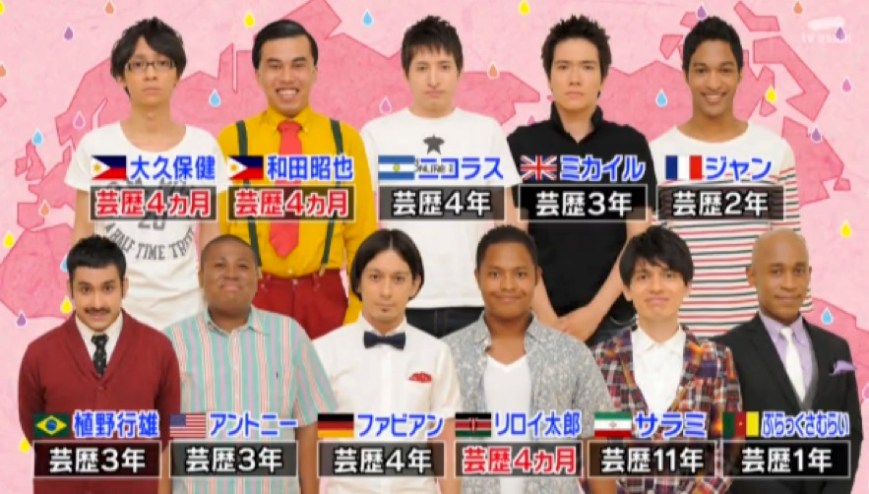
As you know, in Japan, multiracial models on TV have been popular. Recently, multiracial comedians become popular as well. They do not act like fashion models. They make people laugh by talking the story about the incident happened around them only because they are multiracial. First, Japanese are surprised that they can speak fluent Japanese and cannot speak English or another foreign language. Japanese also laugh at the characteristics the multiracial comedians share with other Japanese.

They had had many troubles and unique experiences which happened just because they are “hafu.” If we listen to their stories, we can know how hafu people are treated by Japanese. For example, Anthony, he is one of the ‘hafu comedians’. He is American and Japanese. People laugh at the fact that his hometown is Tokyo and his father managed a Sushi shop. He has knowledge about sushi because his home is sushi shop, but when he goes to a sushi shop, the master of sushi shop offered him ‘California roll’ and he was surprised. He has had other interesting experiences. He is bad at English, and when he was an elementary school student, he decided to go to English conversation school. On his first day of English conversation school, when he entered the classroom, other students misinterpreted him as an English teacher and they said “Hello, how are you?” to him.

I want to tell you about one more ‘half comedian’, Ueno Yukio. He was laughed at because of his obvious Japanese name. He is Brazilian and Japanese. When he plays soccer, the opposing team judged Yukio was a good soccer player by his appearance and many defenseman surrounded him. The opportunities to watch TV programs in which many ‘half comedians’ gather and talk about the things often happen around them are increasing. According to them, following things often happen: 

  • are judged to be foreign people
  • are often stopped by the police 
  • are asked by Japanese to sing foreign songs 
  • are laughed at by Japanese when they sing Japanese songs
  • are often expected to have high athletic ability
  • have difficulty getting a part time job
  • are invited to BBQ parties or Halloween parties
  • are called ‘Bob’ or ‘Michel’ 
  • are treated as tourists everywhere

Of course their nationality is Japanese and most of their hometown is Japan. Why they are laughed? Why do Japanese people stereotype their abilities? When Japanese look at people who look like “gaijin’’, Japanese often expect some specific skills because they have some assumptions. They think that people who have white, black, or other foreign appearance have foreign names and can speak foreign languages, and cannot speak Japanese at all.

It is true that hafu people are not a majority in Japan and many Japanese have little familiarity with thinking about race. That’s why people have expectations about the skills hafu people have. If hafu do not have these skills, Japanese laugh at them and hafu are unilaterally discouraged. 

Mimicking the non-existent

Anonymous student post

Body alterations are a strange thing. Just the words themselves—“body alterations”—make them seem so foreign to our lives, like they’re not something natural. Yet looking at people throughout my life has made me realize that body alteration has become the norm for many people, and desired by, perhaps, many more. If we were to look at how many people use make-up, have surgery, aim for a different body weight/composition, or even just get a piercing, we would see just how widespread this notion of changing our bodies is.

Yet, after reading Terry Kawashima’s (2002) article on racial indicators, I find body alterations strange in another sense. Kawashima discusses this idea of mimicry, in particular the mimicry of “white” traits by Japanese people, arguing throughout her paper that this is not the case for most of Japanese society. But it raised an interesting question about mimicry in relation to body alterations for me: When someone aims to alter their body, is it because they are trying to mimic something or someone else?

This can be a tricky question to navigate, as some will find it too broad a question while others will point out that there are as many reasons for changing one’s body as there are people. Despite this, I can’t help but feel that, at least from what I’ve seen and read, the answer just might be yes, but not in the way that the question is worded. The cautious reader will be skeptical, and thus, I suppose, explanations are in order.

Part of my answer is reinforced by some particular experiences of mine. Growing up with sisters can be difficult, especially when they are constantly attempting to put make-up on and dress fashionably, even when it makes you late for school. Anxiety, I learned, fueled my sister’s actions; she wanted to look “normal”, and thus she would groom herself constantly. For her, body modification was a way of becoming invisible. This resonates with my own experience growing up with raised bumps on my back. My mother, in all honesty, was more worried about them than I; she blamed them for the way I dressed and the activities I gave up when I was older, as well as for my shy and withdrawn personality. She went so far as to offer me a chance to have plastic surgery. Unable to explain to her (or myself) why my scars were not a problem to me, I consented.

After having plastic surgery on only two bumps, and after having grown up with more time to mull over that experience, I’ve realized that my mother believed I couldn’t think of myself as “normal” while I had something “subnormal”, especially when she saw the anxieties my sister held. Body modification, in this context, meant to her an attempt to elevate myself back to “the standard”.

Broadened to a larger scope, we can see in other’s experiences through things like blogs and academic literature that body modification extends across the board. It affects how people relate their body to race, gender, age, culture, health, and all these other touchy subjects that people seem afraid to address sometimes. And—again, from what I’ve seen and read—I think that all these changes that we make to our bodies has something to do with trying to obtain an ideal. In the end, it’s difficult to say that there’s some definitive “real” thing that people try to mimic, because most of the things I’ve listed are just social constructs. Race doesn’t biologically exist, health is relative, and age is reliant on different perceptions of time. In the end, perhaps all people are really trying to do is aim for something that’s not really obtainable because it does not exist in any measurable way. So in a way, we are trying to mimic something; it’s just not something that we can point to and say “there it is”.

Accepting a Cheap Imitation of “White Features” as Beauty in Japan

Anime Drawing / Download & Color it yourself!

(Photo credit: Serena.)

by Yuta Kobayashi

Shoujo Manga has existed in Japan since the early 1900s. Consisting of sensitive artwork and a storyline aimed for young girls, these visual novels have been a part of the lives of many Japanese women since childhood. Although the original target audience of these Shoujo Manga was the young female population in Japan, the release of animations and live action dramas of these mangas in recent years have broadened the target audience towards a much larger population. For this reason, Shoujo Manga can be currently considered to be a widely accepted genre within the Japanese society.

Shoujo Manga is generally known for their sensitive artwork and their dramatic storyline. In most cases, the audience understands that the stories and characters involved are purely constructed from the imaginations of the authors and realize that these visual novels do not necessarily portray reality. However, at the same time, it can be considered true that these visual novels have the potential to influence the lives and the behaviors of the audience in reality.

In “Seeing Faces, Making Races: Challenging Visual Tropes of Racial Difference,” Terry Kawashima (2002) suggests how in Japan, the modern ideal image of beauty consists of a mix of both traditional Japanese and White values. She introduces the fact that some of the features of the modern Japanese concept of beauty, for instance, large eyes, small hook like noses, small mouths, and a round face, are represented on the characters illustrated in Shoujo Manga. In Japanese society, women tend to value beauty very highly. As suggested by Kawashima (2002), what is considered as ideal and beautiful within the Japanese society will be performed and “imitated.” In essence, young women who read these Shoujo Manga will unconsciously attempt to imitate the beautiful looking role models in the novels.

Kawashima (2002) introduces the idea that the modern concept of beauty in Japan can be considered a cheap imitation of Western beauty. To an extent, this can be considered true. In Japan, hair coloring and the usage of Bihaku, or skin lightening, products as a means to enhance looks, especially among women, are common. This artificial form of beauty, in essence, can be obtained through the consumption and usage of cosmetic products. In this manner, it can be assumed and accepted that the modern concept of Japanese beauty is heavily influenced by various aspects of Western beauty.

Kawashima (2002) suggests that Japanese beauty is “oppressed” by Western values. For some people, it may seem odd that Japanese people prefer beauty that is considered not their own. To deny one’s own sense of “traditional” beauty for something artificial or foreign may be interpreted negatively by others. However, I believe that it is not always bad for one to accept an oppressed concept of beauty, especially if the society is willing to accept the idea. The concept of beauty is forever changing. The spontaneous behavior of people in society to act in such way is natural. To add, in a society like Japan, to be beautiful means many things. This cheap imitation of beauty may be interpreted negatively by some people, but for many Japanese people living in the Japanese context, this cheap imitation of beauty is an essential part of life in society.

Some Questions:

Who decides what Japanese people should look like?

Should Japanese people be free to define for themselves what Japanese beauty is?

References

Kawashima, T. (2002). “Seeing Faces, Making Races: Challenging Visual Tropes of Racial Difference.” Meridians, Vol. 3 – 1 (pp. 161-190).