Language is the Key to Work

Anonymous student post

According to Rumbaut (2008), there at least 191 million people who are immigrants all around the world. But many of these immigrants work with low paid work, such as blue collar work, even though they may have a university degree. This blog post will mainly focus on Scandinavian immigrants who have higher education and have to accept a low paid work to earn money. What’s the reason behind this?

First I want to introduce a story about a taxi driver who immigrated to Scandinavia. This taxi driver is from Iran with an education in medicine, he was a general practitioner back in Iran but in this new country, he couldn’t get any job as a general practitioner. He applied to many hospitals, but no one replied. In the end he took a job as a taxi driver so he could support his family.

I don’t know if this is a true story or not, I just remember that I read this story in a newspaper one morning ages ago. The main point in this story is that if you can’t speak the language properly you will not be able to get a job that fits your education. This is also very true with second generation of immigrants. 1/5 of second-generation immigrants that attend a university don’t always find a job fit for their education, and are instead forced to take low-paid work. Why can’t the immigrants get higher-paid work? The answer, I think, lies in the language difference. If the immigrants can’t speak or write properly they have it harder to find a job that fits their education.

Many second-generation immigrants attending the university have a hard time using the language fluently (academic writing and speaking), because many of these people lack the advanced vocabulary of the language. Why? I think this is mainly because these immigrants don’t have the chance to use “advanced” words in their daily life, for example, they can perform a conversation with friends that have similar vocabulary, but rarely do they get the chance to use “advanced” words in a “normal” conversation. If they use an “advanced” word in a conversation with friends or family, they may not understand the word and ask for an explanation or a substitute for the word.

But is the language everything? For the taxi driver it meant the difference between low-paid and high-paid work. He couldn’t speak the language fluently and got low-paid work. This is one of the bad sides; the society misses a lot of valuable resources because the immigrants can’t speak the language fluently, and will probably never do either. From this, another question rises, how can the society take advantage of these highly skilled workers even though they don’t speak the language fluently?

Should the Japanese Government Institute an Education System for Immigrants?

by Megumi Takase

In “International Sociology” class, I was surprised to hear that in Europe, students from other backgrounds take two or three times a week to have lessons in their native languages. In Japan, some elementary schools in which there are many foreign students have Japanese classes for them to understand regular Japanese classes. However, few schools have lessons for immigrants in their own languages. In addition, there are not many ethnic schools in Japan. Even though foreigners living in Japan mostly consist of Chinese, there are only 5 Chinese Schools in Japan. If children from other countries continue to attend Japanese schools and don’t do vigorous effort to learn their history or culture, they will have difficulty in building their identities. This is one of the reasons why foreigners are unwilling to live in Japan for a long time.

In my opinion, Japan should institute an education system for immigrants. For example, it should begin classes for immigrants in their native languages. It not only benefits students from other countries but also Japanese. It will increase the number of immigrants if Japanese education system is reformed in favor of foreigners. Japanese is suffering an aging society, so Japan will face the problem of lack of labor in the near future. Thus, Japan should accept immigrants to solve these problems. In order for foreigners to be willing to come and live in Japan, Japan should create the environment for them to live comfortably. One of reforms which Japan should tackle is education system.

It will also lead to intensification of international competitiveness of Japan if many foreigners immigrate to Japan. It is said that Japanese have difficulty in speaking foreign languages. In the times of globalization, people who are fluent in many languages are needed. If immigrants grow up as bilingual and begin to work in Japanese corporations, they will largely contribute to corporations.

If Japanese government begins to institute an education system for immigrants, many people will come from other countries and live in Japan. They will serve Japanese society. It is difficult for schools to begin classes for immigrants in their native languages because immigrants come from different countries around the world. Schools should create these classes cooperating with the local universities specializing in foreign languages. It will also lead to create Japanese bilingual students.

Reference

[i] Weblio. (n.d.). Retrived October 17, 2013 from http://www.weblio.jp/ontology/%E4%B8%AD%E8%8F%AF%E5%AD%A6%E6%A0%A1_1

On The Stress of Remaining “Neutral” – Reflections By Jeff Kosbie

by Robert Moorehead

I too have been accused … maybe accused isn’t the right word … I’ve had students ask that I be more neutral on the issues we discuss in class. The request is almost always meant in a kind way, since I tend to be rather passionate in my teaching. But I worry that it can also carry with it the idea that we’re reducing talk about science to everyone’s opinions. So, I would need to be open to opinions that are not supported by evidence, even when those opinions contradict decades of research that show a completely opposite pattern.

I try to push students to support their claims, to develop logical arguments that are supported by more than anecdotal evidence. Sociologists disagree with each other all the time, but we don’t (or at least shouldn’t) simply dismiss those with whom we disagree.

Should we be neutral in class? I think a better word is to be diplomatic, to create a classroom environment in which students can freely and respectfully share their ideas and test their understandings. We have to model the behavior we expect from our students, especially when we’re challenging their understandings. When faced with a professor who comes across as dismissive or “biased,” students may become more entrenched in defending their views, as if the classroom were a battle of wills. They also might avoid your classes the next time around. But neutrality in the face of illogical arguments and bad science? What’s the point?

Separate and Unequal: The Remedial Japanese Language Classroom as an Ethnic Project

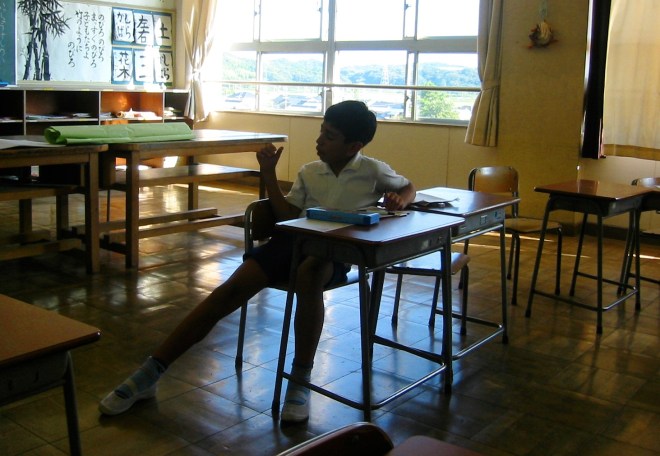
Peruvian Student Ricardo Relaxes in the Remedial Japanese Language Room

by Robert Moorehead

My article in The Asia-Pacific Journal examines the remedial Japanese language program at a school in central Japan. I argue that the program systematically denies educational resources to low-performing immigrant students. Despite the Japanese educational model of equality and inclusion, these immigrant students are tracked into a program that is separate and unequal.

Teachers explain this pattern in ethnic terms by referring to immigrant students’ supposed need not for specialized remedial instruction, but for relaxation as a break from the difficulties of learning Japanese.

To read more, please visit The Asia-Pacific Journal, a peer-reviewed, open source journal that focuses on the Asia-Pacific region. Also, check out Language and Citizenship in Japan, an edited volume published by Routledge.

Learning to read hiragana, katakana, kanji, and the air

Celebrate Diversity!by Robert Moorehead

With the spring semester now over, I’ve been thinking about the challenges of getting students to think differently about incorporating non-Japanese into Japanese society. The arguments students make and the ones sociologists usually cite in the research literature are like two roads that never meet.

As I’ve written before, students’ view of Japanese history seems to skip the roughly 100-year period between the Meiji Restoration and the Tokyo Olympics—nothing important happened in Japan between the 1860s and the 1960s, did it? Based on this, students often claim that Japanese people have little to no experience interacting with people of different cultural backgrounds. Plus, Japan is an island and thus was inaccessible to other groups. The invention of boats around the world apparently didn’t impact Japan … but I digress.

Students also state that Japan, unlike other countries, is a “high-context culture,” meaning that much communication in Japan is unspoken. Meanings are implied, and understanding those meanings requires reading between the lines and reading the context of the situation. Those who can’t “read the air” (空気を読む or “KY”) are treated as socially inept and may struggle in their social interactions.

This is a fair point, as communication in Japanese proceeds somewhat differently compared to communication in English, Spanish, or other languages. But, can’t people learn to “read the air”? Is Japanese culture so byzantine, so complex and inscrutable that non-Japanese can’t simply figure out how to talk to people?

Students also claim that because Japanese are not used to interacting with “KY” people, they can only accept people who are just like them. Interacting with non-native Japanese speakers and people who can’t “read the air” is too much work, so non-Japanese are just out of luck.

This inherently conservative argument could be extended to justify excluding pretty much anyone. Japanese women want a right to equal opportunities for employment? Too bad. They could never really understand men’s particular communication style, and their presence might make men uncomfortable—no more sex jokes in the workplace—so women will just have to settle for serving tea and lower pay. The disabled want to work? Sorry, accommodating their needs could be inconvenient, so they’ll just have to stay home. Okinawans and the Ainu want to express their cultural and linguistic distinctiveness in mainland Japan? Sorry.

This approach dismisses the rights of the individual in support of the rights of the majority. That is, the majority only has to respect the individual rights that are convenient. This approach fits with the LDP’s planned revisions to the Japanese Constitution. As Lawrence Repeta notes, these revisions would subordinate individual rights, such as free speech and free assembly, to the demands of public interest and public order.

On the one hand, I should be thanking students for their honesty. But do researchers cite any of these ideas when analyzing immigrant incorporation? I just finished teaching a course on international migration, and we spent the semester reviewing the sociological literature, including the main schools of thought, and issues of gender, education, transnationalism, citizenship, among others.

And not once in that literature did anyone talk about “high-context cultures,” or the whether interacting with cultural others might be too inconvenient.

So, have sociologists missed the boat? Are we just talking in circles, clueless as to the real issues?

Or is communicating across cultural and linguistic lines simply a fact of life for many people on the planet? Don’t we have to make all sorts of adjustments every day, even if we don’t have any foreigners in our midst? We communicate across lines of class, gender, age, and sexuality all the time, so why should we treat communicating across cultural lines as some special case?

As famed anthropologist Harumi Befu (2001) has noted, the United States is often held up as the main contrast to Japanese society. The US is multicultural and a nation of immigrants, while Japan is neither of those things. In the US, people complain about the challenges of diversity, like struggling to pronounce new names, understanding various accents, and talking with people who are still learning English. But … so what?

Seriously, so what? Is learning new names and using a modicum of patience to interact with non-Japanese really that difficult? Is “reading the air” really that complicated? Are foreigners really that inept at communicating in Japan?

Is it more difficult than figuring out how to pay for health care and pensions for Japan’s elderly, when Japan’s population is dropping and postwar boomers are retiring?

Since Commodore Perry’s black ships forced open Japan to international trade, Japan has gone through the Meiji Restoration, imperial expansion across much of East Asia and the Pacific, multiple wars, fire bombing, nuclear attacks, defeat, occupation, democratization, reconstruction, development into a global economic power, bubble economies, inflation, deflation, stagnation, population booms and declines, earthquakes, tsunami, and nuclear disasters.

Change is the constant. In light of all that, talking to foreigners seems like it should be the least of their worries.

References

Befu, Harumi. 2001. Hegemony and Homogeneity: An Anthropological Analysis of Nihonjinron. Melbourne: Trans Pacific Press.
Undocumented Immigrants in Hiding

by Maki Yoshikawa

In our class, we have studied about undocumented immigrants through video, and reading articles on real-life  undocumented immigrants.

I think it is very difficult to make it clear that undocumented immigrants in Japan should be accepted in this society or not. There are a lot of undocumented immigrants who want to stay in Japan. My opinion is that Japan should accept undocumented immigrants. Indeed, it is true that some Japanese people might lose their job because of increasing number of workers. However I suppose that undocumented immigrants are needed in Japan. Japanese society will not be able to survive on its own without help of foreigners. Some Japanese businesses still need workers to work, for example, farming, caring for aged people, fishing, and so on. In these kind of jobs, most Japanese are not willing to take these jobs.

On the other hand, these jobs are socially needed because the aging society is growing year by year, and the workers in the rice fields are also getting older. As everyone knows, rice is necessary in Japanese food. Who knows how to raise rice according to the changing seasons?  Who will take over the technique? After all, there are many kind of jobs which will definitely need people to succeed to. In addition, from my view, foreigners or immigrants can be engaged in these jobs. This will lead the problems which Japanese society having to be known worldwide and recruit people from all over the world. This will be more effective. However, there is a wall of documents and language when recruiting people from around the world.

It is very complex issue when it comes to children like Noriko Calderon. We have laws to follow, and human rights to protect. It is difficult to put weight on both. When we try to follow the laws, human rights tend to be violated as a term of undocumented immigrants. I insist parents are responsible for undocumented children like Noriko even if they had no choice. Children have no reason to be blamed and be restricted their rights. Therefore, as following the law, parents are supposed to leave the country. There is no way to avoid separation between parents and children. On the other hand, this situation must be changed. As a student like Noriko, I would not want more undocumented children in Japan and other countries to feel like her because they are not guilty, they were just born and raised without knowing they are undocumented.

The Japanese government must do something. However, for government, as a policy it is not appropriate to accept all immigrants without limit. For the first step, the Japanese government needs to promote awareness and interest of undocumented immigrants because a friend sitting next to us who looks completely Japanese might be undocumented immigrant who lives hiding his/her problem.

Is the DREAM Act Good for American Society?

by Satoshi Tanaka

In the United States, the DREAM Act has not yet been put into law. It is the act that the government gives a green card to the youth who have undocumented parents and who satisfy some conditions. These conditions are that they came to the U.S. before they were sixteen and that they have lived there more than five years. Moreover, to qualify, they must have a higher education or serve in the armed service at least for two years. Usually, these undocumented youth have lived only in the U.S., and they can speak English only. Therefore, if they are forced to go back their own countries, they would have a big difficulty from living. While the conditions to get a green card are not so easy for everyone, they would have a possibility to be accepted to live in the U.S. formally thanks to this act.

However, basically, I disagree with this act. First, this act may cause a problem. For example, it is difficult to deal with their parents, and this has been already discussed. Even if the youth get a green card and are accepted to live in the U.S., they have to be separated from their parents if the parents are forced to leave the U.S. During youth age, to be separated from the parents may have a big influence on their life. In addition to the risk of causing a problem, I disagree with the act because immigrating without permission is prohibited in a law. I know that undocumented immigrants left their home countries and came to the U.S. to survive. Therefore, if they are forced to leave from the U.S., they have to have a harder life in their home countries than life in the U.S. However, I think that it is needed to consider the reason why the government passed the law which prohibits immigration without permission. This is because any countries do not have enough capacity to accept all immigrants who they have a desire to come. To keep the social order, the government has to prohibit illegal immigration, and manage the number of immigrants.

Emotionally, I want the government to support these immigrants and their children and it is the best thing that they avoid having a hard life. However, the government cannot wrestle with the problem because of an emotional reason, and they have a responsibility to keep the social order. Therefore, I think that the government should not allow the special case, and they should deal with all immigrants equally.

Is the dream act a good solution for undocumented immigrants in the US?

by Ryohei Sugiyama

The DREAM Act is a law that was suggested in the US in 2000. The purpose of this law is to give young illegal immigrants the opportunity to get a higher education. In the US for a long time the treatment toward young illegal immigrants has been one of the largest sections of immigrant problems. Many of the young illegal immigrants do not have consciousness that they are illegal immigrants. They were taken with their parents and grew up most of their lives in the US. Therefore, there are few differences between these people and American citizens. Nevertheless, these do not get appropriate supports. At this point, the DREAM Act is the progress of the immigrant problem in the US.

If the DREAM Act is approved, young illegal immigrants can have the opportunity to live in the US legally. This is very good point of this law. Today there are a lot of illegal immigrants in the US. They are paying large amount of taxes each year, and actually they have a large influence on the economy of the US. Nevertheless, they get unfair treatment like not entering higher-level schools or not getting jobs because of their illegalness. Especially there is no reason for young immigrants to get unfair treatment. So long as there is no reason, the young illegal immigrants should get the same opportunity as the legal people in the US.

On the other hand, there are a few negative points in the DREAM Act. The article about the military is one of the examples of the negative points. In older for young illegal immigrants to get the legal status there are mainly two choices: one is the entering higher-level school for two years after graduating from high school in the US, and the other is the joining the military. Many of the young immigrants hope to advance a grade, however they sometimes cannot do it because they do not have enough money. In this case in older to get legal status they have to join the military. They may be sent to Iraq and be forced to engage in hard actions. In my opinion, it is an inhumane act. They have to get wounds so as to get rights.

In this way the DREAM Act has some good points and bad points. Therefore, I partly agree with this law and partly disagree. Bad points, of course, should be changed. For instance, in my idea, instead of joining the military, they should engage in public enterprises such as cleaning streets or works at public places. However, it is true that the government of the US intends to tackle with the problems of illegal immigrants. Dream act is the expression of the attitude of the government, and the governments should continue to tackle with the problems of illegal immigrants sincerely and positively.

References

Dream Act Portal. Retrieved June 26, 2013 from http://dreamact.info/

Is the dream act good for the US? Retrieved June 26th 2013 from http://shimamyuko.wordpress.com/2013/05/29/ドリーム法案は米経済にプラスかマイナスか?/#more-3416

Immigration, Development, and Human Rights

by Mei Satoi

In the documentary film of our class (The New Americans), we could see an immigrant family from Mexico. This family’s father worked in the United States separated from his family in Mexico. This situation made the Mexican family feel sad and uncomfortable life. Therefore they decided to move on the legal way to the U.S. On the other hand, the number of immigrants from Mexico is decreasing. As Mexico has been developing its economy and the U.S.’s development has slowed. So, Mexicans choose to get job and life in their homeland. It shows that economic development helps decrease immigrants. When you and your country want to decrease immigrant number, you should support the economic development.

In the Japan, there are some troubles between Korean schools and the government, or Korean schools and citizens. One example is that the Japanese government decided public high school in Japan will be free. However some people have insisted that Korean school do not have to be free and do not need support from the Japanese government. The reason why is that Korean school has settled under the North Korea system. So Japanese government said to make an exception so that Korean high schools will not be free. It means that only Korean school cannot get support from the Japanese government. However, the purpose of the free of high school law includes Korean schools. In the human rights view, Korean schools also should be free. However a lot of citizens have rejected this. This idea comes from discrimination, misunderstanding, and prejudge. The purpose of the free of high school law is protecting and respecting the children’s right to study. The Japanese government and citizen do not have the right to take the opportunity of education from children because of prejudice. In addition, the Japanese government is trying to produce more multicultural and global talented people in the Japanese educational system. Korean people help to feel and think what is multicultural to children.

There are some immigrant and Zainichi people in Japan. If Japanese wants to eliminate them, they should support their homeland’s economic situation. Then the number of immigrants would decrease. In the now, Japanese government has stopped economic support to the North Korea. Before Japanese complain about free Korean schools, they should help the North Korea situation. In addition, Japanese should protect and respect immigrant. To establish brush up education system with Japanese, immigrants, and Zainichi each other, talented people and high quality people are given from Japan.

Undocumented Immigrants and Their Rights to Family Life

by Kentaro Sakamoto

Is it OK to treat someone unfairly for something that is not his/her fault? Most people will probably answer “No” to this simple question, but in reality, many children of undocumented immigrant families are treated differently for something that they are not responsible for. Let’s see the case in the United States, where it has roughly 1 million unauthorized children (Passel and Cohn, 2011). Most of them were brought to America by their adult family members (Poe, 2012). They go to American schools and they are part of American society, but since they do not have American citizenship, they cannot do things that regular Americans can do, such as getting a driver’s license, getting a passport, getting scholarship for their education, and getting a job legally. Some of them had not even know that they were undocumented until they decided to get a job or a driver’s license. However, undocumented immigrants raised in the United States are now starting to stand up for their rights. Many organizations demanding equal rights for them have been formed, calling America to change its laws (Immigrant Youth Justice League, 2013). Thanks to their effort, President Obama announced that he will stop deporting certain young undocumented immigrants. He also supports giving them a chance to officially become legal residents if they go to college or serve for the military for 2 years, which can give them the qualification to apply for U.S. citizenship (Poe, 2012). The situation of undocumented children are starting to change, and more people are starting to recognize their rights.

However, they still cannot fully enjoy the rights that other ordinary Americans do. Their rights to family life are not guaranteed. Moreover, this right is not only a problem for undocumented children, but also for children with American citizenship who have undocumented parents. Families have been divided due to the difference of legal status within the family; the parents are deported while their children are allowed to stay in the country (Cave, 2012). These children have to make a very difficult decision, either to stay in America without their parents or to follow them to a country they do not know much about. This is not merely a problem in the United States, but it also became a sensation in Japan when the situation of Calderon family was reported in the news. They were forced to be separated because of the father and mother’s undocumented status. Noriko Calderon, the daughter of the family who was allowed to stay in Japan due to special measures, had two choices: staying in Japan by herself, or going to the Philippines with her deported parents. She eventually decided to stay in Japan, where she was born and raised and where she had all her friends, and in compensation, she had to make her farewell to her parents. Her right to family life was violated.

The right to family life is determined in Article 9 of the Convention on the Rights of the Child (CRC) ratified by 193 countries and regions (Tanaka et al., 2013). The article says all children have the right to live with their parents unless it creates an environment that is bad for them, such as child abuse (Ibid). America hasn’t ratified this treaty yet (Ibid). Japan ratified, but it declared to interpret Article 9 from its own viewpoint to justify family separation caused by deportation (Ministry of Foreign Affairs of Japan, n.d.). This attitude is criticized by the Committee on the Rights of the Child, asking Japan to change its distinctive interpretation of the article (Ibid). Unfortunately the two major countries that call themselves the ‘champion of human rights’ are violating this right while many other countries are protecting it.

Since the right to family life is an internationally recognized right, countries such as the U.S. and Japan should protect this by ensuring children to stay with their family in the place where they are raised, regardless of their legal status. Children themselves are not responsible for what kind of legal status they or their parents have. Laws in general are made to protect human rights and ensure fairness, and this general principle of law should be applied to all community members contributing to the society, especially if they are raised in the community. Therefore, I think laws violating the community members’ rights (in this case, the rights of children who are raised in the community by their undocumented parents) should be changed immediately. Japan anyway needs more immigrants to support its economy, and the government is actually trying to accept more of them from outside of the country (Gi, 2000), but I think it will be much smoother if we accept those who are already living in Japan, those who know how to live in this country, and those who have their friends, husband, wife and even children here. Why can’t we protect the rights of our community members?

References

Cave, D. (2012, June 18). American children, now struggling to adjust to life in Mexico. The New York Times. Retrieved June 27, 2013, from http://www.nytimes.com/2012/06/19/world/americas/american-born-children-struggle-to-adjust-in-mexico.html?pagewanted=all

Gi, H. (2000, June 9). Nippon de kurashitai: Huhou taizai kazoku tachi no kizuna [We want to live in Japan: The bonds of illegal immigrant families]. Fuji Terebi [Fuji Television]. Retrieved June 27, 2013, from http://www.fujitv.co.jp/b_hp/fnsaward/backnumber/back/00-167.html

Immigrant Youth Justice League. (2013). About us. Immigration Youth Justice League. Retrieved June 27, 2013, from http://www.iyjl.org/about-2/

Ministry of Foreign Affairs of Japan. (n.d.). Dai ikkai houkokusho shinsa: Jidou no kenri ni kansuru iinkai kara no shitsumon ni taisuru kaitou [Examination of the first report: The answer to the question asked by the Committee on the Rights of the Child]. Ministry of Foreign Affairs of Japan. Retrieved June 27, 2013, from http://www.mofa.go.jp/mofaj/gaiko/jido/9605kaito/

Passel, J. S., & Cohn, D. (2011). New patterns in US immigration, 2011: Uncertainty for reform. University of California, Davis. Retrieved June 27, 2013, from http://migrationfiles.ucdavis.edu/uploads/cf/files/2011-may/passel-new-patterns-in-us-immigration.pdf

Poe, C. (June 16, 2012). DREAM Act: Obama stops deportation of children of illegal immigrants. The Washington Times. Retrieved June 27, 2013, from http://communities.washingtontimes.com/neighborhood/ad-lib/2012/jun/16/dream-act-obama-stops-deportation-children-illegal/

Tanaka, N., Yakushiji, K., Sakamoto, M., Asada, M., Kiriyama, T., Obata, I., & Shibata, A. (2013). Beshikku Jyouyakushu [Basic documents of international law]. Tokyo: Toushindo.