Beauty Standards in the White Imagination

by Shinoko Itakura

The phenomenon of changing skin color has been happening all over the world. Some attempt to get lighter skin and some attempt to get tan skin. The reasons behind those two attempts seem opposite yet, the purpose is the same, “high class”. The symbol of high class depends on where you are, and how the standard of the beauty has been created in your society, because the standard of beauty  includes class status.

But who created the standard of beauty and how? We tend to describe people who have straight jet-black hair, and large, double lidded, almond-shaped eyes as “Asian beauty”. Even though we are Asian, whenever we see people who have those facial features, we say, “You are beautiful like Asian beauty!” In fact one of my colleague just described another colleague as an “Asian beauty” the other day. It just feels weird when Asian people describe another Asian as an “Asian beauty”. This is because the idea of Asian beauty has been created in the white imagination. We do not say European beauty or Latin beauty, because the standard of beauty is already based on European (white) features. What is more, something which is called a “universal standard” or “universal beauty” is just not universal. It always based on physical features of white people.

The standard of beauty seems to be controlled by mass media and the marketing of cosmetic products. Cosmetics companies use many strategies to gain more and more profits. “Relatable” is one of the important key concepts; if consumers find any similarity to the advertising models, for example “Asian-ness”, they believe that they can achieve those models’  look, and the universal standard of beauty. Those advertisements do not directly say “you guys can be like this model, if you use this products!” yet they are implying this by using racially ambiguous models. In order to sell the products, they also give us images of dark skin as dangerous, unhealthy, bad, and wrong by using terms such as aging or skin cancer. But what really matters is “skin color”.

I feel wrath about how skin-lightening products are marketed. It is so depressing that somehow we have to feel pressure of skin color or looking, and have to try to look like someone else, just because we are not white. This situation must be stopped and there should be the world which do not judge you by your skin color.

Enhanced by Zemanta

From Ebony to Ivory: Colorism in the Philippines

by Jiyang Shin

The ever-expanding skin whitening market in the Philippines seems to have distinctive characteristics compared to the markets of other countries that also value lighter skin tones. In the discourse of colorism, many tend to conclude that the phenomenon of skin whitening obsession is largely due colonization by European conquistadors; however, that is not always the case in the Philippines.

I would like to raise an example of skin whitening advertisement, featuring Jinky Oda, an African American comedian in the Philippines. The advertisement is composed of before-and-after pictures of Oda. On the left hand side is Oda’s torso before she went on the skin whitening pill. She is in a white tank top, wears gold hoop earings, and has her natural curly hair all swept back with bandana like hair band; a casual style of a typical African American woman that we can easily relate to.

On the right hand side is Oda after finishing the pill, in her brand new bleached-up skin. However, that is not the only significant difference that one can tell from the picture. Other noticeable features are that her attire is considerably more dressy than the left side (you can notice it although the ad only shows down to her chest), but even more importantly, the texture of her hair has turned silky and straightened like the East Asian look that a vast number of Filipino women crave.

One can observe sinister motives behind this marketing. In the book Shades of Difference, Joanne L. Rondilla argues that there are generally three major messages that are conveyed in skin whitening advertisement in the Philippines:

1. Darkening can and must be stopped.

Why? Because having dark skin does not make you good enough.

2. Lightness comes from “within”.

This message misleads people into thinking that their natural color is lighter than they expected, thus their desire to turn white is achievable.

3. Lightening can happen instantly.

The advertisement that featured Oda is unethical because it links having darker skin with wrongness by dressing up her in casual attire. In addition, she seems to have more weight in her before picture, implying she was sloppier when she had a darker skin tone (fatness is often linked to laziness). Such indirect messages have the great potential of stirring up or further encourage racism and discriminations against certain groups of people.

As for why many women in the Philippines opt for a Chinese or Korean look, I argue that it is due to racial hierarchy that exists among Asian countries. For example, in South Korea, people of Southeast Asia origin encounter difficulties renting rooms and searching for jobs. Moreover, in Japan, Filipino people are often referred to as “Pina”, which is a derogatory term used against women who perform in sex-related work. Such unequal treatment might have gradually developed a sense of inferiority towards people of lighter skin color in East Asian countries. I argue that people attempt to escape from such discriminations by assimilating into those who discriminate against them.

Enhanced by Zemanta

Selling whiter skin for beauty

by Kohsei Ishimoto

In Evelyn Nakano Glenn’s Shades of Difference: Why Skin Color Matters (2009), Joanne L. Rondilla looks at the different techniques are used in the cosmetics industry. When looking at the Philippines, advertisements focus on ‘whitening’ the skin, because the people in the country tend to have darker skin. On the other hand, when looking at European countries, advertisements look at ‘brightening’ the skin, for there is the idea that people in these countries naturally have light skin.

When looking at these advertisements, it can be seen that to be beautiful, you must have white skin. Rondilla explains that there are many people in the Philippines who buy skin-whitening products to look beautiful, but is being ‘white’ really being beautiful? The main answer to why ‘white’ is thought to be ‘beautiful’ is colonization. To the countries that had been colonized, the European countries had been superior, fixing the image that ‘whites’ are ‘better’.

When reading Rondilla’s chapter, however, it can be seen that there are various ‘types’ of white skin. One is the European beauty that was mentioned earlier, and the other the ‘Asian beauty’. This refers to East Asian countries, such as China and Japan. Filipinos are actually looking at ‘Asian beauty’, possibly because these countries are closer to them. In Japan’s case, the country looks at being ‘white’, trying to achieve the European look. This statement can be said to be wrong however, for recently Japanese people want to be seen as individuals.

When looking at various advertisements, it can be seen that models of different skin tones are used. For advertisements that use ‘white’ women, companies state that they are the ‘result’ of the product. On the other hand, companies that use models of a darker tone state that it does not look ‘right’, telling the consumers to change by buying the product. It is a fact that many purchase skin-whitening products to gain their ‘beauty’, but exactly how close are they to their ideal image? Will consumers ever believe that they are beautiful enough? The answer to this is probably no. The cosmetics industry has control over the consumers, by selling only a small portion of a product, or changing advertising techniques to trick us into believing that our images are not yet satisfactory. When thinking about this, it is interesting to wonder why people use cosmetics in the first place. Can not having any make-up on be considered beautiful? The answer to this can be explained through society; how people see you, and how you want to be seen.

Enhanced by Zemanta

“Making a choice” or “forceful separation”?

by Kyungyeon Chung

On the walls of immigration bureau offices in Japan, one can easily spot posters regarding dual citizenship. As the Japanese government does not recognize dual citizenship of its citizens, these posters usually say something along the line of  “let’s make it clear: choose your nationality,” “make a choice: no more duality.” Somehow, the rhetoric of posters seems to suggest that dual citizenship is unclear, undesirable, and duplicate, and thus a negative thing.
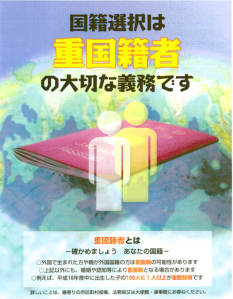
Today, in the face of increasing immigration and the growing flow of goods, services and persons across state borders, the concept of dual citizenship has arisen as a politically hot topic. While some argue that the recognition of dual citizenship is simply a legislative act that allows freedom, many believe it means more than granting of an extra passport. Opponents for the recognition argue it will complicate bureaucratic administration for the government. However, the most prominent argument behind the opposition is that the concept is not compatible with what “citizenship” entails. Citizenship has long been associated with state-control over its people – ‘citizenry’ – and, as T.H. Marshall defined, “a claim to be accepted as full members of the society” (Bloemraad, Korteweg & Yurdakul, 2008). Dual citizenship effectively challenges this idea of state-control as it allows the person to be a member of two separate societies, eligible for two separate sets of privileges, and obligated to two separate sets of duties.

Screen Shot 2014-05-26 at 1.17.07 PMThe confusion it causes is understandable. However, forcing one to choose one citizenship over another – the father’s over mother’s, the birth country over the country of residence, or vice versa – is this reasonable? In an opinion article from the New York Times, Mark Krikorian, the executive director of the Center for Immigration Studies argued that, for US nationals, engaging in dual citizenship basically means renouncing US citizenship, and is an absurdity that should be prohibited (2014). However, having two passports cannot possibly mean that one is betraying their ‘native’ country. For many immigrants, their children, and expatriates around the world, dual citizenship is about having freedom of association. Just because a person has moved from his/her native country to another, it does not mean he/she automatically renounces, forgets, or even wants to distance from the past. As time passes their emotional attachment and/or political participation can grow in both countries. In such situations, denying the chance of dual citizenship forcefully imposes what a person’s identity should be or where his/her allegiance should lie – does this not qualify as an infringement on freedom of personal choice? It effectively forces them to officially renounce their past so that they can be ‘loyal’ citizens of the present country of residence. If that’s what opponents want to achieve by invalidating dual citizenship, how effective could this possibly be anyway in forming allegiance?

It is more likely that dual citizenship is an irreversible and unavoidable occurrence in the face of globalization. Multiple national, racial and ethnic identities will continue to grow unabated no matter what governmental policies are in place. Recognizing multiple nationalities may be a nuisance for many governments, especially the ones who believe in their perceived ‘homogeneity’. Yet, eventually, the time will come that they have to admit the presence of diversity within the artificially set state borders.

References

Bloemraad, I., Korteweg, A., & Yurdakul, G. (2008). Citizenship And Immigration: Multiculturalism, Assimilation, And Challenges To The Nation-State. Annual Review of Sociology, 34(1), 153-179.

Krikorian, M. (2014, January 30). An exclusive relationship. International New York Times. Retrieved May 18, 2014, from http://www.nytimes.com/roomfordebate/2012/05/14/can-dual-citizens-be-good-americans/citizenship-should-be-an-exclusive-relationship

法務省 (The Government of Japan Ministry of Justice). (n.d.). 国籍選択について (About choosing nationality). Retrieved May 18, 2014, from http://www.moj.go.jp/MINJI/minji06.html


Who needs a husband?

Note from Editor: Students are reading Anne Allison’s book Precarious Japan, and sharing their thoughts on how their own future plans are impacted by the instability and insecurity that Allison describes.

by Zhang Shiwen

Work is more loyal than a husband, I think. My ibasho will be my work in the future, as well as my ibasho is my university now. The reason is simple, because if I am not a student or a worker in Japan, I cannot continue living in Japan. Moreover, I can feel that I am valuable when I get a good grade in test or I am needed by my friends, such as having a party after school or going for a trip together. In fact, when I was a student in language school, I was living like a hikikomori (Allison, 2013). I felt pressure from teachers that they want me to go to a good university. On the other hand, I did not have good friends and could not have communication with Japanese. I preferred staying in the dormitory, but I felt so lonely and meaningless at that time. Due to that, being a university student really made me comfortable and my life meaningful. Therefore, my ibasho will be my work which will give me the same value, I hope.

However, if I work in Japan, my work will betray me if I do not have a husband. 10 years later, I will be 30 years old. According to Heikinchokonneirei (n,d.), it is known that 40 years ago in Japan, I should have married by the age of 24 years. However, will it be the best time for me, a 30 years old woman 10 years later, to get married, or it will be later?

What’s more, I have watched a Japanese drama that the main character, a 30 years old Cabin Attendant who was working in a big airline company, was fired at her best period in her career because the company would pay more money to new, young employees. It means that although the situation of women employees is becoming better, women and foreigners like me are the most precarious people in Japan, as Allison (2013) notes. Due to this, even if I want to continue working, from the view of company, they may get more benefits from hiring an unskilled, low-paid youth than me, who is high-paid and skilled. Also, unmarried is looked as irresponsible to the society. Therefore, for women working in Japan, it is hard for them to say “Who needs a husband”, because the society, where the shoshika (low birth rate) is advancing, need women to have husbands!

My other ibasho is my home with my parents, so I hope to have a job which can make me come and go from China to Japan. My parents have no wish to live in Japan, but I should take care of them after they retire. Due to this, I am not sure where should I live after I retire. Therefore, if I work for a Japanese company and pay pension contributions to Japanese government every month in the future, but I finally decide to go back to China, I cannot take back all insurance money I have paid, and also I cannot enjoy the Japanese welfare system. At the same time, the Chinese government will not provide me social security because I have not paid for the Chinese pension system, so how can I feed myself after I retire?

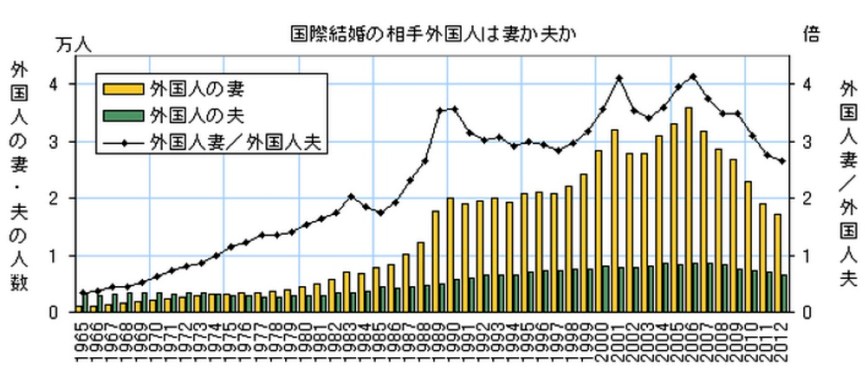
The situation will be better if I can take the right of permanent residence, while it is not very easy. However, a quick and easy way is to marry a Japanese man, which is also recommend by my parents. Therefore, is it good for foreigners to have a Japanese spouse? From Appendix A, it is known that the foreign wives are twice as common as husbands. I believe that most of them are married by love, but some Chinese wives I have known cannot speak Japanese well and seldom have Japanese friends. Caring for the children and their house are the only things they need to do.

Appendix A (Retrieved from http://www2.ttcn.ne.jp/honkawa/1190.html)

Appendix A (Retrieved from http://www2.ttcn.ne.jp/honkawa/1190.html)

In conclusion, it will continue to be hard for women in Japan to be independent from the social or familial role, as Allison (2013, p.22) notes. On the other hand, the pressure of managing both work and family became larger. Women are encouraged to work hard but precariously, and at the same time, they are blamed for not marrying.

I think it is very important for women to marry and have a family, but it should not be done for  the society or family. I means that we relay on our family for spirit,but not for pressure from parents, companies, and the society. Therefore, the government should provide an environment for women to make better choices for themselves and by themselves.

References

Allison,A. (2013). Precarious Japan. Durham, NC: Duke University Press.

Heikinchokonneirei no Suii [The change in the average age of marriage]. Keikon Rikon deta.Net [Marrige and Divorce Net.] (n.d.) Retrieved from http://www.kekkon-data.net/marriage/cnt/heikin_shokon.php

Enhanced by Zemanta

The future is fluid and invisible

Note from Editor: Students are reading Anne Allison’s book Precarious Japan, and sharing their thoughts on how their own future plans are impacted by the instability and insecurity that Allison describes.

by Kota Yanigadani

The future is not fixed, it is fluid and invisible, but still we can have a plan on our future and even try to realize the future. My future is after working at some professional workplace about security or conflict resolution, working, as a world citizen, to reduce violence in the world, correct injustice, and thus end poverty in the world. Therefore, in this post, connections between my future plans and Anne Allison’s vision of Japan are mentioned.

First of all, the current precarious condition in Japan does not have a big influence on my plan superficially. According to Allison, the mainly aging population, people in solitude in  gray zones, lower positions for women, and the typical company employment system are precarious conditions in Japan. On the aging population and seniors, I do not think the truth is so serious because technology is progressing rapidly. Robot industry can solve work forces in the future, and robot can be the catalyst for people and seniors. From this point, I do not think these are related to helping people suffering from poverty and violence. Also, the typical company employment does not have an influence on my future, because as today’s plan, I do not plan to work as a company man.

Second, my ibasho is actually my family and university. University is ba for me to prove myself, and I always feel comforted by being at home. However, what makes my identity is not my nationality. Recently, I have felt as if I am a cosmopolitan, which means I have strong global, world citizenship. To put it simply, while my ibasho is my family and ba is my university, my identity is not Japanese, but world citizen.

Finally, still I have more habits as Japanese compared to other nationalities, and Allison’s view on Japan is really common to me. The most similar vision is that Japan has a strong vertical relation among people. For example, when we meet people being older than us, we usually use keigo, which is polite communication tool in Japan, and we use more polite keigo when we talk with boss in our workplace. When I met president of our company at my workplace, actually I had the most polite posture and used clear keigo.

In addition to this, there is common system in Japanese company called nenkojoretsu, which Allison mentioned. This system is the longer you work in a company, the higher position and salary you can have. However, recently due to this system, a lot of people, especially young people have been fired and some bosses are really incapable, since they do not have much experience of competing for survival in their companies. I believe the system of vertical society and nenkoujoretsu have given rise to one kind of precarious condition in Japan today.

In conclusion, a unique style of society in Japan actually has an impact on my future plan, even though that seems this impact is not a big deal. Family is my ibasho, which should be common to many people. Given the company, because it is too typical to be a company man, working as a salary man is not first-choice for me as I said. Basically, I do not want to end my life too normally, which is to work in a company, to have a family, to see grandson, to end life happily. Instead of this, I always think I would like to make some change, or do some big things, which led to my quite big future plan. In that sense, some condition of Japan like Allison said might have a big impact on my future plan.

Enhanced by Zemanta

Discovering the importance of ibasho

Note from Editor: Students are reading Anne Allison’s book Precarious Japan, and sharing their thoughts on how their own future plans are impacted by the instability and insecurity that Allison describes.

Anonymous student post

Anne Allison views the problems Japan faces from a lot of perspectives. I am very interested in topic about human relationship and ibasho. Therefore I want to think about it related to my experiences.

I became a university student one year ago, and I began living by myself. What I felt strongly in my university life as a freshman is that life consists of a continuance of acts of choosing something. Because I can choose almost all things by myself, I have to take responsibility by myself. I have had more time to face that by myself and imagine my future since I had such an idea. When I think about my future, that is almost shushoku and shukatsu, I often talk to myself what is most important thing in my life at the same time, because I consider future plan is deeply connected with what I value. In thinking about that, I realized that my view on the family has changed so far.

In short, it was not until I left my hometown and lived alone that I understood how valuable my family is. I knew that the greatness of my mother who raised me and my brother by herself with working every day, and how much I have been supported by family for the first time. If I am worried about something, my family always listens to my worries and gives good advice for me. My family accepts and loves me no matter what I am, and filled with my desire of recognition absolutely. I was sure that family is ibasho for me after reading Allison’s paper.

As Allison says, current Japanese society is unstable, liquid and precarious. Human relationships get to be thin more and more, and many people seek their real ibasho. I know it is important to have a “good” job and earn much money, and praised by many people, however, it is more essential to get deep human relationship and feeling of spiritual satisfaction in like there society.

I have not decided concrete my future plan and what I choose as my occupation yet. However, I have the core of myself, that is, I want to be a person who can be proud of myself to the family and protect ibasho. Moreover, I also hope to become a person who can support someone as one of their

Man thinking on a train journey.

Man thinking on a train journey. (Photo credit: Wikipedia)

ibasho.

Enhanced by Zemanta

Family would be my ibasho

Note from Editor: Students are reading Anne Allison’s book Precarious Japan, and sharing their thoughts on how their own future plans are impacted by the instability and insecurity that Allison describes.

Anonymous student post

I hope to get a job as a regular worker and get married and have children for my future. Actually I have only indefinite work plans for my future, however I really hope to get a job in which I can communicate with many people because it will bring me up to talk with all sorts of people. It would make me feel narrow and uncomfortable if there is only one or two ba for me even now. My life is full and enjoyable because I have several my ba, family, friends, relative, university, workplace as a part time. All of them help me differently to have great every day and any one can’t lack in my life. Therefore I hope to get married and have my family and keep working while I can work.

Family would be my ibasho. I consider ibasho as where I can show my everything and don’t need to pretend to be tough. Family is the most suitable place to be ibasho. That’s why I hope to get married and have a family. My mother works part-time and she welcomes me whenever I come back home from school, therefore it is difficult to imagine both mother and father working full-time. However I hope to raise children and keep working. I’m not sure it would go well because I’ve never experienced the family I hope to have in my future. My father and mother are almost typical a husband and wife, my father is a sarari-man and works to support my family, and my mother is a part-time worker and does all household work.

The media often says it is getting difficult to raise children in Japanese modern society because of the insufficiency to guarantee child rearing. It is one of the serious problems that the number of children who need to go to the nursery school exceeds the actual number of the children that nursery schools can accept. It can be said that one of the causes of the declining birthrate in Japanese society is related to lack of satisfaction with such guarantees. I hope there will be a better society in which to raise children, and that the birthrate would recover.

I’ve thought family would help me anytime, even though some people consider that having family might bring more risks than staying alone. I would like to get married and raise children while continuing to work because my family would be my ibasho and working would give me the strength to get through my life.

Enhanced by Zemanta

Skin whiteners and beauty: the impact of global markets

Royal Siam natural skin whitening products

Royal Siam natural skin whitening products (Photo credit: RoyalSiamBeauty)

by Jiyang Shin

Skin bleaching has become such a steady market across the globe that without even trying, one may end up purchasing a skin product that contains substances that make your skin tone lighter, brighter, thus “healthier”, as some cosmetics companies advertise. What this phenomenon signifies is that the majority of society values whiter skin over their natural skin tone. 

A colleague of mine, who is Japanese and has a relatively darker skin tone, once went to a cosmetics corner of a department store and asked the store clerk which shades of eyeshadow would match her color. However, instead of getting her an eyeshadow that she expected, the store clerk recommended her a product that will make her skin glow and bright. I was stunned when she shared her story because the beauty industry (and other political factors) not only succeeded in creating the image of beauty, but it has come to a point where it is socially acceptable for a store clerk to force her skin bleaching worship on individuals who are perfectly confident with their natural skin tone. Skin bleaching has established a firm position in our society that it is almost as if we are given no other option but to turn white.

It is a common theory that the phenomenon of global skin-whitening obsession largely is due to colonial occupation by European nations, and this could also suggest the possibility that our perception of beauty is significantly determined by the distribution of power and wealth among the various racial groups (the whiter, the superior). In recent years, tanning has become a new trend among the young population in the US, and even politicians such as Mitt Romney. Karen Sternheimer (2010) argues that the emergence of the middle class and the automation of labor after World War I re-identified being outside as more with leisure than with work. Being able to afford a vacation in tropical islands is the new richness, so to say.

However, I believe that the current wave of tanning trend, although still dominant, is more complex than the shift in social perception of being outside. Ethnically ambiguous models are frequently featured in advertisement of fashion retailers such as H&M in recent years. It is reasonable to argue that being multiracial is becoming the new definition of beauty, signifying that having white skin will no longer be a necessary criterion to be perceived as pretty.

Reference

Sternheimer, Karen. 2010. “Lightness and whiteness.” Everyday Sociologyhttp://nortonbooks.typepad.com/everydaysociology/2010/05/lightness-and-whiteness.html

Enhanced by Zemanta

But we’re speaking Japanese!

This funny video tackles the issue of how we often struggle when someone’s race doesn’t seem to match our expectations of how the person should act. People who might look Japanese don’t necessarily speak the language, while people who might look like gaijin (ahem, like me) can be quite fluent.

This video really resonates with me, as I just came back from presenting at a conference in Daegu, Korea, on migration in Asia. The conference had speakers from several Korean universities, and representatives from Taiwan, Vietnam, the Philippines, and Japan. As the representative of Japan, I was the only non-native to represent a country—and the only non-Asian at the conference. And yet no one seemed surprised that the speaker from Japan was a white guy from the United States, who was talking about Peruvians in Japan. A sign of progress, perhaps.