
Online Identities and the Growth of Social Media

Profile shown on Thefacebook in 2005

Profile shown on Thefacebook in 2005 (Photo credit: Wikipedia)

by Michael McDonnell

For many of us, the Internet has become an inescapable part of our everyday lives. For many it has always been an inescapable part of their lives, but what effect has this had on how we view and present ourselves? In the article “Face Value,” Mary Gray (2007) gives us a look at the early days of social media. She names three social media sites. Facebook, MySpace and Friendster, all three of which offered the same basic service, a space online to connect with people in your current real life networks, get to know them more easily and, through posting your own updates or pictures, let people get to know you.

In the intervening seven years, social media has grown. According to a study by the Pew Internet Project, 74% of online adults use social media. Facebook is still the largest single social media site with 71% of online adults using the site. The market has fragmented, however. More social media sites have sprung up to fill perceived gaps in the market. For example, Instagram is a platform for people to post photographs that usually the user has taken themselves. Tumblr allows users to share pictures, videos and articles that they find interesting or to share content that has been posted by people they are connected with. Twitter allows users to post comments or status updates with a maximum of 140 characters.

This proliferation of social media sites has led to the fragmentation of personalities. Gray points out that we have always had multiple facets to our personality that we would portray and allow people to develop an impression of us. The difference is that now, with social media sites, we can better tailor the image we want to portray and emphasize aspects of ourselves to different outlets.

The average person has two social media accounts. Statistically these are most likely to be Facebook and Twitter. Due to their formats, the same message is unlikely to be posted to each platform but must be edited. Facebook allows long form posts, multiple photographs in a post, links etc. Twitter on the other hand limits users to 140 characters per post. This forces users to edit their thoughts, to either cut excess material or reword their thoughts. This cannot be done without extra consideration as to what you want to say. On top of this, each social network has a different user base and communities within it. These different audiences can have an effect on how users portrays themselves.

This division of our personalities across multiple social networks has had the side effect of allowing businesses to integrate themselves more easily into our daily lives. The acceptance of multiple identities has facilitated the creation of multiple accounts being set up to appeal to different parts of the market. A newspaper, rather than just one account, can instead have one for each section, allowing them to deliver information to customers without flooding them with content that does not interest them. The specificity of each social network also makes it easier for businesses to study how they work and integrate their content into the network without negatively disrupting it.

One negative aspect of this change in how we present ourselves is that the increasing disconnect between our online and physical selves makes falsifying our identity or at least aspects of it. It becomes impossible to trust that a person is who they say they are. Also, if our online self becomes more malleable and adjustable, there is more likelihood that it will not mesh with our offline self.

There are definitely good and bad points to the use of social media in this way but whether it will lead to long term problems still remains to be seen. Ellison (2013) describes our online persona as being like an actor on a stage. As more people join multiple social networks, it’s as if we are trying to perform different plays to different audiences at the same time.

References

Beckland, J. 2011. Why Mainstream Social Networks Complicate Our Identities. Mashable. Available at: http://mashable.com/2011/09/01/social-media-identities/

Casserly, M. 2011. Multiple Personalities And Social Media: The Many Faces of Me. Forbes. Available at: http://www.forbes.com/sites/meghancasserly/2011/01/26/multiple-personalities-and-social-media-the-many-faces-of-me/

Changizi, M. 2014. Multiple Personality Social Media. Science 2.0. Available at: http://www.science20.com/mark_changizi/multiple_personality_social_media

Ellison, N. 2013. Future Identities: Changing identities in the UK – the next 10 years. http://www.gov.uk. Available at: https://www.gov.uk/government/uploads/system/uploads/attachment_data/file/275752/13-505-social-media-and-identity.pdf

Gray, M. 2007. Face Value. Contexts 6(2):73-75.

Lytle, R. (2013). When One Social Network Is Enough. Mashable. Available at: http://mashable.com/2013/05/26/social-network-enough/

Pew Research Center’s Internet & American Life Project, (2013). Social Networking Fact Sheet. Available at: http://www.pewinternet.org/fact- sheets/social-networking-fact-sheet/

Radacati, S. and Yamasaki, T. (2014). Social Media Market, 2012-2016. http://www.radicati.com. Available at: http://www.radicati.com/wp/wp-content/uploads/2012/05/Social-Media-Market-2012-2016-Executive-Summary.pdf

Statisticbrain.com, (2014). Social Networking Statistics | Statistic Brain. Available at: http://www.statisticbrain.com/social-networking-statistics/

Reforming surgery and the self: Plastic surgery, historical traumas, and beauty in Korea

Girl’s Generation, a very popular K-pop group consisting of nine women who are considered ideal in South Korea

by Lisbeth Lyngs

Plastic surgery and skin whitening have in recent years become a hot and very normalized topic in Asia. Especially in South Korea, where one in five women has undergone some sort of cosmetic surgery, compared to around one in 20 in the U.S., according to the International Society of Aesthetic Plastic Surgeons. Their desired look is the same: Big eyes with double eyelids, white skin, a nose that sticks out and a slimmer jawline. A high Korean consumer culture has made women equate this beauty standard with a higher life quality, better jobs and more luck in marriage. Feminist cries of objectification are overheard, and as I see it, the racial argument that it is “to look white” has faded – as Asia’s own mainstream culture, especially K-pop culture, has grown.

K-pop is pop music from South Korea, and it has spread rapidly through East Asia in the last couple of decades (to some extent it has also hit the Western world with “Gangnam Style”). The industry’s popularity, and the value placed on the plastic surgeries behind the stars, has meant that many Asian women flock to Seoul, the now self-established epicenter of plastic surgery. Not to fix a crooked nose or uneven eyes, but to change their faces to look like the same ideal, the same type.

What I find interesting about plastic surgery in Korea is that it is called ‘reforming surgery’ (성형수술), not translating to ‘plastic’, which in English carries negative connotations of ‘fake’ or ‘cheap’. The Korean phrase carries more positive connotations, like the patient is just waiting to be ‘reformed’ and reveal their ‘true beauty’ from within. Interestingly from language alone, cosmetic surgery in Korea does not have the same stigma to it, that it has in English speaking countries and a majority of the western world.

In fact it is so normalized that Korean women will ask each other “where did you get your eyes and nose done?”, instead of “where did you get your handbag?”, and girls will get plastic surgery as a graduation ‘present’ from their parents. Many Korean kids, especially the girls, thus grow up with the understanding that they are going to have plastic surgery one day.

In the short documentary Korean High School, we get a glimpse of this mentality among high school students.

“[after graduation] I’ll have plastic surgery.”

“But you don’t need plastic surgery.”

“.. I have to do it. Beauty is important in Korea.”

But then what is this beauty, and where does it come from? To say it is because of a Korean beauty standard, or that they “want to look white” is too easy. In this article on The Grand Narrative, a reader suggests to look deeper into Korean history for answers. In this interesting read, she argues that the shift in Korean beauty standards is a response to the country’s historical trauma. She admits it might be a long stretch, but oppression during the Japanese colonization taught the Korean people to think lowly of themselves, before the American occupation pushed the envelope and taught them that there was something wrong with their psychical features.

The first double-eyelid surgery on an Asian face was performed by American plastic surgeon Dr. Ralph Millard. His reasoning was that creating a more Western look would help Asians assimilate better into an emerging international world. The Asian eyelid simply made their expression look passive an unemotional, as opposed to a double eyelid which would produce a more open and approachable face. The surgery quickly caught on, and this procedure of beautification worked its way into mainstream culture which today, I would argue, has been modified into a more “beautiful Asian look” than a “beautiful because it looks Caucasian look”.

To return to the notion of K-pop and the plastic surgeries performed to achieve their looks, I would like point out their ideal small and V-shaped faces. This jaw surgery cuts off a piece of the patients jawbone to make the face slimmer. And even though many Caucasians have small and slim faces, I do not believe this is a response to wanting to look Caucasian – If you inspect some Caucasian celebrities, you find many examples of prominent jaws and high cheekbones. But if you inspect Asian celebrities, they all have small jaws and cheekbones.

What I am getting at is that the reason why skin whitening and plastic surgery have become such common means to obtain this non-traditional Asian beauty-look is not as easy answered as “because the Caucasian look is ideal”.

In a highly globalized world like ours today, where I can eat McDonalds and watch The Hobbit no matter the city, it is easy to assume the Western influence is the sole reason for Asia’s desire to look “not Asian”. What might have started like that, has today evolved into some unique beauty standard required in a lot of Asian cultures to get a better social position.

While part of the answer as to why another girl in the short documentary answers “big eyes with a double eyelid, a white body, a nose that sticks out and a small face.” When asked about beauty, the Western world’s influence on Asia is not the entire story.

References:

http://www.isaps.org/

http://koreanhighschool.com/index.html

The Grand Narrative

White Normality and the Mass Media

by Marcel Koníček

Before I took my international sociology class, I had never heard about skin lightening and the issues connected to it. I did not even imagine that something like that could even exist. Well, my ignorance is not as surprising considering I am a man coming from ethnically uniform Central European country not really interested in recent trends in cosmetics in other parts of the world. However, after reading about the issue I have quickly realized how widely spread and dangerous this trend is.

For those of you who have not heard about skin lightening, it is a practice done in many parts of the world, where people (mostly women) use cosmetics, containing usually either heavy metals or hormones, that change the skin tone towards the fair end of the skin tone spectrum. Prolonged use can lead to many illnesses and can permanently damage the skin. However, many are willing to pay the price.

Of course, people all over the world are doing many different beauty practices that are not good for their health, so this might be somewhat unsurprising. What is so interesting about it is that it is a phenomenon that connects many dissimilar cultures such as Philippines, African countries, African Americans, and even Japan and Korea. Why would people in all these places want to appear whiter, even though import of the whitening substances is banned in their countries?

Evelyn Nakano Glenn is saying that this is comes from mixing of preexisting preferences for fair skin, relicts of colonial supremacy and modern consumer capitalism. Being whiter gives them better chances at getting a job or being a better match for marriage. I agree with this statement and it is quite eminent, that we actually live in an age of “white normality” where any other skin colour than Caucasian white is considered something undesirable, something that you should and can change about yourself. It is true that for example Europe is full of tanning beds but tanning does not influence your racial identity, which does not have to be true for somebody like African Americans.

The huge rise in the industry of skin whitening and the idea of white normality in the current world is in my opinion tightly connected to two things: globalization of pop culture and rising buying power of the middle class in third world countries. The rise of relatively affluent middle class in countries such as India has created hundreds of millions of consumers of skin lightening products, who previously did not have enough disposable income to buy them. The globalized pop culture is what keeps the trend accelerating. All summer blockbusters that Hollywood sells to us are full of unrealistically attractive white women and the smaller entertainment industries all over the world have already adopted the American ideals of beauty – this is clearly visible in the Korean pop scene, where all the young idols have the same surgically altered face – face that is maybe less Asian and more Caucasian.

English: Nicki Minaj live on Femme Fatale Tour...

English: Nicki Minaj live on Femme Fatale Tour in 2011.  (Photo credit: Wikipedia)

We do not have to go as far for a good example – let’s have look at an African American pop star, Nicki Minaj, and the cover of her new single. Her hair looks very Caucasian and her skin tone actually looks almost whiter than my own skin. I am sure that this is not an accident but a careful choice of background, lighting, cosmetics and photo editing. Everything with the goal to make her look as white as she can without losing too much of her racial background. If even the artist of what some people call “black music” has to look white on the cover of her single to give the right impression, how white must be an Indian woman to be considered a good match for a preferably wealthy husband?

This question is very worrisome and I do not know how to solve this problem or even if it can or should be solved in some reasonable way. However, it shows the ways how media, economic development of third world countries and perception of beauty can influence the behavior of people worldwide.

The Links between Skin Tone and Self-Esteem

Gordon Parks' American Gothic. Portrait of gov...

Gordon Parks’ American Gothic. Portrait of government cleaning woman Ella Watson. (Photo credit: Wikipedia)

by Mikaella Hahn

As I was reading Verna Keith’s “A Colorstruck World: Skin Tone, Achievement, and Self-Esteem among African American Women,” I started to wonder if myself as a Korean American being able to distinguish amongst Asians is similar to what was mentioned regarding African Americans being more sensitive to different shades of among African Americans—a distinction that is not significant to the dominant majority.

Well frankly, a Korean person would be insulted if they were asked whether they were Chinese. To the dominant majority in America (which is white), these distinctions probably do not matter, because the main distinction to the majority is whether the person is White or Asian. In general the dominant group doesn’t realize the importance of intra-differentiation is to the minority groups. They don’t have to be able to differentiate, so they don’t learn to, and this contributes to the continued frustration of minority groups in America.

My initial thought after reading the first paragraph was that, self-esteem of African Americans would be low when living in white dominant society due to the discrimination against them, however as opposed to my first thought, the reading revealed that African Americans rather tend to have lower self-esteem when they are living in black dominant society than living in white predominant society. The evidence from this paper provides that the light skin African Americans get better education with better job prospects with higher income.

According to the way I was educated about racism, the inherited, unacknowledged racism in a white dominant society is what I thought would lead to lower self-esteem for African Americans. To live in a society where the color black is associated with something negative, and to be portrayed as harmful to the society by media, it seems to me that people colloquially called “black” would evaluate themselves more poorly. Watching a number of videos about both white and black children favoring white dolls only reinforced my belief.

However the author says this is not the case because after the 1960s’ and 1970s’ racial activism inspired young African Americans to appreciate their natural beauty, which led them to have higher self-esteem.

On the other hand, after the hardships that African Americans have faced, it is hard for me to believe that this movement would do such widespread affect in such a short term. Compounding my disbelief is the number of empirically unproven theories presented by the author. Thus, while this chapter provided stimulating claims, it should be read with other evidence-based papers.

Consent To Plastic Surgery?

by Lin, Tzu-Chun

The demand for plastic surgery is growing. The number of clients in the US experienced a three percent growth from 2012 to 2013, and 15.1 million people in America received plastic surgery in 2013 (ASPS, 2014). The growing number of people getting plastic surgery in a way represents a public approval of plastic surgery, however that is not necessarily the truth.

In “Saving Face: More Asian American opting for plastic surgery,” Jennifer Bagalawis-Simes  connects plastic surgery and looking natural (Simes 2010). Bagalawis-Simes states that plastic surgery has been seen as mimicry of being more “white”, and thus she wrote that “Many have procedures that enhance natural look instead of altering their ethnic appearance”.

This is similar to people using skin-lightening products to “naturally” obtain the skin they had when they were babies. How could it be “natural” for an adult to have baby skin?

On the topic of plastic surgery, how could people look more “natural” after having artificial surgery, compared to how they looked before the surgery? However, there is another link, that people seem to be consenting to having these baby skin cosmetics appear in the Japanese marketplace, and it may be a similar mental activity as they may give plastic surgery the consent to appear.

Certainly, the influences from aesthetics and other factors should not be ignored. In “The poor have the right to be beautiful,” Alexander Edmonds notices that plastic surgery has been a tool to obtain body capital, where the representation of good looks or aesthetics is influenced by national cultures (Edmonds 2007). Edmonds helped develop the thinking of the possibility that one region’s aesthetics may have its own roots beside the western-dominant “white is right” ideology. The sense that plastic surgery may turn a person more like its own belonging instead of white or Caucasian may also be a reason for the suggested consent from receiver and public to plastic surgery.

However, the consent to baby skin cosmetic and plastic surgery may also be just the illusion as the result of ignorance. In the arguments regarding race and ethnicity, the term “dominant group” refers to the people who are the majority of their society, the advantage of dominant leads to a less concerning to the racial and ethnic issues, which create an ignorance to the issues.

Suppose that men do not use baby skin cosmetics (where some may), and not all women use it, and in addition these baby skin cosmetics are mainly spread in Japan. These facts lead to the suggestion that it is the people who do not use baby skin cosmetics being the dominant group, thus they may had never give consent to it but did not notice it.

This suggestion is valid for me personally, that months before I had never thought about the paradox between natural looking and baby skin cosmetics. Applying this suggestion to plastic surgery, it makes sense that the majority of people are those who do not receive plastic surgery, thus it become possible that they did not give consent to its existing but due to unnoticed on the issue.

References

ASPS. (2014, Feburary 26). Plastic Surgery Procedures Continue Steady Growth in U.S. Retrieved November 25, 2014, from American Society of Plastic Surgeons: http://www.plasticsurgery.org/news/past-press-releases/2014-archives/plastic-surgery-procedures-continue-steady-growth-in-us.html

Edmonds, A. (2007). ‘The poor have the right to be beautiful’: cosmetic surgery in neoliberal Brazil. Journal of the Royal Anthroplogical Institute , 363-381.

Simes, J. B. (2010). Saving Face: More Asian Americans opting for plastic surgery. Retrieved November 25, 2014, from hyphen: http://www.hyphenmagazine.com/magazine/issue-22-throwback/saving-face-more-asian-americans-opting-plastic-surgery

The “Return” of Race in Brazil 

cotasby Chloe Lyu

Different from the American white or black model of racial classification, there is a large range of choices between black and white for Brazilians to identify themselves, since Brazil applies skin colour as criteria for classifying one’s race. However, skin colour is more than skin tones in Brazil, as it also relates to the texture of hair, the shape of nose, lips and cultural background.

Moreno (brown) is the most popular term, which is used by nearly 44% of the population when people describe their skin colour. Its ambiguity allows a wide range of people with different skin tones to fit in the same box. In addition, brown is celebrated as a national symbol of mixed raced Brazilians. The founder of Brazil’s national identity, Gilberto Freyre, declared that the skin colour of brown was a great combination of Black, Indian and European, thus it symbolized mixed races of Brazilians’ commonness. Freyre’s work created an image that Brazil was a racial democracy without discrimination, due to everyone’s mixed background, thus everyone was the same.

democracyNevertheless, the reality tells a different story, from the statistics it is obvious that white Brazilians have more opportunities accessing education, work, and a higher standard of living. Despite the race-mixing, the white Brazilian population still occupies the top of Brazilian society, while black and brown people are largely struggling in poverty; Racial democracy is a myth and never actually existed. The colour classification, which has been promoted as a wonderful racial democratic system, sugars up the racial differences and inequality by obscuring the concept of race. In fact, colour and race are the same thing.
The current racial quota policy that benefits black people puts race back on the table and has raised heated discussions. In a debate about the racial quota policy, Demetrio Magnoli, a Brazilian professor, stated that Brazil enjoys racial democracy because people are identified by colour but not race. The new policy has created races by putting into racial boxes and would result in racial discrimination.

Nonetheless, it is really so? Hasn’t race existed forever in Brazil? Without applying the word “race,” people are still judged by their skin colour and treated differently. Racial problems are not returning to Brazil because they never left, while the word race is returning. Brazilians have been fooled so long by the myth of racial democracy, and the black community has begun to say no to the situation.

This response asserts that the American Black or White system is a universal system that should be applied in Brazil for achieving racial equality. However, the colour classification system, as an outcome of myth of racial democracy, makes the race problem rather vague and glosses over the shadow of racial differences and inequality in Brazil.

References

Guimarães, Antonio Sérgio Alfredo. 2012. Race, colour, and skin colour in Brazil. FMSH-PPhttps://halshs.archives-ouvertes.fr/halshs-00714628/document

Edward Telles. 2009. The Social Consequences of Skin Color in Brazil. In Shades of Difference: Why Skin Color Still Matters, edited by Evelyn Nakano Glenn. Stanford, CA: Stanford University Press.

Brazil’s racial quotas (2012), http://www.dailymotion.com/video/xr52qg_brazil-s-racial-quotas_news

When You Determine if a Woman is Beautiful, Does Skin Color Matter?

by Nana Tsujimoto

Belva Davis, founder of the Miss Bronze pageant

“You are beautiful.” This phrase can always make a woman really happy and let her be more confident about herself. Winning in a beauty contest is one of the ways of receiving wide recognition as being beautiful by society. This enables not only the winner but also people in the same social categories, especially in subordinate groups, to gain confidence in their beauty, including their skin color.

Numerous kinds of beauty pageants, including Miss Universe USA pageant, are held every year all over the world. As you might have known, there was the beauty contest called Miss Ritsumeikan Collection at Ritsumeikan University last month. Although competing in a beauty contest is quite widely popular in the world up to now, people in dominant group have been getting more chances to win in contests; one the other hand, people in subordinate group have fewer chances to do so.

Miss Bronze California is a beauty contest for African American women which lasted from 1961 to 1968, during the time when many African-American social protests such as the Civil Rights Movement occurred. The producer of this contest was Belva Davis, who was really making an effort to make African American women, especially dark-skinned African American women, to have more confidence in their beauty as African Americans. This contest was one of the great tools to expand the idea of “Black is Beautiful” in the US society at that time. The contest played an important role in fighting against colorism, racism, and discrimination against African American.

Moreover, because of the existence of dark-skinned winners of the contest, the definition of black beauty was expanded. However, there is an important point to consider in this contest: double consciousness. According to the concept of double consciousness, which was introduced by W. E. B. Du Bois, the standard of beauty in the whole African American community can be categorized into two parts: a white standard of beauty and an African American standard of beauty. This is because dominant views are internalized in the community, so to choose either a light-skinned African American woman (a white standard, which also shows privilege) or a dark-skinned woman (an African American standard, which also shows authenticity) for a winner depends on which standard the judges applied.

missamerica

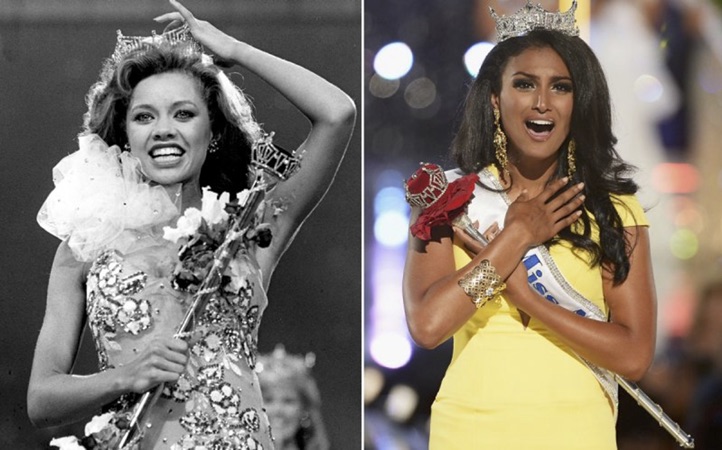
Vanessa Williams (left) and Nina Davuluri (right)

While Miss Bronze California was a contest only for African American, Miss America is now opened for people of all races in the U.S., including African Americans and Asian Americans. The first African-American winner of the contest in 1984 was Vanessa Lynn Williams, who had light skin and blue eyes. Following after her, seven African-American women have been crowned. In addition, this year, Nina Davuluri won the contest as the first Indian-American woman. Both Vanessa and Nina have had to face negative attitudes toward them because of their skin color after they won the contest. For example, Nina has received numerous negative descriptions of her, such as “Too ‘Indian’ to ever be Miss India”. Moreover, she was described as a terrorist on Twitter. Those are not acceptable in the society with racial diversity.

When you determine if a woman is beautiful, does skin color matter? I would answer “No” because I believe all of skin colors are beautiful. Although people’s attitudes toward skin color are shaped in the societies where they grow up, I hope there will be no discrimination on skin color in the near future.

References

Broderick, R. A Lot Of People Are Very Upset That An Indian-American Woman Won The Miss America Pageant (Sept. 16, 2013). Buzzfeednews. Retrieved on Dec 10, 2014. Retrieved from http://www.buzzfeed.com/ryanhatesthis/a-lot-of-people-are-very-upset-that-an-indian-american-woman

Chaudhry, L. Miss America Nina Davuluri: Too ‘Indian’ to ever be Miss India (Sep 16, 2013). F.LIVING. Retrieved on Dec, 2014. Retrieved from http://www.firstpost.com/living/miss-america-nina-davuluri-too-indian-to-ever-be-miss-india-1111477.html

Craig, Maxine Leeds. 2009. “The Color of an Ideal Negro Beauty Queen: Miss Bronze 1961-1968.” In Shades of Difference, edited by Evelyn Nakano Glenn. Stanford, CA: Stanford University Press

Davis, B. Fighting Racism, One Swimsuit at a Time (February 10, 2011). Ms. Blog Magazine, Retrieved on Dec 10, 2014. Retrieved from http://msmagazine.com/blog/2011/02/10/fighting-racism-one-swimsuit-at-a-time/

Stern, M. Vanessa Williams, the First Black Miss America, On Nina Davuluri and Racism (Sep 21, 2013). The Daily Beast. Retrieved on Dec 11, 2014. Retrieved from http://www.thedailybeast.com/articles/2013/09/21/vanessa-williams-the-first-black-miss-america-on-nina-davuluri-and-racism.html

Watson, E. The Miss America Pageant Has Been Beneficial for Women of Color (Sep 12, 2013). The New York Times. Retrieved on Dec 11, 2014. Retrieved from http://www.nytimes.com/roomfordebate/2013/09/12/is-the-miss-america-pageant-bad-for-women/the-miss-america-pageant-has-been-beneficial-for-women-of-color

Hostess workers in Japan – illegal sex work or deserving a visa?

Hostess bars and clubs in Tokyo’s Kabuki-cho

by Kyle Waylyszyn

The women who work as hostess workers work just like you and me, but their jobs come with a heavy stigma that surrounds their line of work. When you hear “hostess worker” or hear about them, they are never portrayed in a very positive light. The job description of a hostess, if you don’t know, is to entertain their male customers by doing things like talking, drinking, dancing and other things. Of course, there are some places that offer services greater than what the majority will not do, which is more sexual in nature, but this isn’t the norm.

Sociologist Rhacel Parreñas

The norm is that these women choose to take these jobs of their own free will, although sometimes out of necessity when giving the choice to either stay in their home country and make a far less salary or work as a hostess. Rhacel Parreñas has conducted firsthand research about this topic, and Parreñas says “No one lied to them and explicitly told them that they would only be singing and dancing on stage.” “They were quite adamant,” Parreñas says, “that they weren’t prostitutes.” Rather, she describes the work of hostessing as “commercial flirtation” through which women work to “bolster the masculinity” of their customers. They typically make money for the club owners to whom their labor is contracted by selling men drinks, not sexual acts.”

Even though that these women took these jobs of their own accord, the Japanese government was not pleased with being ranked the highest employers of “sex trade” workers as they were publicized as. In 2004, the Japanese government began changed the visa laws and enforced stricter requirements for the entertainers visa. This caused these women to lose the valuable income need to support their families, but the important numbers the government seen was that the hostess workers dropped down to only approximately 8,607 in 2006 from the 2004 statistic of 82,741 workers.

In light of the action things that go on and the willingness of these women should there be an entertainer’s visa specifically for hostess workers? These women have a right to make a living just like every other human on this planet, so why can’t they work as a hostess legally in a country that seems to have a demand for it? The morality of these jobs maybe the most prominent reason seeing as it doesn’t just involve the person that attends these places, but also the country that allows such unmoral and socially awkward things to happen as a legal business. Think about it would you choose a country to visit that just legalized commercial flirtation, if the stigma that everyone truly though about it was that it is actually houses of ill repute?

Reference

Parreñas, Rhacel. The ‘indentured mobility’ of migrant Filipina hostesses  http://gender.stanford.edu/news/2011/‘indentured-mobility’-migrant-filipina-hostesses

Can we ever be equal?

English: Differences in national income equali...

English: Differences in national income equality around the world as measured by the national Gini coefficient. The Gini coefficient is a number between 0 and 1, where 0 corresponds with perfect equality (where everyone has the same income) and 1 corresponds with perfect inequality (where one person has all the income, and everyone else has zero income). (Photo credit: Wikipedia)

by Paige Shaw

An unequal society where the upper class holds more of the country’s wealth is considered unfair. In countries such as the United States, the wealthy hold approximately eighty percent of the country’s wealth, and not enough the wealth being taxed from the rich is transferred to the poor. In countries such as Sweden and Denmark, although the distribution of wealth is more equal compared to the U.S., the wealthy still hold a greater percentage of the countries wealth.

Is this still unfair? Objectively, since not all of the classes are equal, it is still unfair. However, I would argue that having a slight inequality between the classes keeps people motivated and is overall better for the economy. People should receive equal opportunities and that everyone should be equal to an extent, but complete equality seems unfeasible.

From a fairly young age we are taught by our parents and in school that everyone is their own individual, and everyone has something about them that makes them unique. Gender, race, and other things aside, you are still different than the person next to you because there is only one of you. So if everyone is different, doesn’t that make it difficult to create a society where everyone is equal?

In his article “Is equality feasible?” Lane Kenworthy mentions that peoples earnings are determined qualities such as intelligence, creativity, confidence, inherited wealth, physical and social skills, and motivation. Most, if not all, are products of genetics, parents’ assets, and traits. We are all inherently different, and we all have our own strengths and weakness, which can make us more capable at performing certain tasks than others. In an equal society where everyone gets paid the same, if one person is a harder worker and better at a certain job than the person beside them, but they are still getting paid the same, it could make them feel less motivated to do their job. Of course there are certain cases that if you loved your job that it wouldn’t matter how much you get paid as long as you could keep doing what you are doing, but the slight inequality between workers keeps people motivated and increases their work effort.

Inequalities are what makes business competitive and drives the economy. And although a completely equal society is an appealing idea, it is not sustainable. In order to pay equally high wages businesses would have to charge their customers more. But in a competitive market, customers will generally refuse to pay more for a good or service when they can get it more cheaply somewhere else. The firm then loses business and has to start letting workers go. Therefore unless wages are lower, which implies some inequality, jobs will not exist.

However it is hard to say whether or not a completely equal society could be good or bad for the economy. It is my general opinion that we need to have that little bit of inequality in order to keep people and markets competitive to drive the economy. It can also be argued that income inequality could decrease consumer demand, and the middle/lower classes may regard high inequality as excessively unfair, causing a decrease in employment motivation and work cooperation.

Complete equality may not be sustainable but too much inequality could also prove to be unsustainable as well. Countries like Sweden and Denmark set a good example of a good balance between equality and inequality. There is still an upper class but more of the countries wealth is transferred to the poor. If more countries adapted a similar system it could prove to be more sustainable.

Reference

Kenworthy, Lane. 2007. “Is Equality Feasible?” Contexts 6(3):28-32.

Being privileged

Nathan W. Pyle / Via buzzfeed.com

by Tommy Pass

I saw an interesting article on a website called buzzfeed.com. It told of an exercise lead by a high school teacher to his students. He instructs his students to crumple up a piece of scrap paper and moves the rubbish bin to the front of the classroom. He then explains the rules of the game; he tells the students that they all represent a population of a country and that in order to move up to the upper class, all they need to do is to throw their crumpled up paper into the rubbish bin at the front of the classroom all while staying in their seat.

The students at the back of the classroom instantly complained, stating that the students sat in front of the classroom have a much greater advantage in the game. The results were as expected, the students sitting at the front of the classroom all had a very easy time getting their papers in the bin, while the students sitting at the back of the classroom had a very difficult time doing so, with only very few managing to get their papers in. The point of the game was to show what privilege looks like, the problems that arise within a society with low social mobility. What happened in the game is that the ones in the back of the classroom complained about their disadvantage while nobody in the front complained as all they saw in front of them was the small space between them and their goal. This can be compared to what occurs within a society with low social mobility; the working class complain about their disadvantages within the society while ignorantly being labelled as simply being uneducated and lazy.

We can compare this example to the veil of ignorance, which is argued by John Rawls. The students in the classroom where very aware of their position, everyone could see each other and everyone was very aware of each other’s advantages, all of whom having the exact same goal. If we were to implement the veil of ignorance in a classroom simulation, would we want to be randomly placed in a typically structured classroom where our chances of sitting right at the back are very high, thus making it very difficult for us to achieve our goal? Or would we want everyone to sit in a line, hence everyone being an equal distance from the rubbish bin? What if the goal was a joint effort, that what would benefit society the most was to get as many crumpled up pieces of scrap paper in the bin as possible? Would we then want to place so many students at the back of the classroom, making it extremely difficult for so many of them to reach the goal? I can’t speak for other people, but I for one would favour all students being placed in a row of equal distance from the rubbish bin, hence making it a fair challenge for everybody, the most attractive choice for me to be placed in from the veil of ignorance and also making it possible to fit the largest amount of crumpled up papers in the rubbish bin.

It is exactly the same in our society; the pros of an equal society far outnumber the cons. Some silver tongued outrider of the corporate world will make the argument sound very attractive for having a very unequal society, but this ignores the fact that we are all reliant on one another in society, none of us are in a world of our own. The truth is even huge corporations depend on the labour of their workforce. This workforce is expensively trained up by the state in the form of public education, state healthcare, etc. The same corporations also depend on the state for other benefits such as research and infrastructure, all (especially the stockholders) while trying to argue for a larger income gap, arguing that doing so will give a society greater competition, higher employment rate, etc. The arguments against a more equal society and higher social mobility is that doing so creates freeloaders and scroungers, but aren’t the ones who rely on the workforce of a state the ones who are the scroungers with their tax avoidance and refusal to pay their workers higher wages? The only ones who benefit from such an unjust society would be the super-rich, which add up to just a fraction of 1% of society, thus the percentage of society which would benefit from equality would be the vast majority.