“Karayuki-san” and “Japayuki-san”

by Tomotaka Isono

It goes without saying that we should learn about the history of Japanese emigration before thinking today’s international emigration. Once Japanese people also went to foreign countries like America, Brasil etc. to work there. So, have you ever heard of the ladies they called “Karayuki-san” (からゆきさん)?

Karayuki-san were Japanese women who travelled to East Asia and Southeast Asia in the second half of 19th century to work as prostitutes (sex workers). The Chinese character for Karayuki-san is written “唐行きさん”. And the word of Karayuki-san means “People who go to Overseas”. (唐 is foreign countries, 行き is going.) Many of woman who went to work in overseas brothels as Karayuki-san were the daughters of poor agricultural or fishing families. Because of poor, the parents sell them to the mediators, and they become prostitutes. Some went to by themselves. But many of parents and daughters were told only that “There are many good jobs in overseas. You can get to be rich enough to send  money your parents home and country!”, they didn’t know working as prostitutes. Moreover the mediators made them own debts of about 5 million yen as secret transportation to overseas from Japan. So they were forced to work in brothels in order to pay back their debts and send money to their families in Japan.

As well as Karayuki-san, there are the women ,called “Japayuki-san” (ジャパゆきさん) in Japan. The word Japayuki-san is created in 1970s by Tetsuo Yamatani (山谷哲夫) who is documentary movie director, but now everyone don’t call like that. Japayuki-san is women from the Philippines, Thailand and so on come to Japan to work as prostitutes.  Some of them are deceived by honeyed words “You can work as model in Japan!”. There are many damages for them such as unpaid wages, illegal overstay or something. However, because they are illegal immigration, they can not call the police. So they don’t have human rights in Japan.

At last, I consider about the common things between Karayuki-san and Japayuki-san. One of the common things is “Poverty and No Education”. Karayuki-san don’t know English, Malay, French, Indonesian. They know only a little sexual words. So they can not take other jobs. Japayuki-san also can’t speak Japanese fluently. Education of foreign languages is very important for people lives in another country. We should address fulfillment of language education in order not to force to work as sex workers.

References

1. Tsuneo Ayabe and Yoneo Ishi .1997. Motto shirttail Malaysia (want to know more about Malaysia). Kobundou.
2.  Japanese School of Kualumpur .2004. Shiryoushuu Malaysia (The Document Collection of Malaysia). Japanese School of Kuala Lumpur


Does Globalization Have a Good Influence on People in Hong Kong?

by Hana Iwaki

Globalization has become big issues to all over the world since 1970s.  Globalization means that many things like human, information, money and stuff move over the countries and a political, economic, and cultural boundary line and a barrier become borderless.  As a result, information network and market on a global scale are formed and then information and capital move freely. That means all over the world receive its impact at the same time.  At first glance, the globalization has a good influence to the world.  But is that so?  In this blog, I want to give an example, Hong Kong which is one of the global cities.  Global city is the center of the global economy, there is a trade with various cities around the world, and it has developed enterprise services (consulting, legal, financial, etc.) particularly.  In the global cities, managers and administrative post, a service industry increases to provide services to them.  Because of that, the ratio, rich and poor, rises and the middle relatively fall.

In Hong Kong, many skyscrapers are crowded.  There is famous as center of finance so many enterprises have a company in there.  They need workers.  Many Chinese people immigrated to Hong Kong so that they can earn money.  People in Hong Kong welcomed them because there were duty and hard work.  Many people didn’t want to do hard work such as building cleaning and construction.  However, Chinese people were willing to do it because they needed money to survive.  So many people immigrated to Hong Kong and it is a small town, so the price of land got high by the immigration and globalization.  A real estate agent built high-class high-rise condominium for a high price so that they can earn money.  Of course, the immigrants have no money such as buying the condominium, much less rent it.  Where do they live?  They live in “beehive apartment”.  It is the apartment separated 7 to 8 spaces in a room.  A space for a person is too small and there are many fleas and lice.  They live inferior environment.

This also happens elsewhere in the world.  To save such people, the government and enterprise should take steps to cope with the situation.  For example, training poor people for taking a good job or guarantee the place where people live more comfortably. They must something take measures, otherwise poor people’s living going down and they might pass away.

References
HARVESLIFE HONG KONG.The reason why steps for poor don’t improve. Retrieved from HARVESLIFE HONG KONG: http://www.harveslife.com/blog/item_3775.html
Maruhaku, T. Inspecting the hypothesis of Global city: polarization of social strata of Hong Kong. Retrieved from BLOGOS: http://blogos.com/article/8477/

A Sad Moment of Reflection

by Robert Moorehead

I would like to dedicate last semester’s blog posts to one of our editors, Alexandra Bitcon, who passed away from an illness after our last class. Alex was an international student from Melbourne, Australia, and her dedication to the success of the blog showed in the quality posts she helped classmates produce, and in her own clever and analytical posts. Alex also brought energy, wit, and insight to our class discussions.

Alex’s family also has my sincere condolences. Seeing your child move away for school is already nerve-racking, and seeing that move take her overseas even more so. But having that journey end so suddenly must be heart-breaking.

Thank you for everything, Alex. We will miss you.

Donations are being collected for the Juvenile Diabetes Research Foundation in remembrance of Alex.

‘I Fought the Law and the Law Won’ — Protestors and the Framing Struggle

by Alex Bitcon

With over two million hits, the UC Davis pepper spray YouTube video has definitely gone viral. But what did the viewers tune in to see? Students rallying against high university fees? Or to see a group of people get pepper sprayed?

The article ‘The art of reframing political debates’ by Ryan and Gamson (2006) that we looked at in class suggests that social movements spend large amounts of money and time trying to perfect a ‘winning’ message.  For protest participants and observers, this translates to something very tangible and persuasive on the day. But what about the people that rely on the news media for their information? Ultimately a different set of objectives (to sell newspapers, appease advertisers etc) brings about a very different framing agenda.  This is evident when you look at the news headlines following the UC Davis protest such as ‘Pepper spray incident prompts protocol appraisal’, ‘UC Davis suspends officers’ and ‘Anger rises as police pepper-spray protestors at UC Davis’. The ‘new’ issue is police brutality and you have to read three or four paragraphs in to find out what the original protest was about. Conflict and controversy are a lot sexier; getting more hits and selling more newspapers. Plus it allowed the media to repackage an issue that was nearing the end of its newsworthiness.

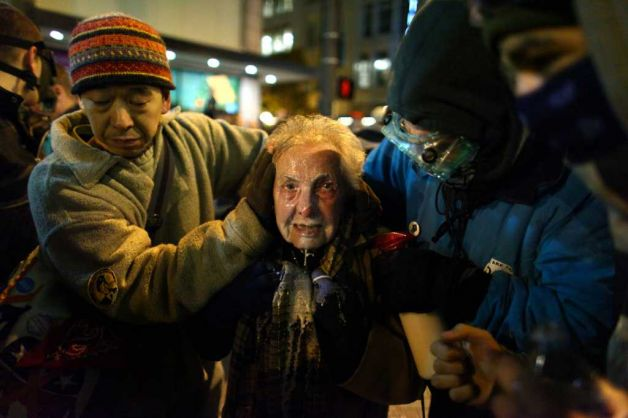
Media theorists refer to this as the protest paradigm, where violence and conflict is highlighted and protestors are framed as in ways that neutralise their message. Imagery, quote selection and headlines are all employed to frame-build and frame-set. Coming up to New Years Day there were a lot of ‘photos of 2011’ galleries online and you may have noticed the famous photo of an 84 year old Occupy Seattle protestor after being pepper sprayed. There are no visual cues to what the protest was about or where she is.


This issue really reinforces the challenges of frame control in the current media climate. Sustaining collective efforts is hard when contextual cues separate, for example, this protest from the wider ‘occupy’ movement. It also becomes easier for your protest to be trivialised. Nandos gimmick anyone? (Lt John Pike flavour – ‘5,000,000 Scovilles served directly into your face, while you sit’). It’s hilarious (sorry – it is!), trivialising and accessible without needing to know the background to the protest. It is also makes you wonder what the 2 million YouTube viewers really came to see…

Is My Future Secure?

I am majoring in Japanese and International Business as well as a minor in Asian Studies in America. Of course, when we go to college, we are going in order to find a job making good money, but also trying to find something we will enjoy doing for the rest of our lives. I chose Japanese as a major, but once I truly thought about having just a major in Japanese, I couldn’t come up with many job opportunities.  So that is why I decided to study International Business as well. Needless to say, Business isn’t my cup of tea, but it is educational and opens a whole new world of opportunities once I graduate.

Now, having experience in big business, I can’t say that I like it, but the pay is good, work is not as physically demanding, and it keeps the kids fed (I don’t truly have any kids…). Working at this Appraisal Management Company for a few years, I have truly felt the life of a college graduate, minus the loan payments. The stress involved in business is beyond explanation at times, especially when a client calls in with nothing but complaints and you don’t know exactly how to make them happy anymore. You can also be the best worker there, working the most hours, and having the highest production, but the old lady sitting next to you is making twice your salary. You stress yourself to no end to make sure you don’t lose your position when layoffs come through.  To this day I will never forget the fear of receiving the call to come to the presentation room (means you’re about to lose your job). Everyone was on edge and worked as hard as they could, making the environment at work not very bright and sunny.

The point I’m trying to make is, job security/insecurity can play a massive role in the way you perform or the way a business runs. Being on the job knowing that in two weeks a new group of people are going to be let go leads you to work like a mule. In Japan they even have a word for this kind of work, KAROUSHI 過労死, means “Death from Overwork”. It’s sad that this is a vocabulary word well known in Japan, but I guess it’s possible! Japan is a prime example of people being overworked without extra pay, without full job security (especially in the beginning of their career), and without time off in years to spend time with family. The stress from work reflects back onto families more than people realize. I believe that Japanese families tend to fall in that category more often than not.

In conclusion, I’m not 100% sure that I will have the job of my dreams when I get out of college, but I know that I want to relate my work with the Japanese language. My biggest worry is that I would not be able to support a family in the future. I want my family to have things, not to JUST get by. I think we all share this same hope. I wish you all the best!

by Aaron (AJ) Glass

The Outlook on Tohoku

We all know of the “Great East Japan Earthquake” that happened earlier this year and how devastating it was. It has had a massive effect on the Japanese economy, but I also want to talk about some of the other effects it has had on Japan and other countries in the sociological aspects.

First point I would like to talk about is the relief efforts the world has put forth to help Japan in their time of need. It is truly something that is hard to express in words. This picture is a map of the countries of the world that offered assistance to Japan by either donating or by sending rescue squads to Japan in their time of need. This has been a very hard year for Japan, and it was great to see how the world came together to aid them.

The international response to the events that took place in the Tohoku region have been mixed through media. Due to the news and media coverage in foreign countries during the earthquakes, tsunamis, and radiation people’s view on Japan has changed in good and bad ways. From my own personal experience, the news broadcasted in America about the radiation and lack of food in Japan was blown out of proportion in my opinion, and because of this, I was forced to return back to America even though I was living in the Kansai region. Many countries, when they heard that the earthquake had occurred in Japan, they believed that the whole country was in jeopardy. It was not only American media, but many other students studying abroad were called back to their homes, especially Europeans. This also cancelled many study abroad options this year for foreigners going to Japan due to liability issues.  This is just one of the international results from the Tohoku events that took place.

Another important point I would like to bring up for discussion is the fact that many people who lost their home have had to go through hard times in recovery and some have had to resort to moving to different places in Japan. Also, think about the effect this has on the children of those regions that were hit the most. I’m sure their lives have been completely changed due to the earthquake. I understand that this is a hard topic to talk about, especially for Japanese people, but I would like to see how everyone views the events that took place and how they were handled or broadcasted in your countries. When a disaster strikes a country like this, think of the drastic changes that take place in families and countries. I believe that countries, through help form the rest of the world, pick themselves up and become stronger because of disasters such as this.

by Aaron (AJ) Glass

McDonaldization

Nowadays, large chains such as McDonald’s, Starbucks, Pizza Hut and Subway can be found pretty much in all parts of the world. While most of them offer affordable, quick meals, they also have a tendency to sell unhealthy food. Another side effect of the chains growing so big is how they have come to control the food market and diets of millions of people. Since they are cheap, it’s easier for people to buy their meals there – at the same time, when people end up eating there all the time, it’s not good for their health.

One of the main driving points behind the McDonald’s chain is how everything is supposed to be the same – yet you can find different things in different parts of the word. For example, in the McDonald’s in Japan you can buy Teriyaki burgers, and the McFlurries tend to have different flavors depending on where you go. So even though the stores essentially sell the same products all over the world, they also offer products aimed at the population of the country it is located in. Another example of this can be found in the Japanese Starbucks, where they sell matcha lattes, and so on. This might have contributed to the chains gaining popularity in the countries they’ve settled in.

Back in my home country, we don’t have a lot of the big chains yet. Places like Starbucks, Subway, KFC and Pizza Hut have yet to set root in my home country. What surprised me at first is how people would react when they found this out. Some would react with disbelief and ask me what we actually do have back there, while others would express how they believed it was a good thing that it hadn’t been overtaken by big chains yet. Back home I didn’t really think about it much, but after traveling a bit and coming to Japan I realized how much of an impact certain chains have made on the world. Take McDonald’s for instance, you can pretty much find them in any part of the world. And while it might be nice to have somewhere to go where you know what the food will be like, regardless of which part of the world you’re in, it’s still kind of overwhelming to think about how large the franchise has become to achieve this.

How is it that chains like these manage to spread out and become this big? And how will they continue to shape the food market from now on?

by Sindre M. Berg

Are the Social Networking Sites Taking Over?

Over the last couple of years, social network sites such as Facebook, Twitter, MySpace and so on have gained a tremendous amount of popularity, and it’s become more unusual for people not to know or have heard of these sites than otherwise. Why have these pages become so popular? One of the reasons Facebook has been able to become as successful as it is, is probably because of how it satiates our natural curiosity. Through simple pages of information and pictures you feel like you can get to know people and their interests better, creating the illusion that you know them better than you actually do. The social network sites can also give off the illusion of having more friends than one actually has.  Because how many of the people listed as a friend on a social network site is someone you can count on in a dire situation?

Social network sites might make it easier to stay in touch with people, although they aren’t the only methods of doing so. There are several programs one can use for chatting with people individually. Why then, should there be a need for adding people on a social network page? One possible reason is how the social network sites make it easier to share information with several people at the same time, instead of contacting them one by one.

Before Facebook and Twitter, a lot of my friends would use Livejournal – a page for writing journal-like entries and finding people with shared interests. While this page has not grown to the size of Facebook, it still has a pretty large community of users. It functioned as a diary of sorts, and you could choose who had access to the entries you posted. Soon everyone had Facebook and Twitter though, and if you didn’t have one you were missing out. And that’s how the situation has become nowadays. If you don’t use any of the social network sites, you’re not “following the times”. When did it become like this? I’ve experienced people around me who initially had no desire to get Facebook or similar pages end up getting it in the end anyway, because if one does not have at least one way of communicating through these social network sites nowadays, one is essentially left with the short end of the stick.

The social network sites seem to have become almost essential in a way to keep in touch and up to date with recent happenings. Whether this is a good or bad thing, however, remains to be seen.

by Sindre M. Berg

Japanglish

I often see the words now, was, will and done at the end of Japanese sentences on Twitter nowadays. I have never saw anything like this when Twitter first became popular, but in a past year or so, a lot of my friends started using these 4 English words (although written in Japanese) used grammatically incorrectly.Likewise, a lot of Japanese people use “Japanglish” in their daily lives, thinking that they are using English words or phrases. In fact, many of these words derive from English, but are transformed so that it is easier for the Japanese people to pronounce, or memorize. For example, the phrase “order made” or オーダーメイド is Japanglish. In English, we would say “made-to-order” or “custom-made.” Other examples include “skin-ship” (スキンシップ) or “Consento” (コンセント). In English, we would say “personal contact” and “outlet” consecutively.

If you think about it, there are a lot of words that sound English, but are actually used only in Japan, and it seems as if this trend of using English is spreading even more recently due to globalization. More and more of these Japanglish are becoming popular, and new ones are continuously formed. For instance, the word “glocalization.” This is a new Japanglish word, often used to describe globalization and the current world system. As can be seen from the word, it is a mixture of “globalization” and “localization,” used in many ways to describe the relationship between global and local issues.

Social networks such as Twitter and Facebook are “glocal” in the sense that it connects both globally and locally, and has a huge influence in our social behaviours. What the individuals “tweet” or “post” could have a major impact on our society, such as the demonstrations in Egypt, which the individuals posted on Facebook to gather supporters and to explain what is going on in Egypt.

And if you think about it further, the words now, was, will and done on Twitter by the Japanese people are also examples of glocalization. Young Japanese people take the English words (global) and use it in their Japanese sentences to “tweet” (local).

Works cited:

Unknown. “Wasei Eigo Towa.” Kimyouna Wasei Eigo no Sekaie Yousoko, n.d. Web.  23 Dec. 2011. <http://www.eieigo.com/index.php?FrontPage&gt;

by Nami Tatewaki

Dual Citizenship in Japan

BASIC MEANING

Dual citizenship occurs when one person acquires nationality from more than one country. This can happen when a child is born of parents of mixed nationality or of parents who are living in country other than that of their citizenship.

CURRENT SITUATION

Nowadays, a child born in Japan of mixed parents would be eligible for both Japanese citizenship and the citizenship of their foreign parents. However, Japan takes a stricter view of individuals holding more than one nationality, since the situations and laws can easily become a bit complex. Therefore, when young people become adult, about 22, they have to choose their citizenship.

Unlike many countries that tolerate but not officially endorse dual citizenship, Japan chooses to take restrictions on dual nationality. Thus, when a Japanese national holding a foreign nationality turns 20, they will be required to choose on sole citizenship within 2 years.

THE GOVERNMENTAL MEASRURES ABOUT HOW TO CHOOSE YOUR NATIONALITY

For Japanese citizens holding a foreign nationality, there are two methods of declaring a single nationality. One is abandoning the foreign nationality, the other one is swearing to Japanese nationality. When the time comes to choose one nationality, people are usually supposed to think carefully and make the right decision.

MY OWN OPINION

In my own opinion, the actively cracking down on dual nationality in Japan may be a wise choice, even though the practice to require one to make a decision seems a little cruel. But what I am thinking of is that it’s better for one to choose which country one belongs to. In this way, it will be more clearly who is responsible for you, but you don’t have to cut the tie with the other country. It’s just like choosing your belief. To our motherland, we should become a faithful, loyal and devoted national.

By Yan Yinyan