
Not American Enough?

 by Dina Akylbekova

One month ago tabloids headlines were dedicated to the Miss America 2014 winner Nina Davuluri. Davuluri became the first Indian-American, who won Miss America. The next few hours there were thousands of racist and xenophobic comments like “If you’re #Miss America you should have to be American”” or “Even Miss America has been outsourced to India. #NinaDavuluri!” (Syracuse, 2013). People posting comments like this do think that winner of Miss America 2014 represents American culture and values. The important point here is that the girl was born and has lived all her life in the USA. Is she still not American enough? Despite this, Nina said “I always viewed myself as first and foremost American.” Why spending her whole life in the US, with American citizenship, American education and self-perception as American are not enough for her to be considered a “real” American? Or is the problem that Davuluri does not look “American”. Do Asian and African descents have a right to view himself/herself as a “true” American, even if they do not look “American”?

The described situation confirms the fail of multiculturalism in America. Today Asian Americans comprise almost 6% of the US population (Pew Research Center, 2010). Almost quarter of all Asian American children were born in the US (Pew Research Center, 2010). Unfortunately, the racist backlash shows that even integrated Asian Americans are not considered “Americans”.

If the reader thinks that this happens only in America, there is a proof that this happens on the other side of the world as well. The next destination is Russia. Elmira Abdrazakova became Miss Russia 2013, the fact that the girl is half-Russian and half-Tatar (ethnic minority in Russia) was a starting point for the racist and nationalist backlash against the winner (The Atlantic, 2013). An additional fact against Abdrazakova was that the she was born in Kazakhstan. Elmira thinks that she fully represents a multiethnic and multicultural Russia (There are 180 ethnicities in Russian federation). However, nationalists probably do not know that Russia is a multiethnic country and continue to resist by saying that Abdrazakova is not Slavic enough.

Both Miss America 2014 and Miss Russia received a huge amount of racist comments concerning their ethnicities. Both the USA and Russia are officially claiming to be multicultural and multiethnic countries, where every ethnicity is respected. The reality shows the fail of tolerance, multiculturalism and multiethnicity in these societies. One can argue that racism in beauty contests is a routine part of these events. But in the reality, beauty contests show whether society is ready to accept other ethnicities beauty on the equal level as the native one. Will the situation change or ethnical minority titleholders would be blamed for being not American or Slavic enough?
Where does youth hostility toward immigrants stem from?

by Anastasia Maillot

Although we live in a highly globalized world where a multitude of cultures, languages and traditions coexist, in the past few years hostility towards immigrants has grown into a frequent and sensitive topic. Not only is it an issue in the US that ironically is said to be the melting pot of cultures, even Europe, the home to a multitude of cultures, has found itself face to face with hatred towards immigrants.

In a way this is nothing new. Xenophobia has existed for a very long time, but the 21st century has given it a new, much younger face. In my home country Finland you can see this change through the emergence of non-official, radical and extreme groups often filled with younger people. Many groups and sub-groups currently exist, both in secret and in public, but in their most extreme and well-known forms these groups consider themselves as Neo-Nazi groups that oppose multiculturalism. Ideas such as “pure, young motherland” are often thrown around by these groups and according to police reports in Finland, members of these groups are most often involved in violence towards immigrants.

Why is this happening at a time like this when the world is so globalized? It is precisely because of globalization, because country borders have become less significant and because right now we are most likely to have at least one neighbor in our neighborhood that isn’t originally from our county. And because it has all happened extremely fast, not all countries and people were ready in the first place. As many usually point out, this hostility is a manifestation of one’s fears and suspicions when faced with a world that is constantly changing at a fast pace.

But there is also another reason, an important reason that I think is far too often forgotten when talking specifically about younger people who participate in violence towards immigrants. This hostility can also be seen as a call for help, for attention. In Finland young people are becoming increasingly more isolated and are greatly ignored in political decisions that are made. This depression has in many cases led to violent behavior, as past cases of school shootings have shown (for more information, see Kauhajoki school shooting in Finland, 2008).

In this time of globalization and multiculturalism, governments tend to forget those who are in need. This has partly led to the birth of extreme mindsets and violent groups among the youth, especially in Finland. In the future, perhaps governments should first resolve domestic social issues before turning their attention towards the international political scene.

Fear of change or fear of oneself?

by Marius Brusegard

In 2008, just below three percent of the world’s population were international migrants, according to “Immigration’s complexities, assimilations discontents” (2008), by the professor of sociology at University of California-Irvine, Rubén G. Rumbaut. This means that as much as 97 percent of the world’s population is still living in the countries where they were born.

It strikes me then, to hear about incidents like the one in which the Ecuadoran immigrant Marcelo Lucero was stabbed to death in Patchogue, N.Y., by 16- and 17-year old boys, as described in Anne Barnard’s article in New York Times (2009). The reasons for these attacks can be argued to be based on ideas such as racism or nationalism, or just the ignorance of youth feeling the urge to experiment with violence or such.

Another way of explaining the attacks can be fear, which the previously mentioned reasons also are rooted in. This being fear of competition in the job market, fear of cultures unknown to themselves, fear of changes etc. If the less than three percent of immigrants (on a world basis), creates enough fear to make someone kill another human being, that might either mean that some people are extremely easily scared, or that they do not need a good reason to become able to kill another human being.

In this case though, the Latino student population in Patchogue Medford School District had risen to 24 percent from 4 in 2003. However, this relatively fast growth of Latino students shouldn’t create as much fear as should be needed to perform the atrocities mentioned. After all, studies have shown that immigrants adjust to their new societies by language assimilation and such. As Rumbaut (2008) describes in his article, the Spanish language of immigrants is no longer spoken by the third generation, because of a switch to English. In fact, studies by Rumbaut and Alejandro Portes (2002) studies show that 95 percent of even Cuban-American children attending private bilingual schools actually preferred English.

Also, Rumbaut argues that according to numerous studies, immigrants are less likely to commit crimes or go to prison than the natives, in spite of the opposite misconception. These are all studies that show how the fear of differences in cultural values, or changes, or just immigrants in general, seems unfounded. The immigrants are adapting to their new societies, not the other way around.

America might be the country with the highest variety of nationalities in the world, and the citizens are almost all known to have heritage from outside of America. They call themselves Irish-American, French-American, Chinese-American and such. Yet in a country like that, it seems to be quite a lot of fear of and resistance towards immigrants, in spite of the American’s ancestors all having been immigrants not too long ago.

From racism to colorism

Anonymous student post

In today’s society, anti-racist movements have been gaining support, to the extent that in most Western countries racism is punishable by law. Discriminating by race is starting to be acknowledged as a social taboo and discriminative actions such as declining  applicants a job opportunity due to race will not only bring negative image but can even lead to jail time. With such improvements in racial equality, one might expect that we are going towards a world without discrimination. Even though this would be truly wonderful if it were to be true, there still is room for improvement—as even in the most non-racist countries racism is still happening beneath the surface—not to mention the social phenomena (or, in other words, social problems) that are replacing racism.

One of the most widespread occurrences is racism changing to “colorism”. Colorism, is a term originally coined by Alice Walker in her 1983 book “In search of our mothers’ gardens” as she used the term to describe discrimination by color excluding factors such as bloodlines or ancestry. Even though racism also includes skin color, in colorism skin color is the sole factor behind discrimination. Especially present in Latin America, Africa, East and Southeast Asia and India however recent trend among various scholars are studies about how colorism has started to replace racism in most parts of the globe.

One could argue that change to colorism has brought several positive effects. Before it might have been impossible to break out of your “racial class”, for example if you were born to a black parent but had very light skin, you would have been deemed black nevertheless and thus discriminated against because of the bloodline. Even if you would not look that different from people around you, the race alone was enough to justify discrimination. Therefore the withdrawal of racism and change to colorism arguably brought some positive effects, as your birth would no longer decide your position in the social hierarchy.

However, when it comes down to comparing racism and colorism, rather than colorism being the cure, it is more like a “pick your poison” kind of a situation. In the 2009 book Shades of Difference, Eduardo Bonilla-Silva and David R. Dietrich depict that colorism causes there to be competition even within the race while there still is competition between different races. For example, in the past blacks have been discriminated against because of their “race”, but now they are being discriminated because of the color of their skin. Not only that, but they also are discriminated among what used to be their “race”, depending on whether their skin color is lighter or darker, not to mention that colorism might take out the vocabulary to describe discrimination (Bonilla-Silva and Dietrich 2009).

So, is colorism the right direction? With colorism replacing racism and racism becoming a widespread social taboo, are we heading towards a less discriminating world? We can see that there is movement towards removing discrimination, as colorism is proof of that; however it is disturbing to see that discrimination still has its place strongly rooted in our everyday lives. It is hard to say if colorism is a proof of improvement, or if it’s just a way to sweep the problem under the mattress. Time will tell, is what I’d like to say, but then again just waiting patiently to see whether the situation gets better or not is a bad excuse not to take action.

References

Walker, Alice. (1983). In search of our mothers’ gardens: womanist prose. San Diego: Harcourt Brave Jovanovich

Glenn, Evelyn Nakano (Ed.). (2009). Shades of difference: why skin color matters. Stanford: Stanford University Press.

The Latin Americanization of Korean race relations

by Yang Jicheol

The process of Latin Americanization is simply about keeping white supremacy from other colors. Eduardo Bonilla-Silva and David Dietrich introduce an example of how the U.S. follows the way of the Latin Americanization for its white supremacy, which is challenged from increasing population of other colors. There is similar example of the Latin Americanization of U.S. race relations in Korea.

As with the United States’ race relations, Korea has also experienced a similar process in terms of racial issues. That appears from young aged population because young aged population tends to be more multiracial. Many Korean consider themselves as a single-race because of same language and skin-tone. However, that single-race nation does not exist anymore. The races are becoming more complex and wider in current Korea. Many western people, whom we regard as white, come to Korea for having job or traveling. Not only western people, but other races such as Southeast Asian also come to Korea for working or marrying with Korean. In that process, a hierarchy has been constructed, which pure Korean place at the top, other western and East Asian people are middle, and others, the Southeast Asian and black people, are at the bottom.

In current Korean society, the interracial marriage rate has dramatically increased between whites with Koreans and nonwhites with Koreans as well. So, there are many multicultural children in Korea now. The multicultural children mean that children have at least two different cultural backgrounds because of their parents’ nations. At the first appearance of multicultural children, it became a hot social issue because of Korean attitudes towards them. The Korean attitudes were harsh to typical multicultural children, who are born from Southeast Asians or blacks. Unlike that attitude, it considered other multicultural children, who are born from the white or East Asian, positively. The multicultural children, born from Southeast Asian or the black, have been considered as negative perspectives such as poor background, dirty, and non-beneficial to Korean children. Nonetheless, other multicultural children have been thought differently. This perspective made Korean society to change its preference towards typical races for equality and norm, which is “We are all Korean”. To solve this problem, schools and libraries have been built only for multicultural children, especially for children having nonwhite parents. Also, government has made public advertisements to make citizen not to discriminate against them. It seemed to work at first because those children have started to respect their identity and have self esteem. Also, the harsh discrimination seemed to disappear. However, those solutions did not work actually. Although people do not tend to show their attitudes directly, they still regard those children as not real Koreans, poor, and shunned children. When we see the surface of that problem, it seems to be solved, but under of the surface, the pure Korean supremacy becomes much stronger and discrimination remains invisibly.

The reason why similar phenomenon appears in Korea is that the world has become smaller that different races are easy to move to other nations where other races are dominant. This makes diversity of race more complex in many nations. So, phenomenon of the Latin Americanization would occur in many other nations like U.S. and Korea to keep position of their majority from influx of immigrant.


What factors lower blacks’ status? Historical reasons, or something else?

by Mai Kusakabe

Now, there is actually prejudice against black people in the world. Eduardo Bonilla-Silva argues that the United States is developing a triracial system with whites at the top, honorary whites follow and collective black at the bottom. Thus, people decide others’ status by skin color, and tend to consider that whites are superior to blacks. Then, why does such stratification happen? Most people think that the reason is historical facts. For instance, in the 16th century, European countries started a slave trade from Africa. This historical fact may be one factor and it leads current situation of blacks. However is it really just historical reasons? I came up with one question, color images also influence on estimation of blacks and whites, don’t they?

In my opinion, most people have images with colors. For example, when we look at red, we feel like hot and passion. On contrary, when we look at blue, we feel like cold, sad, and like that. Then when we look at white color, what kind of feeling is coming up in our mind? Most of us consider it as good, clean, pure and something like these. On the other hand, we tend to consider black color as evil, fear, worry and so on. In fact, the word “white” has meaning that is like guiltiness, blameless and harmless, and one of meanings of “black” is nasty, ominous, surly and so forth. Like this, people basically do not have good impression with black color a long time ago. For instance, in Japanese anime, “名探偵コナン, Detective Conan”, a criminal is always painted by only black color.

In Japan, women try to make their skin whiter, because most people think white skin is beauty. Some people say this is admiration for whites. However is it just for white people? I think there is also admiration for white color, not only whites. For example, a long time ago 8-12 century, in Japan “Heian Jidai”, noblewomen did not even have a chance to meet foreigners, whichever whites or blacks, they put on makeup called “Oshiroi” which is white powder to make their skin white like as you can see from “Maiko” in these days. Thus, the reason why do Japanese people prefer to white skin is not only to admire whites, but also basically to admire white color.

As I stated, images of colors also have a great power to influence on our way of thinking. I think that’s one of the reason why blacks are categorized at the bottom of the stratification in the U.S. and other various countries.

Reference

Bonilla-Silva, Eduardo and David R. Dietrich (2009). The Latin Americanization of U.S. Race Relations: A New Pigmentocracy. In E. Nakano-Glenn (Ed.), Shades of Difference. Stanford, CA: Stanford University Press.

Jinkawiki, Keshou (makeup), 17 October 2013. Retrieved from http://kwww3.koshigaya.bunkyo.ac.jp/wiki/index.php/%E5%8C%96%E7%B2%A7

Japan Grapples with the Rise of Hate Groups

This YouTube video from “The Real News.com” provides an interesting and informative look at the recent protests against resident Koreans and other minority groups in Japan.

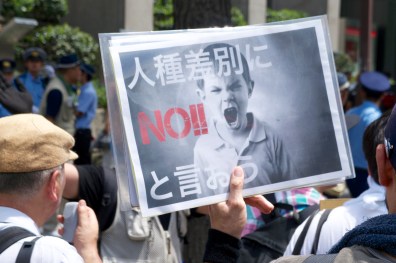
Osaka March Against Racism

Say No to Racism!

Say No to Racism! Click the photo to view the photo set on Flickr.

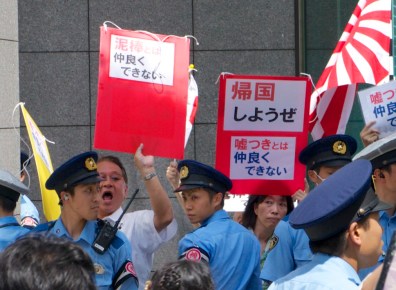
Anti-foreigner protesters hold signs calling for foreigners to leave the country.

Anti-foreigner protesters hold signs calling for foreigners to leave the country. Click the photo to view the photo set on Flickr.

by Robert Moorehead

As the acquittal of George Zimmerman was announced in the US, we were on our way to Osaka, to participate in the March Against Racism. On a hot, sunny day, hundreds marched in protest against the recent hateful anti-Korean demonstrations in Osaka. The march started with speakers blasting Sam Cooke’s “A Change Is Gonna Come,” and instantly we felt at home.

Rainbow flags flew, Korean and Japanese drums were pounded, and marchers carried signs calling for an end to discrimination and a celebration of diversity. In a country where a myth of homogeneity is celebrated, calls for the celebration of diversity are rare.

We ran into a few small pockets of hate, where racists held signs demanding the foreigners leave the country. One man even followed the march, holding an imperial Japanese flag, standing alone while hundreds raised peace signs (and one guy kept flipping him the bird).

The Zimmerman ruling sickens me, but the march was just the right medicine.

Click on the photos below to open a photo gallery.

Click here to view our photos and videos on Flickr.

Racism Does Not Exist?

by Hyeon Woo Lee

Discrimination between different ethnic groups is commonly reported throughout the world. Not to mention the racism against Afro-Americans in US, but also discriminations against Hafu people in Japan, unfair treatment against southeastern brides who came to Korea for marriage, etc. With no doubt such phenomena are spread widely over the world. Professor Terry Kawashima states that race works through several visual readings, or interpretations of the physical differences of a person. However I would like to raise a question of whether racism really exists. Is what we call racism really an act of discriminating other groups of people because of their physical looks? Or is there something else, some other factors that affects us but are hidden beneath the word racism?

In 1994, there was a systematic massacre of minority ethnic groups by major ethnic groups. The Hutu, a majority ethnic group in Rwanda, attacked the Tutsi, a minority group. Triggered by death of the president, Hutus started killing every Tutsi in sight. As a result, at least 500,000 people were killed. The point here is that in external physical appearance, the Hutu and the Tutsi had no difference at all. They all looked like the same black people. However Hutu accused them of being “different”. This may mean different genetics, but it doesn’t make sense since it is widely known that two members of the same ethnic group can be just as different genetically as two people from different ethnic groups. Then in this case, it is safe to say that physical racism was just an official reason, and the true reason mostly lied in the economic structure of Rwanda. The Tutsi monopolized most of Rwanda’s economy while Hutu had very little in it and was unhappy with the fact.

The history of mankind has been a continuation of conflicts, like constant war. Whether it is large or small, there was always war among different groups. The cause varies; it could be a fight for ideology, conflict over economic benefits, or even basic survival itself. However when people mention the difference in ethnicity as a cause of war, I seriously doubt it. It is not the difference that causes conflicts between ethnic groups, but it is rather the way we interpret it. All those conflicts claiming that were triggered by different ethnicities, like the case in Rwanda, actually has other reasons hidden behind the mask of racism. So come to think about it, maybe there isn’t any “true racism”, in which one is hostile to the other for the sole reason of being different, in the world. I believe that there is always something else.

Media create the image of “the lighter the better”

by Yoon Jee Hyun (Jee Jee)

With my iPhone and unlimited 3G services, whenever I feel bored, I unconsciously surf on the Internet to check updated Facebook newsfeed, look up at my Kakoatalk messages, and search for time-killing YouTube videos. As usual, as I was checking updated Facebook newsfeeds, I came across contents regarding skin-lightening issues that caught my attention. The contents were about famous celebrities who have light skin color. Furthermore, videos were posted teaching people how to make “even” skin tone by doing “natural” make-up. In YouTube, over 108,000 results about skin lightening can be discovered when typing in “skin brightening.” However, when typing in “skin darkening,” only 13,900 results can be found in the same social media. To be specific, most of the results found when typing in “skin darkening” related to the opposite of the search word. In my perspective, in today’s world, the media possess such power that affects and surrounds people’s daily life.

Among the effects of the media, it is definite to find traces of the media among Filipinos in terms of skin-lightening issues. To elaborate, wider access to the media resulted in the increase of desire to have lighter skin, as Filipinos became to admire celebrities showing up in the media. For example, K-pop and J-pop are famous pop culture in the Philippine society such as Girls Generation and AKB48. The increase of commercials and advertisements are also alluring Filipinos to buy skin-lightening products by advertising that people can have flawless skin like celebrities on the media.

Skin Lightening issues in the Philippines exemplify how the media can hold huge impact within the society. In other words, people can be tricked and attracted by the words that the media says. Eventually, the easy access to plenty of information all around the world contributes to the notion that “light skin is the better.” White people have abused the media as a means to create a false image of white skin such as portraying white people more intelligent and innocent, while people with darker skin are less educated and evil. There is no doubt that the advancement of media will brain wash people thinking that “the lighter skin you are, the better” which would increase more consumption on skin lightening products.