Running for My Life

Editor’s note: Students have been reading Anne Allison‘s Precarious Japan and are commenting how recent economic and social challenges in Japan are impacting their plans for their futures.

by Miki Yamaguchi

In Precarious Japan, Anne Allison looks at the current situation and problems which Japan faces now. The country where are believed it is full of hopes and wealth no longer exists. Instead of that, people struggle in enigmatic mud. Although it is not easy to lead a steady life, we young generation shouldn’t lose our expectation. And from now, I would like to describe my future plan as one of the young, based on Anne Allison’s study.

My dream is to work for a trading company, because I’m very interested in unique merchandises and imported food which are rarely seen in our table. I think, however, salary, working hours and a system of paid vacation are also considerable. Of course it is lucky to be able to get a job which meets every conditions, I know the society is not so naïve. In fact, I have anxiety and concern for future. My greatest worry is a relationship with our co-workers and bosses. As Anne Allison stated, it’s common to see a company man (kaisha ningen) in Japan. On weekend, fellow workers go lunch and play golf all together, not spending with their family. Furthermore, these gatherings are thought to be more or less influential their career. This system plays a role to create bond (kizuna) among colleagues, I think, however, for women like me who want to make child, this will be affecting their life plans. This means once women quit their jobs for a maternity leave and lose the too tight relationships suddenly, they feel lonely or even feel isolated the society. Unfortunately, the husband also is tied this system and so he works all day and comes home very late. And while the husband is in his company, women have to raise child and do her household. This life style seems very stressful (ikizurasa) and I do not lead such a tired life.

I believe my ibasho is my home in Nagasaki, and my another hope is to create a warm family. In order to balance my work and family life, and make child-raising more happily and enjoyable, husband’s cooperation is important. For example, it very helpful for women that he takes care of his baby on weekend and try to share housework every day. Also the relationship with fellow mom (mamatomo) is necessary, because a complaint and information about parenting can be shared.

Building my career is important, nevertheless I want cherish my family. And under any circumstances, I don’t want to lose my expectation and want to live my own life. To become such a woman, I take the current situation sincerely and consider my way of life.

My future plans and expectations

Editor’s note: Students have been reading Anne Allison‘s Precarious Japan and are commenting how recent economic and social challenges in Japan are impacting their plans for their futures.

by Sana Matsuda

As for my future plan of working, I am thinking of becoming a public servant so that I can work stably. As Allison says, employment situation of Japanese society has been flexible and liquid (Allison 2013). Furthermore, economic situation has continued to be unstable as well. Consequently, I feel it is necessary for me to become one kind of public servant in order to secure my life in this precarious society. More specifically, I would like to be a faculty member of the national university if possible, aiming to improve the Japanese situation as much as possible that the rate of professional women is pretty low (Allison 2013). However, since I will have to repay my scholarships soon after the graduation while struggling to earn living expenses, whether I can go to graduate school, which is necessary for the career, is insecure. Therefore, I am also thinking of another choice to get other jobs such as customs officer or local government employee (public servant, in any case).

At this moment, I can find ibasho within my friends and classes of the university, and my family. However, when I think of my becoming “shakaijin” and working, I feel a little bit anxious that whether I will be able to find it at the workplace as well. Since ibasho is something deeply related to relationships, it will be crucial to build good relationships with others working there. In addition, I would like to make ibasho for my prospective children like what I have felt comfortable within my family.

Speaking of family, I desire to get marry and make a home at latest by 25~26 because I think this would be ideal for having some children safely. In fact, I would like to have about three children so that my future family will be lively, and will also contribute to heightening a birthrate in Japan even just a little. Moreover, I am planning to live in housing for two generations which accommodates my future family and my mother (also parents of my prospective partners if they want) to prevent her from falling kodokushi.

Finally, Allison’s vision that I have felt familiar to my own experience most is the feature of muen shakai. I can find one of the features within my neighborhood. Although I make it a rule to greet the neighbors, I think it is not sufficient because there are rare interchanges among neighbors. Therefore, I would like to think a great deal of not only my career but people around me including my mother, future family, or neighbors.

Reference

Allison, Anne. 2013. Precarious Japan. Durham, NC: Duke University Press.

Civil service for a secure future?

Editor’s note: Students have been reading Anne Allison‘s Precarious Japan and are commenting how recent economic and social challenges in Japan are impacting their plans for their futures.

by Michiyo Umezato

My future plan is to be a national civil servant after I graduate from the university. I have three reasons. First, I never lose my job: national servants do not have “ristora”. As Anne Allison discussed in her book, contemporary Japan is very precarious, so the most important thing on working is stability, I think. When I was a child, I wanted to have a more unstable occupation: pro golfer, pastry chef, and so on. However, as I got older, I thought I should get more stable job. Second, it is easier for women to take a maternity leave and reinstate after it. Of course, women’s reinstatement is getting usual in general company but, it is still about 20 percent. “Matahara” is very serious problem too. Third, all of my family (father, mother and two sisters) are national civil servants. So, I can know many various things about job easily.

In order to take a maternity leave, I have to marry with someone and bear a baby. I feel this is one of the most difficult events in my life. As I mentioned above, stability is very important. So, I am going to marry a man of a national civil servant like my parents and want two children.

After I retire the job, I want to immigrate to the place which is very tranquil: New Zealand, Hawaii, New Caledonia and so on. This is because if Japan does not change a lot, this country would be still unkind to elderly people. Maybe I will not live so long. I want to die around seventy.

Next, I think “ibasho” is the place I can relax and speak my mind. Especially we Japanese put a high value on “honne to tatemae”. So, to speak our minds means we trust you. When we are with people we trust: family, best friends and so on, we can relax. I feel “ba” and “ibasho” are mixed. For example, in the class room, if I sit down alone, there is “ba” but, if I sit down with my friend, there is “ibasho”. They are being inseparable. Also, these ideas relate to some Japanese social problems. People who cannot make “ibasho” in society become hikikomori or get kodokushi (dying alone). Also, I think these problems are caused by smartphone and internet. They bring us fictitious ibasho: friends or community on the internet. It is not real ibasho. This hallucination is cause of them. We should think about how to use them more.

Mixed Race Assimilation in Japan

Anonymous student post

According to most assimilation theories, the highest indicator of assimilation is intermarriage. In her 2010 article “What happens after segmented assimilation? An exploration of intermarriage and ‘mixed race’ young people in Britain”, Miri Song explores the identification of mixed race people. The subjects of her study were those who had a single British parent and one immigrant parent, and had grown up in Britain. When asked what group they identify with, many chose the category ‘British’ – claiming that culturally they were British. I believe such findings may be applicable in other settings, not just Britain.

Japan is infamous for not being open to migration. There are only a small percentage of immigrants, especially compared to many other “developed” nations. However, this does not mean there are no intermarriages. In fact, intermarriages have been rapidly increasing recently and Hafu (the term used to call half Japanese, literally meaning ‘half’), have become less of a rare sight. Flick through a few television channels or pages in a magazine and with a high possibility, you will find a Hafu model or celebrity. Recently, Hafu are not only constrained to modeling because of their foreign looks, but also other roles in entertainment.

Comedy duo “Denisu”Here, I would like to bring up the case of Yukio Ueno, a member of the comedy duo ‘denisu’, who is half Japanese and half Brazilian. His character and portrayal in media is a great example of the position of Hafu in Japanese society.

The audience will roar in laughter as he introduces his extremely Japanese name, and mentions that he grew up in Suita city of Osaka. He talks of how he is usually assumed to be a foreigner and treated differently from his Japanese peers. What makes Yukio Ueno funny for the Japanese audience is the fact that he is culturally Japanese but looks foreign.

Yukio Ueno and other similar Hafus symbolize the Japanese attitudes towards at the moment. You can have a Japanese parent, have Japanese nationality, speak Japanese, have a Japanese name, be born and raised in Japan – yet not be treated as Japanese due to features you adopt from your non-Japanese parent. It becomes important for Japanese born and raised Hafus to assert their Japanese-ness, as can be seen in the case of Ariana Miyamoto. Ariana Miyamoto won the Miss Universe Japan contest for 2015, but being half African-American, has been receiving internet abuse for being unfit to represent Japan.

Japan is still less accepting of foreign looks for sure compared to Britain. However, I do believe the Hafu that are born/raised in Japan do identify as culturally Japanese – just as most of the subjects in Song’s study (2010) claims.

However, not all of Song’s subjects (2010) chose the British category. Half-black people chose to identify as the minority category. We see the race of the non-immigrant parent plays a large role in the identification and assimilation of a ‘mixed race’. Race does matter in Japan too. The treatment of a ‘Hafu’ is effected by the race of their immigrant parent. Being half white is usually an advantage over other races. This is perhaps due to the adoration of Caucasian features as aesthetic.

As people continue to move over borders and mixed race people increase, how will concepts of assimilation change??

Miss Universe Japan — spectacle, race, and dreams

Ariana Miyamoto’s victory in the Miss Universe Japan contest has raised debates about race, representation, gender, and identity. While hāfu women are very visible in fashion and mass media in Japan, these women are rarely Blackanese. Recent events, like a blackface performance by Momoiro Clover Z and a call for apartheid, in Japan have reminded us that Japanese society has a long way to go in acknowledging and accepting the diversity of its population. Thus Ms Miyamoto’s victory gives hope that maybe, just maybe, things are changing in Japan. Mitzi Uehara Carter’s blogpost shares some important insights on these issues.

Blackface Remains Mainstream in Japan

Teen idol group Momoiro Clover posing in blackface with singing group Rats and Star

A quick post to note that blackface remains part of mainstream Japanese culture, as shown by the pictures of teen idol group Momoiro Clover posing in blackface. Despite the fact that the girls in the group are quite young, they seem to be going after an older demographic. First they record a song with KISS, and now they’re performing in blackface. Will their next single be a new version of “Mammy”?

What does it say about race relations in Japan when in one week we have an op-ed in a major newspaper calling for a system of apartheid, and a teen girl group performs in blackface? It’s depressing that my post on blackface is as current now as it was four years ago. Please click the link below to read my 2011 post on blackface in Japan, and share your thoughts in the comments.

japansociology's avatarJAPANsociology

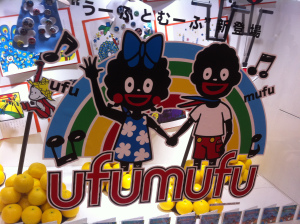
Window Display of Ufu and Mufu

by Robert Moorehead

Imagine my surprise as I walked through Kyoto Station’s shopping areas today, when I came across a large window display filled with cartoon images of blackface children. Skin as dark as night, giant, oval eyes, ruby red lips, and large, bushy afros greet customers to the shop “Mono Comme Ça.” The display announces the release of a sequel to “Little Black Sambo,” called “Ufu and Mufu: The Cute Little Twins’ Big Adventures.” Ufu and Mufu are Sambo’s younger twin siblings. The parents, Mambo and Jambo, are still around, and with Mambo still dressed as a mammy, right down to her plus-size body, red apron, and red bandana. Accompanying the release of the book are a CD-DVD combo, and various merchandise, like pins, patches, dolls, mugs, and purses, all adorned with jet black faces and giant eyes. The DVD features a…

View original post 734 more words

Racializing the white nose in Japan

https://www.youtube.com/watch?v=pjFsvkm7pws

What is it with white noses in Japan? Can Japan get past its seeming obsession with whites as long-nosed tengu?

Racializing white bodies is pretty much guaranteed to make a splash, as we saw with Toshiba’s bread maker (which was so good it would turn you into a white person), and ANA’s new international service (which again could turn you white).

Now we get Proctor and Gamble’s new ad for laundry detergent. The detergent smells so wonderful that it makes white people’s noses grow and flap around. These people were already white, so there’s no race-changing going on, just oddly morphing white faces.

So, what is it with white noses in Japan? As a white person with a somewhat prominent proboscis, I’d really like to know. And I’m definitely not buying this brand of detergent. The last thing I need is a bigger nose.

If your clothes stink, do white noses shrink? Cue the George Constanza reference …

For a more detailed look at this issue, visit Arudou Debito’s site, debito.org.

The Worldwide Abuse of Women

English: American women's earnings by educatio...

English: American women’s earnings by educational attainment, from Women in America (2011) (Photo credit: Wikipedia)

by Olivia Katherine Parker

As an American-born woman, I have a choice. I have a choice to my career, who I marry, whether or not I raise children, and how I spend my future. Women in other countries are not as fortunate. In class, we discussed a few of these cases. For example, Filipino maids face abuse from their employers. Chinese women move to Beijing in order to temporarily escape marriage and to find work in factories that pay low rates. Migrant workers in Japan’s hostess bars have pay withheld from them. Furthermore, mothers from Sri Lanka who need to raise money to feed their children move thousands of miles away to do so. Even in a developed country known as an economic superpower, Japanese husbands oftentimes regard their wives as the domestic half – an idea that was common in American society in the 1950’s. That is not to say that America is the perfect place for women; the Caucasian woman only earns 70 cents to her male Caucasian coworker’s dollar. On top of that, women in America also face prejudice when they decide to live childfree lives or focus on their careers. This boils down to a thought: are women being taken advantage of in a global sense?

It was not long ago that, universally, men were the breadwinners and women were the caretakers. Why is it that in extreme poverty it is the mother who leaves her children behind to earn money for the family? Where are the husbands? Why aren’t they moving thousands of miles away to earn money and why are they allowing their wives to go to such lengths to care for their children?

In class we discussed that human trafficking and sex work are rampant in Japan’s night life. We focused on research by Rhacel Parreñas, who explained that male employers pressured female employees to perform sexual acts in return for money (the definition of prostitution). Parreñas also stated that if an employee was in Japan on an expired visa or any other less-than-legal terms, her pay was almost always withheld at least once.

Recently, we have been seeing a new trend in Japan where fathers are becoming more involved in the early years of their children’s lives. After speaking with several Japanese students I learned that it was common for their fathers to be absent from the home. It wasn’t manly to be seen with their children! After working long hours they would go to the bar and return home late in the night to eat dinner, watch TV, and go to sleep. Now, Japan has laws that allow fathers to take time off work to care for their newborn babies and we are seeing Japanese fathers take on the responsibilities that normally only the wives would have. Still, this is a new trend and it may be looked down upon by old and new generations alike.

Overall, we see a unified theme of women being taken advantage of, whether it is in a domestic setting or the work place. Of course, the severity ranges by location, and the idea that everything is the male’s fault is flawed. Still, the tired belief that women belong in the home needs to change and it is, slowly. Ultimately, we could see a shift in responsibilities between men and women.

Japan’s Rightwing Violence Escalates

A march by the far left “Anti-Imperial System Action Network” is met by a ferocious series of counter-demonstrations by rightwing activists, with a thin line of riot police in between. These events occurred on August 15, 2013, on the streets of Tokyo.

The Consequences of Being a Migrant Hostess in Japan

English: Host and hostess clubs in Ginza (Plac...

English: Host and hostess clubs in Ginza (Place – Ginza-7-Chōme) (Photo credit: Wikipedia)

by Luke Kariniemi

In class we have been speaking about the advantages and disadvantages of Filipino women migrating to Japan and working there as “hostesses”, the experiences they have, and how Japan as a country deals with the perceived image these hostesses create.

Many Filipino women migrant to Japan to work as a hostess for a variety of reasons. Mainly, they migrate for the large increase in wages compared to what they could receive in their home country. They are paid to entertain male clients, pouring their drinks, offering flirtatious comments, singing karaoke and sometimes dancing. Many of the women enjoy doing this work and often see themselves as professional singers or dancers. The higher wages they receive from doing this can be sent back home to help support their families better than if they had stayed working in their domestic country.

However, there are many downsides to working as a hostess too. As Rhacel Salazar Parreñas says in her book Illicit Flirtations, “sexual harassment is the norm in hostess work”. Hostesses have to bear the harassment for however long the client has paid for. In many cases, this can be seen as male superiority. Men basically pay hostesses to compliment them and to have the ability to choose which girl they want, dismissing the less attractive ones. Essentially, ‘fluffing’ up the men’s ego. This can be soul-destroying for women and many of them would not be able to put up with being so insulted, let alone sexually harassed.

All of these problems can escalate very quickly when it comes to the world of migrant hostesses. Usually, a Filipino women with an ‘entertainer’ visa gets the job as a hostess through a ‘middleman broker’—similar to hiring agencies in western countries, apart from the fact that once they get a job for the woman in a specific club, the woman then ‘owes’ them a debt for doing so. This stops them from quitting their job before the contract with the middleman expires, because they will often be penalised if they do so. This can lead to them doing jobs that they do not want to perform, often including sexual acts, because they cannot quit. Hostesses become vulnerable to human rights violations because they end up depending on their sponsoring employers.

When the U.S. State Department labelled around 80,000 Filipina hostesses as “trafficked persons” in 2004, thinking that they were suffering forced prostitution, the Japanese government imposed new restrictions on the entertainer visa, believing that it would help the women be rid of the ‘hostess’ title. Although it did just that, lowering the number of Filipina hostesses in Japan by 90%, it may not have been for the best after all. When all of these women were sent back to their home country, they also went back to a much lower wage and therefore couldn’t care for their family as they could when working in Japan as a hostess. For a lot of them, their skill sets would only include things that the hostess job involved, and so there’s a chance they would end up going into prostitution which would have been a lot rougher in impoverished countries like the Philippines. Altogether, Japan managed to get rid of the image that other countries perceived it to be concerning the so called “trafficked persons”. Nevertheless, when in fact these women were not being illegally trafficked into Japan, but going through their own free will, the consequences may not be that great after all.