Social Movements and Japanese Political Culture

English: Anti-Nuclear Power Plant Rally on 19 ...

English: Anti-Nuclear Power Plant Rally on 19 September 2011 at Meiji Shrine Outer Garden 日本語: 2011年9月19日に明治神宮外苑で行われたさようなら原発集会 (Photo credit: Wikipedia)

by Chihiro Kobayashi

When I was in the U.S., I joined some social movements such as “Stop Modern Slavery Walk” and “9.11 Unity Walk” for the first time. My image toward the U.S. is that they insist and try to change their society by themselves through social movements if the current society is not what they want. Therefore, when they want to change the society, social movements are one of the most important ways.

However, in Japan, many people would think social movements are a bad thing and they avoid doing it. One of the biggest reasons why Japanese people do not join social movement is that they fear the bizarre eyes toward people those who join movements such as demonstration march. I do not say there is no social movements at all in Japan, but I think the understanding toward social movements is lower than other countries. Since demonstration type of social movement is hated by Japanese, it is important to find the suitable social movement instead to change our society better.

At the Japanese Political Culture Theory class, I learned Japanese people tend to avoid joining social movements as their culture. Instead, they tend to rely on others to change the society. For example, in the case of politics, many Japanese people complain current policies and criticize about the government as well. However, Japanese citizens tend not to make social movements to change these, instead they depend on politicians to change these problems. I do not really know if these tendency is because of Japanese culture as I learned in the Political Theory class, but I think it is sure that many Japanese have negative image toward social movements. However, I think Japanese people need to have better understanding toward social movements because it is difficult to make our society only by depending on the politicians.

In the past seven years, the Prime Minister of Japan has changed seven times, and Japanese citizens do not expect politicians to make our society better anymore. Since Japanese cannot rely on and trust politicians anymore, how we can change our society? I think we individuals need to join social movements and speak out about the problems to the government.

For example, more and more anti-nuclear plants demonstrations have been occurring in Japan recently, since the Fukushima Nuclear disaster. However, Japanese still might avoid joining a social movement, such as a demonstration march, because they do not want to be seen as bizarre in the eyes of other people. I think there are many other ways which is more suitable for Japanese cultural characteristic to join social movements which is other than demonstration. For example, in the case of anti-nuclear power plants, we have these variety of social movements.

  1. Voting for anti-nuclear politicians: Social Democratic Party and Communist party are anti-nuclear plants.
  2. Purchasing campaign: By buying the products from local area, they can appeal that they do no need to depend on money from the nuclear power plants but they can be independent.
  3. Consumer Boycott: Avoid buying the products which company is related to building nuclear power plants, such as Toshiba, Mitsubishi Heavy Industries, and Hitachi, Ltd.
  4. Changing the deposit account: Our deposit which is deposited in mega bank such as Japan Post Bank and Bank of the post office is used in bond purchases, and as a result, it will be used to construct dam construction and nuclear power plant constriction. By changing the bank account such as to National Association of Labor banks, it is possible to prevent our deposit from being used for building nuclear power plant. (Stop Kaminoseki Nuclear Power Plant)

Even though these social movements do not stand out openly rather it is more hidden movement different from demonstration march in the city, these movements still have big power to change the society. Also, even if we cannot change our society and policies, we can still influence public policy by bringing attention to the issues. Considering the recent lack of trust in politicians, we individuals need to stand up to make our society better.

I think it is important for Japanese people to find the best suitable social movements for them, based on their political culture (avoiding demonstrations) because we have different culture and characteristics from Americans and other countries. These little by little hidden social movements might change not only policies but also might change people’s negative perspective toward the social movements in the future.

Reference

“Stop Kaminoseki Nuclear Power Plant.” Web. 19 Dec. 2013.

“Gaijin” to Japanese: What Japanese Often Expect from Foreigners

by Satona Kato

comediansTerry Kawashima argues that people have a consciousness about race, and this consciousness depends on their background. We can see this by comparing various ways of thinking about shojo manga characters by Western people and Japanese people.

In Japan, many people put the people who are not Asian (Japanese, Korean, Chinese, South East Asian) into one category called “gaijin”. Many Japanese people do not think about the country where the “gaijin” were born. Furthermore, they tend to stereotype that sort of people have specific skills. In Japan, some of the people who are unilaterally labeled as “gaijin” have experiences that they are wounded or feel alienated, especially the people who are multiracial or who were born and grown up in Japan.

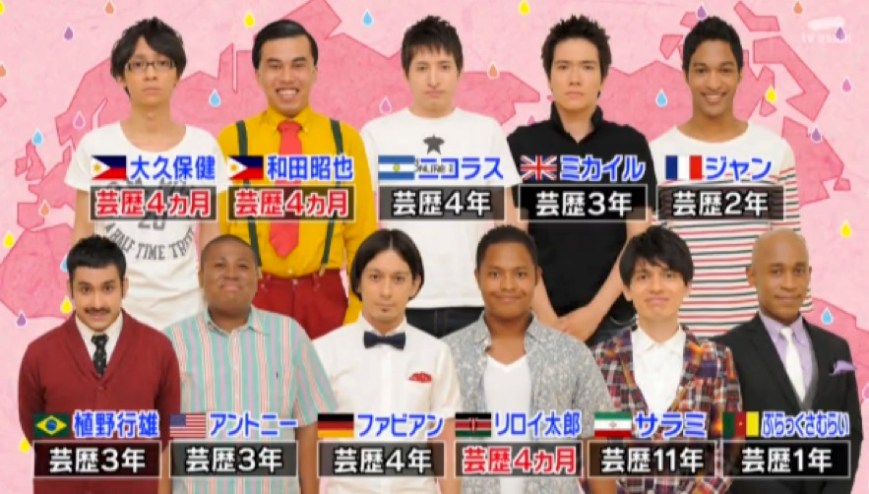
As you know, in Japan, multiracial models on TV have been popular. Recently, multiracial comedians become popular as well. They do not act like fashion models. They make people laugh by talking the story about the incident happened around them only because they are multiracial. First, Japanese are surprised that they can speak fluent Japanese and cannot speak English or another foreign language. Japanese also laugh at the characteristics the multiracial comedians share with other Japanese.

They had had many troubles and unique experiences which happened just because they are “hafu.” If we listen to their stories, we can know how hafu people are treated by Japanese. For example, Anthony, he is one of the ‘hafu comedians’. He is American and Japanese. People laugh at the fact that his hometown is Tokyo and his father managed a Sushi shop. He has knowledge about sushi because his home is sushi shop, but when he goes to a sushi shop, the master of sushi shop offered him ‘California roll’ and he was surprised. He has had other interesting experiences. He is bad at English, and when he was an elementary school student, he decided to go to English conversation school. On his first day of English conversation school, when he entered the classroom, other students misinterpreted him as an English teacher and they said “Hello, how are you?” to him.

I want to tell you about one more ‘half comedian’, Ueno Yukio. He was laughed at because of his obvious Japanese name. He is Brazilian and Japanese. When he plays soccer, the opposing team judged Yukio was a good soccer player by his appearance and many defenseman surrounded him. The opportunities to watch TV programs in which many ‘half comedians’ gather and talk about the things often happen around them are increasing. According to them, following things often happen: 

  • are judged to be foreign people
  • are often stopped by the police 
  • are asked by Japanese to sing foreign songs 
  • are laughed at by Japanese when they sing Japanese songs
  • are often expected to have high athletic ability
  • have difficulty getting a part time job
  • are invited to BBQ parties or Halloween parties
  • are called ‘Bob’ or ‘Michel’ 
  • are treated as tourists everywhere

Of course their nationality is Japanese and most of their hometown is Japan. Why they are laughed? Why do Japanese people stereotype their abilities? When Japanese look at people who look like “gaijin’’, Japanese often expect some specific skills because they have some assumptions. They think that people who have white, black, or other foreign appearance have foreign names and can speak foreign languages, and cannot speak Japanese at all.

It is true that hafu people are not a majority in Japan and many Japanese have little familiarity with thinking about race. That’s why people have expectations about the skills hafu people have. If hafu do not have these skills, Japanese laugh at them and hafu are unilaterally discouraged. 

Mimicking the non-existent

Anonymous student post

Body alterations are a strange thing. Just the words themselves—“body alterations”—make them seem so foreign to our lives, like they’re not something natural. Yet looking at people throughout my life has made me realize that body alteration has become the norm for many people, and desired by, perhaps, many more. If we were to look at how many people use make-up, have surgery, aim for a different body weight/composition, or even just get a piercing, we would see just how widespread this notion of changing our bodies is.

Yet, after reading Terry Kawashima’s (2002) article on racial indicators, I find body alterations strange in another sense. Kawashima discusses this idea of mimicry, in particular the mimicry of “white” traits by Japanese people, arguing throughout her paper that this is not the case for most of Japanese society. But it raised an interesting question about mimicry in relation to body alterations for me: When someone aims to alter their body, is it because they are trying to mimic something or someone else?

This can be a tricky question to navigate, as some will find it too broad a question while others will point out that there are as many reasons for changing one’s body as there are people. Despite this, I can’t help but feel that, at least from what I’ve seen and read, the answer just might be yes, but not in the way that the question is worded. The cautious reader will be skeptical, and thus, I suppose, explanations are in order.

Part of my answer is reinforced by some particular experiences of mine. Growing up with sisters can be difficult, especially when they are constantly attempting to put make-up on and dress fashionably, even when it makes you late for school. Anxiety, I learned, fueled my sister’s actions; she wanted to look “normal”, and thus she would groom herself constantly. For her, body modification was a way of becoming invisible. This resonates with my own experience growing up with raised bumps on my back. My mother, in all honesty, was more worried about them than I; she blamed them for the way I dressed and the activities I gave up when I was older, as well as for my shy and withdrawn personality. She went so far as to offer me a chance to have plastic surgery. Unable to explain to her (or myself) why my scars were not a problem to me, I consented.

After having plastic surgery on only two bumps, and after having grown up with more time to mull over that experience, I’ve realized that my mother believed I couldn’t think of myself as “normal” while I had something “subnormal”, especially when she saw the anxieties my sister held. Body modification, in this context, meant to her an attempt to elevate myself back to “the standard”.

Broadened to a larger scope, we can see in other’s experiences through things like blogs and academic literature that body modification extends across the board. It affects how people relate their body to race, gender, age, culture, health, and all these other touchy subjects that people seem afraid to address sometimes. And—again, from what I’ve seen and read—I think that all these changes that we make to our bodies has something to do with trying to obtain an ideal. In the end, it’s difficult to say that there’s some definitive “real” thing that people try to mimic, because most of the things I’ve listed are just social constructs. Race doesn’t biologically exist, health is relative, and age is reliant on different perceptions of time. In the end, perhaps all people are really trying to do is aim for something that’s not really obtainable because it does not exist in any measurable way. So in a way, we are trying to mimic something; it’s just not something that we can point to and say “there it is”.

What are “Ikumen”?

by Kaho Nagao

Recently Japanese media such as TV and newspapers often mention the word “ikumen.” Ikumen means men who are taking care their children so much and spend more time than traditional Japanese father. Actually my father was non-Ikumen and we, my father and I, spent only 5 years together because of father’s job and my school life. He lived in the mountains and he came back home only once a month or once a week. I never felt sadness because it was natural for my family, and I could spend good time with my mother and friends. In addition I never envied friends who spent much time with their father. However, after he came back home, we did not know how to communicate with each other. Still it makes our relation little bit complicated. Therefore, when I heard the word Ikumen, I felt very uncomfortable. Are these good fathers real or are they just on the screen? This question is coming up my mind.

On the other hand, one of my professors in Ritsumeikan really helps his wife and is caring for his children. He often mentions about that in small talk before class starts. In addition, Takeshi Tsuruno, who is a TV star, is quite famous as Ikumen. He has four kids and he appears on some child caring programs. Moreover, he took child caring break for three month in 2010. When this news appeared, most people think that Japanese society is changing.

Of course, there are still many traditional Japanese fathers. According to News Post Seven, even though bosses think it is nonsense for men take child care breaks, and for them it seems selfish and spoils their wives. Moreover, they tend to question what man can do to babies.

For old generations, it has been difficult to change our minds toward child caring, but for young generations, it is not too late to change our minds. The reason why younger generations want to take care of their children is they may not get enough money as pension from government and seniority by length of service in company.

Before researching about this topic, I thought Ikumen was just Japanese men starting to have interests to take care of children and changing their minds, however, it is one of the reasons and they also have worry about their future. Needless to say, Japanese society is starting to change and Ikumen is a word, which shows the reality in Japan. Still this word and situation seems to be uncomfortable for some people. However, someday this word is going to be usual and it is really great to everyone who has children can enjoy child-caring.

Reference

News Post http://news.mynavi.jp/news/2013/11/17/037/

Filipino hostesses in Japan: Volition or Coercion?

Rhacel Parreñas in the field, working as a hostess in Tokyo

by Jonas Horvei

According to the United Nations Protocol to Prevent, Suppress and Punish Trafficking in Persons (2013), human trafficking can be defined as:

“[t]he recruitment, transportation, transfer, harbouring or receipt of persons, by means of the threat or use of force or other forms of coercion, of abduction, of fraud, of deception, of the abuse of power or of a position of vulnerability or of the giving or receiving of payments or benefits to achieve the consent of a person having control over another person, for the purpose of exploitation.”

In this week’s blog post I would like to examine to whether or not Filipino hostesses working Japan can be considered as victims of human trafficking, especially under the category of sex trafficking. I will also consider whether there is a possibility that this is not the case of human trafficking, but rather an action which they carry out by their own volition.

First of all I would like to examine what kind of typical activities a hostess performs while working in a bar in Japan.

  • Takes on the role as an entertainer
  • Pours her customers drinks, often alcoholic beverages
  • Dances with them
  • Sings for her customers, often karaoke
  • Talks with her customers, being engaged in a conversation, often with a bit of “flirtative” nature, often while at the same time complimenting them.

On the basis of only this, it is naturally impossible to say whether these people working in such establishment are victims of human trafficking or not. Nevertheless if we look a bit deeper and consider if this at the perspective of sex trafficking we can start hypothesizing at least. According to the U.S Code §7102 – (10) sex trafficking can be defined as the following;

The term “sex trafficking” means the recruitment, harboring, transportation, provision, or obtaining of a person for the purpose of a commercial sex act”.

Judging from this definition, there does not seem to be any particular aspects that resembles a commercial sex act, and thus I argue that such kind of cannot be considered a case of sex trafficking. Although occasionally acts such as masturbating the customer did occur, nothing was mentioned whether this was carried out by their own volition or not. Looking at the culture of south-east Asian countries though, such “happy ending” customs are fairly normal in especially massage establishments such as in China and Thailand, which might explain why this is not necessarily  considered prostitution. While there are Filipinos working as prostitutes in Japan, at least on the surface it seems to me at first glance that the Filipino who come to serve as hostess, are mainly not victims of sexual trafficking.

For the meantime, let us go back to the case of human trafficking and see if there is any evidence that these workers can be considered victims of such a phenomenon. While indeed, it is likely that some of the Filipinos who migrate to Japan are forced to go against their own volition, and thus can be defined as victims of human trafficking, I argue that this is the exception rather than the norm. According to Parreñas (2011 p.3) no conclusive evidence exists that these workers are victims of human trafficking, but rather research indicates that most of the workers take this decision by themselves, and migrate by their own volition. Yet again according to Parreñas (2003 p.199), as much as 34 to 54 percent of the Filipino population is sustained by remittances by migrant workers. Such numbers tells exactly how much of an importance overseas Filipinos workers affect the homeland economy.

Nevertheless despite most of these people not being victims of human trafficking, there is no question that especially for migrants in such vulnerable occupations the working conditions can be lackluster, and that they might be victims of forced labor. This is something which needs to urgently be addressed, preferably in collaboration between the Philippines and the Japanese government.

Since 1999, Japan’s immigration policies have made it considerably more difficult, ultimately forcing many bars to shut down and many having difficulty coming over to work as hostesses (National University of Singapore, 2012). However, imposing restrictions on entertainer visas is in my opinion not a solution to combat human trafficking, or rather it is not a solution to improve the labor conditions for Filipino hostesses. Rather, I think such restrictions are what actually promotes and can actually be the trigger to human trafficking in the first place.

These migrants cannot work in their own country, the wages are either not enough to support a family, or simply they cannot find a jobs. Then naturally the next step is to seek work elsewhere, a different city, or a different country. Suddenly these options start to dwindle, and one is only left with the options of either living a life full of poverty or as a last resort they become victims or sexual trafficking, or become prostitutions out of their own volition to take care of their family.

I argue that hostess is a harmless job, and as long as this work is carried out of their own volition, restrictions should be lessened on entertainer visas, back to the way they used to be. Still, these people will continue to be exploited due to their resident status and so on, and therefore I believe the most important step to take now is rather than imposing more and more restrictions, a step in the right direction would be to protect these people by giving them more rights to them being victims of forced labor, and to collectively come up with a solution which can benefit all parties involved.

As summarized by the United Nations Global Programme against Trafficking in Human Beings report, a lot of the responsibility lay at the hands of the Japanese and Filipino government to improve this situation (Cameron and Newman).

References

“Human Trafficking.”  United Nations Office on Drugs and Crime. Accessed 17 Nov. 2013. http://www.unodc.org/unodc/en/human-trafficking/what-is-human-trafficking.html

“U.S Codes – USC§ 7102 Definitions” Cornell University Law School. Accessed 17 Nov. 2013., http://www.law.cornell.edu/uscode/text/22/7102

Parreñas, Rhacel Salazar. Illicit Flirtation; Labor, Migration, and Sex Trafficking in Tokyo. Stanford University Press (2011).

Parreñas, Rhacel Salazar. 2003. “The Care Crisis in the Philippines: Children and Transnational Families in the New Global Economy.” Pp. 39-54 in Global Woman: Nannies, Maids, and Sex Workers in the New Economy. New York: Metropolitan Books

“Filipino in Hostess Clubs.” National University of Singapore, 29 Apr. 2012. Accessed 17 Nov 2013 http://wiki.nus.edu.sg/display/JPE2012/Filipino+in+hostess+clubs

Cameron, Sally, and Edward Newman. “Trafficking of Filipino Women to Japan: Examining the Experiences and Perspectives of Victims and Government experts” United Nations University. Online-only journal. Accessed Nov 17. 2013. http://www.unodc.org/pdf/crime/human_trafficking/Exec_summary_UNU.pdf

Structural Denial of Ethnic Diversity in Japan

by Sten Alvarsson

Japan’s ethnic diversity is continuing to be denied at the expense of a more equal and inclusive society. Ironically, equality and inclusivity are both at the heart of mainstream Japan’s perceived identity. This could be described as “ethnicity blindness” and is best described by Professor Kondo (2013) who states that, “Japan is still the only developed industrialised democracy that does not have an anti-discrimination law” (para. 6). This can be seen as a result from the belief that racism and discrimination do not exist in Japan so, therefore, there is no need to have laws targeting such behavior. On the whole, however, ethnicity blindness is not the most accurate depiction of the situation regarding ethnic minorities in Japan. Instead, the inequality and exclusivity regarding the country’s ethnic diversity is what I would describe as being “ethnic denial”.

While Japan’s ethnic diversity is fully comprehended by the country’s ethnic minorities, amongst the Yamato majority, however, the belief in a monolithic and homogeneous national identity persists. This belief is structurally enforced which was highlighted by the country’s 2010 census which failed to provide a measure for ethnicity (Japan Times, 2010). Instead, only nationality was measured without the acknowledgment of the ethnic diversity that exists under the umbrella of Japanese citizenship. This structural denial of the ethnic diversity of minority groups includes the Ainu, Koreans, Ryukyuans, Chinese, naturalized citizens and children from mixed marriages. Ethnic minorities are ignored despite the fact that minority groups such as these make up around 10 percent of the local population in areas such as the Kinki region of central Western Japan (Sugimoto, 2010). This structural denial is one of the keystones in maintaining the myth of a national identity that is both monolithic and homogeneous.

Japan’s structural denial of ethnic diversity within the country in order to enforce the myth of a monolithic and homogeneous national identity is not only a domestic issue but is also of international consequence and concern. Japan uses its perceived ethnic and cultural purity to ignore its international obligations as a signature member of the United Nations Convention Relating to the Status of Refugees. Instead, Japan maintains a policy of neglecting asylum seekers and rejects the overwhelming majority of their claims (Dean & Nagashima, 2007). In fact, from 1981 to 2007 Japan only accepted 451 refugees (Sugimoto, 2010). Sadako Ogata, a Japanese national who served as the former High Commissioner of the United Nations High Commissioner for Refugees from 1991 – 2001 stated that one of the fundamental reasons for Japan’s exclusion of asylum seekers is due to, “prejudice and discrimination against foreigners which is based upon the mono-ethnic myth” (as cited in Dean & Nagashima, 2007, p. 497). It must be remembered that this mono-ethnic myth has no historical routes and was brought into popular consciousness after the Second World War.

Ethnic diversity in Japan needs to be acknowledged and accepted. Unlike the country’s last census in 2010, Japan’s next census in 2015 should strive to measure its ethnic diversity. In order to achieve this, such questions as, “Where were you born?”, “Where were your parents born?” and, “What national origin or ethnicity do you consider yourself to be?” should be included in the census. As a multicultural country, Australia recognises 275 different cultural and ethnic groups in its census (Australian Bureau of Statistics, 2011). For Japan, there is no excuse not to also measure the diversity that exists amongst its citizens.

The structural denial of ethnic diversity in Japan needs to end in order to contribute to a more equal and inclusive society for all its members. After all, in Japan there are over 100 different varieties of the chrysanthemum flower (kiku 菊) with a myriad of different colors, scents, sizes, textures, patterns and durations. Wouldn’t it be a shame if Japan only recognised a single variety of chrysanthemum and denied the existence of the rest?

References

Australian Bureau of Statistics. (2011). Australian Standard Classification of Cultural and Ethnic Groups. Retrieved from http://www.abs.gov.au/ausstats/abs@.nsf/Lookup/1249.0main+features22011

Dean, M., & Nagashima, M. (2007). Sharing the Burden: The Role of Government and NGOs in Protecting and Providing for Asylum Seekers and Refugees in Japan. Journal of Refugee Studies, 20(3), 481-508.

Japan Times. (2010, October 5). Census blind to Japan’s true diversity. Retrieved from http://www.japantimes.co.jp/community/2010/10/05/issues/census-blind-to-japans-true-diversity/#.Umt_AflmhcZ

Kondo, A. (2013, May 6). Can Japan turn to foreign workers. Retrieved from http://www.eastasiaforum.org/2013/05/06/can-japan-turn-to-foreign-workers/

Sugimoto, Y. (2010). An Introduction to Japanese Society (3rd ed.). Cambridge, UK: Cambridge University Press.

Accepting immigrants in Japan

by Yuri Kasai

From Asian countries such as the Philippines, Korea, and China, many immigrants have come to Japan. After World War II, the Japanese government accepted many Nikkeijin (日系人), who have one Japanese parent or Japanese parents under the Immigration Control Act of 1952 and taking part in the convention of international immigration. Since the 1970s, in the bubble economy, there were four categories of immigrants, according to sociologist Hiroshi Komai. Firstly, many immigrants such as Filipinos, Koreans, Taiwanese and Thais have come for entertainment work and they can get an ‘entertainer’ visa. Secondly, refugees from Cambodia, Vietnam and Laos have come to Japan for the Convention Relating to the Status of Refugees between 1970s and 1980s. The third category consists of Japanese group who went to Manchuria during the World War II. The fourth category consists of businessmen in Europe and the US.

Japanese Immigration laws are more limited to European countries and the US because Japanese society has not accepted immigrants historically. After the crackdown of the bubble economy, the number of immigrants from Europe and the US dropped. However, globalization has been widespread today and immigrants have grown again while international companies come to open their brunches in Japan. The Japanese immigration system needs to be amended because we need to accept more immigrants than before.

In Japan, 24 percent of the population is over 65 years of age, and in 2055 this aged people is estimated as 40 percent of Japan’s total population. We will need more care workers and nurses. We already lack the number of care workers and nurses because these jobs are tough for long working time and heavy tasks. They have a low salary and they struggle to work as care workers and nurses. We need to foster more care workers and nurses and to give higher salary to them.

However, it is difficult for Japan government to use money for more public service because the government holds deficits financing for the pension. Therefore, Japanese government needs to invite more immigrants from Asian developing countries such as the Philippines and to foster immigrants to support our aging society. Especially, Filipino women can care well for elderly people because they have the culture to respect for elder people. Many Filipino women emigrates overseas such as in the US or the UK. They can speak English well and can adopt to an English-speaking environment.

In Japan, although Japan accepts many Filipino women with the skills of nurse or caregivers in the hospitals, Japan government mandates them to pass though each skill exam and Japanese proficiency exam. Because of it, many Filipino nurses or caregivers cannot pass through national qualifying exam and have to go back to their home country. However, they can study Japanese while communicating with patients after they can pass through their skill exam. I think that getting human resources is the urgent problem. The government needs to reconsider and deal with the aging society and the deficit finance for the pensions. Accepting immigrants is a good solution to aging society.

Reference
Komai, Hiroshi. 2000 “Immigrants in Japan. Asian And Pacific Migration Journal 9(3):311-326.


Should the Japanese Government Institute an Education System for Immigrants?

by Megumi Takase

In “International Sociology” class, I was surprised to hear that in Europe, students from other backgrounds take two or three times a week to have lessons in their native languages. In Japan, some elementary schools in which there are many foreign students have Japanese classes for them to understand regular Japanese classes. However, few schools have lessons for immigrants in their own languages. In addition, there are not many ethnic schools in Japan. Even though foreigners living in Japan mostly consist of Chinese, there are only 5 Chinese Schools in Japan. If children from other countries continue to attend Japanese schools and don’t do vigorous effort to learn their history or culture, they will have difficulty in building their identities. This is one of the reasons why foreigners are unwilling to live in Japan for a long time.

In my opinion, Japan should institute an education system for immigrants. For example, it should begin classes for immigrants in their native languages. It not only benefits students from other countries but also Japanese. It will increase the number of immigrants if Japanese education system is reformed in favor of foreigners. Japanese is suffering an aging society, so Japan will face the problem of lack of labor in the near future. Thus, Japan should accept immigrants to solve these problems. In order for foreigners to be willing to come and live in Japan, Japan should create the environment for them to live comfortably. One of reforms which Japan should tackle is education system.

It will also lead to intensification of international competitiveness of Japan if many foreigners immigrate to Japan. It is said that Japanese have difficulty in speaking foreign languages. In the times of globalization, people who are fluent in many languages are needed. If immigrants grow up as bilingual and begin to work in Japanese corporations, they will largely contribute to corporations.

If Japanese government begins to institute an education system for immigrants, many people will come from other countries and live in Japan. They will serve Japanese society. It is difficult for schools to begin classes for immigrants in their native languages because immigrants come from different countries around the world. Schools should create these classes cooperating with the local universities specializing in foreign languages. It will also lead to create Japanese bilingual students.

Reference

[i] Weblio. (n.d.). Retrived October 17, 2013 from http://www.weblio.jp/ontology/%E4%B8%AD%E8%8F%AF%E5%AD%A6%E6%A0%A1_1

Tri-Racial System and Hiding the Truth

by Lilia Yamakawa

Eduardo Bonilla-Silva and David R. Dietrich’s contention is that America is developing a complex “tri-racial” system of stratified classification that will be composed of whites at the top, honorary whites in the middle, and collective blacks at the bottom.

If we consider President Barack Obama, we can see that Americans still don’t really have that classification system. “The First Black President” of the U.S. had a white mother and a black father. He was raised entirely by his white mother and his white grandparents. Still, Americans see him as a black man. Why doesn’t he fall into the “honorary white” category which includes other multi-racial people?

Americans are still seeing race in terms of black and white. Other reasons for seeing him as black may be that he seems to self identify as black. Also, his wife is black. Finally, many Americans may tend to fall into one of two groups. They may be very proud of having a black president or they may feel uncomfortable or actually not like having a black president. Either way, we’re classifying him as black and stressing his blackness. Of course, because of his position as President of the U.S, Obama is not typical and is not viewed as typical. Still, it’s interesting to think of him in terms of the author’s thesis. We can see that the biracial system is still going strong in people’s minds.

Bonilla-Silva and Dietrich also explain that the way we currently talk about race includes the idea that “We are all Americans – no matter what color we are.”  This will create a tendency to ignore the fact that racism is a problem. Ignoring the problem, white supremacy will continue, and blacks and other minorities will continue to suffer inequality. They won’t have a clear starting point to argue against discrimination.

This is something like the Burakumin issue in Japan where people don’t want to give it a name or say there is a discrimination problem. If it doesn’t have a name, maybe it will go away. But is the problem being really solved this way? Do the Burakumin still face discrimination, just more of a “smiling discrimination” in the society?

Actually I think there is less discrimination against the Burakumin in my generation than in the one before. There is no pigmentocracy in the Burakumin discrimination issue. There is no racial difference. If the older generation continues hiding who the Burakumin are, or where the Burakumin area is, it will be very difficult to distinguish them. Eventually, the problem may disappear. But we have to find out whether or not discrimination still exists.

Reference

Bonilla-Silva, Eduardo and David R. Dietrich (2009). The Latin Americanization of U.S. Race Relations: New Pigmentocracy. In E. Nakano-Glenn (Ed.), Shades of Difference. Stanford, CA: Stanford University Press.

The Burakumin: Japan’s invisible race . (n.d.). Retrieved from http://www.tofugu.com/2011/11/18/the-burakumin-japans-invisible-race/


What factors lower blacks’ status? Historical reasons, or something else?

by Mai Kusakabe

Now, there is actually prejudice against black people in the world. Eduardo Bonilla-Silva argues that the United States is developing a triracial system with whites at the top, honorary whites follow and collective black at the bottom. Thus, people decide others’ status by skin color, and tend to consider that whites are superior to blacks. Then, why does such stratification happen? Most people think that the reason is historical facts. For instance, in the 16th century, European countries started a slave trade from Africa. This historical fact may be one factor and it leads current situation of blacks. However is it really just historical reasons? I came up with one question, color images also influence on estimation of blacks and whites, don’t they?

In my opinion, most people have images with colors. For example, when we look at red, we feel like hot and passion. On contrary, when we look at blue, we feel like cold, sad, and like that. Then when we look at white color, what kind of feeling is coming up in our mind? Most of us consider it as good, clean, pure and something like these. On the other hand, we tend to consider black color as evil, fear, worry and so on. In fact, the word “white” has meaning that is like guiltiness, blameless and harmless, and one of meanings of “black” is nasty, ominous, surly and so forth. Like this, people basically do not have good impression with black color a long time ago. For instance, in Japanese anime, “名探偵コナン, Detective Conan”, a criminal is always painted by only black color.

In Japan, women try to make their skin whiter, because most people think white skin is beauty. Some people say this is admiration for whites. However is it just for white people? I think there is also admiration for white color, not only whites. For example, a long time ago 8-12 century, in Japan “Heian Jidai”, noblewomen did not even have a chance to meet foreigners, whichever whites or blacks, they put on makeup called “Oshiroi” which is white powder to make their skin white like as you can see from “Maiko” in these days. Thus, the reason why do Japanese people prefer to white skin is not only to admire whites, but also basically to admire white color.

As I stated, images of colors also have a great power to influence on our way of thinking. I think that’s one of the reason why blacks are categorized at the bottom of the stratification in the U.S. and other various countries.

Reference

Bonilla-Silva, Eduardo and David R. Dietrich (2009). The Latin Americanization of U.S. Race Relations: A New Pigmentocracy. In E. Nakano-Glenn (Ed.), Shades of Difference. Stanford, CA: Stanford University Press.

Jinkawiki, Keshou (makeup), 17 October 2013. Retrieved from http://kwww3.koshigaya.bunkyo.ac.jp/wiki/index.php/%E5%8C%96%E7%B2%A7