Racial Stratification in Hong Kong

by Chris Leung

Latin Americanization means the phenomenon of racial stratification and the book Shades of Difference took the example in the United States. However, this term can also be applicable in other places. For instance, in my birth place, Hong Kong, racial stratification is also obvious. However, the situation is quite different from the States.

Since Hong Kong was colonized by Great Britain, racial stratification has already been installed into people’s minds. In terms of the strata, in the beginning of the colonization period, British people and other European were obviously in the top level, followed by East Asians especially Indians. Finally most of the Chinese were in the bottom of the strata. However, there were also some elite Chinese, who could manage to live in the same standard with the Europeans, most of them also discriminated against the collective Chinese with the Europeans. At that time, many luxurious restaurants and shops insisted “Not allowing dog and Chinese.”

This strata system lasted for a quite long period until there were more Chinese people started to work for the government. Nowadays, as Hong Kong has already returned back to China, the strata system has also changed drastically. As there are no more foreigners taking major role in the government, the Chinese could finally regain the position they used to have before colonization and the discrimination against races has a lot improved.

However, when I say Chinese, it only means those who born and grew up in Hong Kong, those who emigrated from the mainland China in this decade also face a huge discrimination by the local ‘Chinese.’ Since many of them are not well educated, they could only do low-paying jobs like cleaner or security guard. Further, there are many family issues among these immigrants, hence the area they live is always a big social concern to the government and there were few movies trying to describe the life in the area where many of the residents think that the movies tried to label their living place as the slum of Hong Kong.

In conclusion, the situation in Hong Kong is quite special. In general term, stratification and discrimination are always between races like in the States. However, in Hong Kong, such things are happening inside one race, which is the Chinese.

Identity of Hafu and Japanese

by Kanami Hirokawa

One in 30 children is born as a hafu today in Japan. Hafu have parents who have different nationality and looks. Therefore, hafu tend to have different looks with Japanese and they may catch people’s eye easily. In such a situation in Japan, how do hafu people build their own identity? Do they have only one identity or hybrid identity? Why do many Japanese think hafu is cool and beautiful?

First of all, it is necessary to think about identity of hafu. When I watched a video about hafu in class, many of hafu said that they have a hybrid identity, but they said that they can not become complete and true Japanese. Many of hafu in this video grow up in Japan and know the Japanese culture. Moreover, some of them can speak Japanese fluently. However, why can’t they become ‘true’ Japanese? In order to have the consciousness of belonging, to have same value and culture is needed. For example, if they live in Japan, they try to speak Japanese. In addition to this, it is also important that hafu are appropriated by Japanese, regarded as a member of Japan and they can join Japanese society.

Next, Japanese often regard hafu as a ‘stranger’ even if they know Japanese culture and can speak Japanese. Hafu often attract people’s eye and they are regarded not as Japanese but as a special people. Today, in Japan hafu and foreigners are minority and many Japanese still have the fixed idea that Japan is a homogeneous nation. This is why hafu and foreigners are regarded as a ‘stranger’ in Japan. Such a fixed idea should be broken because Japan has been a multicultural country since the old days. For example, Ainu people lived in Hokkaido as native people and in the 20th century many foreigners like Koreans and Brazilians came to Japan. I suggest that Japanese must change their fixed idea and appropriate hafu.

Japanese tend to ask hafu questions like “where are you from?” even if they grow up in Japan and have Japanese values and Japanese culture. Japanese must know that people who have different looks with Japanese live in Japan as Japanese. Moreover, Japanese should accept hafu as a member of Japan and should not make borders between Japanese and hafu because they grow up in Japan and have same identity with Japanese. In order that hafu become Japanese completely, not only Japanese accept hafu as a member of Japanese in Japanese society but also Japanese government should begin the approach to make Japan a ‘true’ multicultural country. Japan is based on the idea of jus sanguinis and conservative to foreigners. Today, in the world, globalization is developing now and Japan should review their principle.

In conclusion, hafu are often regarded as special people in today’s Japanese society. In order that hafu become true Japanese, Japanese should break their fixed ideas and Japanese government should change their policy. Furthermore, in the future Japan may have to accept more foreigners because of the declining birth rate and the lack of workers. If such a situation comes, foreigners will come to work in Japan and have more opportunities to get on with foreigners. The number of hafu will be increasing from now on. Therefore, Japanese need to appropriate hafu and foreigners.

References

Hafuwokangaeyou [Let’s think about hafu].(2010). Sandra, H. Retrieved May 8, 2013, from http://half-sandra.com/qa/

Natalie, M. W, and Marcia, Y. L. (2010). The Hafu Project. The Hafu Project.

Seichisyugi [Jus Sanguinis]. (n.d.). Murato Lawyer Office. Retrieved May 8, 2013, from http://www.japan-immigration.com/article/14579964.html

The Impacts of Immigrants in Japan

by Yurika Chiba

The number of foreigners is small in Japan compared to other countries. Basically, it is said that Japan is mono-cultural, homogeneous and monolingual society. For example, all of my classmates in high school were Japanese who have black hair and speak Japanese. We did not have opportunities to interact with foreigners in Japan. When we see foreigners, we feel they are “different” because they do not look like Japanese. It is hard for foreigners to live in such a society, I think. For instance, there was an international student in my high school. She was from America and had gold hair. I mean her appearance was completely different as Japanese. We saw her as “gaijin.” We did not know how to communicate with her although we wanted to get along with her. Finally, she could not fit in our class. One of the reasons why Japan has few foreigners is that Japanese society is said to be homogeneous. Therefore, Japanese people tend to refuse foreigners and different cultures. However, it is time to change Japanese society to make comfortable society for foreigners because globalization has been expanding. I mean that Japan needs foreigners in order to lead to economic growth.

The number of immigrants would be increasing if Japan became comfortable place to live for foreigners. Immigrants are important to solve some problems in Japan. In particular, the problem about the declining birth rate and a growing proportion of elderly people. For example, immigrants come to Japan in order to work and marry Japanese people. Their children probably will also work in Japan. This will help increase the population long term and help to solve Japanese population crisis. Immigrants have an important role in Japan.

However, Japan has difficult problems to solve in order to absorb immigrants. There are strict rules of immigrants in Japan. In addition, the rules are different from their countries. It is said that the crime rate will go up if immigrants increase. Japan might not be ready to receive immigrants. Japan should make new laws about immigrants. For instance, new laws to allow immigrants to live in Japan easily. The laws suitable for immigration should be established. Besides the laws, Japanese people need to change values like understanding different cultures. For example, Japanese children should be educated in English since a kindergarten. They can go abroad more often and communicate with foreigners easier if they can speak English well. I think English has a important role to accept immigrants.

Japan has some difficulty of absorbing immigrants. Japanese government and Japanese citizens should be aware of and solve these problems. Of course, things cannot be changed soon. It takes much time to make better society for immigrants. Japan has to do what it can do for immigrants immediately. I hope that my children or grandchildren would be free of prejudice and live in multinational society in the future.

The notion of citizenship in Japan

by Kentaro Sakamoto

Citizenship is a proof to show a person’s belonging to a certain community. Usually the community is a nation, or at least some sort of political community formed in a certain location. Dictonary.com (n.d.) defines citizenship as “the character of an individual viewed as a member of society; behavior in terms of the duties, obligations, and functions of a citizen” (“Citizenship”). This definition makes us believe that one is accepted as a member of the society as long as he/she holds a citizenship of that community. However, the reality is different in many countries including Japan. Even if you have a Japanese citizenship, people often regard you as a foreigner as long as your appearance is different from an ‘average’ Japanese person or if you do not follow an ‘average’ Japanese cultural lifestyle. This is making harder for those who look ‘non-Japanese’ to incorporate into the society even when they have the citizenship of Japan. To know why this happens, understanding the modern history of Japan is important.

Since the Meiji Restoration, when Japan tore down the Samurai regime and started modernizing the society under a strong central government, the government worked hard to create an ethnic-based nation state by spreading the myth of ‘Japan as a mono-cultural, mono-ethnic society’ (Oguma, 1995). By giving people a common understanding of Japanese history and teaching them to speak the ‘common Japanese language’ which was created based on the Yamanote dialect, the central government succeeded to make the majority of Japanese people believe that Japan has been a homogenous country throughout the history (Ibid). The diversity represented by Ainu People and Okinawan people was denied, and they were force to assimilate into the Japanese society. Even when Japan started expanding its territory to overseas, it tried to assimilate people from its colonies in various ways. One example is claiming Japanese and Koreans have the same origin, implying Koreans to follow the Japanese way as ‘Japanese people’ (Kim, n.d.). After World War 2, this idea of homogenous Japanese society was even strengthened as Japan lost its territory overseas which resulted in having less diversity. Historically, having the citizenship of Japan did not merely meant having a legal contract with the Japanese government, but it also meant integrating to the Japanese society culturally.

However, Japan is becoming diverse. The number of international marriages is increasing which is making the so-called ‘hafu’ (a term described to use a person born between a Japanese parent and a foreign parent) people more and more visible to the society (Yamashita, 2013). Having Japanese citizenship does not automatically mean you look Japanese, speak Japanese, and follow Japanese lifestyle anymore. However, the myth of homogenous society is still dominating Japan so strongly that it seems like it will take more than decades for Japan to become a multicultural society where people do not automatically assume someone as a foreigner just because of the way he/she looks, or how he/she acts. While there are movements trying to create a multicultural society to accept hafus and other minorities, people from younger generations are tilting to the right influenced by the media, especially internet websites stirring up ill feelings against minority and foreign people. They often believe that Japan should be a nation only for Japanese, but their notion of ‘Japanese’ usually do not include those who do not look Japanese and do not follow the typical Japanese lifestyle, regardless of the possession of Japanese citizenship. What makes it harder for them to accept multiculturalism is news from European countries telling the ‘fail of multiculturalism’, represented by the 2011 England riots.

Then, what is the solution? How can Japan become a more open society? How can it change the notion of citizenship? It is very difficult to find the answer, but one way is to wipe away the negative images towards multiculturalism. What is not introduced about multiculturalism in Japan is how it has contributed to the economy of countries such as Britain, France, Germany, Canada, the United States, and Australia. By giving immigrants citizenship, the government can collect more taxes which can become a solution for the collapsing national pension system due to the rapid growth of the population of old people. It can solve depopulation in rural areas. It can increase workers in farming and fishing industries which are facing serious problems because of the lack of young labors. Many of these difficult issues that appear to be insoluble can be solve by giving immigrants Japanese citizenships, changing the notion of citizenship to a thing that is given to everyone who helps forming the community in Japan, and creating a diverse society accepting different people.

References

Citizenship. (n.d.). In Dictionary.com Unabridged. Retrieved May 09, 2013, from http://dictionary.reference.com/browse/citizenship

Kim, M. S. (n.d.). Koukoku shikan to kouminka seisaku [Emperor-centered historiography and Japanization]. Retrieved May 09, 2013, from http://www.han.org/a/koukoku.html

Oguma, E. (1995). Tannitsu minzoku shinwa no kigen: Nihonjin no jigazou no keihu [The origin of mono-ethnic myth in Japan: The history of a Japanese self-portrait]. Tokyo: Shinyosha

Yamashita, M. (2013, April 11). 30 nin ni hitori ga hafu no jidai: Tachihadakaru bunka no kabe wo dou norikoeruka [An age that one in 30 children are hafu: How to overcome cultural barriers]. Wedge Infinity. Retrieved May 09, 2013, from http://wedge.ismedia.jp/articles/-/2702

Understanding about another: The most important thing to understand foreigner or “hafu”

by Tomoya Yamaguchi

Recently, in Japan there are a lot of “hafu” who is one parent is a foreigner who is white people.  Their faces are different from so-called “Japanese” and they are often thought as a foreigner in Japan, because consciousness of Japanese people is “Japanese is Japanese”.  This means that people think Japanese has a similar face as Asian ethnicity, so they are thought as a foreigner.  Another reason why people think they are foreigner is also that Japan is said to be a mono-racial country.  Hafu is rare to ordinary Japanese.  These facts result in that situation in Japan.

Hafu has a Japanese citizenship, and they have lived in Japan since they were born.  Some of the hafu has an identity as a Japanese citizen.  However Japanese people have a consciousness as mono-racial country.  This is a serious problem to hafu.  In order for them to be accustomed to Japanese society comfortably, Japanese government should create a class about multiculturalism or different culture from the elementary school.  By taking a class in the early period of children, they can understand or learn hafu or another culture and foreigner.  International school is a good example.  In our class, we watched a movie about discrimination and the identity of hafu.  In the movie, one hafu said that his company forced him to use his French name because he could be forgiven by customer when he mistook.  This is a terrible discrimination.  I think that the boss of him who forced him to use the name hasn’t touched another culture or foreigner in his childhood and he doesn’t understand the feeling of them.  If he understood the feelings, he would not say such a terrible thing.  In Japan, a lot of people don’t have an opportunity to contact with foreigners who have different culture and racial background.  This contributes to that discrimination indirectly, so it is important for children to take the class.

I think that it is difficult for us to change this situation because Japan is said to be a mono-racial country and people don’t have a consideration as to foreigner or hafu even today when globalization has progressed.  Besides, Japan doesn’t have a lot of immigrants and the policy toward foreigner is also hard or rigid.  I don’t intend to say that Japan should take an action drastically to multiculturalism because the measures about it are not prepared for.  However Japanese education should be changed to multiculturalism because globalization is progressing now and from now, more people will come to Japan from foreign countries.  In addition to it, the number of the hafu will increase more and more.  According to it, for children to take the class must be so valuable and to be a person who can understand foreign stuff is important.

Update: After Protests, Genky Store Takes Down ‘Foreigner Crime’ Sign

by Robert Moorehead

After protests by local non-Japanese residents, the Genky store in Minokamo, Gifu prefecture, has taken down the signs that warned foreign customers that they were being watched as potential criminals.

My Portuguese skills are limited, so hopefully a reader can help translate the video. I am encouraged by the response of the local non-Japanese community in standing up for their rights, and by the fact that the store management responded to those concerns.

Stereotypes are harder to maintain when the person the stereotypes supposedly describe is standing right in front of you. In that case, we sometimes fall victim to what Tim Wise has called “enlightened exceptionalism.” That is, have prejudiced views about a group but making an  exception for individual members of that group. This approach lets prejudiced whites vote for Barack Obama, while still holding racist views of African Americans. In this case, clerks at the Genky store might have said to the protestors, “Of course the sign doesn’t describe you. It refers to other foreigners.”

The protestors used the uncomfortable tension the staff likely felt when confronted with protests to their advantage, in demanding that the signs be taken down and in rewarding the removal of the signs with applause. In so doing, they hopefully have taken a step toward turning a foe into an ally. But whether the staff at Genky will still watch non-Japanese customers with suspicion or not, at least that suspicion is no longer publicly posted for all the world to see. The public posting of the signs reproduced and reinforced negative stereotypes of foreigners in Japan.

A Portuguese page on Facebook contains links and discussion about this issue: https://www.facebook.com/pages/Preconceito-eou-Discriminação-no-Japão/551075024924887.

80% of Japanese welcome foreigners of Japanese descent?

by Robert Moorehead

After the posting of signs alerting foreign shoppers that they’re being watched for crimes at Genky markets, the Cabinet Office has announced the results of a poll on Japanese attitudes towards foreign residents of Japanese descent (Nikkei Teijū Gaikokujin). (Here’s a link to English coverage in the Japan Times.) 1,883 Japanese people responded to the survey, out of 3,000 asked, completing short structured interviews. The results of the survey are encouraging, with 80.9 percent of respondents stating that they would accept Nikkei into their communities. However I wonder about social desirability effects, or the extent to which people are saying what they think will make them look good. Is this a case of tatemae over honne?

The survey asked respondents if they knew that there were Nikkei living in Japan, and how they knew this. Nearly 53 percent the respondents either knew that Nikkei were living in Japan, or had heard about it. 46 percent answered that they did not know that this group was living in Japan. The fact that Nikkei are concentrated in industrial regions of the country may account for the high percentage of Japanese who were unaware that this group is here. (At its peak in 2007, nearly 400,000 South Americans were registered residents in Japan. Much of this population is either of Japanese descent, or is a family member of someone of Japanese descent.)

Only 16.7 of respondents who knew of the existence of Nikkei in Japan (that is, about 9 percent of all respondents) knew or had worked with someone who was Nikkei. Nearly 73 percent had heard about this group on TV, and 48 percent had read about them in the newspaper. Having less than one out of 10 respondents actually know someone who is Nikkei means that the Nikkei remain vulnerable to negative depictions in mass media. The National Police Agency fuels this situation by continuing its inaccurate connection of foreigners with crime. Fear sells newspapers and funds budgets.

88 percent of respondents state the Nikkei need to learn the language, and nearly 92 percent state they need to learn Japanese culture and customs. More specifically, when asked how much of the Japanese language and culture Nikkei should know prior to coming to Japan, 46 percent responded that the Nikkei should know enough to be able to live independently (fujiyū shinai). Another 42 percent responded that they should know the bare minimum to get by in their daily living. 41 percent answered that the Nikkei should be familiar with Japanese culture and customs before coming, while another 50 percent think they should at least learn this after they arrive. These points seem fairly obvious. Economic security and social mobility in Japan require learning the Japanese language and culture, and the Nikkei are adapting. Assimilation happens every day, in many little ways, even by those who might be opposed to “turning Japanese.”

The survey then examines respondents’ support for government policies to facilitate this assimilation, including programs for Nikkei kids in school, interpreters at Hello Work employment centers, and skills training for Nikkei workers. The survey did not include any discussion of how much money respondents would want the government to spend on these programs. 87 percent of respondents stated that special policies to facilitate the integration of the Nikkei should be either maintained (nearly 60 percent) or increased (27 percent).

The most surprising result was that nearly 81 percent said that they were open to accepting Nikkei into their local communities. 30 percent said they would accept them, and nearly 51 percent replied that they were somewhat open to accepting them (“Dochirakatoieba, ukeiretai“). Nearly 13 percent said they would prefer not to accept Nikkei into their local communities.

So what does this mean? What does it mean to ‘accept’ Nikkei into your community? Can they rent an apartment in your building? Work in your company as something other than a manual laborer? Can they join your social groups? Can they marry your daughter? And what are the conditions of this acceptance? Are they welcome as long as they act Japanese?

On the one hand, I’m encouraged by the support for Nikkei in Japan. It’s certainly better than if they had said the opposite. But … I’m skeptical. South Americans in Japan, Nikkei and non-Nikkei alike, have told me very clearly that they do not feel included in Japanese society. Instead, borrowing some phrases from Eli Anderson’s The Cosmopolitan Canopy, they’re perpetually ‘on probation.’ In this provisional status, any misstep can be used against you as a sign of the fact that you’ll never fit in. You can enjoy a certain bonhomie with Japanese, but there’s always that chance that you’ll make a mistake with the language or do something else wrong—and those faux pas could out you as a perpetual gaijin (foreigner/outsider). There’s always the risk of the gaijin moment, in which a Japanese person calls you out on your foreign status by calling you gaijin (or the gaijin‘s dressed up cousin, gaijin-san) or posting signs in stores warning all customers that gaijin are being watched as potential criminals.

Scholars have noted that surveys are better at reflecting respondents’ public performance of attitudes about minority groups, than at accurately measuring people’s “real” views. We’ve become really good at hiding what we think, and instead we present a front stage image of ourselves that tries to make us look good. Survey techniques that pursue the issue with flexible follow-up questions reveal more negative views, as do in-depth interviews. In Japanese, these presentations of self are defined as tatemae (your front stage performance) and honne (your true beliefs). So to what extent do these questions reflect respondents’ real views? Ethnographic research on this topic reveals persistent barriers to the fuller integration of non-Japanese into Japanese society. People will often say they’re open to having other groups live in Japan, but when push comes to shove, foreigners remain on probation.

Hopefully government officials will use this survey to promote further initiatives to empower the Nikkei (and hopefully other non-Japanese) in Japan. Publicly conducting the survey, posting it on the Cabinet Office website, and releasing it to the press, may indicate that the government is testing public support for such initiatives.

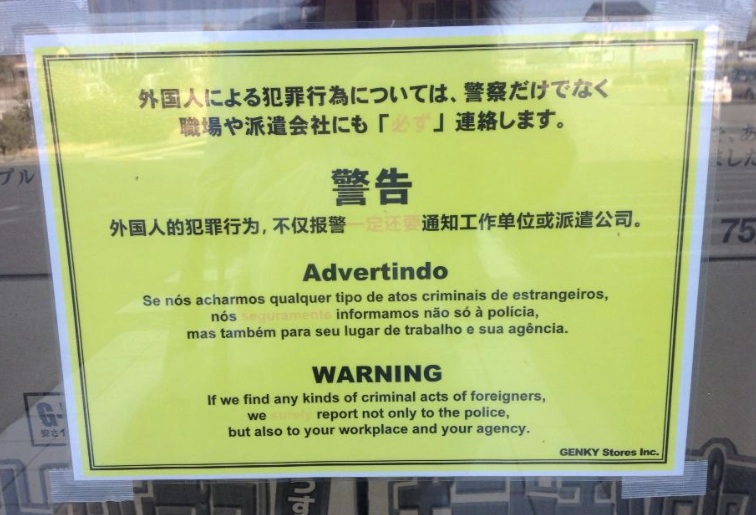
Genky Stores on the Lookout for “Criminal Acts of Foreigners”

“WARNING If we find any kinds of criminal acts of foreigners, we SURELY report not only to the police but also to your workplace and your agency.” – GENKY Stores Inc (a drugstore in Kani-shi, Gifu-ken, dated February 28, 2013, taken by HSD, courtesy of shared links on Facebook through SM)

by Robert Moorehead

Arudō Debito posted the above picture on his blog, debito.org, as another example of the persistent stereotype that connects foreigners with crime. As other posts on my blog have shown, this stereotype is not unique to Japan and is inaccurate. Simply put, foreigners are no more likely to commit crime than the native-born are. Debito’s blog points out that instances of shoplifting are increasing in one demographic group: elderly Japanese are committing shoplifting in increasing numbers. However, their crimes are often depicted in much nicer ways, as crimes of loneliness.

As a foreign resident of Japan, shouldn’t I also be on the lookout for crime? And shouldn’t I be looking out for all crime, and not just the tiny percentage committed by the country’s tiny foreign population? If non-Japanese are less than two percent of the population, shouldn’t we really be focusing on the other 98 percent? Something tells me they’re committing way more crime. Drawing on the Occupy Movement, maybe foreigners’ rallying cry should be “We are the 98 percent.”

When I lived in the city of Kasugai, in Aichi prefecture, most homes in my quiet suburban neighborhood were decorated with crime-watch signs in Chinese. The fact that there was no crime wave, Chinese or otherwise, was irrelevant, as was the fact that this supposed threat made up only 0.5 percent of the city population. Rumor had it that years earlier, someone had their home had broken into, and the alleged perpetrator was Chinese.

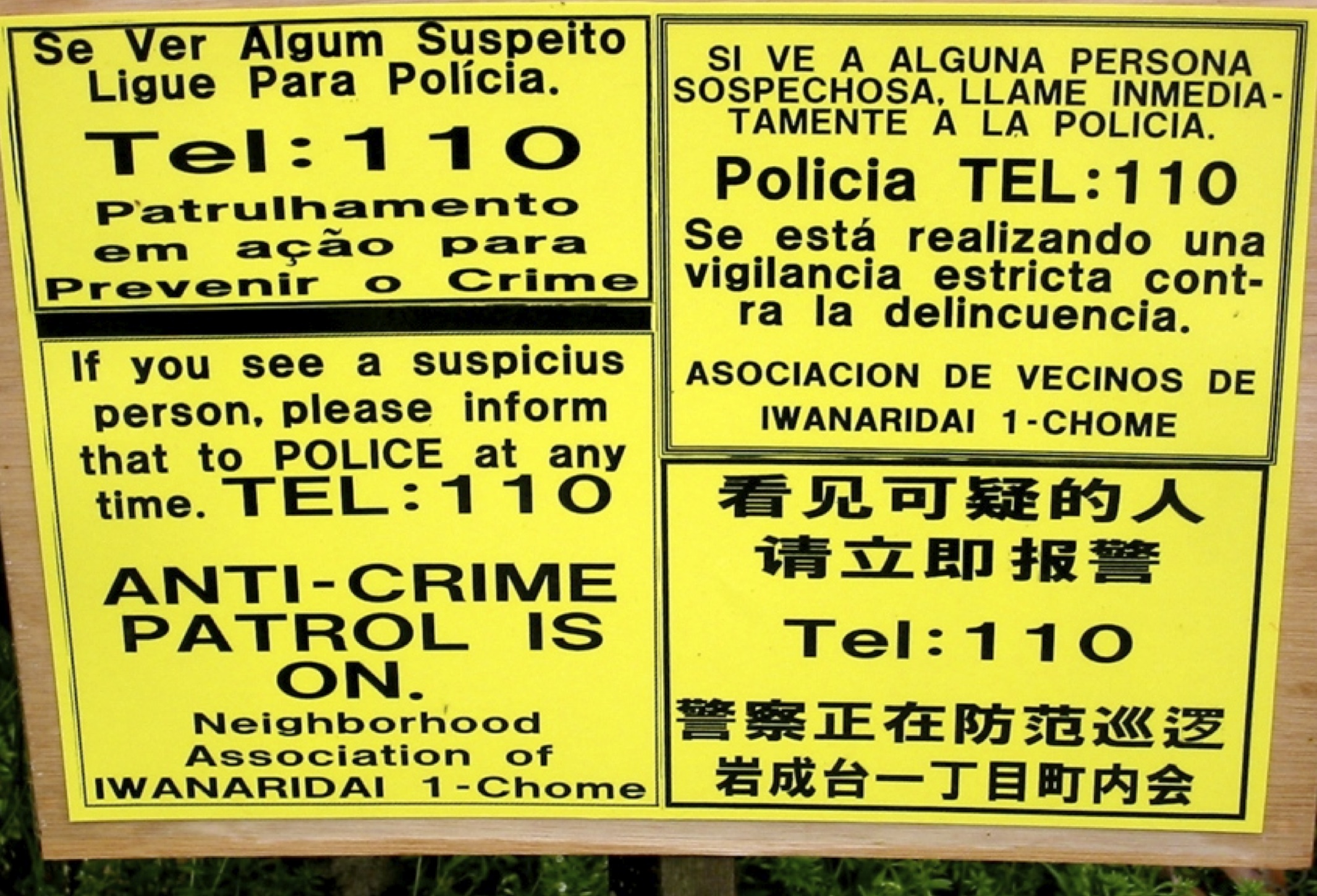
Following the logic that if one is guilty, all must be guilty, many homes in Kozoji New Town were festooned with signs in Chinese from their neighborhood associations, warning that residents would report anyone who looked suspicious (and Chinese) to the police. While an occasional sign was in Japanese, most were not. The enterprising neighborhood association of Iwanaridai cast a broad net over most foreigners in the area, putting up crime multilingual watch signs in Portuguese, Spanish, Chinese, and English.

Crime Watch Sign

Beyond perpetuating stereotypes that foreigners are somehow more likely to commit crime, these signs equate not being Japanese with crime and being Japanese with being law-abiding. They warn Japanese to be on the lookout for foreigners, and they warn foreigners that they’re being watched. They’re also an affront to our (shared?) humanity.

Update: The issue has prompted a video response on YouTube:

Pakistani student’s parents file complaint against classmates over bullying

by Robert Moorehead

From the Mainichi Shimbun:

The parents of a 13-year-old Pakistani junior high school student in Takamatsu have filed a criminal complaint with police, accusing their son’s classmates of bullying and injuring him.

A male Pakistani student at a public junior high school in a town in Kagawa Prefecture was bullied and seriously injured by his classmates, his parents alleged in a complaint filed on Feb. 18 with prefectural police.

The parents requested on the same day that the town’s board of education investigate the case and take measures to prevent a recurrence as they claim the student has been racially abused by four of his classmates since last spring. However, the education board denies bullying took place at the school.

According to the parents who held a news conference, the student was verbally bullied about the color of his skin by four of his classmates ever since he entered school last April. The parents claim that the students would make racist comments that their son’s skin was “dirty” and that they told him to “go back to his home country.”

The student was also physically bullied repeatedly by his classmates. Last November, one of the four classmates tripped him over when he was running in the hallway, severely injuring his legs and face. Since that incident, the student reportedly has to use crutches to walk.

The student’s 41-year-old father said, “We asked the homeroom teacher and vice principle multiple times to improve the situation but they failed to take any action.”

Original Japanese article:  http://mainichi.jp/select/news/20130219k0000m040116000c.html

Peoplemovin – A Visualization of Migration Flows

by Robert Moorehead

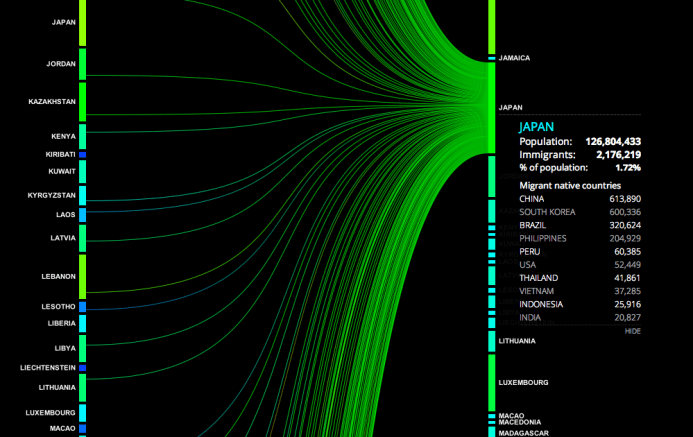
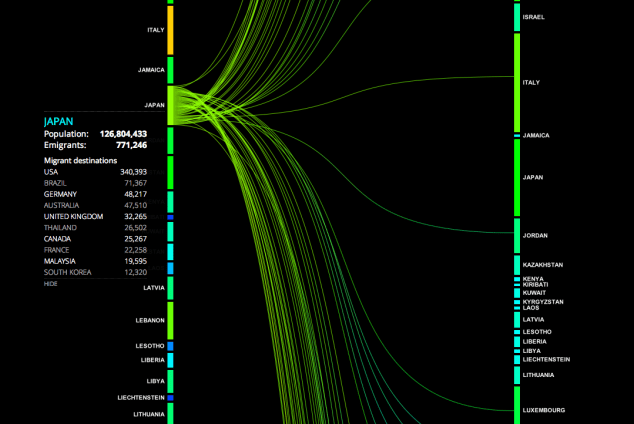
This is a short post that’s a heads-up to check out the site peoplemov.in, which provides visualizations of global migration. You can see data from 2010 on emigration and immigration flows for countries around the world. (Clicking on the pictures in this post will take you to the site.)

Migration into Japan

The top five source countries for immigrants to Japan are China, South Korea, Brazil, and the Philippines, and Peru. For Japanese emigrants, the site shows the top five destinations are the US, Brazil, Germany, Australia, and the UK.

I’ll leave the debate as to whether those “in-migrating” are “immigrants” or something else for another post. For now, emigrants are those going out, and immigrants are those going in. I know many in Japan say that Japan is not a country of immigration, and thus has no immigrants. Rather, it has “foreign workers,” “migrant workers,” dekasegi, etc. “A rose by another other name would smell as sweet.”

Migration out of Japan

Migration out of Japan