Globalization and the image of success

by Asako Morita

Globalization brings us so much information by mass media such as TV and Internet. Historically, America and other western countries have led world economy and therefore they who have succeeded in business and living sophisticated life became the model of success. Whether they are actually happy or not, media especially TV dramas which shows how free city life were broadcasted all over the world and people tend to think this would be the life when they become rich. The scariest thing is globalization even change typical life style and people’s life aim.

Especially, I was interested in women’s global beauty. The globalization made the ideal women and people take it as a big market. This global market and the typical ideal beauty invades society and culture, and sometimes people think it can destroy tradition and originality, I think no one can stop it in this capitalism leading world economy and even it influences a lot, the basic identity and tradition would never change.

For instance, since pale became the image of success among worldwide women, whitening products were targeted by multinational companies and sold thousands of them. These advertisements such as TV commercials also created the image clear and even more penetrate in society.

Not only whitening products but also choice of clothes is influenced. When I visited India, I was so surprised when I saw TV programs. Most shows broadcasted totally western lifestyle. Women are dancing at dance club wearing sexy dresses. Even woman wear a sari which is a traditional Indian dress was exposing shoulder and the breast. It was like Indian actors and actresses imitate part of American culture. I remember that I felt so strange the pictures I saw on TV were completely different from what I saw on the street outside.

However the fact TV programs, other multinational products and other factors affect on different countries and culture, I think this is the result of globalization and capitalism. As long as America which is a capitalism country leads the world economy, we can never stop the image formation and marketing of multinational companies. It may influence on different cultures, but it does not ruin each culture. Traditions and basic cultural morals cannot be changed easily since they have taken over for long time. The western influence may create different life aims but culture and lifestyle have changed in each time and I think people are just adapting how to live the present age.

Three Questions of Cultural Globalisation

by Hiroki Matsukura

We have several issues around cultural globalisation, such as the conflict between globalism and localism. On this post, I would like to focus on three topics which cultural globalisation is facing, in my opinion. These three topics, or questions, challenge us on whether we continue to cope with cultural globalisation in the way we are doing at the present.

The first question about cultural globalisation is a suspicion on the equality of each culture in midst of the globalisation. In other words, when we treat cultures in globalisation, each of them has its own power to influence people’s lives in the world. Some are stronger and others weaker. For example, as we experience now, the American and the Western European cultures affect our lives around the world very much. They are so powerful that globalisation seems to mean the global access to the Western cultures. On the other hand, taking a look at the Bolivian culture, for instance, we notice the difference of treating between them. With an extreme strong expression, people perhaps will see globalisation as a Western non-territorial invasion. In international society, culture can be a form of soft power. Thus, cultural globalisation has a competitive nature among cultures as one of its characteristics. That may be associating to exclusiveness of one culture from others.

The second is the possibility to strengthen the situation in which culture leaves its essence. Cultures can be stated as consisting of the home land and/or ethnicity. However, because of the globalisation, cultures are leaving them. Last Christmas, I went to my Italian friend’s place in Rome, and experienced a traditional catholic Christmas. It was totally different from what I had imagined. In the dinner of Christmas and its Eve they did not eat meats, and the cake was not decorated. They visited churches in the night. They celebrated Christmas for almost whole a week since the Eve. They visited their kin and ate together. Actually, it was quite similar to the tradition of the Japanese New Year’s Day fiesta. There is a possibility that others’ cultures we got to know through globalisation are not genuine, or are faked. Moreover, when we read foreign books, see foreign films, and listen to music from overseas, we may face a difference of norms. We might get completely different feelings from the native people’s feeling while touching on the culture. Even though we do not notice the difference, the norms, the basis of culture, should be completely different from what we, outsiders to one culture, imagine about it. We possibly will misunderstand the cultures from others. Thus, the questionable point is whether the globalisation can transport real and genuine culture toward others.

The third is a point that cultural globalisation is not moral globalisation. Similarly to the difference and gap of each cultural norm, the idea of morality on each culture is not same. Even if we would like to transport our moral idea to others, we might not know whether we could or not. Culture as form can be easily transported, but when it comes to think about the mentality on culture, the transportation will be not easy as the norms show us. Which side, left or right, of escalators standing on is still a cute matter. Probably, respect toward lives or the value of violence will be not same on each culture. This is not a small gap.

With these three questionable points, however, we cannot stop globalisation. It already has preceded our recognition. It cannot be helped as a fact though we have to try not to let the situation be. This is because the gap of recognition and the exclusiveness of our cultures might be leading us to much larger misunderstanding and turmoil. In the situation that the values and goals of each culture are different, the cultures are facing power-relationship and a sort of race now. Since our mixture and co-existing with others through cultural globalisation, we will need to strive to revise the influence of our cultures.

Globalization and Westernized Japanese Women

by Anonymous

Today, the world is more globalized, and more and more people, culture, religion, things, and money are spreading over the countries. We can find cell phones, TV, computers, and also McDonald’s in almost every country. So, what is globalization? For me, globalization seems like the westernization of the world because it spreads things that are made by western countries in most cases. Moreover, westernization reaches people, like many people including Japanese want to be like western people. Especially, recent Japanese women are westernized by globalization.

In Japan, many women dye their hair and wear makeup and they envy long legs or arms. I think these features come from image of the Western. Unconsciously, we came to have the idea that western outlook is good and beautiful, bright skin, blond hair, big eyes, blue eyes and nice shape of body. In fact, models in magazines for young women often look like westerners, and it might be one reason for westernizing Japanese women. However, we have to remind ourselves that this phenomenon sometimes brings health damage. For instance, some Japanese women put colored contact lens in their eyes to make them blue or big, but it sometimes hurts their eyes. And there is the way to make eyes bigger that put eye liner as close to mucous membrane as possible, but it also hurt their eyes.

While Japanese women mimic western women, it is a famous story that western men like Japanese women. It is said that they are fascinated by black hair and sharp eyes, but also they are surprised at too much makeup Japanese women do. So there is the gap about pretty Japanese women between themselves and others. However, many of Japanese women have complex with their outlook especially small eyes and flat faces so they cannot stop using makeup, and I think these complexes are come from the adoration of the West.

I cannot say “stop westernizing your face” because I am one of the women who want to make eyes bigger. I think western women who have big eyes, sculptured face and long legs and arms are beautiful. Globalization might change concept of beauty in Japan. It means that women who have small eyes and round face like otafuku were considered as beautiful women in Japan in the past. On the other hand, the image of beautiful women in today’s Japan is like western women, and the concept flowed into Japan with progress in globalization. Although I think the Western is cool, it is sad that if we totally lose Japanese beauty. So I think we should find reconsider about Japanese beauty and figure out Westernized Japanese beauty as a new concept.

The Risks of Globalization

by Noriko Abe

I have studied various effects of globalization in class. I always have a good image of globalization and I often use the advantage of globalization in my policy recommendations. However, I saw many risks brought from globalization in this class. Therefore, I focused on various risks brought from globalization.

First, I raise the advantage of globalization. Globalization promotes economic liberalization. India actually developed their economy because the country changed their economic policy from controlled economy to liberal economy. It is thought that the variation of strategy which companies take has broadened. Also, new information technologies have proliferated. People’s lives have been made more convenient all over the world. More and more people go to foreign countries for business, sightseeing, and other reasons. I think that each human in the world gradually has his mind to try to know humans in other area and country because of globalization.

On the other hand, many experts fear the dangerousness which globalization causes. I pick up the report written by the World Economic Forum (WEF). The World Economic Forum is an independent international organization committed to improving the state of the world by engaging business, political, academic and other leaders of society to shape global, regional and industry agendas. The World Economic Forum showed the Global Risks 2012 report on January 11th, 2012. The Global Risks reports are showed every year and the reports, which focused on the findings of a survey of 469 experts and industry leaders, outlined top five global risks in terms of likelihood in the next 10 years. This year’ s report says severe income disparity, chronic fiscal imbalances, rising greenhouse gas emission, cyber attacks and water supply crisis from a higher rank. This year’s report shows a shift away from worries about the environment to concerns about a breakdown in society and economies. I think this means that effects of globalization have become more serious from superficial problems. Also, the report believed these risks threaten global growth as they drive nationalism, populism and protectionism at a time when the world remains vulnerable to systemic financial shocks, as well as possible food and water crisis. It is strange that the world, which has originally nationalism, populism and protectionism, do globalization in pursuit of the progress and the result return to nationalism, populism and protectionism.

The usefulness of globalization is large, but we also have to look the measure for the problems which globalization cause. The measure goes to protectionism. We may not change our today’s life, so we have to rethink ourselves in globalization.

Reference

‘Global Risks 2012 – Seventh Edition’, World Economic Forum, <http://www.weforum.org/reports/global-risks-2012-seventh-edition&gt;

Globalization and social movements: a revolt for globalization.

by Wataru Yukita

Globalization gives us many interests in many aspects, financial system, investment, free trade, communicate with people around the world and so on. Therefore, we can get news in the world and culture in our house. Products of TOYOTA or SONY influence wasting life in the world. However, globalization has negative aspects and they raise some social movements.

For instance, in 1980’s, IMF(International Monetary Fund) support developing countries in order to introduce open markets, easing of regulation and cutting government spending. They promoted globalization. By these political measures of IMF, investments for these counties had increased, not only traditional direct investments but also investments to stock and bond certificate for free and international financial markets. They had firm effect on economy in developing countries.

However, after economic crisis in Asia in 1997, IMF forced East Asia counties to pursue fiscal austerity. By this tight budget, these counties must take measure of cutting social welfare, unemployment, inflation of basic goods. What is worse, downturn of economy causes social disorder and political confusion. In Indonesia, Rebellions popped out by reason of cutting subvention for food and fuel. In Thailand, jobless workers in urban area pour to rural area. By these unsteadiness and confusion, the measures of IMF to East Asia introduce social movements for anti-globalization to oppose globalization.

In 1999, NGO of development and environment and labor association worked large social movements for anti-globalization in a conference by WTO at Seattle. The crowd became about 50 thousand people. These movements argued that liberalization by WTO result in much damage in many aspect, people health, environmental pollution and labor condition in many societies. Thanks to these social movements, WTO could not set up new round and create new agenda to support developing countries. In 2001, through these amendments for some policies, WTO was able to establish new round. Today, WTO is biggest regime by join 153 countries and region. WTO address to equity of trade rule and deal in development by reflecting developing countries opinion. It shows that recognition that developing countries should get benefit by free trade is shared around the world in spreading globalization rapidly.

I think that globalization give people many opportunities to progress civilization. In addition, it needs governance that control negative aspects of globalization. So, globalization requires making rule and policies that take care of wealth gap and environmental pollution in international, region and nation level. Social movements take a important role to frame these rules.

Reference

Koji Murata, “Catch International Politics”(Japanese), YUHIKAKU,2009.

Cleaning and care product companies need to step up to the plate for commercials featuring men

by Sherry Stanczyk

The year is 2012, and it’s fair to believe that there has been social progress in regards to the equality of women since the past. Women have made strides in participating in the working world that was once dominated by men. In In this day and age it is not uncommon for the wife of the family to bring in just as much money as her husband, or in some cases even more. But behind all this progress, the fact remains that little has changed in regards to the gendered nature of ‘unpaid’ labour, such as childcare and house cleaning. Even though it is normal to now consider women family breadwinners, this gender inclusion does not extend to inside the home, where housekeeping and childcare are still primarily considered the jobs of women. The idea that women are still the primary home caretakers creates inequality; firstly as Erhenreich and Hochschild have illustrated in their article “Global Woman”, in the majority of middle and upper class Western households where the wife is unable to do the housework, instead of a division of labour between husband and wife, the house and child care duties are passed onto other women, typically paid maids from poorer countries. This creates situations where these migrant women, hidden away in households, are vulnerable and lack worker’s rights. Gendered housework also feeds into and sustains the existence of the glass ceiling; women are still not paid as highly as men because society still believes a women’s priorities are family, thus higher salaries, promotions, and job positions are usually given out to men. The gender divide of housework also creates an unfair situation for women who end up having to sacrifice either their career or family ambitions.

However, although not the majority, many men do participate in household and child care tasks. But the fact remains that society in many ways stigmatizes men who participate in cleaning and caretaking roles, as well as discourages men from taking part in the house and family. And nothing is upholding these norms more than the advertisements for cleaning and other household products. Advertising- as much as one would like to believe they are able to filter out- remains a powerful and strongly influential factor in dictating how we as a society believe and view what is both normal and desirable. And advertising for cleaning and household products almost never show men in their ads. These ads create the illusion and normalize the idea that cleaning and childcare are only and should only be done by women, while ‘real’ men take no part in housework. When ads for household products do feature men in their ads they typically showcase them as the housework-clueless and useless husband who need his wife to come to the rescue, or as the emasculated house-husband. (And although there is nothing wrong with a man who wants to play the traditional homemaker role while his wife wears the pants, showing it advertising still feeds into the idea that housework is ‘feminine’ and a woman’s job.)

There has been some change in advertiser’s thinking. For example, this year when Huggies created a series of diapers tv advertisements which featured incompetent fathers ignoring their baby’s dirty diapers in favor of ‘guy things’, such as a sports game on television, many real life fathers protested on Facebook, resulting in an official apology from Huggies and a new set of ads showing far more competent fathers. However, more companies need to step up to plate, and bring in some freshness and creativity to their advertising. I think we need to see more cleaning ads featuring normal, everyday fathers and men using their products. Although having more house care ads feature men isn’t going to magically fix the problem of gendered housework, it would be a step in the right direction. If we’ve come so far in social progress and ideas regarding gender roles, why are we still afraid to show that men can participate in household tasks too?

Social Movements, globalization and gender

by Julia Helbing

When thinking about Social Movements and globalization, there are many points that come into my head.

First of all, I think that Social Movements are very important nowadays. They are easy to start; you can just use the internet or advertisements in the radio or in the TV to inform about what you are going to do. You can create an event on Facebook and invite all your friends, who will invite other friends or post it on Twitter and other social media. This way more and more people will hear and read about your movement and maybe want to participate or support you. I think that Flash Mobs are also some kind of Social Movements. People appoint at public places to a certain time and start doing all the same at the same day, e.g. start to dance or pillow fight. After the Flash Mob is over, everyone is leaving to a different direction. Normally, the people who come to Flash Mobs don’t know each other.

In my opinion, Social Movements can really change something. For example, after the catastrophe in Fukushima, there were many protests in Germany. Germany still runs a lot of nuclear plants and even has an atomic disposal zone, which is also used by other European countries. People were shocked about Fukushima’s nuclear disaster and didn’t want something like that to happen in Germany. Therefore, they activated advertisements and thousands of people started to protest. This was reported in the TV and attracted more protester. When the movement became bigger, the government hat to react. They changed the atomic energy law and shut down nuclear plants that already were kind of a risk. In addition, they promised to shut down all nuclear plants in the future and to develop the use of renewable energy. Of course affected this changes other European countries and they are also discussing about new energy laws.

Finally, I think globalization also helped the gender revolution. Women wanted to be treated equal with men, they also wanted to be able to go to work instead of taking care of the household all day long. They went out on the streets, started protesting and this was reported by the newspapers all over the world. It influenced other women to also think about what they can do to change something. The result is that now the equal treatment of women and men is part of the law in many developed countries. And even if it is not carried out in all countries, I think it started the way that people think about gender roles. In Germany, there are some fathers who stay home now and take care of the children or the household.

So even though globalization has many bad points, at the same time some things also changed to a better condition.

Immigrants face labor issues in the host countries

by Mao Shibata

Nowadays, globalization spreads all around the world and it has brought diffusion of international transportation so that people are able to flow freely over borders. The number of international immigrants who look for a job and seek more stable life is getting increase over the world, while they are struggling with serious labor problem in their host countries.

When I went to Vancouver during this summer vacation and stayed with my host Pilipino family, they were facing labor problem. The father had quit security guard and wanted to be an elementary school teacher, though the Vancouver government did not accept his require and grant letter of acknowledgement. Moreover they had two children who were still 6 and 8 and they live separately with their parents so that he had to take care of them in the home while the mother went to work during the long vacation. Since the mother was a breadwinner, she went to work 7 days a week and even worked on holidays as salary was higher than usual. They knew that as long as this condition persists, it is really difficult to make a living as their children get older. Then, what should they do? Should the father have to find another job-even if it is a lower wages one- while he leaves his children home alone? Should they send their children to their home country where their parents take care of their children?

Though they leave their home countries to get a job or to help their families, they cannot get stable and well-paid occupation even they have documents and the host country’s nationalities. Needless to say, immigrants who come to new country without any documents or visa cannot get a proper and high paying job. What’s more, their children those born and raised in host country also regard as illegal immigrants. Even they are educated exactly as well as children who have that host country’s citizenship and high skilled or talented people, they are not able to enter the university, get any certificate and satisfying job. It causes not only deprives of the children’s bright future but also it endanger their safety and the lives. Since it forces them to engage in unsustainable work and harsh environment such as day labor, low wages and prolong work besides, it may drag them into drug or gun crime to make much money.

Internationalization and development of the transportation make people easy to cross a frontier throughout the world and millions of people decided to go overseas to earn a livelihood or send money home to their families, however, they face multiple barriers in the host countries; low wages and long hour works, limited visa and citizenship. Not only try to restrict the immigrant’s occupations and to drive them away, but we need to consider how to improve their severe working situations and shift policies more flexible to accept them.

Prejudice and Multiculturalism in Japan

by Ayaka Nishizaki

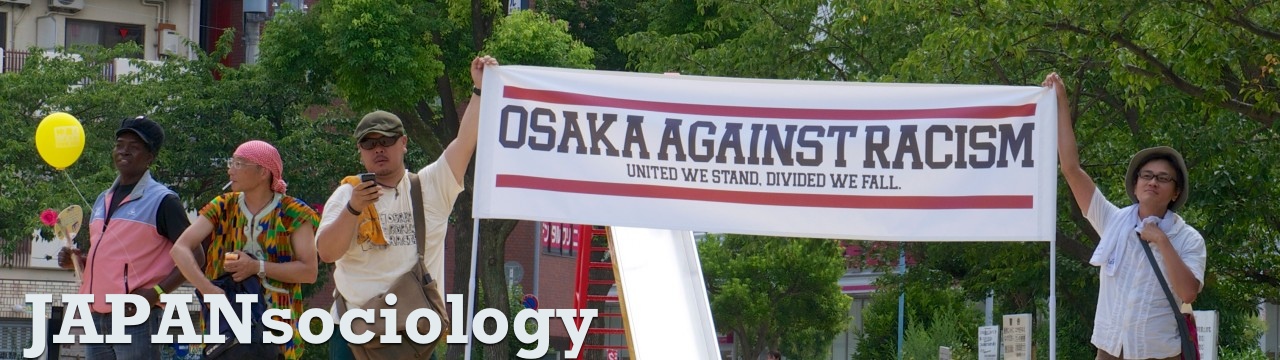
In this time, I would like to bring the topic about prejudice and multiculturalism in Japan. One month ago, I saw a shocking situation that one couple of an American boy and a Japanese girl were insulted by one Japanese stranger. I was sad there is still some situations that ‘being different from others’ is not enough accepted in Japanese society. Therefore, I start to think how that situation occurs and about multiculturalism.

One big problem is that the Japanese idea of ‘egalitarianism’ sometimes causes prejudice. I learned the word ‘egalitarianism’ during class and I agreed that Japanese school and society focus on equality for everyone. Japanese school gives students the idea that we have to give same opportunity for everyone so that prejudice will not occur. However, I wondered ‘this egalitarianism is the exactly same meaning as treating people equally?’ In my opinion, Japanese school teaches how important they have to give same opportunities and rights for everyone, but they don’t teach ‘how important we accept something being different from others’. I felt strange when during discussion class, some Japanese students mentioned same opinion that I had heard before and many students agreed on. Japanese prefer ‘safety’ in society, so they unconsciously chose opinions they may feel comfortable with. I know not all of Japanese are like that and that is just one of examples, but my point is that Japanese society focus on being equal so much that it sometimes makes difficult to express ourselves and try to become similar to others in terms of fashion, hair style, even our different idea or thoughts.

‘Multiculturalism’, which is one I learned, will be very important in Japan. It is commonly said that many Japanese can’t think say their different opinion. On the other hand, American society gives people the basic idea that everyone is originally different. I don’t mean that American education is better: I think at least Japanese egalitarianism leads to some prejudice for foreigners. Therefore, Japanese needs to respect something being different, but how can Japanese society teach multiculturalism and make Japanese multiculturalism? I think it needs long time because Japan has one ethnic and they already have similar background, so students have difficulty in imaging what does being different mean. It is not easy to bring multiculturalism to Japan because of fixed environment. However, I can suggest that changing Japanese education system is one of the ways. After I came back to Japan from my studying in the U.S, I felt how few there are opportunities to share my opinion in Japan. Making more opportunities for students to discuss and share their opinion could be one step to multiculturalism in Japan.

Borderless Culture

by Ayaka Nakamura

When I asked foreign friends a question, “what is Japanese culture?” many said, samurai and kimono that are related to traditional Japanese stereotype, and Japanese people also often say Japan is a mono-cultural traditional country. Yet, I think Japanese culture contains many foreign origin customs and is ever-changing. However, although it is difficult to differentiate a multicultural country from a global country, Japan is not enough globalized to be capable to accept people who have different cultures.

One of the most frequent answers to the question, what is Japanese culture, might be kimono. There is no doubt the traditional clothes is a part of Japanese culture, and many Japanese wear them for festivals and various ceremonies. Yet, kimono is not Japanese original or only-Japanese culture. Similar style wears were used over Asia, and Japanese people actually imported pre-kimono clothes from China and Korea. Then, how about Zen culture? Japan has five famous Zen temples where sophisticated monks created poetry and paintings, and the word, Zen, is widely known as a Japanese culture in the world. Yet, Zen was happened in India and was brought to Japan much later. Although both kimono and Zen are not originally from Japan, they are part of Japanese culture.

In addition to these pan-Asian cultures, Japanese culture contains Western cultures, too. One will hear the Symphony No. 9 in D minor, Op. 125, by a European composer, Beethoven, on the last day of every year in Japan. Playing and singing the Symphony No. 9 altogether is a Japanese ending year custom, and people eat soba noodles listening to it. Moreover, how about shaking hands? Is it not a Japanese culture? Although touching someone’s body part would not fit into Japanese polite manners, shaking hands became a common way of a greeting especially in business, and most of all Japanese know what shaking hands means. From ancient time, Japan integrated many foreign cultures into its own culture, and people are not aware of their non-Japaneseness as cultures are invisible.

However, instead of accepting foreign cultures, Japan is not capable of having people who have different cultures yet. If accepting people is about globalization, then Japan has not globalized enough. Although many companies expresses they need “global” people to work with, they would not hire a Muslim man who can do a great work but who needs to have praying time five times a day. It would still take time for Japan to stand at the global stage. Yet, I believe it is not impossible, and Japan can be a more multicultural and global country. For the change, Japan definitely has to deal with some overdue customs, such as treating women as tea servers and recruiting only Junior students, that would cause a delay in the global business race.