You Might Be a Sociologist if …

by Robert Moorehead

In the WW Norton blog Everyday Sociology, Peter Kaufman lists the 41 reasons he’s a sociologist, writing “I am a Sociologist Because …

The list reads like something straight from my week 1 Introduction to Sociology lecture. Has he been spying on my classes, or am I just that unoriginal?

Kaufman hopes the list will help people see the importance of identifying as sociologists. I imagine a meeting of Sociologists Anonymous, where scholars come out of the closet and admit their afflictions. “My name is Robert, and I’m a sociologist. It’s been 2 weeks since my last analysis.”

As Kaufman writes, “it wouldn’t hurt if more people proudly proclaimed: ‘I am a sociologist because …” We’re here, we’re analytical, get used to it.

But rather than teach people why “identifying as a sociologist is important,” shouldn’t we teach people to think like sociologists (while writing better)? It’s not the identity that matters, but the perspective and the action that identity can produce.

Kaufman’s reason #33 states “I expect to transform knowledge into action and create a more just and equal world.” It’s not about who gets credit, but about the world we can create.

Here’s Kaufman’s list:

“To this list of lists I add one more: the list of what it means to be a sociologist. Beginning with the prompt: “I am a sociologist because. . . .” here is what I came up with:

  1. I am curious about the world in which I live
  2. I am fascinated by all things social
  3. I am intrigued about why people do the things they do
  4. I am interested in how people interact with each other
  5. I believe that society is a human invention and I want to know how, why, and who invents it
  6. I wonder how meanings are created
  7. I question who has the power to create social norms
  8. I realize that there may be an artificial and even arbitrary distinction between normal and deviant
  9. I am aware that my beliefs, attitudes, values, and actions are based on my social position and not some innate personality traits
  10. I recognize that the time period in which I live has also influenced my beliefs, attitudes, values, and actions
  11. I struggle to be mindful of the biases that may cloud my views
  12. I am suspicious of neat and tidy explanations
  13. I attempt to understand reality from the perspective of others
  14. I listen to the stories that people tell about their lives
  15. I observe social practices and social processes
  16. I collect and rely on data to support my assertions
  17. I focus on patterns and trends instead of on unique individual experiences
  18. I ask questions, and then ask some more, instead of accepting commonly offered answers
  19. I engage myself and those around me with inquiries about the bigger picture
  20. I try to be attentive to the interdependent web of connections that characterize our world
  21. I prefer to explain things based on structural factors rather than just pointing to individual actions
  22. I strive to understand how our lives are impacted by forces such race, gender, sexuality, social class, ability and other such variables
  23. I am angry that inequality is increasing in a world of plenty
  24. I see examples of racism, sexism, homophobia, and other forms of inequality in the fabric of our social institutions such as the media, education, sports, health care, religion, and politics
  25. I am concerned that our inability to recognize institutional forms of oppression often results in our collective denial of such oppressions
  26. I do not stand by silently when I hear others make comments or jokes that are sexist, racist, homophobic or reflect other forms of inequality
  27. I challenge taken-for-granted assumptions that perpetuate inequality, oppression, and injustice
  28. I refuse to accept the social order as natural, inherent, and “just the way it is”
  29. I reject the notion that the status quo is permanent, stable, and everlasting
  30. I maintain that the only thing that is permanent is the impermanence of the world in which we live
  31. I endeavor to be socially aware so that I may see things that others may not recognize
  32. I use my sociological knowledge to deflect harm not cause it
  33. I expect to transform knowledge into action and create a more just and equal world
  34. I am committed to fostering positive social change
  35. I think about sociological ideas
  36. I read sociological books
  37. I study sociological theories and concepts
  38. I write sociological essays and papers
  39. I discuss sociological themes
  40. I encourage others to embrace the sociological perspective
  41. I act like a sociologist by engaging in the behaviors on this list.”

What’s Changed, 2 Years After Fukushima?

As one: People join hands Sunday morning on a beach in Iwaki, Fukushima Prefecture, ahead of the second anniversary of the Great East Japan Earthquake. | KYODO

by Robert Moorehead

Two years ago today, at 2:46pm, Japan suffered one of the worst disasters in its history. A magnitude 9 earthquake shook for 6 minutes, followed by a massive tsunami that destroyed entire cities and carried people and debris out to sea. The quake and tsunami also crippled the Fukushima Dai-Ichi nuclear power plant, taking out its backup power generators and safety systems. Tens of thousands remain displaced and likely never to return to their homes.

I watched news coverage of the tsunami and nuclear disaster from the safety of the United States, while my suitcases sat packed and ready for travel to Japan to start my position at Ritsumeikan. I heard American broadcasts warn of everything but Godzilla marching down the street, and Japanese broadcasts calmly, quietly, try to balance informing the public with protecting those in power. Somewhere in between those two extremes lied the news people needed to hear, and that is still largely ignored in the mainstream Japanese press.

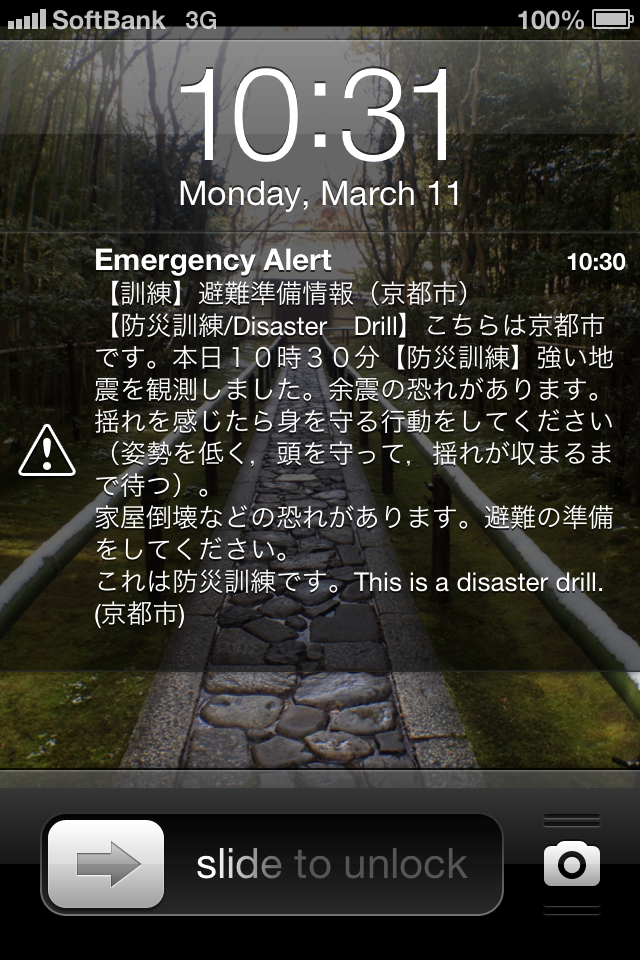
Governments across Japan conducted disaster drills on the anniversary of 3-11.

Governments across Japan conducted disaster drills on the anniversary of 3-11.

This week, TV news have covered elements of the nuclear disaster in detail, and undoubtedly many people across the country will observe a moment of silence at the time the quake struck. But for the those who had to evacuate, there is likely no going back. Many still live in poorly built temporary housing and struggle to form new community ties. Victims of the disaster continue to struggle with domestic violence, unemployment, depression, and suicide. And many live just outside the evacuation areas, near radioactive hotspots, and in areas where radiation cleanup work has been shoddy and ineffective. The yakuza, Japan’s labor broker of last resort, have done well in the aftermath of the disaster, but how about the people of Tohoku?

While disasters often bring people together, leading us to help each other and to sacrifice for the common good, eventually the institutionalized patterns of corruption and inequality reappear. Prior to the disasters, the regulatory bodies that ostensibly existed to protect the public from the deadly hazards of nuclear power, instead served to protect the profits of the agencies they were supposed to regulate. This brazen failure of governance raises the question I have asked my Japanese students each semester, whom does the government serve? Does it represent you, your voice, your interests, or those of Japan’s corporate oligarchy? Is the system rigged in their favor? The questions are largely rhetorical, but I often get the sense that students had not previously given this issue much thought.

Nobel laureate writer Kenzaburo Oe (right), joins a demonstration after an anti-nuclear rally in Tokyo on Saturday, March 9, 2013. Thousands of anti-nuclear demonstrators rallied in Tokyo, urging Japan’s government to abandon nuclear power. — PHOTO: AFP

One cliche often heard in Japan was that 3-11, much like 9-11, changed everything. The challenge Japan faces is whether the events changed anything at all. Beyond the buildings and nearly 20,000 lives that were lost, what has changed?

The Abe administration moves ahead with plans to restart Japan’s nuclear power plants, and a newly restructured nuclear regulatory agency struggles for legitimacy. Will the new agency actually regulate the industry? Will the agency shut down nuclear power plants that were built on active earthquake faults? Will it enforce new safety regulations? Will the government be able to turn down the companies that have invested billions in plants and fuel processing facilities? Who will the government represent in making those decisions?

A protester holds an anti-nuclear power sign at a rally in Tokyo on Saturday, March 9, 2013. Thousands of anti-nuclear demonstrators rallied in Tokyo on Saturday, urging Japan’s government to abandon nuclear power. — PHOTO: AP

My students tell me that Japanese people don’t protest and that there are no social movements in Japan. And if you only read the mainstream press, this perspective makes sense. But tens of thousands of people across Japan continue to protest the return to nuclear power. Will these voices be represented in government? (It’s also disheartening to hear my students ignore 60 years of protest in Okinawa, but that’s the subject for another post.)

It will take another 40 years to decommission the Fukushima Dai-Ichi plant, requiring the use of technologies not yet invented to remove melted nuclear fuel from inside the damaged reactors and spent fuel pools. Righting the country’s course will require continued vigilance. If that happens, then 3-11 will really have changed everything.

Douglas Kim’s “I’m Asian American” Challenges Stereotypes

by Robert Moorehead

Let’s turn the lens from racial stereotypes Japan to those in the United States, to appreciate Douglas Kim’s music video “I’m Asian American.” Parodying Ben Fold’s “Rockin the Suburbs,” Kim takes on the stereotypes that all Asians look alike and don’t speak up, that they’re all on track to becoming doctors, pressured by Amy Chua’s Tiger Mothers, and ignored by Asian American women.

As Kim writes in the YouTube description of his video, “Our friendly neighborhood American Asian is just a regular guy trying to get through life in America without getting hated on by Asians and Americans, is that too much to ask?”

I’m thinking of showing this video in my upcoming class on Race and Mass Media, between the Slanted Screen and Better Luck Tomorrow. For my Japanese students, these American stereotypes of Asians are completely foreign. My students often struggle to imagine the experience of being in the minority and subject to such stereotypes. When I’ve shown clips of yellow-face characters like Mr. Yunioshi from Breakfast at Tiffany’s or Long Duk Dong from Sixteen Candles, I expected students to get angry. Instead, they dismiss the images as simply inaccurate. Some even say they understood that others might stereotype the Japanese and other Asians, just like the Japanese and other Asians stereotype other people.

At first, I was struck by how seemingly blasé they were to the images, but gradually we realized that these images were but one of many images of Asian people that those living in Asia see everyday. They see Asian actors playing every role, from doctors and lawyers, to janitors, mechanics, and office workers. From this perspective, seeing one ridiculous caricature might not seem like such a big deal.

In the US, on the other hand, Asian characters in film and on television have been much fewer and farther between. So those few portrayals carry much greater weight—just there are few non-Japanese on television and in film in Japan, and many foreigners seethe when they see a gaijin playing the fool. Tarento (performers) such as Bobby Ologun and Rola make viewers laugh with their misspoken Japanese and silly expressions, and the ability to entertain others is a great thing—but not at the exclusion from other performing other types of roles.

Kim’s video highlights the stereotypes of Asian Americans, and then smashes them, like the cello he destroys at the end of the video. And just as his Tiger Mom shifts to rocking out with him, hopefully Kim’s viewers will come to see past the stereotypes.

Here are the lyrics:

Let me tell y’all what it’s like

Being Asian we all look alike
It’s a bitch if you don’t believe
Read about it in a magazine
Sham on

I’ve got Tiger momma on my brain
So intense that I can’t explain
All alone in my Asian pain
You know they’ll punish me if I complain

I’m Asian American
And my friends are all pre-med
I’m Asian American
Get a B and I’ll be dead
I’m Asian American
I take the grades and face the facts
Some advisor with computers puts me on some shitty track

I’m pissed off but I’m too polite
When Asian girls all want a guy who’s white
Mom and dad you made me so uptight
Can’t ever party on a Friday night

Don’t know how much I can take
Give me something I’m allowed to break

I’m Asian American
Doing what my parents said
I’m Asian American
And it made me talented
I’m Asian American
I write on facebook and face the facts
Typing wall posts on computers is the only way I mack

In a haze these days
I’m cursing my poor eyesight
And I can feel something’s not right
I can feel someone’s trapped me in a lame cliche
Sending dirty vibes my way
Cause I would not be their robot
And I would not be a white collar slave

It wasn’t my idea
Never was my idea
Just drove to the store for some ramen and jap chae

Y’all don’t know what it’s like
Being Asian we all look alike
It gets me real pissed off and makes me wanna say

“Oh hello! Being Asian American has had profound unique effects on one’s psychological disposition, and as such, they’re not always able to effectively communicate their feelings in a way that doesn’t seem contrived, irrationally angry, oh thank you, or insecure. Wait, what’s that…”

Stuck in someone else’s song
I’m Asian American
Where the pho do I belong
I play some ball and face the facts
Can’t just sit behind computers
Gotta take it to the rack these days

Yeah yeah
I’m Asian American

You better watch out because I’m gonna say

Update: After Protests, Genky Store Takes Down ‘Foreigner Crime’ Sign

by Robert Moorehead

After protests by local non-Japanese residents, the Genky store in Minokamo, Gifu prefecture, has taken down the signs that warned foreign customers that they were being watched as potential criminals.

My Portuguese skills are limited, so hopefully a reader can help translate the video. I am encouraged by the response of the local non-Japanese community in standing up for their rights, and by the fact that the store management responded to those concerns.

Stereotypes are harder to maintain when the person the stereotypes supposedly describe is standing right in front of you. In that case, we sometimes fall victim to what Tim Wise has called “enlightened exceptionalism.” That is, have prejudiced views about a group but making an  exception for individual members of that group. This approach lets prejudiced whites vote for Barack Obama, while still holding racist views of African Americans. In this case, clerks at the Genky store might have said to the protestors, “Of course the sign doesn’t describe you. It refers to other foreigners.”

The protestors used the uncomfortable tension the staff likely felt when confronted with protests to their advantage, in demanding that the signs be taken down and in rewarding the removal of the signs with applause. In so doing, they hopefully have taken a step toward turning a foe into an ally. But whether the staff at Genky will still watch non-Japanese customers with suspicion or not, at least that suspicion is no longer publicly posted for all the world to see. The public posting of the signs reproduced and reinforced negative stereotypes of foreigners in Japan.

A Portuguese page on Facebook contains links and discussion about this issue: https://www.facebook.com/pages/Preconceito-eou-Discriminação-no-Japão/551075024924887.

Racism in Japan Part 2 日本では人種差別がありますか?パート2[字幕付き]

by Robert Moorehead

Here is an update to my recent post on the American teacher who is being challenged for his lessons on racism and discrimination in Japan. Medama-sensei has posted an update, explaining why he will not be taking down his videos. Ganbare, sensei! And thank you for speaking truth to power.

A Critique of Little Black Sambo and “Chikiburo Sambo”

http://www.youtube.com/watch?v=1ROLBF_p3R8&feature=share

by Robert Moorehead

A Japanese university student discusses her objections to “Little Black Sambo” as well as the Japanese version, “chibikuro sambo.” To put the shoe on the other foot, she presents an online parody of the children’s book, entitled “Little Yellow Jap,” so that her Japanese audience can better understand how the book is offensive.

Unwrapping the house for spring

by Robert Moorehead

As the days grow warmer and brighter, and the chill of winter starts to fade, we’ve gradually started removing the winter wrappings from our house.

Winter wrappings? Yes, in Japan, we survive cold winters not by wrapping our houses in insulation, but by using plastic gimmicks to try to keep out the cold. For example, we cover our windows in bubble wrap and hang thin plastic shower curtains (here, they’re cleverly relabeled as insulating sheets) under the curtains. We also put absorbent tape at the bottom of the windows to absorb the sheets of water that build up on the windows. (As a side note, my cats like the water, as they can sit in the window sill and lick the glass when they’re thirsty.)

But why don’t Japanese homes use insulation? Ah, there’s the rub. In the attic of our 21-year-old house, there’s nary a fiber of fiberglass insulation. But why not? Isn’t Japan trying to reduce its electricity consumption? Doesn’t letting all the heat escape from the house go against the mantra of “mottainai” (a Japanese phrase expressing regret at wastefulness)? Yes, and of course. So … how do Japanese explain this seeming incongruity?

During one of my many winter rants, which usually occurred after I found it was warmer outside my house than inside or after I received a utility bill, I asked this question to whomever would listen. The responses intrigued this sociologist, and ranged from cultural explanations (Japanese like cold houses), to appeals to tradition (Japanese traditionally have lived simply, including having cold houses), to vague religious connections (it’s originally Shinto, I think), to dismissive self-flagellation (yes, Japan is so stupid, I really wish it would change). Feel free to mix and match these explanations, as they’re not mutually exclusive. I also heard that Kyoto is simply colder than anywhere else, even places where the temperature is much lower. And, there’s always the unspoken thought that this whining gaijin should stop complaining. (That may be the most on-target one of all.)

None of these explanations satisfied me. If the Japanese like cold houses so much, then why are their offices so hot? And why are the electronics stores overflowing with a mind-numbing array of gadgets to heat your home? Electric blankets for your bed and for your lap, electric carpets, electric tables, electric toilet seats, kerosene heaters, natural gas heaters, electric heaters, radiant heaters. This doesn’t include the hand warmers, long underwear, gloves, scarves, hats, mittens, jackets, and sweaters. But Japanese like being cold?

Another chicken-and-the-egg explanation is that Japanese don’t want to buy insulation, and thus stores don’t stock it. But if you wanted to buy it, you can’t, because the stores don’t stock it. My head is spinning … And let’s not forget the complaint that US-style central heating is incredibly wasteful. Mottainai! This contrast leaves us choosing between heating rooms we’re not using, and freezing in rooms we are using. Are these really the only choices? Isn’t there something in the middle? If you want to only heat a few rooms, that’s great. But wouldn’t insulating those same rooms keep them warmer at a lower cost?

These explanations reminded me of Mirror of Modernity: Invented Traditions of Modern Japan, which deconstructs numerous cultural explanations of life in Japan and replaces them with structural and historical analyses. When we do this, we often find that the traditions we think are real, are often recent constructions. So why are Japanese houses so cold? My guess is that they’re cheaper to build that way, and that government regulations are probably set to discourage the construction of warmer houses. Why? Because the system’s rigged to the benefit of some and not of others. Consumer choice is an illusion. I’m sorry if that’s not as romantic as the image of a snowy Japanese night, with a woman in kimono snuggled under a kotatsu (heated table), in a room so cold she can see her breath. But, as Marx said, money talks.

If Japan is serious about reducing its energy consumption, then it will encourage people to insulate their homes, such as through tax incentives or rebates. A $500 investment per home in fiberglass insulation would pay for itself in energy savings very quickly. Insulated homes are cheaper to heat and cool. This isn’t rocket science, or even something harder, like sociology.

For now, I’m happy to no longer see my breath inside my own house. The shower curtains have come out of the windows, and soon the bubble wrap will also come down. And soon after that we’ll be cursing the summer heat and humidity, and feeling like winter’s cold stretch was a lie, that the torture of summer in Japan will never end. And then we’ll be cold again.

Dissertation Review

Review at dissertationreviews.org

by Robert Moorehead

Michael Orlando Sharpe, of CUNY’s York College, has graciously posted a review of my dissertation on dissertationreviews.org. Dissertation Reviews is a great site that offers reviews of recently defended, unpublished dissertations. Currently, the site focuses on dissertations related to Asia, particularly China, Japan, and Korea.

The reviews cover the main insights offered by the dissertations, the intellectual grounding of the authors’ arguments, and prospects for future development of the projects. In addition, the reviewers offer private feedback for the authors.

Getting the word out about our work is challenging, and this site enables us to spread the word and make contact with other scholars who do similar work. If you recently filed your dissertation or are close to filing, this site can be a helpful tool in informing others of your work. And be sure to return the favor and sign up as a reviewer.

Cure for crime: Give me a job

by Robert Moorehead

In today’s news of the obvious, a white paper released by the Ministry of Justice states that employment is the key to prevent youth offenders from repeating their crimes. In response, the world says “Duh.”

Since Japan’s economic decline in the 1990s, young Japanese men have struggled to find full-time, relatively permanent work. To reduce employment costs, Japanese companies have protected older workers, at the expense of younger workers. For an insightful analysis, see Mary C. Brinton’s Lost in Transition: Youth, Work, and Instability in Postindustrial Japan.

“Young people discharged from reformatories feel a sense of relief in being accepted by society when given employment and a place to stay,” says Mitsuyuki Iijima, president of a trucking company in Tokyo and volunteer probation officer.

Then again, don’t most people feel a sense of relief when they’re given a job and a place to stay? Which would give you more relief, no job and no place to stay, or a job and a place to stay? Who’s more likely to commit crime, someone with a job (and thus something to protect) or someone who’s unemployed (and thus has little or nothing to lose)?

“It is a highly important task for us to extend a helping hand to them in securing employment, along with helping improve the ability of families to supervise and support them,” he added. Reformatories encourage families of inmates to meet them as frequently as possible to ensure a positive living environment awaits them after their release from the facilities. Having strong family ties is essential to preventing recidivism, the white paper stressed.

So a positive living environment can discourage criminality. Again … duh. However, the news article plays a bit loose with the statistics. (Let’s assume that the original report is more rigorous in its statistical analyses.) The strength of family ties are measured by the number of times your family visits you while you’re in jail.

96 percent of the men said that their families had visited them twice or more, and only four percent (27 out of 644 people) said their families had visited them only once or not at all. Four percent! Those whose parents visited them only once or not at all had a recidivism rate 11 points higher, but now we’re only talking about two percent of the total group (15 out of 644 re-offended). Am I missing something? 15 men re-offended, whereas we’d expect only 12 to do so. So the difference is only three people? 644 young men are in jail, and researchers’ analysis explains the behavior of only three of them?

It’s also worth noting that the article does not specifically state that it’s referring only to men, but … it is. If the white paper were referring to the criminality of young women, it would specifically say so, as would the newspaper article. However, men’s gender is understood here. It’s the default, accepted category. So we can write an article about men’s criminality while referring to people in general, but an article about women’s criminality would refer only to women.

The decline of employment opportunities for Japan’s young men likely foretells greater propensity to crime. For those who don’t go on to college, high schools used to link students to full-time employment after graduation. Now, those links have largely been severed. More students are thus continuing their education into 2-year or 4-year colleges or vocational schools, but without improved employment prospects when they graduate, is staying in school just delaying the inevitable? Jobs that used to be attainable with a high school diploma now go to college graduates, further marginalizing those who don’t go to college.

One question unanswered in these studies is what happens to minority youth in Japan. Groups such as the Burakumin and Zainichi Koreans have historically been outside the mainstream employment market, which guides youth to work for large corporate employers. Joining these groups are second-generation South American Nikkei, who are now coming of age in Japan. If mainstream Japanese are struggling to find jobs with major employers, what effect is that having on minority candidates who are already on the margins?

Link: “Employment called the key to reducing recidivism among young offenders.” The Yomiuri Shimbun, Nov. 13, 2011.

Kyoto urges more samurai dramas: “Constant production is indispensable”

Image from the samurai action film “Hisshiken Torisashi”

by Robert Moorehead

According to Kyodo News, officials from Kyoto city and prefecture visited TV network offices to urge them to continue to broadcast samurai TV dramas. Why? Could it be because the dramas are often filmed in Kyoto, at the city’s film studios and the city doesn’t want to lose the jobs?

While that would seem like a reasonable concern, Kyoto officials packaged their concerns in terms of spreading “Japanese culture” around the world. The TV programs are “extremely effective” in teaching Japanese culture, according to the officials. But what version of Japanese culture are the TV shows teaching? The last time I walked outside my home in Kyoto, I didn’t see any samurai walking down the street. Why the insistence on depicting an image of Japan that’s trapped in the era of samurai?

“Constant production is indispensable,” according to Kyoto governor Yamada and mayor Kadokawa, to preserve and pass on the knowledge of staff and artisans. Whether enough people actually watch the shows is apparently less important than keeping people employed in the time-honored, traditional practice of … making a television show. I would like to add that my family also requires “constant production,” that is, “constant employment” to preserve and pass on knowledge, to pay time-honored bills, and to continue the cultural practice of putting food on the table and a roof over our heads. So where’s my TV show?

How about new shows, like a drama about working in the accounting department at Olympus, where fudging the numbers, hiding losses, and padding wallets has been taken to a new level? You could even make one of the accountants dress like a samurai.

Or a show that combines samurai with cosplay?  In which a samurai travels through time to find himself winning a costume competition at Comicon.

Or the samurai get new neighbors from Brazil, and all sorts of wacky adventures ensue? The samurai could drown his sorrows by talking to a hostess from the Philippines at his favorite sunakku.

Or combine shows to make “My Samurai is a Foreigner” (Samurai wa gaikokujin), in which the lovable, romantic Tony Lazlo not only loves kanji but also is a samurai.

Or “My Wife Is a Foreign Samurai” (Okusama wa Gaikokujin Samurai), combining the Japanese pastimes of watching samurai dramas and gawking at foreigners.

Or last, but not least, a brave samurai attacks the radioactive fallout at Fukushima Dai-ichi, repairs the reactors, and then unleashes his wrath on TEPCO. Now that’s a show I’d watch.