Japanese Finance Minister and deputy prime minister Aso Taro claimed Friday that ignorance by Japanese bank managers saved Japan from buying the subprime loan products that later collapsed in value and ushered in the Great Recession. According to Aso, bank managers’ command of English was so poor that they avoided studying the complex financial products and instead avoided them.
As reported in the Japan Times, Aso told a seminar in Tokyo “Many people fell prey to the dubious products, or so-called subprime loans. Japanese banks were not so much attracted to these products, compared with European banks.”
“Managers of Japanese banks hardly understood English. That’s why they didn’t buy,” he said.
Other explanations would be more encouraging. For example, “Japanese bank managers avoided the products because they saw them as too risky,” or “Japanese bank managers showed keen insight into the global economy and recognized that these products were a poor investment.” But praising bank managers’ ignorance of English?
Aso is well-known for his verbal gaffes, including saying that the elderly should “hurry up and die” to save the government money on end-of-life care. “Heaven forbid if you are forced to live on when you want to die. I would wake up feeling increasingly bad knowing that [treatment] was all being paid for by the government,” said Aso in January. “The problem won’t be solved unless you let them hurry up and die.”
Aso has also referred to people unable to feed themselves as”tube people,” made quips about Alzheimer’s Disease, and said that poor people should not get married. “It seems rather difficult to me for someone without means to win people’s respect.”
Maybe Aso’s comments could fuel new advertising slogans for banks …
“Bank of Tokyo, where the only English we know is our name.”
“Globali-what? Come to Bank of Osaka, where we put your money under a mattress.”
“At the Bank of Kyoto, we make sure none of our employees has ever left the country.”
UPDATE: Toshiba has removed the video from both YouTube and from its own website. The video is still available at Kotaku.com, and has been uploaded to YouTube by user “xbatusai”: We’ll see if Toshiba releases a public statement in response to this issue.
Toshiba promotes its SuiPanDa bread maker by dressing up a Japanese woman in a blond wig and fake nose … because eating bread changes your appearance and makes you speak Japanese with a fake foreign accent. Rice is Japanese, she says, but bread is Western. You can add rice when making your bread … to make hafu bread?
Maybe they should have Becky or Shelly advertising the bread maker … use rice to make hafu bread—hafu Japanese, hafu Western. As much as that would essentialize and reify racial categories, it would still be better than having a Japanese person dress up in gaijin-face and speak accented Japanese.
Just to make sure that viewers know that this woman is gaijin, they also use katakana for her subtitles. (Katakana is used in writing foreign words in Japanese.) Oddly enough, despite the racialization of bread as non-Japanese, Japan is filled with specialty bread shops. It seems half the shops in Japan are either boulangeries or hair salons. So maybe bread isn’t all that foreign after all …
An equivalent commercial in the US would have a sad white woman eating a sandwich, but who longs for some rice for lunch. A white woman in yellowface (who speaks English with a fake Asian accent) would then tell her that making rice is too hard for Westerners. Think of Mr. Yunioshi from Breakfast at Tiffany’s selling a rice cooker.
Heaven help us if Toshiba expands its devices to include other types of food, like fried chicken, tortillas, or anything else “foreign.”
Here’s the now-dead link to Toshiba’s original video:
“It is not our differences that divide us. It is our inability to recognize, accept, and celebrate those differences.” Audre Lorde
Repeatedly in the past few weeks, some of the worst parts of 20th-century Japanese history have been in the news. Osaka mayor Toru Hashimoto has repeated comments he’s made over the years, including denying that women were forced into sexual servitude by the Japanese state during the war. Just yesterday, Lower House representative Nariaki Nakayama joined the party by saying “We need to raise our voices and tell the world that (females) were not forcibly taken away.”
These comments have been widely criticized for their fictional view of Japanese history, but how well do people in Japan understand that history? If there’s hope for the future, then present-day university students would show a deeper, more accurate grasp, right?
One of my classes has been discussing the experiences of refugees, including whether Japan should accept more of them. In recent years, Japan has granted refugee status to only about 0.05% of applicants, for a total of about 10-30 people per year. In contrast, other developed countries have accepted tens of thousand of refugees per year. Japan has ratified the UN Convention on Refugees, and as one of the wealthiest and most populous nations in the world, Japan could be a stronger member of the international community by lending aid to more of the world’s most needy.
However, many students disagreed, and their disagreements show a clear pattern in describing Japan as a special, unique place that cannot be compared with anywhere else. In this version of Japan, there are no foreigners, only Japanese—and all Japanese share the same ethnicity and language. (Well, some say that there are Ainu, but their existence does not refute the dominant narrative.)
How could Japan sustain this monoracial, monoethnic, homogeneous space? Geography. As a series of islands, Japan was inaccessible to the rest of the world. Precisely how the inhabitants of the Japanese islands got here is unclear, because if they used boats, then couldn’t other people have also used boats to travel here? Was there an ancient land bridge that later collapsed, standing the islands in the middle of the ocean? Were the original inhabitants amazing swimmers who made the journey from the Korean peninsula?
The Japanese people have been united through a shared “island mentality” (shimaguni konjō) that instructed them to love each other and to love being Japanese. This mentality prevents Japanese from accepting others into their club. Also, the fact that Japan has always been so homogeneous means that Japanese have no experience living near non-Japanese, and are not familiar with dealing with such people.
I’ve tried to remind my students that in the first half of the 20th century, Japan was the head of a colonial empire that spanned much of Asia and the Pacific Islands. Millions of people from throughout the empire lived on the Japanese mainland, held Japanese citizenship, and voted in Japanese elections. One student later acknowledged that his grandmother told him that as a child many of her friends were Korean.
Notions of Japanese identity in this era justified Japan’s dominance by emphasizing ties between Japan and its Asian neighbors. One government propaganda slogan professed Japanese unity with its Asian brothers and sisters as “do-so, do-shu” (Same origin, same race). The idea of Japan as a homogeneous nation is a postwar idea to reunite a defeated nation after the collapse of its empire.
These facts of Japanese history are absent from students’ narratives. Instead, they act as if nothing happened in Japan between the Meiji Restoration in the 1860s and the Tokyo Olympics in 1964—100 years of solitude on Fantasy Island. It’s as if Gabriel García Márquez and Mr. Roarke were both Japanese and had 127 million love children.
But somehow their fantastical islands have a few million non-fantastical people, and there are other people whose islands became part of the fantasy more recently—and many of whom are unhappy about this. And many people who pass as fantasy people are, in fact, of non-fantastical ancestry. And let’s not forget the hundreds of thousands of fantastical return migrants, who also brought their slightly less fantastical Latin American family members.
Students express concerns over the challenges of integrating immigrants, refugees, and other foreigners into Japanese society. Those are valid concerns, but their solution is to close the door and to isolate Japan from the rest of the world. Is that a solution? Japan does have a neighbor that is much more isolated and that is largely closed to foreigners—North Korea. But is that the model they want to follow?
In an attempt to get students to rethink the issues, I read Dr. Seuss’s classic story Green Eggs and Ham, which challenges readers to get past their dislike of the unfamiliar. Green eggs and ham are delicious, after all.
Japan’s economic success has come from being embedded in the global economy, and continued success in the 21st century requires accepting not only people’s money, but the people themselves. We’re not scary. We’re green eggs and ham. Try us, you might like us.
Props to Ritsumeikan alum Yuya Kuori for having his post “The stereotype of black people in Japan” get its 10,000th view this weekend. The blog has had nearly 80,000 views, so about 1 in 8 of those views have been of Yuya’s post.
Most of the traffic for Yuya’s post has come from Google searches that include the words “stereotype,” “black people,” and “Japan.” So if you’re writing a post, don’t make the title an afterthought! The right title can lead to more traffic to your post.
Most student papers sit unread in a drawer (or on a hard drive) after being graded, but the posts on this blog continue to draw hits long after students have graduated. Congratulations, Yuya. Which post will be the next to hit 10,000?
Amid debates over the cost of higher education and the struggle to keep the door open to under-represented groups, this post reminds of the need to make failure an easier, less expensive option. In Japan, the costs of failure are high. Students are prepared to march down a narrow path of getting into the right high school and then the right university, followed by getting a job at a major corporation. Veer off that path and you might find yourself shut out completely. Such a system goes beyond discouraging risk-taking to making taking risks nearly fatal. Tressie McMillan Cottom writes “One of the rarely discussed consequences of the high cost of college for some students is that debt can effectively calcify a system whose flexibility is a strength.” Such calcification seem to have hit Japanese institutions decades ago, such that students get rewarded for feeding the process. What does this portend for those of non-Japanese or mixed ancestry? When students and job candidates are measured for their Japanese calcium content and not their unique contributions, how much harder is it for them to gain a foothold in Japanese society?
I came out of the closet on twitter today with an idea I’ve had for some time. Part of being a junior scholar is learning what ideological wars you don’t have the gravitas to wade into. The hyper-focus on degree completion and persistence is one of those. But since the cat is out of the proverbial bag, I will own this one.
Degree completion is a good thing. I will say this and many will still ignore it but I’m just covering my bases here.
Degree completion is a good thing. Persistence is a good thing. Sticktoitiveness is a good thing.
But the real thing is that, for some students, being able to move in and out of college over time is a net positive and a defining benefit of our structure of higher education.
The many entry points of our higher education system is fairly unique among education systems…
I admit to feeling torn by the problem of plagiarism and the use of sites like TurnItIn. On the one hand, having students use TurnItIn to check their work to see if they have sufficiently used their own words and not plagiarized could be useful … but I can’t even type that sentence without feeling a little sick to my stomach. To what extent are we reducing the process of taking in new ideas (and languages, as many of my students are English learners), and reducing them to a statistical score calculated by some TurnItIn algorithm? If students get a low enough score on the site, then they’ve sufficiently tweaked the wording so it looks like it’s their own … but is it? How different is that from having computers, and not people, grade students’ essays? Having students submit their work to these sites also presumes they’re guilty and requires them to prove their innocence. No one is justifying simple copy-and-paste plagiarism, or failing to write your own work, but I also want students to try to emulate the beauty of the language they can find in literature (and on rare occasions, in sociology). That language can inspire them, and the process of incorporating that language into their own, to embody it, is incompatible with plagiarism warnings and submitting papers to TurnItIn to have it scored.
With a new academic year starting this week, and students scurrying into class late on the very first day, here’s a reminder to get to class on time. I’ve had students walk in 30, 45, even 60 minutes late … something I would never have dared to do as a student.
Although I have to admit that as soon as I give the “get to class on time or else” speech, I will inevitably struggle to make it to class on time the following week. It’s karma coming to get me.
So get to class on time … or else you might get an email like this one.
Ok, let’s get serious here. A popular professor at NYU’s Stern School of Business replied to a student’s email in a way that is part jerkface but mostly, part sage life advice. Deadspin reports that a student walked into the 1st day of class an hour late and the professor told her to leave & come back to the next class. In the comments section, most people were surprised to find themselves siding with the professor, citing topics like the rudeness of interrupting 80 people who pay full tuition to the foolishness of “shopping” 3 classes in the same time slot. The professor actually XXXX’d out the student’s name and emailed it to all of his students! See below.. what’s your take on this?
A video of a Japanese girl speaking at an anti-Korean rally in Tsuruhashi, Osaka, has recently gone viral. In the video, the girl calls for a “Tsuruhashi Massacre,” akin to the Nanking massacre by Japanese troops in World War 2. Yelling into her microphone, she tells Koreans to leave Japan before they are killed for their alleged arrogance.
The sight of a junior high school-age girl proudly proclaiming her hatred of an ethnic group and her desire to kill members of that group is chilling. The Zaitokukai and other right-wing groups have the support of a small portion of the Japanese population, but where is the outcry against such calls for violence? In times like this, quotes from Martin Luther King, Jr., fill my head. As Rev. King told us:
“History will have to record that the greatest tragedy of this period of social transition was not the strident clamor of the bad people, but the appalling silence of the good people.”
It’s depressing enough to see a young girl as one of the “bad people,” but we shouldn’t be surprised by open expressions of hate by groups like this. But how do we respond? Do we look the other way? Do we post a comment on a website, saying how terrible it is, and then move on? As Rev. King wrote:
“He who passively accepts evil is as much involved in it as he who helps to perpetrate it. He who accepts evil without protesting against it is really cooperating with it.”
So if we follow Dr. King’s call to action, how do we respond? Do we take up arms against our oppressor?
“Darkness cannot drive out darkness: only light can do that. Hate cannot drive out hate: only love can do that.”
Do we organize our own rallies? In my case, I will be making this a topic of conversation in every one of my classes. Year after year I have Japanese students tell me they had no idea such protests were occurring in Japan—but now that they know, what will they do about it?
“Nothing in all the world is more dangerous than sincere ignorance and conscientious stupidity.”
Some have replied with the Japanese saying “Netta ko wo okosuna” (Don’t wake a sleeping baby). It’s similar to the English saying “Let sleeping dogs lie.” If we ignore the problem, it will go away. But will it?
“Freedom is never voluntarily given by the oppressor; it must be demanded by the oppressed.”
My students sometimes think I’m pushing them to become radical activists (sometimes?), but I’d like to think that I’m pushing them to start living.
Two messages came across my inbox recently, and I’ve been thinking about how they’re related. The first is a brilliant animated film that captures the rigors of the job hunting process, or shūkatsu, in Japan. (You can find some insightful analysis of the film here.) In their final year of studies at the university, students dye their hair black, get more formal business haircuts, put on matching black suits, and go out to try to show how well they can toe the company line and become good corporate drones. In the process, students can lose themselves and become a person they no longer recognize.
Failing in this process also stings, as applicants can feel that their personal worth is wrapped up in the outcome. You’re reducing yourself to a commodity and peddling it to companies, and finding yourself dehumanized in the process.
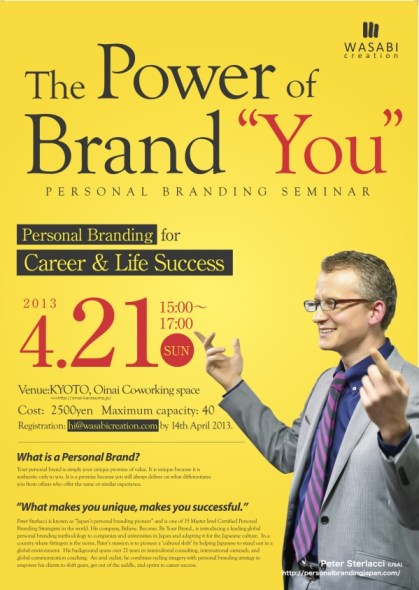
The second message came from a workshop on “The Power of Brand ‘You’: Personal Branding for Career and Life Success.” The workshop is led by Peter Sterlacci, who, according to his own ad, is “known as ‘Japan’s Personal Branding Pioneer’ and is one of 15 Master level Certified Personal Branding Strategists in the world.” (Let’s set aside grammar issues with the excessive use of capital letters, and the questions about who, exactly, knows Mr. Sterlacci in this manner. Maybe it’s just him. Let’s also set aside questions about just what a personal branding strategist is, who certifies such a person, and how many levels there are.)
In the messages on Sterlacci’s website, we can find a few kernels of truth. For example, the Japanese workplace places a high value on workers fitting into the existing hierarchy of the company. In a changing, 21st-century economy, workers need to look for jobs in a more global marketplace—and that marketplace can include settings in which workers need to promote themselves less as workers who can fit in, and more as workers who bring something unique to the company.
So far, so good. But the messages go further, to encourage workers to become their own “personal brand.” You are to be the brand, believe in the brand, and live the brand. But beyond Ophrah-esque messages of believing in yourself, listening to your heart, following your dreams, and opening yourself up to wealth, what does this mean? Am I a brand? (And if I am, are my children my “product line,” like from the iPad comes the iPad mini?)
In my introduction to sociology classes, I discuss Karl Marx’s notion of species being, which we can also think of as human nature. Marx states that humans are unique in our creative ability to produce things. Some animals can build bridges, and a few gorillas have learned sign language, but that doesn’t compare with humans’ ability to create things, from food to clothing, to buildings, to the global computer network on which you’re reading this.
In this sense, this ability is part of what defines us as humans, and we have an intimate connection with the things we create. We become alienated if the products of our labor are taken from us, or if we become little more than appendages to the machines in the factory. Think of the the satisfaction we feel when we make ourselves a nice dinner, compared to the disdain we felt toward the burgers many of us flipped in minimum-wage service jobs. (And if you ate any of the food I prepared at the Solano Drive-In in the 1980s, I apologize.)
In recent decades, our experiences at work have changed dramatically. Once-solid factory jobs in countries like the US and Japan have moved elsewhere, and workers find themselves struggling to find jobs that pay enough to support themselves and their families. Commitments from companies to long-term employment have practically vanished, replaced by temporary or contract work. We’re all free agents now, freed from being trapped in the same job and also free to go hungry while we search for work.
In this environment, it makes sense for workers to retool themselves for the changing dynamics of the workplace. Keep your resume up-to-date, and always be on the lookout for the next opportunity. Believe in yourself, market yourself, take charge of your destiny—think Stuart Smalley meets Gordon Gecko—become the product others want to buy.
And there’s the catch: are you a product? or a brand? or a commodity? or whatever synonym you prefer? What is your value in the marketplace? If you are your brand, and you live that brand all the time, 24 hours a day, are you really living up to your full human potential? Are you reducing yourself to your exchange value? What is your brand worth?
As I kid I remember my brother and I arguing with our dad about what something was worth. We loved some of our stuff so much that we imagined someone would pay us a fortune for it. Then we’d make all sorts of plans to sell our things and reap our rewards. Our father would then tell us that the things were only worth what someone would pay us for them, and that was probably a lot less than we imagined. Not yet schooled in the economics of capitalism, my brother and I confused use value and exchange value. The joy we got from playing with something (it’s utility, or use value) didn’t match the value of that thing in the marketplace (it’s exchange value).
So what happens when the thing we’re trying to sell is ourselves? And what if we buy so deeply into the process that we literally become the product, that we live the brand? Becoming and living your personal brand would involve not only matching the marketing of yourself with your skills and interests, but also shaping your daily life to fit the brand you’ve become. With the brand and the person one and the same, and the brand also a product that is marketed and sold at its exchange value, how in the world can we do this without reducing our humanity down to a tag line, a logo, and a website?
“What makes you unique, makes you successful,” says Sterlacci’s ad in bold print. But what if you’re not successful? Not everyone gets the job of their dreams, since capitalism requires there to be a sufficiently large population of people to be out there, looking for work. And if you don’t succeed, do you blame it on your brand? Do you reincarnate yourself as version 2.0? 3.0? 4.0?
While mired in this process and focusing on your personal brand, how can you engage your sociological imagination, to connect your personal experiences to the bigger picture? How can we find a middle ground, in which people can pursue work that rewards them without selling out and becoming tools. Or brands.


 Repeatedly in the past few weeks, some of the worst parts of 20th-century Japanese history have been in the news. Osaka mayor Toru Hashimoto has repeated comments he’s made over the years, including denying that women were forced into sexual servitude by the Japanese state during the war. Just yesterday, Lower House representative Nariaki Nakayama joined the party by
  How could Japan sustain this monoracial, monoethnic, homogeneous space? Geography. As a series of islands, Japan was inaccessible to the rest of the world. Precisely how the inhabitants of the Japanese islands got here is unclear, because if they used boats, then couldn’t other people have also used boats to travel here? Was there an ancient land bridge that later collapsed, standing the islands in the middle of the ocean? Were the original inhabitants amazing swimmers who made the journey from the Korean peninsula?
 Students express concerns over the challenges of integrating immigrants, refugees, and other foreigners into Japanese society. Those are valid concerns, but their solution is to close the door and to isolate Japan from the rest of the world. Is that a solution? Japan does have a neighbor that is much more isolated and that is largely closed to foreigners—North Korea. But is that the model they want to follow?


 JAPANsociology