Multiculturalism a failed sociological phenomenon?

The answer straight away: No.

The most dynamic nations regarding economy, science and arts on this earth are multicultural.

This includes nations like the the USA, Israel, Canada, Australia and almost all EU countries and. Additional to this you also can see China and other emerging powers like India or Brazil as quite multicultural.

 As contrast: Anywhere where one “authoritarian culture” tries to block all the cultural influences from outside, stagnation and decline is more likely.

You can see that in most Arab countries, North Korea, Pakistan and in general, in areas where one group tries to ideologically or religiously particularly stay “clean”.

Not to long ago, many heads of states with a multicultural policy -mainly in Europe- declared their political approach as failed.

Since I am from Germany, let us focus on this case.

To quote Chancellor Merkel: multiculturalism had ‘failed utterly’.

Yet, it is more concrete that there is a long history of success, which just needs a new adjusted framework, not only to support immigration and migration but also challenges its participants and prevent parallel society-system within a state!
Nowadays one out of five people in Germany has foreign roots and the proportion of people with foreign origin is increasing – and so is the need for more money for education.

This was completely clear from the beginning!

An economist could tell you this without thinking. With the target to make profit, you need to invest your money.

The history of Germany always was, is and will be characterized by German citizens emigrating or foreigners immigrating. This can be for work, housing, marriage, wealth and cultural reasons.

In addition to that the first half of the 20th century with its millions of forced migrations during and following the two world wars created a even more multicultural society, which was working very well.

Learning from that, the key of multiculturalism comes from the efforts, not to separate but to integrate and still provide freedom for own cultural aspects.
Only then, when there was a successful integration, the enrichment opportunities due to multiculturalism can be realized.

by Anonymous

Japanese Immigration Policy in the Future

“Japanese must enact a new immigration law so it will allow us to bring in many immigrants.” Japan Times reported the interview of Tokyo Gov. Shintaro Ishihara at the Tokyo metolopolitan Government building. In this interview, Ishihara answered his view of politics for immigration in Japanese society. “Since we are not a homogeneous people because our ancestors can be traced back to Korea, China, Mongolia, whether the number of foreigners increases or not in Japan is irrelevant. Because of labor shortages as society rapidly ages, we need more foreign residents to make up for our labor shortage.” He favors accepting foreign residents in Japan to strengthen our aging society. However, even if he favors positive immigration policy, he opposes the idea that gives the right to vote in local elections to long-term foreign residents. “Such a thing is impossible, must not happen and is dangerous because regional issues influence the state” he said. If foreign residents want to participate in local politics, they should become naturalized Japanese citizens, he said in the interview.

Do you think the immigration policy that Ishihara proposed is the best policy which Japanese government should proceed to? Should we accept more immigrants just for making up for labor shortage? We do not have to treat them as citizen but just as labor, and we do not have to guarantee their right as citizens? What does he mean “they should become naturalized Japanese citizens”?

I think the idea of Ishihara is very conservative and it is far from the ideal policy which we have to proceed to with regards to immigration policy. First of all, even if he thinks our country is not homogenous society because of the diversity of our ancestors, our society is still very homogeneous with regards to national politics; for instance, it makes much of the interest of Japanese and neglects the right of non-Japanese people. It regards Japanese society as if homogeneous country and still many non-Japanese people are eliminated from in various social situations. Actually, our society has much cultural diversity. According to the statistics from the Ministry of Justice, the number of population those who do not have Japanese citizenship (what is called “Gaikokujin” in Japanese) is over 2 million. The number has been increasing and will continue to increase in the future. Considering these situations, we cannot say our society as homogeneous, and we cannot continue our national politics which limit the right of non-Japanese people any more. It is much more the case if we have more immigrants with some immigration policy in the future.

Though Ishihara answered that it is impossible to allow long-term foreign residence to have right to vote in local election, I think his idea is impossible in reverse. If more immigrants will live in Japan, inevitably we will have various issues related to them. We will have more children who have non-Japanese parents in schools; we will have more workers who are not Japanese at stores. If we have more immigrants, it does mean that they play more important role in our society. If we have more immigrants, we will not be able to ignore their right such as voting right even if they are not permanent residence.

It is easy to say that we will accept more immigrants because we need more labors amid the rapid aging society; however, before we accept them as labors in Japanese society, there are many issues with which we have to tackle. We will need to change our national policy so that people who are from outside of Japan have more right in Japanese society. Not only ensuring their right, we also have to create social supporting system which new immigrants will be able to start their live in Japanese society smoothly. We also have to create environment where Japanese people can live together with immigrants; for instance by offering more cultural education in schools. Just making immigrants naturalized Japanese citizens will not be our solution.

by Shunsuke Ochi

Same-sex kissing in Japanese Entertainment Industry

Yes, they are two straight guys. And yes, they are kissing.

In Japan, one of many bizarre things that amaze me is that, even though homosexuality or bisexuality are still taboo subjects in the society (and there are still negative perceptions and condescending remarks  targeted at the out-of-closet queers),  the line of sexuality is blurred in the world of entertainment.  Two guys in a boy band can kiss without anyone doubting their ‘straightness’ or labelling them as gays. Why, they can even lick and grope each other on stage and then come home as straight as ever.

When I first got into the world of Japanese entertainment, I was surprised (and weirded out) to find such acts were done frequently by the idols, in concerts and music events. But that is not all; the even weirder part is that the female fans love it! The ear-splitting screams echoed through the stadium every time  the idols do something ‘intimate’ convince me that the fans not only love it but they want more!

In Sociology class we learned that there are heterosexual women that engage in same-sex kissing as a way to get attention, but in Japan, I can say that the male idols also kiss each other for the same reason; the attention of their fans. And somehow, the whole thing is even made as a value for marketing purposes.

While we know that the male idols make out as a ‘fan service’, I cannot fathom why the female fans love seeing two of their favourite male idols kiss.  Like the guys who love seeing girl kissing another girl in a party, do Japanese fan girls also find male-kissing-male ‘hot’ too?  Or is it only because it is a kiss between two handsome guys?

Regardless of the answer, we can still conclude that the role of sex and gender in Japanese entertainment is definitely different from the norms.  Japanese idols certainly bring new perspective of what doing gender really means.  And that sexuality, sexual desires and behaviours do not always have to be parallel and they can very much contradict one another, without us losing our sexual identity over them.


         By Sakina Mahmud

Should we accept immigrants to Japan?

I think it’s good to accept immigrants to Japan.  There are some good reasons.  First, now, Japan is aging society.  The population is now declining in Japan.  So, if immigrants live in Japan and get married with Japanese, we can bump up Japanese population.  Second, we can receive pension plenty.  Positive countries to accept immigrants like the U.S, Canada, and Australia have no problem about pension, so if immigrants work in Japan, it’s good for our society.  It means that if they pay tax, elderly people can receive enough pension.  Third, we can usually meet many cultures.  Japan is isolated country, so we didn’t have relationship with other culture.  We don’t get used to be with other countries’ people, so this is the good opportunity to be multicultural country.

On the other hand, there are some bad points to accept them.  First, there are immigrants who receive unfair profits.  I heard one example of unfair immigrants from my relative.  They live in Japan with no working, even though they are healthy, and they are on welfare.   Their life style in Japan gives bad influence to our society, so we shouldn’t keep this situation.  Second one is about employment issue.  Even though we are in problem of employment issue in Japan, if we accept immigrants, there will have less jobs for Japanese.

I think quota immigration Act is good for our society.  It’s not for shut out immigrants, it’s for control to be well-ordered.  Quota immigration Act in the U.S is for turn down immigrants especially Asian by control number of immigrants who live in the U.S less than two percent per each country.  My thinking of Quota immigration act is controlling the number of immigrants according to their past year’s behavior.  For example, if immigrants from China did just few crimes in 2015, we will accept more immigrants from China in 2016.

Making it enforce, we should have some efforts.  One, we should teach Japanese for them.  Unless immigrants can speak kind of Japanese, they can’t become familiar with our society in the true sense of the word, so we should make this opportunity for them.  Other aspect, this is good for Japanese because it could make jobs for Japanese teachers.  Two, we should enfranchise for immigrants. (just for permanent residents)  This is to be expected rights for them.

I think we can keep our stability if we enforce my thinking of Quota immigration Act.

by Konomi Yamamoto

Brand names in education: a sad portrayal

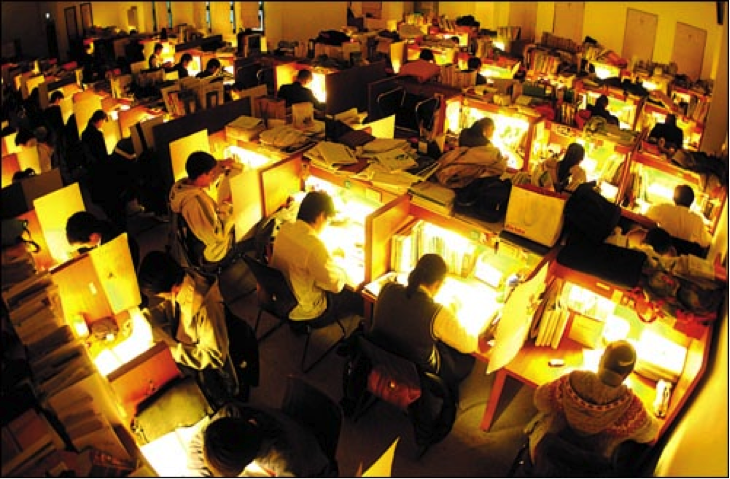
수능: [pronounced: Soo-nung] University Entrance Examination in Korea, the hurdle every Korean high school student must pass. On the day of the exam, sometime in November, the entire nation is on alert: mothers pray in temples and churches; flight schedules are delayed in the morning; police cars are called for those running late, etc. It’s like the SAT in America, but of a much, much higher importance and national highlight. To foreigners who do not know about the Korean education system, it must look bizarre how a single examination can have such significance in society. And why is that so? Well, long story short, getting high grades on the Exam allows an entrance to a brand-name university, which is believed to guarantee a successful career in the future.

In Korean society, a degree from a high-ranking university has always been looked up to – like as a social norm. You might argue that it is not only in Korea that famous universities are highly regarded. But it is quite more than that. It doesn’t matter much whether a student is actually capable; if you didn’t get into one of such brand-name schools, too bad, you will never achieve the proud social status given to graduates of those schools. Did you not feel well on the Exam day and get a low score as a result? Too bad, you’ve just been given a negative label as an ‘unsuccessful’ student. Likewise, such social norms dictate the way people think of education. From the age as early as 10 (or younger), children are sent to numerous academies, cram schools and to private schools so that they can get high scores on the University Entrance Exam. It is not uncommon that young and bright 19-year-olds sacrifice a year of their youth, just to take the test one more time; or in extreme cases, to commit suicide out of desperation.


Typical "study rooms" where students pay monthly to have a single desk and quiet setting for studying

I think this is one good example of how we develop the sense of ‘self value’ through socialization. Ordinary students in Korea are raised in social settings in which studying to get high grades, and thus attending a ‘good’ high school and university are considered the best thing you can achieve as a student. Playing sports or music is pursued as a hobby only seldom. Even for myself, it was only after I came to Japan and attended an international school that I discovered I could manage both academics and club activities.

This is not to downgrade universities or students in Korea and their efforts, but just to address the ridiculous amount of pressure imposed upon them due to inflexible social norms. Instead of enjoying their “青春” (youth) to maximum, students are overwhelmed by the society’s expectations. Having grown up in such settings, students are socialized to follow the system, without many other ways out. Just imagine how many different skills and dreams could have been discovered, had the system been different. Recently, there have been many proposals for reforms, as well as positive changes in people’s views on the current education system. Hopefully, a better future is waiting for younger generations.

PS. This year’s Exam just took place on November 10th. A big cheer for those finally freed of the shackles!

"Thanks officer!": A student, running late, is hurriedly getting off of a police car 10 minutes before the exam begins

by KyungYeon Chung

What makes a guy fashionable: Being fashionable in Japan and in the U.S.

I have analyzed how the standard of being fashionable differs in Japan and in the U.S. Three years ago, when I was 16 years old, I lived in Atlanta, Georgia, and went to a public high school there as an exchange student. Unlike most of Japanese high schools, most American high schools do not have school uniform, so that the students can wear whatever they want to. Japanese kids wear their own clothes only when they are off school. I noticed during my stay in the. U.S. that what the American high school students wear is different from the Japanese counterpart, and I decided to analyze why they are different on the premise that people wear clothes that they think will make them look good.

There is a considerable difference between American fashion and Japanese fashion. For example, in the states, many boys that are called “cool” and seem popular among the American teenagers wear their sport wear, especially the one of the sport team that they belong to, and a sweat shirt with their school’s name on it. Those who do not belong to any sport teams wear a simple plain t-shirt and jeans. Some people wear what Japanese would call pajama in school. One thing that the clothes that American boys wear have in common is that they are focused on comfortableness rather than appearance. Obviously, sport wear is made very comfortable; otherwise, it is not suitable for sports. The sweat shirt is nice and soft and warm. In Japan, on the other hand, if a boy comes to school with his sport wear or very plain clothes, he will be asked by his friends, “why are you wearing that kind of clothes today? Did you have no time to change after club activity?” or “are you wearing pajama today?” Japanese boys are very concerned about their fashion, so they usually wear fashionable clothes rather than comfortable ones. Not only clothes but hairstyle is different in the U.S. and Japan. In Japan, many young men dye, perm, and style their hair with men’s cosmetics, whereas few American men, if any, in the states do.

My insight is that the standard of being fashionable is different in Japan and in America because what the media portray fashionable boys is different. People tend to wear what others wear; you do not want to wear something that is completely different from what others wear, otherwise, you will look strange. People have a common sense of being fashionable, and it is highly influenced by the media, in a sense that what they are wearing is basically the same as what people in the media, e.g. TV actors wear.

As a conclusion, we can say that it is obvious that what makes people look good in Japan and in the U.S. are different, but there is one thing common to both the countries: people want to look good in society, and their sense of being good-looking or fashion comes largely from the media.


by Yutaro Nishioka

Korean resident in Japan “Lee Tadanari”

For Korean residents in Japan, choosing one nationality is very difficult. The representative of Japan for soccer, Lee Tadanari, is one of them. In the Asian Cup final of soccer, he decided the winning goal. He became famous suddenly in Japan. Lee’s last name is Korean, but Tadanari is a Japanese first name. This expresses that he want to be both of Korean and Japanese. His blog was written this. “I am Korean and Japanese.”

The professor of Osaka City University, Boku, said “40’s to 50’s of the second Korean resident in Japan was assimilated reluctantly and 10,000 they came to Japan every year.” On the other hand, 20’s to 30’s of the Korean resident in Japan often use Korean name and value Native language. It is thought that Japanese government accepted a lot of Korean resident in Japan as a backdrop. A difference is found by the idea in them old generation and young generation. Old generation of Korean resident in Japan chooses a nationality either in South Korean or North Korean. On the other hand, young generation of Korean resident in Japan values both of Korean and Japan and they have an identity of people resident in Japan.

Management of Korean Residents Union in Japan said “It is wrong prediction that all Korean residents in Japan become to Japanese in the future. They will keep about 300,000 people at least”. Boku said “Korean government should accept dual nationality for Korean resident in Japan.” Then we can protect Korean resident in Japan who important property which connects both countries. South Korea government said “to implement policy valued a race than a nationality is very important moreover Japanese government should enrich Korean education for Korean resident in Japan.”

If Korean government Korean eliminates resident in Japan who choose a nationality of Japan, they cannot accept young generation who has identity of Korean resident in Japan.

What do you think?

by Sunao Tanaka

Should Japan accept immigrants?

   Today Japan has various social problems, such as shortage of labor force and low birthrate and longevity. Therefore it is seems that acceptance of immigration will become inescapable for Japan from now on. On the other hand, failure of multicultural symbiosis is pointed out in European and American advanced nations. I would like to consider what kind of measures is the problem in the bottom prove and can be taken towards the future immigration.

   Now some measures are taken against the organization which supports the foreigner of Kyoto. For example, they support Japanese teacher arrangement to elementary and junior high schools, and installation of law or the consultation window of a life about English and the Chinese interpreter staff corresponding to the administration in a city office. There is support like the recommendation to the real estate agent which otherwise deals with the residence which can perform life orientation and foreigner moving in. However, even if there is support organizations like this. In fact, the huge problem is occurred. Then it is considered that how society of ideal multicultural symbiosis is saying. First, it is important that a foreigner don’t receive unjust treatment in a life for being a foreigner. Second, employment is stable irrespective of Japanese or a foreigner. Finally, it is society which can understand mutual culture and can harmonize. How is such society realizable if it carries out?

   In the company, you should consider expansion of regular employment towards the reality of a multicultural society. So, it also becomes economic activity and solution of a security problem. In terms of education, you should aim at expansion of the Japanese language education in overseas, and fullness of a Japanese language education institution. Moreover, cultural exchanges in a school or local community are also indispensable. The government should restrict the number which invites nations’ family to the limitation and Japan in technology or occupational description, in order to suppress extensive inflow of a cheap labor layer.

   Thus, it is necessary that a company, a citizen, and the government prepare in advance the organization which accepts immigration. For getting such a situation, the reality of the multicultural society is carried out and it sells at more ideal form.

by Saki Uetsuji

Many people didn’t like to accept foreigners in the past, while recently only a few people think so. Why?

Presently, the relationship between Japanese and foreigners is so closed. In spite of the increasing of opportunity that we see foreigners is recent occurrence, and in our parents’ generation, many people don’t like to accept foreigners compared with our generation. Why?

According statics of change of foreign population, foreign population increased rapidly in 1990s. Especially, increase of population except for Chinese and Koreans is remarkable. It is related that many foreign businesses came into Japan. In 1990s, foreign company increased in Japan. People had inevitably many opportunities to have to do with foreigners in their life. It resulted in increased of foreign population. This is why it is easy to come to Japan for foreigners. Moreover, various foreign cultures even became an object for admiration for Japanese people. Foreign foods, movies or products often come into fashion and are often picked up on the TV, magazine, and so on. Similarly, many foreigners are fascinated with Japanese culture (including subculture), go to study or travel to Japan. And, Japanese who marry foreign people is increasing. The number of international marriage in 30 years ago is only about 7,000 families, while the number in the present is about 40,000 families. However the purpose that Japanese contact with foreigners was for business in the first time, become for life at this time.

That’s why Japanese people became tolerance for foreigners. The rising of the number of foreign people brings international society to Japan. In the past, Japanese people were exclusive to foreign people. However, now is we cannot live in the Japan without having to do with foreign people. It is not too much to say that foreigners bring Japanese present world.

by Ayako Takagi

Non-Japanese nurse

This year, 16 candidates for nurse who were accepted from Indonesia and Philippines passed the national examination.  Last year, people who could pass the examination are only 3, so compared with last year, successful candidates increased this year.  However, percentage of passing this examination is only 4%.  Why is percentage of passing this examination very low?  Most important reason is language.  Learning Japanese is very difficult for many non-Japanese people.  Moreover, medical terms which nurse uses frequently are more difficult.  Candidates for nurse were accepted by Japanese government according to Economic Partnership Agreement (EPA).  EPA decided that the length of their stay is 3 years, so they have to pass the national examination within 3 years, and they also have to master Japanese within 3 years.  I think it is very difficult, because 3 years are too short to master foreign language.  So, I think that non-Japanese nurse reception system should be improved many things.

I think supporting system is more need for candidates.  Japanese government should give more opportunities to learn Japanese in their mother country.  For example, government support to study abroad, dispatch teachers who teach Japanese and so on.  The point at issue is not only language but also difference of culture.  If candidates pass the national examination, they have to fit into Japanese society to work inJapan.  Of course, lifestyle, language, food are all different from their mother country, so they will be homesick.  Therefore, government should take care of non-Japanese nurse until they can fit into Japanese society.

Now, Japan is short of nurse and doctors.  This situation will become more serious due to aging society, and demand of non-Japanese nurse will be higher.  So, their bad present situation should be improved immediately.  I think accepting non-Japanese nurse is good idea because they can solve labor shortage in Japan.  Therefore, I hope non-Japanese nurse play an active part in Japan.

References

Asahi.com http://www.asahi.com/national/update/0325/TKY201103250413.html

by Mari Honda