How do/should we learn from this course, Japanese Society?

Jiro Okada

“What do you think in the lecture room?”

This is what I would like to consider on this blog post.

(I do not criticise on this post, I just want to have a consideration with questions.)

When people look at something, there is an aspect of it that the person glances. Also, every single person has her/his own perspectives, backgrounds, and interests. Then, how do they apply to the class that we are taking? I am, personally, quite curious about how other classmates of mine are looking at this class. There would be something we have not known though it must be quite beneficial and exciting.

This class, Japanese Society, gives a quite interesting spotlight on minorities in the Japanese society, and we can actually recognise them through the class with the rich knowledge provided in it. The issues already presented are; for example, Ainu; Burakumin; Hafu; and Japanese Peruvian. Likewise, it vividly draws attention and gives us the great opportunities to consider the issue related identity. What are the mostly treated in the class are the issues and the facts with full of sources of thinking. Those contents in the course strongly make me think about the issues both in and out of the classroom.

However, I sometimes consider like “So what? What should we think from just knowing their existence and issues?” We can know the issue, and we can understand the contents of the issue. Then, we can feel something struggling inside of ourselves.

So, what?

I have known the reality Ainu people faces.

I have understood that Okinawans has been marginalised from mainland.

I know it is obvious that the issues in the class are all quite controversial.

Likewise, it is obvious that those controversial issues cannot be solved in a day or week.

Thus, it leads to the question on me:

“For What?”

On the other hand, there is another question. In this class, we often consider about the issue of identity. We can consider that there are people who have troubled with there identities. The issue of identity is actually difficult to think. Even this is the concept which did not exist in Japan before, as it can be seen from the fact that there is no direct translation of the word ‘identity’ in Japanese language.

In this class, the issues of identity get attention. It must be quite worthy to study this issue. Even around the world, there are several places that provide the course related identity issue. Also, there are several people who have mixed identity.

Then, this is my question.

Is this for whom, in what way?

It must be quite meaningful for everyone. But, sometimes I wonder how I should contribute to the discussion because I, personally, do not have any of the obvious identity problems on myself. Is there no way to contribute the discussion not just only asking to somebody who has something inside of her/him?

As I mentioned first, I am not criticising. For both questions I mentioned, I have got my own answers as meanings for study these issues. I am enjoying the class every Wednesday, and this class is actually brilliant. I would simply like to know how our perspective towards the class could be cultivated, and it must be worth to share. Though it might be answered in each of blog post in issue by issue, how about sharing the idea about this whole course?
The Mechanism of Discrimination

Masayuki Tanaka

In today’s multiethnic society, there are number of situations that people discriminate against someone. For example, we have learnt the facts of discrimination against Japanese-Peruvian, Okinawan, Ainu, Chinese and Zainichi Korean. But we have not studied why people discriminate. Although this is an extremely huge and fundamental question, I believe it is important to know the mechanism of discrimination and how to solve it for making Japan a discrimination-free society.

Discrimination can be classified in two ways. In one case, people do or say some discriminatory things on purpose. This is called ‘conscious discrimination’ because there is a certain intention to discriminate. For example, if parents tell their child, “Don’t go to that area! Many Burakumins are living,” this is conscious discrimination since the parents recognize that they are discriminating against someone (even if they are not feeling guilty).

In the other case, however, people often discriminate without recognition. This is called ‘unconscious discrimination.’ For instance, many Japanese people used to call an instant camera ‘bakachon-camera’ (which means even stupid Koreans can take pictures) without understanding its meaning. Although many of them were not trying to discriminate against Korean people, they eventually did. So this type of discrimination is called ‘unconscious discrimination.’

What makes people discriminate? To know its mechanism, I am going to give an example of ‘unconscious discrimination’ by showing a short scene of a film called Gentleman’s Agreement. This is a fiction movie which focuses on ethnic discrimination in the US society. A Catholic American journalist spends a couple of months in New York with his family, his mother and little son between his ex-wife, as Jewish to write about his first-hand experiences of anti-Semitism.

In this film, I would like you to pay attention to the scene when a woman said some words to a crying boy from 00:45. After you watch, I am going to explain how she unconsciously discriminated against Jewish people.

http://www.youtube.com/watch?v=OH81iB8kyM8&feature=related

When Tommy, the journalist’s son who was also pretending to be a Jewish, said, “They (his friends) called me a dirty Jew. And a stinking Kike!,” Kathy, the journalist girlfriend, embraced him and replied, “It’s not true. It’s not true. You’re no more Jewish than I am. It’s just a horrible mistake.” Kathy was just trying to comfort Tommy, but she unconsciously gave Tommy a negative image about Jewish people. What this scene telling us is that people unconsciously discriminate against somebody without vicious intention. This type of discrimination is more serious than the conscious discrimination because the people do not recognize their words or behavior as discrimination.

How can we avoid it? ‘Conscious discrimination’ (discrimination on purpose) is easy to prevent if you have a sense of human right, but in the case of ‘unconscious discrimination,’ it is very hard to avoid because even a moral person often discriminate carelessly. It means even if you are not trying to discriminate against anybody, you might hurt someone. The solution is knowing discriminatory words and behavior. If you recognize certain words or behavior as discrimination, you will not use it. I think this is the only way to solve the mechanism of discrimination.

Consequently, there are two ways of discrimination: conscious discrimination and unconscious discrimination. In order to prevent them, we have to learn the mechanism of discrimination.

Takeda no Komoriuta

Kudo Tomofumi

It was a 2years ago when I heard a famous artist, Kazumasa Oda, was singing “Takeda no Komoriuta” that was born in Takeda area in Kyoto. It attracted me so much, but he told it has some story behind it. I immediately realized that this song must have been a “Buraku” song. At that time, I did not know that “Takeda” area exists in Kyoto and we can go there by JR.

“Takeda no Komoriuta” was a million hit song in 1970s, and many artists song it. However, at some point, this song have disappeared from the media, radio, and TV.  Do you remember the “Imjin River” which Kosuke song in Pacchigi! and the reason why it was not allowed, or hesitated to sing it in public? This was just because it was  a “Buraku” song. In 1969, Akaitori, a folk song band, song “Takeda no Komoriuta” and got a first prize in the Yamaha Music Contest, which made Akaitori famous afterwards. However, it was not its lyrics but melody that attracted many listeners. Actually, most people, even the member of Akaitori, did not know the meaning of the lyrics, and what was worse, few people could notice which “Takeda” area  this song represented. Once these uncertainties has got revealed, it was thrust into a taboo as a “Imjin River”.

I have learned about “Buraku” in my junior high school days, but it seemed a past story at all. I had thought liberation of Buraku movements have not solved “Buraku” problem, but recreated it, and that is why many broadcast station have imposed the voluntary regulation on broadcasting “Buraku” songs. However, almost all of the Buraku songs were self-explanations as a grief, anger. I believe that the images of “Buraku” is disappearing in a various societal change such a trend toward the nuclear family, but what we need to think most carefully is how to overcome the recreation of negative images, including “Buraku”.

“Takeda no Komoriuta” was not just a lullaby for baby, but one which awakes people who try to “sleep” pushing their countless experiences of discrimination away and trying to make those forgotten for good.  Its lyrics makes us notice that Japanese nursery rhyme cannot be represented only by the peaceful, innocent, and adorable ones like “Akatonbo”, “Edo no Komoriuta”. We should not forget  the grievous voices of young baby sitters who were too impoverished to study at school.

Here is a link of “Takeda no Komoriuta”.

Akaitori version:  http://www.youtube.com/watch?v=ace5tJUnP4s

Original:  http://www.youtube.com/watch?v=duX-s8tNo-M&feature=related

To understand Zainichi

Yuki Kuori

How many of us in this class know about Zainichi people or are related to them? I do not think that we often have connection with them. To be honest, I did know much about them until I watched “Pachigi” and “Go”. Although, watching just two films dose not mean I am quite familiar with Zainichi people, these two films were meaningful for me.

I have been living in Osaka since I was born. Osaka is one of the famous places where many zainichi people live in, and lots of them are in Turuhashi where we can eat cheap Yakiniku but good quality. but I had little chance to get involved with them when I was a kid because their schools and Japanese public schools were separated and it seemed they lived in their community. Therefore, I did not know much about them.

The first time I was related to them was when I was in junior high school. I belonged to the soccer club and through the soccer match against “Chosen schools”, I came to know them. When I saw them for the first time, I was very shocked. Because they all were with shaven heads, spoke Korean and Japanese by turn and their soccer skills were amazing. At that time my images of zainichi people were kind of scary and totally different from us. After I graduated from the junior high school, there has been no opportunity to know them.

But recently, I have watched ” Pacchigi!” and ” Go” in this class and I have never watched those films describing Zainichi people before. Although the films describe them violence, we Japanese should watch them, because we rarely learn about Zainichi people in school and I think that films are very important means for most Japanese to understand them.

As long as we live together in this land we have to know each other and get along with. At the moment, Japanese do not know much about Zainichi people, so I think watching those films will give us the opportunity to understand them.

Struggle of Nikkei people living in Japan

Wakana Dohtan

As we already learned in the Japanese Society class, the issue of Nikkei people living in Japan has been a quite controversial topic. Now it is apparently true that Japanese economy is heavily depending on foreign labor forces in a variety of places, for instance, manufacturing or agricultures. The home countries of these foreign workers are mainly from China, Korea, and the growing number of Nikkei people.

Especially talking about Nikkei people, since the new law, which enables Nikkei workers come and work in Japanese society with almost no conditions required, came into force in 1990, the number of them has been skyrocketing up until today. They usually devote themselves to unskilled and low-paid jobs which is so called 3D (Dirty, Dangerous, and Demeaning.) The reason why Nikkei people poured into Japan then were also associated with the very big economic downturn happened at the same time and mal-politics back home in large part of Latin America. Japanese government decided to accept Nikkei people because they predicted that if they have at least something in common with native Japanese like an ancestral linkage, there would be less conflicts and disagreements among Japanese society which seemed to prefer homogeneity and resulting efficiency at working place. However, this easygoing assumption turned out to be completely wrong. Even though they were “Nikkei”, their attitudes, culture, or speaking languages were totally Peruvian, or Brazilian, therefore, they had great difficulties of integration and there appeared so many problems like lack of necessary information, housing problems and cultural clashes with Japanese neighbors.

For such a situation, a friend of mine told me that Japanese government does not have to do anything to support them. He insists that Nikkei people were coming to Japan spontaneously with their own will and that they may not get any jobs if they stay in their home countries. In comparison with their homeland, Japan must be much better for them, therefore Japanese government should not take any extra responsibility for them.

Well, that could be one reasonable opinion. I personally, however, believe that as long as Japanese government is economically willing to accept cheap labor forces to fulfill the demand at working site, they also have to prepare and supply them basic circumstances for coming immigrants, for example by providing them with the Japanese-learning class, multilingual information, some sorts of social security, or checking system that investigates if their working contracts with the company is legal, all of which are greatly important for foreigners to survive in Japan. However, the reality is completely insufficient. Especially after the economic crisis in 2008, Nikkei people have been suffering from sudden and wrongful determination or unexpected cut down on their salary.

Self-help is the theory which is applicable only to the majority I think. Thus Japanese government should take it into account that Nikkei people are not only cheap labor forces but also “human beings”.

Dowa Problem in Japanese School

In Japanese Society class, we learn about Dowa problem. As we confirm in the class, almost all Japanese students learned about Dowa problem in elementary school and junior high school. We Japanese learn about Dowa problem in moral education class. Moral education class is a class about moral, citizenship, and behavior pattern. In that class, students learn about right and wrong from a moral point of view. Japanese elementary and junior high school have moral education class. The moral education textbook usually have several stories that make students think about better citizen. The stories are typically heartwarming stories. The stories stimulate students to act kindly. However, it might be a problem that students learn about Dowa problem in such class. Because it is not a moral issue but social issue. Not only Dowa issue, but when we learn about discrimination issue, we tend to think it is not “our issue” but it is “their issue”. We learn about discrimination and tend to think some kind of people (not me) is discriminated and other kind of people (not me) discriminate them. However, all of us can be discriminated and can discriminate others. The solution of discrimination is not to change individual’s mind, but discrimination is human rights abuse. When Japanese students learn about Dowa problem in a moral education class, they would think “discrimination is bad thing! ‘They’ (people who discriminate others) have to change their mind!” Because Dowa issue is social problem, it should be taught as a human rights problem not as a moral problem in school.

by Nana Uno

The reasons of Zainichi Koreans’ hostility toward Japan

I watched the movies “Pacchigi” and “Go” both of which are stories about Zainichi Koreans through the class. In both movies, Zainichi Koreans usually have a hostile against Japanese. I was shocked to see that. I like Koreans and have a lot of Korean friends, so this fact made me sad. I think I am a good friend with my Korean friends. Then, I have been considering why the most of the Zainichi Koreans dislike Japanese. I came up with four reasons for this.

First, there is an unchangeable fact that Japan annexed to Korea in the past. At that time, Japanese people integrated Korea cruelly Japanese forced Koreans to assimilate Japanese culture, language, and name. They also treated with Koreans severely. Then, Koreans have an image that all Japanese people are spiteful.

Second, Japanese people actually discriminated against Zainichi Koreans just because they are different from Japanese. Japanese despised, teased, and did something spiteful to Zainichi Koreans. Some Japanese are so mean to Zainichi Koreans that a lot of Koreans living in Japan have an image that all Japanese people are ill-natured.

Third, even though any Japanese isn’t hard on Zainichi Koreans, Zainichi Koreans have some stresses because Zainichi Koreans are often disliked by Koreans living in Korea. It’s because Zainichi Koreans don’t have duty of military service in spite of their nationalities as Koreans, Zainichi Koreans had right to come back to Korea, but they didn’t, and during The Korean War, Zainichi Koreans didn’t fight and fled to Japan. Then, Zainichi Koreans take it out on Japanese just because Zainichi Koreans feels some stresses

Fourth, it’s just because Zainichi Koreans envy Japanese people’s wealthy by comparing with themselves or their own country Korea. Japan is a well developed country and has a lot of good points. For example, Japan is the safest country of all countries and there’re a lot of splendid cultures in Japan. Thus, Korean people usually envy Japanese.

For four reasons, Zainichi Korean have animosity toward Japanese people, I suppose. Even though there is such a Korean who doesn’t like Japanese, I like Korean people very much.

by Akimi Yano

English Conversation Schools in U.S. Military Bases

There are 135 U.S. military bases in this small country, Japan. Topics about U.S. military bases are recognized widely especially relating to Futenma base camp in Okinawa and the discussion is still going on. For the most part, issues related to U.S. military bases in Japan are spoken with negative implications. For example, some Okinawan people argue about the noises combat planes make, or about some serious crimes committed by U.S. soldiers. However, in this post, I would like to put my focus on positive impacts that U.S. military bases give to Japanese society, mentioning an example of English conversation schools inside the base.

How many of the readers of this blog know about English conversation schools in the U.S. military base? In fact, I did not know much until I began researching about it in writing this post. Though there aren’t many, there are some U.S. military bases that preserve English conversation schools. I would like to mention about Mommies’ English School in Sumouhara base as an example.

Mommies’ English School is located in the American Town within Sumouhara base where 2000 Americans live. It serves comfortable time to have natural conversation with native English speakers and it is possible to change your instructor if he/she was compatible to you. By learning at this school, it is possible to acquire not only English skills, but also able to become conscious of ‘real’ culture and customs. English conversation schools in U.S. military bases enable you to feel as if you are studying abroad without stirring to other countries.
It is always important to look at both positive and negative points. Here, I touched some positive aspects on U.S.  military bases especially those to Japanese society, since negative aspects are taken up only. Just arguing does not necessary lead to the solution of issues. It is sometimes important to look at the good effects U.S. military bases give to Japanese society.

by Minami Hosokawa

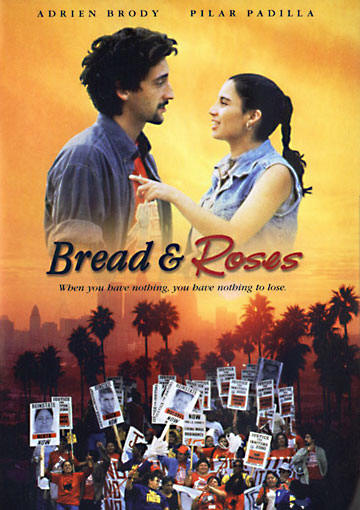
Bread and Roses

The film ‘Bread and Roses’ is a story about janitorial workers’ struggle to get better work conditions and the right to unionize in Los Angeles. Most of the janitorial workers are immigrant workers who have illegally entered the U.S from South America. They are viewed as commodities and expendables. They reluctantly continue to accept low wages and poor working conditions to make their living. However, they protest for higher wages and benefit packages, and the employers decide to meet the workers demands in the end.

The film’s title, “Bread and Roses”, comes from the textile strike in Lawrence, Massachusetts, in 1912 which was led by large groups of female workers. They struggled and fought under the slogan ‘We want bread but we want roses, too!’ In the end, they got their salary increased. In the film, janitorial workers unite and march through the streets, shouting ‘We want bread but roses, too’, like the 1912 textile strike in Lawrence. No matter how hard they work for it, they do not get paid enough for their hard work. They struggle not only to get bread, which symbolizes the minimum requirements to survive, but also roses that symbolize human dignity. They have to put up with terrible work conditions such as low salaries, as low as 5.75$ an hour, no health insurance, paid holidays or sick leaves. All of this is because of their economical troubles and the treat to be exiled. However, they fight against the ruthless employers for fair wages and dignified conditions and also to restore their rights as a worker and a human through unity.

There are a huge number of immigrant workers in the U.S. Most of them are Hispanics, including Mexican people who have smuggled themselves into the U.S. Actually their life is terrible beyond imagination. Even though they have crossed the border at the risk of their own life to overcome poverty and seek better opportunities, they cannot escape from the cycle of low wages and being exploited by employers. In the film, janitorial workers won and got back their rights, however in reality it is difficult for immigrant workers to organize a labor union. They are forced to put up with poor working conditions that exploit them, under the constant threat of dismissal or exile. In the film, janitorial worker Maya asked Sam, a labor organizer, “What do you risk?” Because they should put more than everything they have to fight against unreasonable working conditions, mostly they accept the reality and give up their hopes to struggle. If they can eat the bread, they cannot have the rose; this is the reality they will have to face. To be able to eat bread, they will have to sell their roses.

Being guaranteed immigrant workers’ rights as a worker and a human is still far off. However, the film shows also hope that they can do it. Fighting for immigrant workers to get bread and roses will not stop.


by Jeawon Moon

Today

Today, I want to write about “meaning and recognition of being Japanese” thinking with education in Japanese elementary school.

First of all, I am Japanese. My mother and father are Japanese, I born in Japan and grow up in Japan. But I lived in England for 4 years in total when I was in elementary school. I spend half of the time in Japanese school and the half in local school. In a way, it was the most shocking experience in my whole life and also later day life after I came back in Japan.

I came back in Japan when I was third grade in elementary. It was private elementary school in Nara and there were about 80 children in each grade and I was the only transfer student in my school. Also I was the only student who can speak with ES teacher. At first day in my elementary, I was called “gaijin” just because I came back from England and can speak English. The word was enough for me to addle my identity.

Why I am “gaijin”? What is the difference between me and other children?

From 2011 in Japan, every elementary school required English class for children to acquire basis of communication. The numbers of foreigners in Japan are increasing and it is not rare to see “Hafu” child in Japanese elementary school. I think this is good mood for Japanese education but still there are many things to think about. Japanese are ethnic group of accommodativeness which means they don’t like the “difference” especially when they are child. We have to think and teach about how children deal when they met with “difference” and how to understand it not just thinking about “communication skill”.

by Anonymous