

English: National Institute of Education, Singapore (Photo credit: Wikipedia)
Anonymous student post
Large numbers of Singapore’s population are immigrants. Since the country got its independence in 1965, there have always been new immigrants coming in from all over the world who become members of the community. As a result, it has become very ethnically and culturally diverse. Just looking at its population, according to CIA World Factbook, there are 74.2% Chinese, 13.3% Malay, 9.2% Indian, 3.3% other (2012 est.) Some scholars believe that this cultural diversity brought by immigrants is what has made Singapore so economically successful. (Yin, 2013)
Adjusting to this type of diverse environment, Singapore sets four different languages for its official use. So when I was there, I could see many public signs, written in those four when I was there. It was certainly a surprising experience for someone who has been lived in Japan, which only has Japanese as its official language.
Following this astonishment, a new question came up to my mind as a student who was studying in a university in Singapore; that is, how do the educational institutions deal with this diversity?
In this blog post, I would like to see the current language education system in Singapore and observe the outcomes.
Firstly, the Singaporean government heavily focuses on education as it contributes to economic development and unification of the people. They decided to offer basic education in two languages, one is English, other is their ethnic mother tongue languages from where their roots are from, such as Chinese, Malay or Tamil. The reason is that government believes educating people in English will be useful in the process of future economic development foreseeing the globalization; and other languages to preserve their cultural identities. (Nakamura, 2009)
This has worked out successfully for the first aspect. English has contributed Singapore becoming the hub of Southeast Asia. It also has become the symbol of nationwide unity that connects people with different cultures and enabled them to communicate with each other. Now they even created so-called “Singlish” (Singapore-English; mixture of English and languages of different ethnic groups exist in Singapore), which could also be considered as part of their national identity.
However, for the second aspect of preserving diverse cultures through learning non-English languages, is not functioning as it was expected. As a matter of fact, less people are using their ethnic mother tongues in Singapore as they no longer use them outside their communities. Because cultures could not be transmitted onto next generation without the languages, it has become a problem. This is also leading to the changes in individual’s identities. As their language ability for non-English languages declines, their identity as a member of each community declines, too. Thus, this is now seen as a challenge how to keep their languages and cultural diversity in this country (Nakamura, 2009).
In addition, there is an issue that social mobility in the society is somewhat depending on their English ability. I will further discuss this point in the later blog post.
In conclusion, through this outcome of bi(multi-)lingual language education in Singapore, we could observe the difficulty of uniting people with different cultural backgrounds under one national identity whilst preserving the cultural diversity. This type of phenomenon is what many nation states would be expecting to see in their countries as more and more international migration occurs in the world. How to protect the cultures and languages while adjusting to the flow of globalization is a difficult question to find a solution.
Reference
Nakamura, M. (2009). Shingaporu ni okeru kokumin togo. Kyoto: Horitsubunkasha.
Singapore. (2014, May 1). Central Intelligence Agency. Retrieved May 25, 2014, from https://www.cia.gov/library/publications/the-world-factbook/geos/sn.html
Yin, D. (2013, June 6). Singapore Needs Immigrants, Says Jim Rogers. Forbes. Retrieved May 25, 2014, from http://www.forbes.com/sites/davidyin/2013/06/06/singapore-needs-immigrants-says-jim-rogers

 When discussing international migration, many groups of immigrants came to mind; coming from Europe, I am myself familiar with a large immigration population being entirely or only partially part of the society I found myself in. Additionally, as I live in Japan, I am lucky enough to experience immigration from another angle, from the other end. In turn, the latter has helped me to understand to a greater extent issues and complains voiced by first, second, and even third generation immigrants back in my country. Yet, one particular group has peaked my curiosity from the onset; the case of Chinese migrants in
  South Africa has had 2 waves of

 On the walls of immigration bureau offices in Japan, one can easily spot posters regarding dual citizenship. As the Japanese government does not recognize dual citizenship of its citizens, these posters usually say something along the line of “let’s make it clear: choose your nationality,” “make a choice: no more duality.” Somehow, the rhetoric of posters seems to suggest that dual citizenship is unclear, undesirable, and duplicate, and thus a negative thing.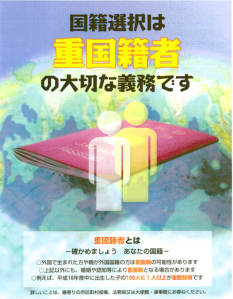
 JAPANsociology