The Homi housing development

In recent years, Japanese population is decreasing due to declining number of children, so there are many people who claim Japan should accept immigrants to get the workforce.  However, accepting immigrants have not only good points but also bad points.  For example, there are many problems between Japanese and Brazilian immigrants in the Homi housing development.

The Homi housing development was built in time of rapid economic growth in Toyota city in Aichi.  Many Brazilian came to Tokai district as immigrants, because there are many manufacturing industry such as auto industry in Aichi.  In 2010, about 9,000 people live there, and 4,000 of whom are Brazilian immigrants.  Many Brazilian has been lived there, so there are many posters which are written in Portuguese.  However, there are many problems which were caused by difference between Japanese culture and Brazilian culture.

Most of Japanese who live there claimed Brazilian people’s manner is very bad.  For example, illegal parking is increasing, they do barbecue at veranda, they often drink and make merry at night and so on.  Many Japanese said “Brazilian immigrants shouldn’t move into here anymore” because Brazilian behaviors make Japanese angry.  On the other hand, Brazilian also complained against Japanese who live there.  Of course, Japanese and Brazilian hope that the Homi housing development become comfortable place for them.

I think they should promote exchanges between Japanese and Brazilian.  Brazilian may not know about Japanese low, so they do illegal parking, and they may not know about Japanese culture, so they think “our manner isn’t bad.”  Japanese also should understand Brazilian culture to make good relation.  I think self-governing body have to hold exchanging party, and they can introduce each other’s culture there.  However, in case of this situation, I felt Brazilian immigrants need more effort to adjust Japanese life style.  There is a proverb such as “When in Rome do as the Romans do.”  They should not only tell about Brazilian culture but also learn about Japanese culture.  Now, most of Japanese approve accepting immigrants, but there are problems such as the Homi housing development.  Should we accept immigrants? What do you think?

by Mari Honda


Migrant Worker and Education in China

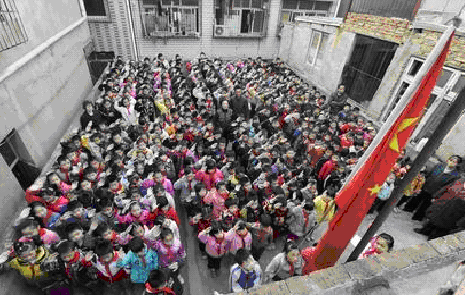
Do you recognize what it is? Many children are gathered at small rooftop, and the national flag of China is hoisted in front of them. People call it “the roof top elementary school”. There is no schoolyard, gym and even roof, but children study here every day. Many people are interested in the school.

This school is one of the elementary school for migrant worker. Children of migrant workers from farm village go to this school. This type of school always is in the big city in China, and children study under worse educational circumstance than public elementary school remarkably. The schoolhouse is a building which has four floors. There are many houses and buildings around the school, so it is difficult to find it. The entrance and door are narrow. The school has classrooms, dormitory, and lunchroom, but these are simple rooms which are for living. The schoolhouse is too small for 375 children to study.

Elementary schools for migrant worker in China are run differently, but the school that I told is a general type. It is said that their surrounding improved gradually. However big cities which continue economic growth need labor forces of migrant workers and security system do not reach to migrant workers and their children now. Elementary schools for migrant workers try to make interest of many people and get a lot of support. At present, the project of reconstruction of the elementary school which I told gets ahead surely. It needs three million yen or four million yen.

There are many children who want to study even under harsh condition like this school. My condition to study is not to be compared with them of children of migrant workers, so I think I have to study harder. I hope that reconstruction perfect safely and elementary school for migrant worker improves greatly.


reference:

http://hb.qq.com/a/20111124/000848.htm


by Ayako Ueda

Repatriation Program

Zainichi Korean (Korean Resident in Japan) has living in Japan since 1910.  In 1945, the emancipation of Korea from Japan after, a lot of Korean did back to motherland, however, about 600thousand Korean people had lived in Japan after emancipation.  They couldn’t went to motherland, because they don’t had a money what Korea – Japan ship had moved in a part of place, so they should needed go to where.  In 1948, two countries are found in Korean peninsula that is Democratic People’s Republic of Korea (D.P.R.K.) and Republic of Korea (ROK). They motherland was cut by cold war regime.

In 1954, D.P.R.K. government was announcement to Zainichi Koreans “You are our country citizen”.  At the next year, Chongryong (the General Association of Korean Residents in Japan) to be organization in Tokyo what support to D.P.R.K. as motherland.  In other side, some Korean made group of ROK supporting as motherland that is Mindan (the Korean Residents Union in Japan).  In 1965, ROK gave ROK citizenship to Zainichi Koreans by Treaty between ROK – Japan however, ROK did a few supports only to Zainichi Koreans.  D.P.R.K. was different.  D.P.R.K. sent money to Zainichi Korean for founding of Korean School.  And D.P.R.K. leader Kim Il-Sung encouraged repatriation to D.P.R.K.  A lot of Koreans had sympathy to D.P.R.K.  At the same time, Japan government disliked Korean, because they ware left wing and they had sympathy of communism.  GHQ (reigned over Japan for 1945 – 1951) had same opinion.

In 1959, D.P.R.K. – Japan negotiated on repatriation of Zainichi Korean, when D.P.R.K. and Japan agreed they opinion; Japan want removal Koreans, D.P.R.K. want manpower for country building. In this time, Repatriation Program was planning.  December 14th 1959, Ship of Repatriation departed from Nigata port that taken about 900 Koreans.  This time after, about 60thousand Zainichi Korean went back to “motherland”, however a lot of Zainichi Koreans real motherland was the present of ROK.  That was continued in 1980s.  Zainichi Korean had kept “Dream” and “Hope”, because D.P.R.K. government did statement “our country is a paradise on the earth”.  And, if they had continued living in Japan, they might have given discriminations from Japanese and Japan government.  Practice, a lot of Korean is giving discriminations from Japan.  In that situation, they thought dream and hope to D.P.R.K.

by Kazuki Baba

How do you think about citizenship?

In this time, I would like to talk about citizenship.


First of all, I tell you about Japan and Korea.  In Japan, from 1985, if you have Japanese mother or father, you can have Japanese citizenship.  Also in Korea, if you have Korean father or mother, you can have Korean citizenship.  Then can you have dual citizenship entire your life?  The answer is NO.  You have to choice the only one citizenship when you will be 22 years old.


Next, I would like to tell you about the U.S.  The U.S can have dual citizenship.  There are many countries that recognize to have two or more citizenship.  For example,  the U.S., Russia, Canada, Mexico, Brazil, Peru, France, Italy, Nigeria, the South African Republic, Australia, New Zealand, Taiwan, the Philippines, and so on.  Because of globalization of recent years, many countries accept dual citizenship.


Is it good to have dual citizenship?  From the sight of moral, I think it is good to have dual citizenship because you have two mother countries.  But from the sight of logical way, I think you should choice the one citizenship.  The reason why I think you should choice the one citizenship is law.

How about military obligation?  In Japan, there is no allegiance to go to military obligation, but in Korea, you have to go to military obligation before you will have been 29 years old.  If you are a guy, and you have Japanese father and Korean mother, what will you do then?  I think it is difficult decision.  So, I think you should choice the one citizenship.

Moreover, how about marriage, franchise, and crimes?  If you have two citizenships, can you marriage to two people?  Can you participate in two countries’ government?  If you are a criminal, which country’s law are you tried by a court?

There are big problem about crimes.  Even though you are kicked out from one of your mother country, as long as you have two passports, you can enter again with the use of one of the other your passport.

From these reasons, I think it is difficult to have dual citizenships.


by Konomi Yamamoto

International Marriages In Japan

Why do Japanese women yearn for international marriage? In Japanese, international marriages have increased with the development of internationalization and globalization. Marriages between Japanese and foreigners in the 1960s are 4-5 thousand. The surge began in the late 1980s, exceeded 40,000 in 2005. However, it began to decrease after a peak of 4.47 million people in 2006. Foreigners in Japan is about 200 million people (alien registration number), the ratio of international marriages as compared to less than 2% of total population is quite high. To marriage foreigner of Japanese man has a reason. In an increasingly depopulated area it is going from wife shortage. And Japanese men ask their wife to focus on Asian countries. This is beneficial for both parties. Japanese men in countryside can find their wife. Women in developing countries can live in Japan. On the other hand, the reason Japanese women marry to a foreigner is admiration. Moreover, in this case marry foreign men are predominantly white or black not Asian. If Japanese woman marry to foreigner, they can live in Europe and America with the blonde husband. Their children are very cute because they are half. Husband must be active in housework and childcare. Most of Japanese women has image like this.

I found an interesting article. This is the article published by newspaper of China. International marriage has increased in recent years of Chinese and Japanese. A significant increase in cases, especially Chinese women marry in Japan. The newspaper cities the following four points about the effect of Chinese women marry in Japan. In the first it’s active birth. In Japan, the aging progresses, international marriage have played an important part of the Japanese marriage form. Couple number of births has increased every year during the day. Next that’s what made to stop the depopulation of rural labor. The minimum area of Yamagata Prefecture in the agricultural population is declining, according to statistics scholars, in 1989 were only 18 foreign. However, in 1995 most Chinese women were increased to 180 people. In addition, it plays an important role in international exchanges between China and Japan. In Yamagata Prefecture the Chinese women put in effect “interpreters assisted living”. Married bride is faced with cultural differences in various scenarios. So, she eliminates the differences such as medical care, life and parenting. Finally, culture of China has to respect for their parents. And it appears that this effect can strengthen the bounds of the same family in Japan. In this way, international marriage sometimes has an important means.


by Saki Uetsuji

The situation of Japanese-Brazilians in Japan

From the latter half of 1980, the number of Japanese-Brazilians who came to Japan to find work was increased remarkably. While Japan was in the bubble economy, Brazil hadn’t been improved the employment opportunity and the standard of wages. It was because immigrations of Japanese-Brazilians kept increasing. Japanese-Brazilian could not find their jobs very well. They still have the serious problems. Especially, I state about two problems――language, living in Japan.

First, it is difficult to find their jobs for Japanese-Brazilians who cannot speak Japanese. Moreover, because most of them have no skills to work, cannot get respectable job. And what is even worse, it is the situation that many Japanese-Brazilian children cannot receive education in Japan. It is said that over the half number of Japanese-Brazilian children doesn’t receive education in Japan. In Japan, support of education for foreign people isn’t enough to be provided. As a result, such children also cannot get the job, the Japanese-Brazilian are forced strict living.

Second, it is a problem that losing the Japanese-Brazilians’ job because of the depression after the collapse of the bubble economy. Most of the Japanese-Brazilians are temporary worker.  Because Japanese companies tried to cut personal expenses, many of them who cannot speak Japanese and haven’t skills are fired from temporary jobs. Not a few Japanese-Brazilians go back their country to find their job for their living. Also, their poverty is a one of the cause that no education of Japanese-Brazilian children as stated above.

Many differences of lifestyle between Japanese-Brazilian and Japanese caused some problems. In a certain apartment complex, Japanese people and Japanese-Brazilians live together. While Japanese tell that Brazilians have no manners, Japanese-Brazilians tell that Japanese are so stiff. The large-size refuses and noises by Japanese-Brazilians who don’t know Japanese rules are problems in the apartment complex. However, they don’t mean any harms, the compromise is necessity each other.

However there are a lot of the third or fourth-generation Japanese-Brazilians, their living is still in unstable condition. Now, we are demanded to live with foreign people who have different theirs sense of values. For this reason, Japanese-Brazilians hope that the systems are established for them, for example, the system that give the equal opportunity of education for Japanese-Brazilian children or the system of employment that Japanese-Brazilians can work as not temporary worker but regular worker. I think Japan should respond to them.

by Ayako Takagi

Which is better for immigrants to live as groups or individual?

Many immigration countries set a borderline between natives and immigrants. I mean that many residents live separtely according to the region. For example, in the U.S.A,  there are residential segregation of black. In Los Angels, whites live along the beach where it is comfortable to live and blacks live aroud the center city such as Lennox regarded as dangerous place. The number of hispanics is higher than that of whites, and blacks. They spread and live. In Canada, there are Indian streets and Italian streets and so on. Why did they set the borderlines like this? Because of convinience? Because of others?


Personally, I believe it is better to live as individuals. Of cource, family is together. In case, the host countries accept them favorably and there are many immigrants. I need this idea to realize multi-cultural society. I think the ability of communication increases and people can understand each other.

I think to live as group create the wall. Someone could think that this area is dangerous, and I do not want to go or someone might say here is better than over there. It might show little interest in others. They might have ideas living as groups, not countries.


However, this idea have a lot of difficulties. It is natural that same race gather as same place and the standards of their lives are different dependent on races. Actually, the rate of hard jobs of whites is low, but Hispanic or Black don’t, so it genarates. It is regarded as a problem of differences of income. Further more, they have different culture and religion. It creates hate crime or discrimination. In Europe, there was some troubles that natives attacked immigrants or mosque. On the other hand, there are examples that get along with immigrants.


I know it is very difficuclt, but I wish the society would be better living together with  less difference.

What do you think?


by Rie Murata

Undocumented People In Japan.

In Japan, the definition of “Undocumented People” is not always unified, and it varies with the law. One definition is provided “people don’t have nationality of Japan” by immigration control law and refugee recognition law. The other definition is “people don’t have nationality of Japan except those who have permission of a landing in transit, permission of crew member landing, permission of temporary landing and permission of landing at port of call”. In this way, the definition of Japan may be give loose impression comparatively. According to this definition, the child who hasn’t done “alien registration” can go to public school.

In the case of Japan, record of a social position act is recorder by the family register system and a resident card. A foreigner is recorded by the alien registration system. After the common Japanese takes out a marriage registration form and a birth certificate on the assumption that family register system, it has an image which has parents’ entrance to a child’s public school. People hold the image often “alien registration system” like this. As a result, misunderstanding “an illegal immigrant child hasn’t gone to school” is produced. For example, the girl who parents are illegal alien was forced to leave school in Tokyo. She was born and to live in Japan. She speaks Japanese only. However, she was dismissed from school because her parents are illegal alien by trial. And they were commanded to deport. When the children who ask for “special permission for residence” are introduced, the question “why the child goes to the public school that parents haven’t done alien registration” comes out. So, the government of Japan should inform nation and immigrant people “a just right of undocumented people in Japan” properly.

However, “Illegal immigrant reduction by half campaign” is performed from 2003 in order to send a child to a public school a condition. The illegal immigrant performs alien registration. But the cases that the staff of the city reports this act are occurring frequently. On the other hands, the illegal immigrant tries to avoid the alien registration which was being performed in the idea of “making alien registration a child’s education for health insurance”. It’s the latest tendency that it’s difficult for an illegal immigrant child to receive education as the result. How do you think about that illegal immigrant child should education in Japan or not?


by Saki Uetsuji

Bread and Roses

The film ‘Bread and Roses’ is a story about janitorial workers’ struggle to get better work conditions and the right to unionize in Los Angeles. Most of the janitorial workers are immigrant workers who have illegally entered the U.S from South America. They are viewed as commodities and expendables. They reluctantly continue to accept low wages and poor working conditions to make their living. However, they protest for higher wages and benefit packages, and the employers decide to meet the workers demands in the end.

The film’s title, “Bread and Roses”, comes from the textile strike in Lawrence, Massachusetts, in 1912 which was led by large groups of female workers. They struggled and fought under the slogan ‘We want bread but we want roses, too!’ In the end, they got their salary increased. In the film, janitorial workers unite and march through the streets, shouting ‘We want bread but roses, too’, like the 1912 textile strike in Lawrence. No matter how hard they work for it, they do not get paid enough for their hard work. They struggle not only to get bread, which symbolizes the minimum requirements to survive, but also roses that symbolize human dignity. They have to put up with terrible work conditions such as low salaries, as low as 5.75$ an hour, no health insurance, paid holidays or sick leaves. All of this is because of their economical troubles and the treat to be exiled. However, they fight against the ruthless employers for fair wages and dignified conditions and also to restore their rights as a worker and a human through unity.

There are a huge number of immigrant workers in the U.S. Most of them are Hispanics, including Mexican people who have smuggled themselves into the U.S. Actually their life is terrible beyond imagination. Even though they have crossed the border at the risk of their own life to overcome poverty and seek better opportunities, they cannot escape from the cycle of low wages and being exploited by employers. In the film, janitorial workers won and got back their rights, however in reality it is difficult for immigrant workers to organize a labor union. They are forced to put up with poor working conditions that exploit them, under the constant threat of dismissal or exile. In the film, janitorial worker Maya asked Sam, a labor organizer, “What do you risk?” Because they should put more than everything they have to fight against unreasonable working conditions, mostly they accept the reality and give up their hopes to struggle. If they can eat the bread, they cannot have the rose; this is the reality they will have to face. To be able to eat bread, they will have to sell their roses.

Being guaranteed immigrant workers’ rights as a worker and a human is still far off. However, the film shows also hope that they can do it. Fighting for immigrant workers to get bread and roses will not stop.


by Jeawon Moon

Feel Of Outsider

 Almost people have own parents, family, community and so on. There are our greatest supports to live our life. Especially, hometown is very precious thing for us. We can feel that where we belong with because of hometown. However, sometime we feel like as if we were outsider in spite of we are in hometown. Why people think that so? What is hometown? I consider about the topic.

   I think that change is cause of feeling like outsider. Every time when I go back to my hometown, I can see the regular scenery and meet the regular friends. So, I can feel there is my hometown and I belong in here. Although, I guess that I may feel like as if I were an outsider if the scenery and friends gone, and change my hometown that I pictured to strange space. Even if the location of my hometown has never change, there is not my hometown any longer if there have no things that belong with me. Therefore, we need hometown to proof where we belong with and who I am, I think.

      In the class, we learn about outsider in some countries. I think that they also feel about the changes. Increasing immigrants make their hometown strange place. Opening new cultural restaurants, selling some strange things are the instance of changes. Only that things, but it is very important things for people who living there. Finally, people feel just like they were robbed job and treated cruelly. Can it really be true? I think that it is not true in almost cases, but some changes make them feeling so.

      In conclusion, feel of outsider come from the changes. We cannot live without relations. We need to proof where we belong with and who I am. So, we need to hometown too. I think that if people know about the relations, the matter of outsider is decreasing.

by Erina Hayashi