
by Lyu Dian
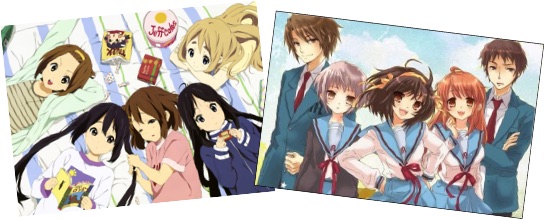 It is easy to recognize Japanese Manga characters from their exaggerated round eyes, small nose, spindly legs and colorful hair. These features that are generally common for most Japanese readers confuse Western readers sometimes because in their eyes Manga characters look like Caucasians but Japanese. In Kawashima’s article, many Westerners consider stylized Manga figure as an expression of “trying to be white” and the idea of “becoming white” is a product of cultural imperialism since the white people were historically dominant in the world. They even express their sympathy to “Asian people” who try to become white by stating that their should stay who they are but not constrained to racial hierarchy thinking. In fact, the thought of regarding Manga figures as white or trying to be white is a symptom of visual production of race and racial privilege thinking.
Different from Western viewers, Japanese readers naturally regard Manga figures as Japanese, blonde hair and round eyes are nothing more than exaggerated factors of Manga, as well as spindly arms and legs. In addition, colorful hair and round eyes are widely used for highlighting distinct personalities and showing emotional performance in artistic works, same as characters in Disney cartoon who usually have oversized head (eyes too) and disproportioned body. As a Chinese reader, it never occurs to me that these characters look more Caucasians since they do not even look like man in reality with their unbelievable shape of hair and limbs thin as stick. The reason why Western viewers especially tend to think Manga characters as white, as Kawashima pointed out, is that they usually hold stereotype of “Asian look” in their mind. In their and mass media’s views, Asian look should be flat face, small and slanted eyes, yellow skin and straight black hair which are actually not correct (see the Disney movie Mulan as a example). In the American drama, The Big Bang Theory, when Sheldon’s mother carved a smiling face on a pancake she said “his eyes are little thin but pretend him to be Chinese”. It is really common to see stereotype of “Asian looking” face in mass media, thus it would not be surprise to understand why Westerner viewers cannot accept Asian face with round eye and lighten hair naturally because that against their typical expectation of Asian people. Exactly as Kawashima discussed, the idea of “Asian looking face” or “what Asian people should look like” is a process of picking and ignoring certain features as standards to create and evaluate race. This fixed mind-set is artificially and socially constructed, rigid characters in films, cartoons, dramas are outcome of it and also reinforced it. Even though, mass media are far less racial than in the past but stereotype still exists.
References
Terry Kawashima. 2002. Seeing Faces, Making Races: Challenging Visual Tropes of Racial Difference. Meridians 3(1):161-190.
Matt Thorn. The Face of the Other. http://www.matt-thorn.com/mangagaku/faceoftheother.html
How come Japanese cartoon do not look like Japanese people. http://boards.straightdope.com/sdmb/archive/index.php/t-77407.html
 Manga are a topic that has been well-researched in Japanese Studies. However, when it comes to racial identity, we can see strong wonders about the racial identity found in the manga characters. On the one hand, if you search on the internet the question in English “Do Manga look like white people”, you have 14,000,000 results. On the other hand, if we do the same search in Japanese “漫画キャラクターは白人っぽい“, you only get 736,000 results and it is mainly a translation on the question asked by foreigners.
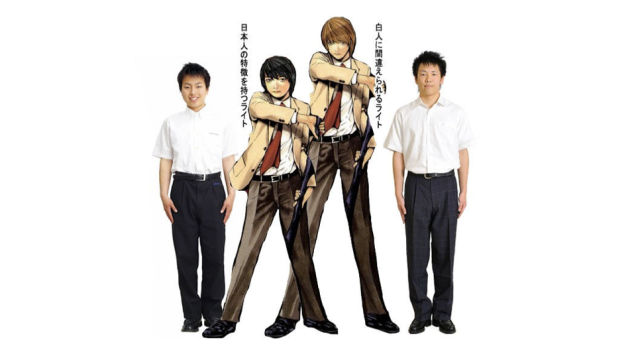 Terry Kawashima (2002), in her essay “Seeing Faces, Making Races: Challenging Visual Tropes of Racial Difference,” argues that the manga characters are mainly based on whiteness’ particularities and they influence the young women when it comes to the concept of beauty. According to her, the manga readers had been “culturally conditioned to read visual images in specific racialized ways that privilege certain cues at the expense of others and lead to an over determined conclusion” and highlight the issues on how “race” is a social constructed category.
 So why do we see specific racial features in these “odorless” characters? It is mainly because of our personal representation of racial differences. These differences are called “markedness” by Matt Thorn (2004), we used our own culture and features of our own personal experiences to identify the character’s race. For example, look at a manga character with blond hair and blue eyes who is eating a bowl of rice with chopsticks. Where a French person will see a French personage because of its physical features and because he is himself French, the Japanese will see a Japanese person because this he/she is eating a bowl of rice with chopsticks.
 JAPANsociology