Separate and Unequal: The Remedial Japanese Language Classroom as an Ethnic Project

Peruvian Student Ricardo Relaxes in the Remedial Japanese Language Room

by Robert Moorehead

My article in The Asia-Pacific Journal examines the remedial Japanese language program at a school in central Japan. I argue that the program systematically denies educational resources to low-performing immigrant students. Despite the Japanese educational model of equality and inclusion, these immigrant students are tracked into a program that is separate and unequal.

Teachers explain this pattern in ethnic terms by referring to immigrant students’ supposed need not for specialized remedial instruction, but for relaxation as a break from the difficulties of learning Japanese.

To read more, please visit The Asia-Pacific Journal, a peer-reviewed, open source journal that focuses on the Asia-Pacific region. Also, check out Language and Citizenship in Japan, an edited volume published by Routledge.

Learning to read hiragana, katakana, kanji, and the air

Celebrate Diversity!by Robert Moorehead

With the spring semester now over, I’ve been thinking about the challenges of getting students to think differently about incorporating non-Japanese into Japanese society. The arguments students make and the ones sociologists usually cite in the research literature are like two roads that never meet.

As I’ve written before, students’ view of Japanese history seems to skip the roughly 100-year period between the Meiji Restoration and the Tokyo Olympics—nothing important happened in Japan between the 1860s and the 1960s, did it? Based on this, students often claim that Japanese people have little to no experience interacting with people of different cultural backgrounds. Plus, Japan is an island and thus was inaccessible to other groups. The invention of boats around the world apparently didn’t impact Japan … but I digress.

Students also state that Japan, unlike other countries, is a “high-context culture,” meaning that much communication in Japan is unspoken. Meanings are implied, and understanding those meanings requires reading between the lines and reading the context of the situation. Those who can’t “read the air” (空気を読む or “KY”) are treated as socially inept and may struggle in their social interactions.

This is a fair point, as communication in Japanese proceeds somewhat differently compared to communication in English, Spanish, or other languages. But, can’t people learn to “read the air”? Is Japanese culture so byzantine, so complex and inscrutable that non-Japanese can’t simply figure out how to talk to people?

Students also claim that because Japanese are not used to interacting with “KY” people, they can only accept people who are just like them. Interacting with non-native Japanese speakers and people who can’t “read the air” is too much work, so non-Japanese are just out of luck.

This inherently conservative argument could be extended to justify excluding pretty much anyone. Japanese women want a right to equal opportunities for employment? Too bad. They could never really understand men’s particular communication style, and their presence might make men uncomfortable—no more sex jokes in the workplace—so women will just have to settle for serving tea and lower pay. The disabled want to work? Sorry, accommodating their needs could be inconvenient, so they’ll just have to stay home. Okinawans and the Ainu want to express their cultural and linguistic distinctiveness in mainland Japan? Sorry.

This approach dismisses the rights of the individual in support of the rights of the majority. That is, the majority only has to respect the individual rights that are convenient. This approach fits with the LDP’s planned revisions to the Japanese Constitution. As Lawrence Repeta notes, these revisions would subordinate individual rights, such as free speech and free assembly, to the demands of public interest and public order.

On the one hand, I should be thanking students for their honesty. But do researchers cite any of these ideas when analyzing immigrant incorporation? I just finished teaching a course on international migration, and we spent the semester reviewing the sociological literature, including the main schools of thought, and issues of gender, education, transnationalism, citizenship, among others.

And not once in that literature did anyone talk about “high-context cultures,” or the whether interacting with cultural others might be too inconvenient.

So, have sociologists missed the boat? Are we just talking in circles, clueless as to the real issues?

Or is communicating across cultural and linguistic lines simply a fact of life for many people on the planet? Don’t we have to make all sorts of adjustments every day, even if we don’t have any foreigners in our midst? We communicate across lines of class, gender, age, and sexuality all the time, so why should we treat communicating across cultural lines as some special case?

As famed anthropologist Harumi Befu (2001) has noted, the United States is often held up as the main contrast to Japanese society. The US is multicultural and a nation of immigrants, while Japan is neither of those things. In the US, people complain about the challenges of diversity, like struggling to pronounce new names, understanding various accents, and talking with people who are still learning English. But … so what?

Seriously, so what? Is learning new names and using a modicum of patience to interact with non-Japanese really that difficult? Is “reading the air” really that complicated? Are foreigners really that inept at communicating in Japan?

Is it more difficult than figuring out how to pay for health care and pensions for Japan’s elderly, when Japan’s population is dropping and postwar boomers are retiring?

Since Commodore Perry’s black ships forced open Japan to international trade, Japan has gone through the Meiji Restoration, imperial expansion across much of East Asia and the Pacific, multiple wars, fire bombing, nuclear attacks, defeat, occupation, democratization, reconstruction, development into a global economic power, bubble economies, inflation, deflation, stagnation, population booms and declines, earthquakes, tsunami, and nuclear disasters.

Change is the constant. In light of all that, talking to foreigners seems like it should be the least of their worries.

References

Befu, Harumi. 2001. Hegemony and Homogeneity: An Anthropological Analysis of Nihonjinron. Melbourne: Trans Pacific Press.


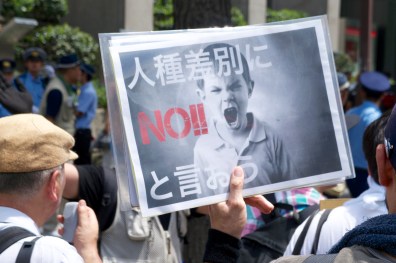
Osaka March Against Racism

Say No to Racism!

Say No to Racism! Click the photo to view the photo set on Flickr.

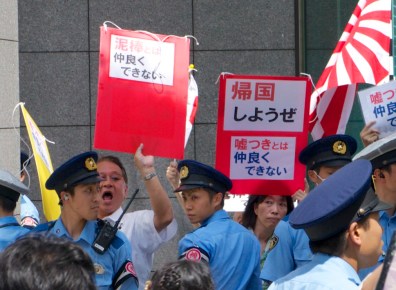
Anti-foreigner protesters hold signs calling for foreigners to leave the country.

Anti-foreigner protesters hold signs calling for foreigners to leave the country. Click the photo to view the photo set on Flickr.

by Robert Moorehead

As the acquittal of George Zimmerman was announced in the US, we were on our way to Osaka, to participate in the March Against Racism. On a hot, sunny day, hundreds marched in protest against the recent hateful anti-Korean demonstrations in Osaka. The march started with speakers blasting Sam Cooke’s “A Change Is Gonna Come,” and instantly we felt at home.

Rainbow flags flew, Korean and Japanese drums were pounded, and marchers carried signs calling for an end to discrimination and a celebration of diversity. In a country where a myth of homogeneity is celebrated, calls for the celebration of diversity are rare.

We ran into a few small pockets of hate, where racists held signs demanding the foreigners leave the country. One man even followed the march, holding an imperial Japanese flag, standing alone while hundreds raised peace signs (and one guy kept flipping him the bird).

The Zimmerman ruling sickens me, but the march was just the right medicine.

Click on the photos below to open a photo gallery.

Click here to view our photos and videos on Flickr.

Undocumented Immigrants in Hiding

by Maki Yoshikawa

In our class, we have studied about undocumented immigrants through video, and reading articles on real-life  undocumented immigrants.

I think it is very difficult to make it clear that undocumented immigrants in Japan should be accepted in this society or not. There are a lot of undocumented immigrants who want to stay in Japan. My opinion is that Japan should accept undocumented immigrants. Indeed, it is true that some Japanese people might lose their job because of increasing number of workers. However I suppose that undocumented immigrants are needed in Japan. Japanese society will not be able to survive on its own without help of foreigners. Some Japanese businesses still need workers to work, for example, farming, caring for aged people, fishing, and so on. In these kind of jobs, most Japanese are not willing to take these jobs.

On the other hand, these jobs are socially needed because the aging society is growing year by year, and the workers in the rice fields are also getting older. As everyone knows, rice is necessary in Japanese food. Who knows how to raise rice according to the changing seasons?  Who will take over the technique? After all, there are many kind of jobs which will definitely need people to succeed to. In addition, from my view, foreigners or immigrants can be engaged in these jobs. This will lead the problems which Japanese society having to be known worldwide and recruit people from all over the world. This will be more effective. However, there is a wall of documents and language when recruiting people from around the world.

It is very complex issue when it comes to children like Noriko Calderon. We have laws to follow, and human rights to protect. It is difficult to put weight on both. When we try to follow the laws, human rights tend to be violated as a term of undocumented immigrants. I insist parents are responsible for undocumented children like Noriko even if they had no choice. Children have no reason to be blamed and be restricted their rights. Therefore, as following the law, parents are supposed to leave the country. There is no way to avoid separation between parents and children. On the other hand, this situation must be changed. As a student like Noriko, I would not want more undocumented children in Japan and other countries to feel like her because they are not guilty, they were just born and raised without knowing they are undocumented.

The Japanese government must do something. However, for government, as a policy it is not appropriate to accept all immigrants without limit. For the first step, the Japanese government needs to promote awareness and interest of undocumented immigrants because a friend sitting next to us who looks completely Japanese might be undocumented immigrant who lives hiding his/her problem.

Should Japanese schools teach multiculturalism?

by Masataka Yamamoto

Recently, the world internationalizes in everywhere and a lot of people’s exchange is going on in society. To understand the people who came from different places requires some knowledge of different cultures. Japan is one of the developed countries in the world so we have to know other cultures to play a role in international society as Japan.

I don’t think any Japanese schools teach multiculturalism so far. The word multiculturalism describes that the education of human race, ethnicity, gender, economic hierarchy, handicap problem, and sexual orientation. It is necessary to support students to realize who they are in many groups so they can understand what really they are. However, many old people try to protect Japanese culture itself from other cultures’ intervention. Also Japanese geographical features are island so it has fewer relations with other cultures, compared to countries which are located on the continent. Japan has fewer chances to touch with other cultures so Japan should more freely to know other cultures.

In my opinion, Japanese school should teach multiculturalism in every school. It is because I have an experience of living in countryside of the United States and there were many black people and fewer Asian people. White people and black people were friendly to each other, but not to Asians. They called us like narrow eyes, kamikaze, yellow monkey, whatever that describes Asian or Japanese people badly. I felt very uncomfortable by being called such discriminatory words, so I thought it needs to disappear. This happened in the U.S., and Japan has fewer chances to get with other cultures than the U.S. If many foreigners go to Japanese elementary school or junior high and Japanese students don’t have multicultural education, what will happen? I think students will have discrimination against different cultures. To prevent this from happening, every Japanese school should teach multiculturalism for understanding of other cultures. Also knowing other cultures have merits when people going to other countries. For example, people in U.S. are mixed together as German, Russian, African, Chinese, etc. so to know other cultures is important in international society.

In conclusion, Japanese school should teach multiculturalism to understand other cultures and learning multiculturalism will need when people go to another places. People are exchanging everywhere in this International society so learning of multiculturalism will be main tool to have a communication with people from different places.

Keep Having Friends

by Kensuke Ikeda

I saw a documentary movie about young boy as undocumented immigrants on TV called “Nihon de Kurashitai: Huhou Taizai Kazoku no Kizuna” (We want to live in Japan: the bounds of family who are undocumented and overstay). In the movie the young boy said “please leave me in Japan, I cannot speak other language and I don’t have any friends in another country”. I realized uneasiness of the undocumented immigrants because his speech is so honest and so direct.

In Japan there are many undocumented immigrants, and some of them are children. They don’t have decision to leave in Japan or to return to “home” country where they have never lived. They should return home country by legal steps. Also, they force to return the country instantly. Japanese government takes care of undocumented people because they will do terrorism and have relation to group of drug peddler. I understand the stance of the Japanese government, but the legal steps are too tactless to ignore other undocumented immigrants who are useful for improving the Japanese economy.

These ineffective legal steps have the room to improve. I suggest that these legal steps are used by the Internet. If undocumented immigrants get approval of stay, they can stay in Japan as have been the way until now. However, they need long process to take the approval because the official apply is tiresome. If they can get temporary approval by the internet apply, they may need not to immediately return home county and they can submit their official document for immigrants. Also, if they cannot stay in Japan, they have some time for preparing to live other country, for example children can learn other language and adult can find the job in other country. The internet gives undocumented immigrants time to pass the legal steps.

However, the use of the internet for apply is dangerous because the apply may be not appropriate on legal. For instance, terrorist can make the stay time in Japan long, and then they can plan the terrorism without haste. In short, the crime people also have time to prepare next crime and escape. For this problem, the governments should strict for immigration by passport. To begin with, these crime people should not come in Japan. It is important that people who come in Japan are terrorist or not and drug peddler or not. Young undocumented immigrants deliberately make crime as overstay. I think the Japanese government should give them the room to think next life. They don’t need to lose their friends and their country.

References

“Nihon de Kurashitai: Huhou Taizai Kazoku no Kizuna” (We want to live in Japan: the bounds of family who are undocumented and overstay).2000. Fuji TVstation. http://www.fujitv.co.jp/b_hp/fnsaward/backnumber/back/00-167.html

HP of Kayamori Office. http://www.geocities.jp/a_kayamori/index.html

Poor English Saved Japanese Banks?

by Robert Moorehead

Japanese Finance Minister and deputy prime minister Aso Taro claimed Friday that ignorance by Japanese bank managers saved Japan from buying the subprime loan products that later collapsed in value and ushered in the Great Recession. According to Aso, bank managers’ command of English was so poor that they avoided studying the complex financial products and instead avoided them.

As reported in the Japan Times, Aso told a seminar in Tokyo “Many people fell prey to the dubious products, or so-called subprime loans. Japanese banks were not so much attracted to these products, compared with European banks.”

“Managers of Japanese banks hardly understood English. That’s why they didn’t buy,” he said.

Other explanations would be more encouraging. For example, “Japanese bank managers avoided the products because they saw them as too risky,” or “Japanese bank managers showed keen insight into the global economy and recognized that these products were a poor investment.” But praising bank managers’ ignorance of English?

Aso is well-known for his verbal gaffes, including saying that the elderly should “hurry up and die” to save the government money on end-of-life care. “Heaven forbid if you are forced to live on when you want to die. I would wake up feeling increasingly bad knowing that [treatment] was all being paid for by the government,” said Aso in January. “The problem won’t be solved unless you let them hurry up and die.”

Aso has also referred to people unable to feed themselves as”tube people,” made quips about Alzheimer’s Disease, and said that poor people should not get married. “It seems rather difficult to me for someone without means to win people’s respect.”

Maybe Aso’s comments could fuel new advertising slogans for banks …

“Bank of Tokyo, where the only English we know is our name.”

“Globali-what? Come to Bank of Osaka, where we put your money under a mattress.”

“At the Bank of Kyoto, we make sure none of our employees has ever left the country.”

Submit your own slogans!

Are You Kidding Me? Toshiba’s New Stereotype Maker

by Robert Moorehead

UPDATE: Toshiba has removed the video from both YouTube and from its own website. The video is still available at Kotaku.com, and has been uploaded to YouTube by user “xbatusai”: We’ll see if Toshiba releases a public statement in response to this issue.

Toshiba promotes its SuiPanDa bread maker by dressing up a Japanese woman in a blond wig and fake nose … because eating bread changes your appearance and makes you speak Japanese with a fake foreign accent. Rice is Japanese, she says, but bread is Western. You can add rice when making your bread … to make hafu bread?

Maybe they should have Becky or Shelly advertising the bread maker … use rice to make hafu bread—hafu Japanese, hafu Western. As much as that would essentialize and reify racial categories, it would still be better than having a Japanese person dress up in gaijin-face and speak accented Japanese.

Just to make sure that viewers know that this woman is gaijin, they also use katakana for her subtitles. (Katakana is used in writing foreign words in Japanese.) Oddly enough, despite the racialization of bread as non-Japanese, Japan is filled with specialty bread shops. It seems half the shops in Japan are either boulangeries or hair salons. So maybe bread isn’t all that foreign after all …

An equivalent commercial in the US would have a sad white woman eating a sandwich, but who longs for some rice for lunch. A white woman in yellowface (who speaks English with a fake Asian accent) would then tell her that making rice is too hard for Westerners. Think of Mr. Yunioshi from Breakfast at Tiffany’s selling a rice cooker.

Heaven help us if Toshiba expands its devices to include other types of food, like fried chicken, tortillas, or anything else “foreign.”

Here’s the now-dead link to Toshiba’s original video:

Are Zainichi Koreans “foreigners”?

Anonymous student post

There are lots of ethnicities in Japan, such as Zainichi Korean, Chinese, Japanese, Ainu, Okinawan, and more. In spite of the existence of plural cultures for a long time, Japanese government had ignored their existence until the 1980s when globalization came into Japan. The Ainu and Okinawans had maintained their culture and language since 18c or 19c though the Japanese government prohibited them from using their language and sought to assimilate them.

On the other hand, Zainichi Koreans came to Japan as a result of Japan’s colonization of Korea from 1910 to 1945. During the colonization, Koreans were referred to as Japanese subjects. However, After Japan got independent in 1952, Koreans lost their legal rights as Japanese subjects and became ‘foreigners’. Some went back to their home country, but others decided to stay in Japan because of the confused situation of Korea such as Korean Separation or Korea War. Due to this, they stayed in Japan as ‘foreigners’ with permanent residence status, so-called ‘Zainichi Koreans’.

In 1965, the central government prohibited schools from teaching Korean culture and language to the Korean children, and the government policy was that teachers were to treat Korean children in the same way as Japanese kids. Because of this policy, later generations of Zainichi Korean were assimilated more and more. Now, most descendants of Zainichi Koreans were born in Japan and speak Japanese as their first language with little Korean language skill and many of them use their Japanese name not Korean name. However, they are referred to as ‘foreigners’. In this case, the question what does ‘foreigners’ mean?

Most Japanese people see ‘foreigners’ as someone born outside Japan and come and stay in Japan temporarily. Japanese government had been speaking out that Japan was a monolingual and monoculture state by making the ethnic minorities ‘foreigners’. That is the reason why Zainichi Korean were invisible ‘ethnic minorities’ for a long time. However, this situation changed from 1970s to 1980s.

In 1970s, Dowa problem rose widely in Japan and ethnicity became ‘human rights’ issue. Also, a lot of immigrants came to Japan as guest workers and ‘foreigners’ education were acknowledged in 1980s. These things had impacts on the Zainichi Korean policies. In 1991, the central government finally allowed schools to teach Korean culture and language though lots of policy changes had already occurs in local levels.

Due to these movements, Zainichi Korean were ‘discovered’ as ‘ethnic minority’ in Japan. By becoming ‘visible’, Zainichi Korean got explicitly identity as a Zainichi Korean not Japanese or foreigners. However, whether they chose which identity is their problem. Fortunately, I think they are easy to assimilate into Japanese society more than African people or European people because our culture is similar to each other and physical features are also similar. However, it is not only identity issue but also their legal statement issue. They haven’t got the citizenship and have been discriminated against in terms of education, housing and work. Even though the existence became visible, there are still a lot of difficulties for Zainichi Korean in reality.

References

Hokkaido Ainu Kyokai.http://www.ainu-assn.or.jp/about03.html

Lie, John. 2008. “Zainichi Recognitions: Japan’s Korean Residents’ Ideology and Its Discontents.” The Asia-Pacific Journal >http://japanfocus.org/-John-Lie/2939

Okano, Kaori. 2006. “The Impact of Immigrants on Long-lasting Ethnic Minorities in Japanese Schools: Globalization from Below.” Language and Education 20(4):338-354.

Japanese aspect toward Hafu

by Ryota Takatsuka

What image do you have of hafu? Hafu means people who have one Japanese parent and one foreign parent. In Japanese, they are sometimes called “Ainoko” or “Konketsuji” and so on. What we can know from these word is that Japanese regard them as a not pure Japanese but as a half blood people. In fact, there are still discrimination against hafu in everywhere. For instance, according to the movie “Hafu project” almost all hafu people who interviewed have an experience that they were not treated as Japanese. In some case, when they were young, they were called “Gaikokujin” (means foreigner) and bullied. In general it is said that child is cruel because they do not cover word. However, what hafu people states is that they are still feeling as if they are outsider of Japanese society and they lost identity “Who am I”. This feeling gives Japanese a question”What make us treat hafu that way”.

In the movie “hafu project”, there some interesting interview of a Japanese young woman. She was asked the image of hafu people she has, and she answered”hafu people is cool and beautiful than us”. The point is she thinks hafu people has different characteristics and hafu is different from other people. In addition to this example, one man stated that he envy hafu, because they are bilingual.  From date which the director of this movie took, Japanese people pointed out almost same image they have such as cool. bilingual, and something about the differences what hafu have. Japanese tend to have image that hafu have a one Japanese aspect and other aspect from parent from oversea. This is why Japanese sometimes treat hafu as a foreigner because of such kind of image.

Due to this,what hafu people think of themselves? Many hafu people states they confuse whether they are Japanese or not. Once they in foreign country they feel I am Japanese, but in Japan they feel like different. This seems related with japanese image of Japanese people.

In my experience, some Japanese have narrow aspect against multiculturalism. Japanese have no education about culture in obligation education system. Japanese have less ability to understand the other aspect from other country, because we do not have knowledge about way of thinking. For example, I met person who is polychronic. He does not care about the time even when I rush him. I learned that there is such kind of idea in the world. As this experience shows Japanese people have to know the difference of other sense so that Japanese people adapt hafu.

Japanese society face aging problem and declining birth rate problem together. Therefore world tend to promote internationalization in terms of society, education and so on. In order to these situation around Japan, foreigner who try to get Japanese citizenship will be precious length for many field. My conclusion is Japanese should set an education about multiculturalism and promote reception of immigrants. Understanding of hafu people will be the key to develop internationalization in Japan.

References

Views from street on hafu (English Version), Hafu project, from  http://www.youtube.com/watch?v=Wi2r23e7fpA

Hafu’s identity, Hafu project, from http://www.youtube.com/watch?v=96SbzJX1Jlw