Jiko sekinin—does it help us?

by Tomoki Bischel

Is jiko sekinin (individual responsibility) a good thing? For a long time I have thought of it not as a good thing but more of a matter of course. Therefore, I was for jiko sekinin. A few experiences made me think this way. One of them was during junior high school. Two classmates of mine had started a fight during lunch break and the teacher got very disappointed about this and decided to make us stay late after school and discuss about this topic, saying it was rentai sekinin (group responsibility). However, although I was for jiko sekinin, reading Anne Alison’s book gave me a new point of view: the aspects of jiko sekinin being a bad thing. So, I have decided to sort out the pros and cons of jiko sekinin in order to make things clear.

One of the pros of jiko sekinin is the aspect that helps us have responsibility over what we do. Being told that what you do is up to you, and that you have to take responsibility for it, people will stop to think if what there about to do is sufficient. So, in a way, jiko sekinin can act as a sort of legal force and help us not do the things we should avoid.

However, there are cons to this, and the biggest con, I believe, is that it can turn to something very cruel. This connects to what Anne Allison mentions in her book. Too much coercion can cause stress against people and start to build fear against society in them and be unable to feel at ease. Therefore, looking at this aspect, it may be said that jiko sekinin is one of the reasons of this precarious Japan that we live in now. However, does this tell us that we should lose the idea of jiko sekinin?

As I mentioned, jiko sekinin has both sides of the coin, and both sides have a really important role. So, what can we do or what should we do? I believe that just ignoring the idea of jiko sekinin will not solve the problem but cause more. What we need to do is to respect human-to-human relationships, and try to help each other above the idea of jiko sekinin. Although this may sound very vague, I strongly believe that this is very important and in the future, jiko sekinin will be something a lot better for the society than it is now.

Enhanced by Zemanta

Living on minimum wage in Japan

Minimal Minimum Wage

Minimal Minimum Wage (Photo credit: PropagandaTimes)

by Tomohiro Doi

I am talking about minimum wage in Japan. In Japan, the minimum wage is determined. However, this tackling is relieved with Abe’s government and the workers are difficult to work and live and it is easy to run companies for the administration. Namely, it is easy to live for the administration and it is difficult to live for the workers in Japanese society.

If I get minimum wage in the future, if I am living by myself, it might not have any problems. However, if it is a part time work, in my old age, it is uneasy because it do not have social security and an employee pension. And if I get married to somebody and I become parent in the future, it is hard to support my family. In other thing, Japanese society will become the age of a declining birthrate and aging population more and more in the future. Households what the son support the son’s parents will increase. If I support my parents, it will be hard to manage to make a living more and more.

To think this problem about if I get minimum wage, first in Kyoto, the minimum wage is about 773 yen. In this wage, for instance, I work five days for a week and work for eight hours for a day. And its simple total is 6,184 yen for a day. For a week, its total is 30,920 yen. For a month, its total is 154,600 yen. However, this is simple total. If I am a part time worker, it is very difficult to work every day and to get 154,600 yen for a month because a non-regular employee is not stable, for instance even if the non-regular employee is taken on, it is rather difficult to get work and to get money.

Now, to think this, for example, I live in Kyoto in minimum wage. First, the most important thing is the place of live what is house. The market of house rent is about 40,000 yen. To deduct house rent from revenue, it is about 114,600 yen. Others one, most important thing is food. For a month, it is thought it is about 45,000 yen. This is 500 yen each a one meal and 1500 for a day. And the power, gas and water rate is collectively about 7000 yen. Therefore, what is left is 62,600 yen. At first sight, it has a surplus. However, it is extremely hard and it is as I say above so this life will be very harsh.

Enhanced by Zemanta

The trend of Japanese whiteness

by Yusuke Shiga

For women in modern society, whitening the skin by cosmetic products is so prevalent, and this trend is becoming more significant in terms of racial discrimination today. The influence of colonialism on not only developing, but developed countries is incalculable in various aspects. Still today, one’s appearance, especially skin color, plays a tremendous role in one’s access to essential stuff, from necessities for life such as housing, food, and clothing, to social security and social welfare. By lightening the skin color, people can more easily get these kinds of advantages and live more comfortably in a society. This social structure promotes the preference of whiter skin, however the skillful advertising and marketing strategies of cosmetic firms also affects this social inclination to white skin. Evelyn Nakano Glenn (2009) argues that the giant multinational corporations have grown by meeting the needs of women in each nation, thus the market for cosmetic products has expanded. When you focus on the Japanese case, the complicated contents can be seen.

Recently, Japanese women have sought white skin, as they think that white skin is beautiful or healthy and they persist in trying to to have whiter skin. There are some arguments about the reasons for this tendency, and some claim that Japanese ideal image of women is almost Caucasian because of the advertisements of media and companies. They insist that in most cases, whites are chosen as the models of cosmetic companies, and regarded as beautiful women, and therefore Japanese women try to mimic Westerners. On the other hand, others claim that whitening one’s skin color is part of Japanese traditional culture, because even in the Nara period, people already had customs to whiten their skin tone by using “Oshiroi” (White powder). However, in my opinion, these arguments neglect some important points toward this question “Why do Japanese women seek white skin?”.

Of course, we cannot define the main cause of Japanese preferences for white skin, since there are lots of causes and all of them are associated with each other. Through the discussion of my class, many of the interesting, persuasive ideas are came up and I consider this issue deeply, then I came to the conclusion.

In my opinion, we Japanese all share the misleading idea “Japanese must have nearly same white skin tone naturally”. Therefore, we sometimes discriminate against “Jiguro people (people who naturally have blacker skin compared to other Japanese)” regardless of their birthplace, and draw the line between “naturally white Japanese” and “naturally black Japanese”. Furthermore, because of this premise, “skin whiteness” symbolizes one’s youth or health. Having white skin implies that you make an effort to keep your youth by caring for your skin condition.

In Japan, a proverb says “stand out from the crowd and you just invite trouble for yourself”. Not to be “others”, to keep one’s youth, and to become healthy, Japanese women are paranoid to have white skin, I guess.

Enhanced by Zemanta

Selling whiter skin for beauty

by Kohsei Ishimoto

In Evelyn Nakano Glenn’s Shades of Difference: Why Skin Color Matters (2009), Joanne L. Rondilla looks at the different techniques are used in the cosmetics industry. When looking at the Philippines, advertisements focus on ‘whitening’ the skin, because the people in the country tend to have darker skin. On the other hand, when looking at European countries, advertisements look at ‘brightening’ the skin, for there is the idea that people in these countries naturally have light skin.

When looking at these advertisements, it can be seen that to be beautiful, you must have white skin. Rondilla explains that there are many people in the Philippines who buy skin-whitening products to look beautiful, but is being ‘white’ really being beautiful? The main answer to why ‘white’ is thought to be ‘beautiful’ is colonization. To the countries that had been colonized, the European countries had been superior, fixing the image that ‘whites’ are ‘better’.

When reading Rondilla’s chapter, however, it can be seen that there are various ‘types’ of white skin. One is the European beauty that was mentioned earlier, and the other the ‘Asian beauty’. This refers to East Asian countries, such as China and Japan. Filipinos are actually looking at ‘Asian beauty’, possibly because these countries are closer to them. In Japan’s case, the country looks at being ‘white’, trying to achieve the European look. This statement can be said to be wrong however, for recently Japanese people want to be seen as individuals.

When looking at various advertisements, it can be seen that models of different skin tones are used. For advertisements that use ‘white’ women, companies state that they are the ‘result’ of the product. On the other hand, companies that use models of a darker tone state that it does not look ‘right’, telling the consumers to change by buying the product. It is a fact that many purchase skin-whitening products to gain their ‘beauty’, but exactly how close are they to their ideal image? Will consumers ever believe that they are beautiful enough? The answer to this is probably no. The cosmetics industry has control over the consumers, by selling only a small portion of a product, or changing advertising techniques to trick us into believing that our images are not yet satisfactory. When thinking about this, it is interesting to wonder why people use cosmetics in the first place. Can not having any make-up on be considered beautiful? The answer to this can be explained through society; how people see you, and how you want to be seen.

Enhanced by Zemanta

Who needs a husband?

Note from Editor: Students are reading Anne Allison’s book Precarious Japan, and sharing their thoughts on how their own future plans are impacted by the instability and insecurity that Allison describes.

by Zhang Shiwen

Work is more loyal than a husband, I think. My ibasho will be my work in the future, as well as my ibasho is my university now. The reason is simple, because if I am not a student or a worker in Japan, I cannot continue living in Japan. Moreover, I can feel that I am valuable when I get a good grade in test or I am needed by my friends, such as having a party after school or going for a trip together. In fact, when I was a student in language school, I was living like a hikikomori (Allison, 2013). I felt pressure from teachers that they want me to go to a good university. On the other hand, I did not have good friends and could not have communication with Japanese. I preferred staying in the dormitory, but I felt so lonely and meaningless at that time. Due to that, being a university student really made me comfortable and my life meaningful. Therefore, my ibasho will be my work which will give me the same value, I hope.

However, if I work in Japan, my work will betray me if I do not have a husband. 10 years later, I will be 30 years old. According to Heikinchokonneirei (n,d.), it is known that 40 years ago in Japan, I should have married by the age of 24 years. However, will it be the best time for me, a 30 years old woman 10 years later, to get married, or it will be later?

What’s more, I have watched a Japanese drama that the main character, a 30 years old Cabin Attendant who was working in a big airline company, was fired at her best period in her career because the company would pay more money to new, young employees. It means that although the situation of women employees is becoming better, women and foreigners like me are the most precarious people in Japan, as Allison (2013) notes. Due to this, even if I want to continue working, from the view of company, they may get more benefits from hiring an unskilled, low-paid youth than me, who is high-paid and skilled. Also, unmarried is looked as irresponsible to the society. Therefore, for women working in Japan, it is hard for them to say “Who needs a husband”, because the society, where the shoshika (low birth rate) is advancing, need women to have husbands!

My other ibasho is my home with my parents, so I hope to have a job which can make me come and go from China to Japan. My parents have no wish to live in Japan, but I should take care of them after they retire. Due to this, I am not sure where should I live after I retire. Therefore, if I work for a Japanese company and pay pension contributions to Japanese government every month in the future, but I finally decide to go back to China, I cannot take back all insurance money I have paid, and also I cannot enjoy the Japanese welfare system. At the same time, the Chinese government will not provide me social security because I have not paid for the Chinese pension system, so how can I feed myself after I retire?

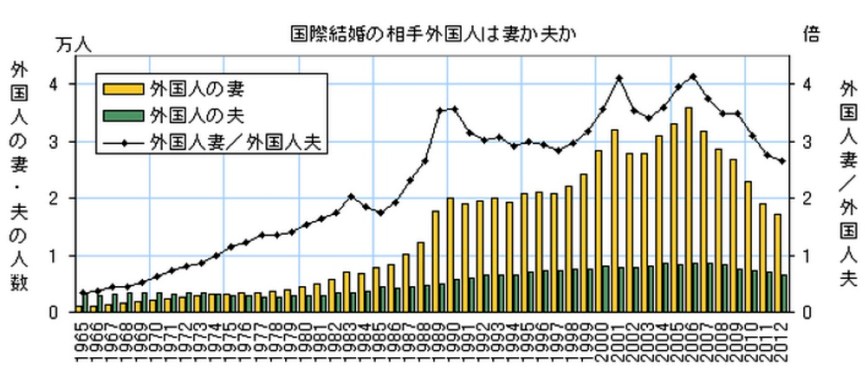
The situation will be better if I can take the right of permanent residence, while it is not very easy. However, a quick and easy way is to marry a Japanese man, which is also recommend by my parents. Therefore, is it good for foreigners to have a Japanese spouse? From Appendix A, it is known that the foreign wives are twice as common as husbands. I believe that most of them are married by love, but some Chinese wives I have known cannot speak Japanese well and seldom have Japanese friends. Caring for the children and their house are the only things they need to do.

Appendix A (Retrieved from http://www2.ttcn.ne.jp/honkawa/1190.html)

Appendix A (Retrieved from http://www2.ttcn.ne.jp/honkawa/1190.html)

In conclusion, it will continue to be hard for women in Japan to be independent from the social or familial role, as Allison (2013, p.22) notes. On the other hand, the pressure of managing both work and family became larger. Women are encouraged to work hard but precariously, and at the same time, they are blamed for not marrying.

I think it is very important for women to marry and have a family, but it should not be done for  the society or family. I means that we relay on our family for spirit,but not for pressure from parents, companies, and the society. Therefore, the government should provide an environment for women to make better choices for themselves and by themselves.

References

Allison,A. (2013). Precarious Japan. Durham, NC: Duke University Press.

Heikinchokonneirei no Suii [The change in the average age of marriage]. Keikon Rikon deta.Net [Marrige and Divorce Net.] (n.d.) Retrieved from http://www.kekkon-data.net/marriage/cnt/heikin_shokon.php

Enhanced by Zemanta

The future is fluid and invisible

Note from Editor: Students are reading Anne Allison’s book Precarious Japan, and sharing their thoughts on how their own future plans are impacted by the instability and insecurity that Allison describes.

by Kota Yanigadani

The future is not fixed, it is fluid and invisible, but still we can have a plan on our future and even try to realize the future. My future is after working at some professional workplace about security or conflict resolution, working, as a world citizen, to reduce violence in the world, correct injustice, and thus end poverty in the world. Therefore, in this post, connections between my future plans and Anne Allison’s vision of Japan are mentioned.

First of all, the current precarious condition in Japan does not have a big influence on my plan superficially. According to Allison, the mainly aging population, people in solitude in  gray zones, lower positions for women, and the typical company employment system are precarious conditions in Japan. On the aging population and seniors, I do not think the truth is so serious because technology is progressing rapidly. Robot industry can solve work forces in the future, and robot can be the catalyst for people and seniors. From this point, I do not think these are related to helping people suffering from poverty and violence. Also, the typical company employment does not have an influence on my future, because as today’s plan, I do not plan to work as a company man.

Second, my ibasho is actually my family and university. University is ba for me to prove myself, and I always feel comforted by being at home. However, what makes my identity is not my nationality. Recently, I have felt as if I am a cosmopolitan, which means I have strong global, world citizenship. To put it simply, while my ibasho is my family and ba is my university, my identity is not Japanese, but world citizen.

Finally, still I have more habits as Japanese compared to other nationalities, and Allison’s view on Japan is really common to me. The most similar vision is that Japan has a strong vertical relation among people. For example, when we meet people being older than us, we usually use keigo, which is polite communication tool in Japan, and we use more polite keigo when we talk with boss in our workplace. When I met president of our company at my workplace, actually I had the most polite posture and used clear keigo.

In addition to this, there is common system in Japanese company called nenkojoretsu, which Allison mentioned. This system is the longer you work in a company, the higher position and salary you can have. However, recently due to this system, a lot of people, especially young people have been fired and some bosses are really incapable, since they do not have much experience of competing for survival in their companies. I believe the system of vertical society and nenkoujoretsu have given rise to one kind of precarious condition in Japan today.

In conclusion, a unique style of society in Japan actually has an impact on my future plan, even though that seems this impact is not a big deal. Family is my ibasho, which should be common to many people. Given the company, because it is too typical to be a company man, working as a salary man is not first-choice for me as I said. Basically, I do not want to end my life too normally, which is to work in a company, to have a family, to see grandson, to end life happily. Instead of this, I always think I would like to make some change, or do some big things, which led to my quite big future plan. In that sense, some condition of Japan like Allison said might have a big impact on my future plan.

Enhanced by Zemanta

Discovering the importance of ibasho

Note from Editor: Students are reading Anne Allison’s book Precarious Japan, and sharing their thoughts on how their own future plans are impacted by the instability and insecurity that Allison describes.

Anonymous student post

Anne Allison views the problems Japan faces from a lot of perspectives. I am very interested in topic about human relationship and ibasho. Therefore I want to think about it related to my experiences.

I became a university student one year ago, and I began living by myself. What I felt strongly in my university life as a freshman is that life consists of a continuance of acts of choosing something. Because I can choose almost all things by myself, I have to take responsibility by myself. I have had more time to face that by myself and imagine my future since I had such an idea. When I think about my future, that is almost shushoku and shukatsu, I often talk to myself what is most important thing in my life at the same time, because I consider future plan is deeply connected with what I value. In thinking about that, I realized that my view on the family has changed so far.

In short, it was not until I left my hometown and lived alone that I understood how valuable my family is. I knew that the greatness of my mother who raised me and my brother by herself with working every day, and how much I have been supported by family for the first time. If I am worried about something, my family always listens to my worries and gives good advice for me. My family accepts and loves me no matter what I am, and filled with my desire of recognition absolutely. I was sure that family is ibasho for me after reading Allison’s paper.

As Allison says, current Japanese society is unstable, liquid and precarious. Human relationships get to be thin more and more, and many people seek their real ibasho. I know it is important to have a “good” job and earn much money, and praised by many people, however, it is more essential to get deep human relationship and feeling of spiritual satisfaction in like there society.

I have not decided concrete my future plan and what I choose as my occupation yet. However, I have the core of myself, that is, I want to be a person who can be proud of myself to the family and protect ibasho. Moreover, I also hope to become a person who can support someone as one of their

Man thinking on a train journey.

Man thinking on a train journey. (Photo credit: Wikipedia)

ibasho.

Enhanced by Zemanta

Family would be my ibasho

Note from Editor: Students are reading Anne Allison’s book Precarious Japan, and sharing their thoughts on how their own future plans are impacted by the instability and insecurity that Allison describes.

Anonymous student post

I hope to get a job as a regular worker and get married and have children for my future. Actually I have only indefinite work plans for my future, however I really hope to get a job in which I can communicate with many people because it will bring me up to talk with all sorts of people. It would make me feel narrow and uncomfortable if there is only one or two ba for me even now. My life is full and enjoyable because I have several my ba, family, friends, relative, university, workplace as a part time. All of them help me differently to have great every day and any one can’t lack in my life. Therefore I hope to get married and have my family and keep working while I can work.

Family would be my ibasho. I consider ibasho as where I can show my everything and don’t need to pretend to be tough. Family is the most suitable place to be ibasho. That’s why I hope to get married and have a family. My mother works part-time and she welcomes me whenever I come back home from school, therefore it is difficult to imagine both mother and father working full-time. However I hope to raise children and keep working. I’m not sure it would go well because I’ve never experienced the family I hope to have in my future. My father and mother are almost typical a husband and wife, my father is a sarari-man and works to support my family, and my mother is a part-time worker and does all household work.

The media often says it is getting difficult to raise children in Japanese modern society because of the insufficiency to guarantee child rearing. It is one of the serious problems that the number of children who need to go to the nursery school exceeds the actual number of the children that nursery schools can accept. It can be said that one of the causes of the declining birthrate in Japanese society is related to lack of satisfaction with such guarantees. I hope there will be a better society in which to raise children, and that the birthrate would recover.

I’ve thought family would help me anytime, even though some people consider that having family might bring more risks than staying alone. I would like to get married and raise children while continuing to work because my family would be my ibasho and working would give me the strength to get through my life.

Enhanced by Zemanta

But we’re speaking Japanese!

This funny video tackles the issue of how we often struggle when someone’s race doesn’t seem to match our expectations of how the person should act. People who might look Japanese don’t necessarily speak the language, while people who might look like gaijin (ahem, like me) can be quite fluent.

This video really resonates with me, as I just came back from presenting at a conference in Daegu, Korea, on migration in Asia. The conference had speakers from several Korean universities, and representatives from Taiwan, Vietnam, the Philippines, and Japan. As the representative of Japan, I was the only non-native to represent a country—and the only non-Asian at the conference. And yet no one seemed surprised that the speaker from Japan was a white guy from the United States, who was talking about Peruvians in Japan. A sign of progress, perhaps.

Devoting myself to family and future

University of Queensland

University of Queensland (Photo credit: Wikipedia)

Note from Editor: Students are reading Anne Allison’s book Precarious Japan, and sharing their thoughts on how their own future plans are impacted by the instability and insecurity that Allison describes.

Anonymous student post

My future plan is still vague, but I’m going to clarify it a little at a time. Concretely, I’m going to explain about job, my family, and my ibasho in the future.

First of all, I have a few jobs which I want to do in the future. For instance, in the future, I want to be an interpreter, especially interpreting from Japanese to English and from English to Japanese. I haven’t decided the workplace where I will translate, but to give you example, at a big corporation, in a diplomatic situation, at an international organization, and so on.

To make the dream true, I plan to go to the University of Queensland in Australia to study an interpretation next spring, as an exchange student. However, I need an IELTS score to get a right to be an exchange student, so I study hard for the IELTS.

Furthermore, I also want to be engaged in a job like saving children. There are a lot of children who suffer from hunger, diseases, and war. Some children don’t have their parents and houses. I desire to save these children, give them future hopes.

Secondly, I think family is a very important factor in planning my future. This is because family members exist to make other members comfortable, relaxed, and happy and help them when they are at a loss at what to do. Without family, I might not be able to lead a life. Therefore, I want to marry someone, and have a few children. Furthermore, I like children, so I will take a child-care leave at least for three months and I want to devote myself to my children with my wife in the future.

Followed by the family, I’m going to think about my ibasho. Ibasho means a place where you can feel like yourself, or to live in safety, comfort and dignity, where he or she is valued as a person full of history and experience (Ibasho-Creating Social Integrated and Sustainable Communities that Value Their Elders-, http://www.ibasho.org/web/). I agree with the concept of living in safety, comfort, and dignity. My home represents safety and comfort. If I come home, I have parents who wait for me at home. When I go home and stay in my room, I feel relaxed and relieved. Moreover, I have another ibasho, school. There are a lot of friends whom I can tell my real intensions and cooperate each other in difficult situation. Therefore, school makes me feel relaxed and comfortable.

Enhanced by Zemanta