Recently, in Japan there are a lot of “hafu” who is one parent is a foreigner who is white people. Their faces are different from so-called “Japanese” and they are often thought as a foreigner in Japan, because consciousness of Japanese people is “Japanese is Japanese”. This means that people think Japanese has a similar face as Asian ethnicity, so they are thought as a foreigner. Another reason why people think they are foreigner is also that Japan is said to be a mono-racial country. Hafu is rare to ordinary Japanese. These facts result in that situation in Japan.
Hafu has a Japanese citizenship, and they have lived in Japan since they were born. Some of the hafu has an identity as a Japanese citizen. However Japanese people have a consciousness as mono-racial country. This is a serious problem to hafu. In order for them to be accustomed to Japanese society comfortably, Japanese government should create a class about multiculturalism or different culture from the elementary school. By taking a class in the early period of children, they can understand or learn hafu or another culture and foreigner. International school is a good example. In our class, we watched a movie about discrimination and the identity of hafu. In the movie, one hafu said that his company forced him to use his French name because he could be forgiven by customer when he mistook. This is a terrible discrimination. I think that the boss of him who forced him to use the name hasn’t touched another culture or foreigner in his childhood and he doesn’t understand the feeling of them. If he understood the feelings, he would not say such a terrible thing. In Japan, a lot of people don’t have an opportunity to contact with foreigners who have different culture and racial background. This contributes to that discrimination indirectly, so it is important for children to take the class.
I think that it is difficult for us to change this situation because Japan is said to be a mono-racial country and people don’t have a consideration as to foreigner or hafu even today when globalization has progressed. Besides, Japan doesn’t have a lot of immigrants and the policy toward foreigner is also hard or rigid. I don’t intend to say that Japan should take an action drastically to multiculturalism because the measures about it are not prepared for. However Japanese education should be changed to multiculturalism because globalization is progressing now and from now, more people will come to Japan from foreign countries. In addition to it, the number of the hafu will increase more and more. According to it, for children to take the class must be so valuable and to be a person who can understand foreign stuff is important.
A video of a Japanese girl speaking at an anti-Korean rally in Tsuruhashi, Osaka, has recently gone viral. In the video, the girl calls for a “Tsuruhashi Massacre,” akin to the Nanking massacre by Japanese troops in World War 2. Yelling into her microphone, she tells Koreans to leave Japan before they are killed for their alleged arrogance.
The sight of a junior high school-age girl proudly proclaiming her hatred of an ethnic group and her desire to kill members of that group is chilling. The Zaitokukai and other right-wing groups have the support of a small portion of the Japanese population, but where is the outcry against such calls for violence? In times like this, quotes from Martin Luther King, Jr., fill my head. As Rev. King told us:
“History will have to record that the greatest tragedy of this period of social transition was not the strident clamor of the bad people, but the appalling silence of the good people.”
It’s depressing enough to see a young girl as one of the “bad people,” but we shouldn’t be surprised by open expressions of hate by groups like this. But how do we respond? Do we look the other way? Do we post a comment on a website, saying how terrible it is, and then move on? As Rev. King wrote:
“He who passively accepts evil is as much involved in it as he who helps to perpetrate it. He who accepts evil without protesting against it is really cooperating with it.”
So if we follow Dr. King’s call to action, how do we respond? Do we take up arms against our oppressor?
“Darkness cannot drive out darkness: only light can do that. Hate cannot drive out hate: only love can do that.”
Do we organize our own rallies? In my case, I will be making this a topic of conversation in every one of my classes. Year after year I have Japanese students tell me they had no idea such protests were occurring in Japan—but now that they know, what will they do about it?
“Nothing in all the world is more dangerous than sincere ignorance and conscientious stupidity.”
Some have replied with the Japanese saying “Netta ko wo okosuna” (Don’t wake a sleeping baby). It’s similar to the English saying “Let sleeping dogs lie.” If we ignore the problem, it will go away. But will it?
“Freedom is never voluntarily given by the oppressor; it must be demanded by the oppressed.”
My students sometimes think I’m pushing them to become radical activists (sometimes?), but I’d like to think that I’m pushing them to start living.
Two messages came across my inbox recently, and I’ve been thinking about how they’re related. The first is a brilliant animated film that captures the rigors of the job hunting process, or shūkatsu, in Japan. (You can find some insightful analysis of the film here.) In their final year of studies at the university, students dye their hair black, get more formal business haircuts, put on matching black suits, and go out to try to show how well they can toe the company line and become good corporate drones. In the process, students can lose themselves and become a person they no longer recognize.
Failing in this process also stings, as applicants can feel that their personal worth is wrapped up in the outcome. You’re reducing yourself to a commodity and peddling it to companies, and finding yourself dehumanized in the process.
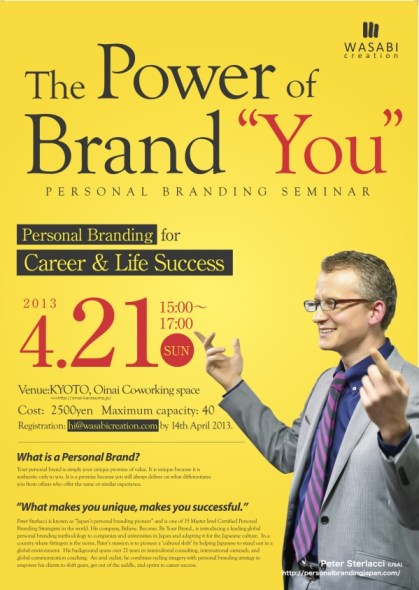
The second message came from a workshop on “The Power of Brand ‘You’: Personal Branding for Career and Life Success.” The workshop is led by Peter Sterlacci, who, according to his own ad, is “known as ‘Japan’s Personal Branding Pioneer’ and is one of 15 Master level Certified Personal Branding Strategists in the world.” (Let’s set aside grammar issues with the excessive use of capital letters, and the questions about who, exactly, knows Mr. Sterlacci in this manner. Maybe it’s just him. Let’s also set aside questions about just what a personal branding strategist is, who certifies such a person, and how many levels there are.)
In the messages on Sterlacci’s website, we can find a few kernels of truth. For example, the Japanese workplace places a high value on workers fitting into the existing hierarchy of the company. In a changing, 21st-century economy, workers need to look for jobs in a more global marketplace—and that marketplace can include settings in which workers need to promote themselves less as workers who can fit in, and more as workers who bring something unique to the company.
So far, so good. But the messages go further, to encourage workers to become their own “personal brand.” You are to be the brand, believe in the brand, and live the brand. But beyond Ophrah-esque messages of believing in yourself, listening to your heart, following your dreams, and opening yourself up to wealth, what does this mean? Am I a brand? (And if I am, are my children my “product line,” like from the iPad comes the iPad mini?)
In my introduction to sociology classes, I discuss Karl Marx’s notion of species being, which we can also think of as human nature. Marx states that humans are unique in our creative ability to produce things. Some animals can build bridges, and a few gorillas have learned sign language, but that doesn’t compare with humans’ ability to create things, from food to clothing, to buildings, to the global computer network on which you’re reading this.
In this sense, this ability is part of what defines us as humans, and we have an intimate connection with the things we create. We become alienated if the products of our labor are taken from us, or if we become little more than appendages to the machines in the factory. Think of the the satisfaction we feel when we make ourselves a nice dinner, compared to the disdain we felt toward the burgers many of us flipped in minimum-wage service jobs. (And if you ate any of the food I prepared at the Solano Drive-In in the 1980s, I apologize.)
In recent decades, our experiences at work have changed dramatically. Once-solid factory jobs in countries like the US and Japan have moved elsewhere, and workers find themselves struggling to find jobs that pay enough to support themselves and their families. Commitments from companies to long-term employment have practically vanished, replaced by temporary or contract work. We’re all free agents now, freed from being trapped in the same job and also free to go hungry while we search for work.
In this environment, it makes sense for workers to retool themselves for the changing dynamics of the workplace. Keep your resume up-to-date, and always be on the lookout for the next opportunity. Believe in yourself, market yourself, take charge of your destiny—think Stuart Smalley meets Gordon Gecko—become the product others want to buy.
And there’s the catch: are you a product? or a brand? or a commodity? or whatever synonym you prefer? What is your value in the marketplace? If you are your brand, and you live that brand all the time, 24 hours a day, are you really living up to your full human potential? Are you reducing yourself to your exchange value? What is your brand worth?
As I kid I remember my brother and I arguing with our dad about what something was worth. We loved some of our stuff so much that we imagined someone would pay us a fortune for it. Then we’d make all sorts of plans to sell our things and reap our rewards. Our father would then tell us that the things were only worth what someone would pay us for them, and that was probably a lot less than we imagined. Not yet schooled in the economics of capitalism, my brother and I confused use value and exchange value. The joy we got from playing with something (it’s utility, or use value) didn’t match the value of that thing in the marketplace (it’s exchange value).
So what happens when the thing we’re trying to sell is ourselves? And what if we buy so deeply into the process that we literally become the product, that we live the brand? Becoming and living your personal brand would involve not only matching the marketing of yourself with your skills and interests, but also shaping your daily life to fit the brand you’ve become. With the brand and the person one and the same, and the brand also a product that is marketed and sold at its exchange value, how in the world can we do this without reducing our humanity down to a tag line, a logo, and a website?
“What makes you unique, makes you successful,” says Sterlacci’s ad in bold print. But what if you’re not successful? Not everyone gets the job of their dreams, since capitalism requires there to be a sufficiently large population of people to be out there, looking for work. And if you don’t succeed, do you blame it on your brand? Do you reincarnate yourself as version 2.0? 3.0? 4.0?
While mired in this process and focusing on your personal brand, how can you engage your sociological imagination, to connect your personal experiences to the bigger picture? How can we find a middle ground, in which people can pursue work that rewards them without selling out and becoming tools. Or brands.
I recently came across the writing of Akemi Johnson, a fellow Fulbright scholar who writes on issues of race, gender, and power in Okinawa. Johnson adeptly connects her experiences as the child of a Japanese American mother and a WASP father with the challenges the women and men of Okinawa face in dealing with the presence of US military bases in the prefecture.
Her website, akemijohnson.com, provides links to several articles that she has published, including a brilliant piece in the Kyoto Journal. She is currently working on a literary nonfiction book based on her experiences in Okinawa. Check out her work!
Jeffrey and Ivan have just released another powerful video on Fukushima—this time from inside the evacuated zone with some farmers who have refused to leave. It’s a powerful, moving look at the damage inflicted by the nuclear disaster, and the lives affected by it.
The documentary “Women of Fukushima” is available for free online viewing this week.
by Robert Moorehead
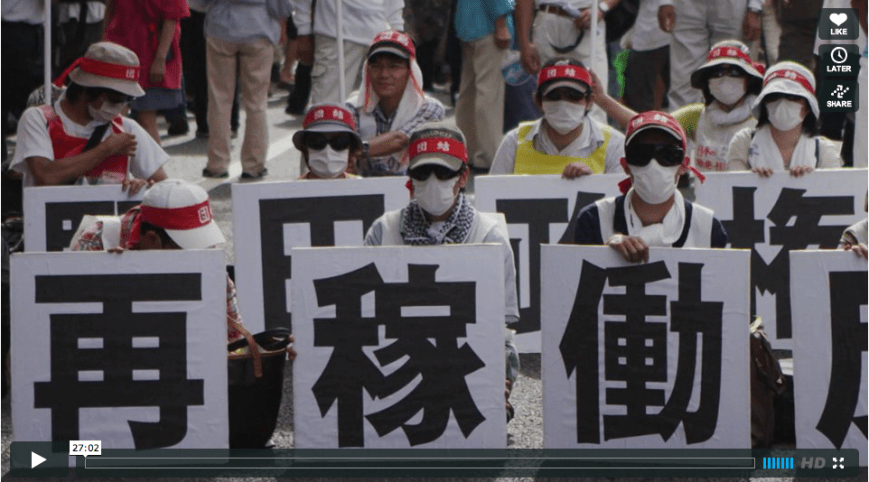
To highlight the ongoing difficulties experienced by many in Japan, the wonderful and inspiring documentary ‘Women of Fukushima’ is available for free online viewing this week. To see the documentary, click on the image above and you’ll be taken to vimeo.com.
As one: People join hands Sunday morning on a beach in Iwaki, Fukushima Prefecture, ahead of the second anniversary of the Great East Japan Earthquake. | KYODO
by Robert Moorehead
Two years ago today, at 2:46pm, Japan suffered one of the worst disasters in its history. A magnitude 9 earthquake shook for 6 minutes, followed by a massive tsunami that destroyed entire cities and carried people and debris out to sea. The quake and tsunami also crippled the Fukushima Dai-Ichi nuclear power plant, taking out its backup power generators and safety systems. Tens of thousands remain displaced and likely never to return to their homes.
I watched news coverage of the tsunami and nuclear disaster from the safety of the United States, while my suitcases sat packed and ready for travel to Japan to start my position at Ritsumeikan. I heard American broadcasts warn of everything but Godzilla marching down the street, and Japanese broadcasts calmly, quietly, try to balance informing the public with protecting those in power. Somewhere in between those two extremes lied the news people needed to hear, and that is still largely ignored in the mainstream Japanese press.
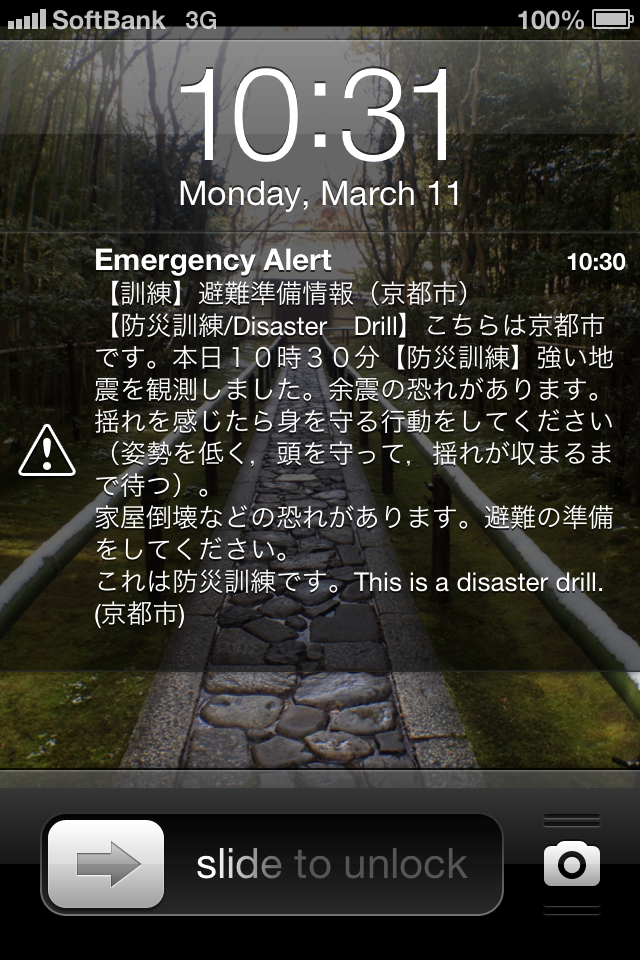
Governments across Japan conducted disaster drills on the anniversary of 3-11.
This week, TV news have covered elements of the nuclear disaster in detail, and undoubtedly many people across the country will observe a moment of silence at the time the quake struck. But for the those who had to evacuate, there is likely no going back. Many still live in poorly built temporary housing and struggle to form new community ties. Victims of the disaster continue to struggle with domestic violence, unemployment, depression, and suicide. And many live just outside the evacuation areas, near radioactive hotspots, and in areas where radiation cleanup work has been shoddy and ineffective. The yakuza, Japan’s labor broker of last resort, have done well in the aftermath of the disaster, but how about the people of Tohoku?
While disasters often bring people together, leading us to help each other and to sacrifice for the common good, eventually the institutionalized patterns of corruption and inequality reappear. Prior to the disasters, the regulatory bodies that ostensibly existed to protect the public from the deadly hazards of nuclear power, instead served to protect the profits of the agencies they were supposed to regulate. This brazen failure of governance raises the question I have asked my Japanese students each semester, whom does the government serve? Does it represent you, your voice, your interests, or those of Japan’s corporate oligarchy? Is the system rigged in their favor? The questions are largely rhetorical, but I often get the sense that students had not previously given this issue much thought.
Nobel laureate writer Kenzaburo Oe (right), joins a demonstration after an anti-nuclear rally in Tokyo on Saturday, March 9, 2013. Thousands of anti-nuclear demonstrators rallied in Tokyo, urging Japan’s government to abandon nuclear power. — PHOTO: AFP
One cliche often heard in Japan was that 3-11, much like 9-11, changed everything. The challenge Japan faces is whether the events changed anything at all. Beyond the buildings and nearly 20,000 lives that were lost, what has changed?
The Abe administration moves ahead with plans to restart Japan’s nuclear power plants, and a newly restructured nuclear regulatory agency struggles for legitimacy. Will the new agency actually regulate the industry? Will the agency shut down nuclear power plants that were built on active earthquake faults? Will it enforce new safety regulations? Will the government be able to turn down the companies that have invested billions in plants and fuel processing facilities? Who will the government represent in making those decisions?
A protester holds an anti-nuclear power sign at a rally in Tokyo on Saturday, March 9, 2013. Thousands of anti-nuclear demonstrators rallied in Tokyo on Saturday, urging Japan’s government to abandon nuclear power. — PHOTO: AP
My students tell me that Japanese people don’t protest and that there are no social movements in Japan. And if you only read the mainstream press, this perspective makes sense. But tens of thousands of people across Japan continue to protest the return to nuclear power. Will these voices be represented in government? (It’s also disheartening to hear my students ignore 60 years of protest in Okinawa, but that’s the subject for another post.)
It will take another 40 years to decommission the Fukushima Dai-Ichi plant, requiring the use of technologies not yet invented to remove melted nuclear fuel from inside the damaged reactors and spent fuel pools. Righting the country’s course will require continued vigilance. If that happens, then 3-11 will really have changed everything.
After protests by local non-Japanese residents, the Genky store in Minokamo, Gifu prefecture, has taken down the signs that warned foreign customers that they were being watched as potential criminals.
My Portuguese skills are limited, so hopefully a reader can help translate the video. I am encouraged by the response of the local non-Japanese community in standing up for their rights, and by the fact that the store management responded to those concerns.
Stereotypes are harder to maintain when the person the stereotypes supposedly describe is standing right in front of you. In that case, we sometimes fall victim to what Tim Wise has called “enlightened exceptionalism.” That is, have prejudiced views about a group but making an exception for individual members of that group. This approach lets prejudiced whites vote for Barack Obama, while still holding racist views of African Americans. In this case, clerks at the Genky store might have said to the protestors, “Of course the sign doesn’t describe you. It refers to other foreigners.”
The protestors used the uncomfortable tension the staff likely felt when confronted with protests to their advantage, in demanding that the signs be taken down and in rewarding the removal of the signs with applause. In so doing, they hopefully have taken a step toward turning a foe into an ally. But whether the staff at Genky will still watch non-Japanese customers with suspicion or not, at least that suspicion is no longer publicly posted for all the world to see. The public posting of the signs reproduced and reinforced negative stereotypes of foreigners in Japan.
Here is an update to my recent post on the American teacher who is being challenged for his lessons on racism and discrimination in Japan. Medama-sensei has posted an update, explaining why he will not be taking down his videos. Ganbare, sensei! And thank you for speaking truth to power.
After the posting of signs alerting foreign shoppers that they’re being watched for crimes at Genky markets, the Cabinet Office has announced the results of a poll on Japanese attitudes towards foreign residents of Japanese descent (Nikkei Teijū Gaikokujin). (Here’s a link to English coverage in the Japan Times.) 1,883 Japanese people responded to the survey, out of 3,000 asked, completing short structured interviews. The results of the survey are encouraging, with 80.9 percent of respondents stating that they would accept Nikkei into their communities. However I wonder about social desirability effects, or the extent to which people are saying what they think will make them look good. Is this a case of tatemae over honne?
The survey asked respondents if they knew that there were Nikkei living in Japan, and how they knew this. Nearly 53 percent the respondents either knew that Nikkei were living in Japan, or had heard about it. 46 percent answered that they did not know that this group was living in Japan. The fact that Nikkei are concentrated in industrial regions of the country may account for the high percentage of Japanese who were unaware that this group is here. (At its peak in 2007, nearly 400,000 South Americans were registered residents in Japan. Much of this population is either of Japanese descent, or is a family member of someone of Japanese descent.)
Only 16.7 of respondents who knew of the existence of Nikkei in Japan (that is, about 9 percent of all respondents) knew or had worked with someone who was Nikkei. Nearly 73 percent had heard about this group on TV, and 48 percent had read about them in the newspaper. Having less than one out of 10 respondents actually know someone who is Nikkei means that the Nikkei remain vulnerable to negative depictions in mass media. The National Police Agency fuels this situation by continuing its inaccurate connection of foreigners with crime. Fear sells newspapers and funds budgets.
88 percent of respondents state the Nikkei need to learn the language, and nearly 92 percent state they need to learn Japanese culture and customs. More specifically, when asked how much of the Japanese language and culture Nikkei should know prior to coming to Japan, 46 percent responded that the Nikkei should know enough to be able to live independently (fujiyū shinai). Another 42 percent responded that they should know the bare minimum to get by in their daily living. 41 percent answered that the Nikkei should be familiar with Japanese culture and customs before coming, while another 50 percent think they should at least learn this after they arrive. These points seem fairly obvious. Economic security and social mobility in Japan require learning the Japanese language and culture, and the Nikkei are adapting. Assimilation happens every day, in many little ways, even by those who might be opposed to “turning Japanese.”
The survey then examines respondents’ support for government policies to facilitate this assimilation, including programs for Nikkei kids in school, interpreters at Hello Work employment centers, and skills training for Nikkei workers. The survey did not include any discussion of how much money respondents would want the government to spend on these programs. 87 percent of respondents stated that special policies to facilitate the integration of the Nikkei should be either maintained (nearly 60 percent) or increased (27 percent).
The most surprising result was that nearly 81 percent said that they were open to accepting Nikkei into their local communities. 30 percent said they would accept them, and nearly 51 percent replied that they were somewhat open to accepting them (“Dochirakatoieba, ukeiretai“). Nearly 13 percent said they would prefer not to accept Nikkei into their local communities.
So what does this mean? What does it mean to ‘accept’ Nikkei into your community? Can they rent an apartment in your building? Work in your company as something other than a manual laborer? Can they join your social groups? Can they marry your daughter? And what are the conditions of this acceptance? Are they welcome as long as they act Japanese?
On the one hand, I’m encouraged by the support for Nikkei in Japan. It’s certainly better than if they had said the opposite. But … I’m skeptical. South Americans in Japan, Nikkei and non-Nikkei alike, have told me very clearly that they do not feel included in Japanese society. Instead, borrowing some phrases from Eli Anderson’s The Cosmopolitan Canopy, they’re perpetually ‘on probation.’ In this provisional status, any misstep can be used against you as a sign of the fact that you’ll never fit in. You can enjoy a certain bonhomie with Japanese, but there’s always that chance that you’ll make a mistake with the language or do something else wrong—and those faux pas could out you as a perpetual gaijin (foreigner/outsider). There’s always the risk of the gaijin moment, in which a Japanese person calls you out on your foreign status by calling you gaijin (or the gaijin‘s dressed up cousin, gaijin-san) or posting signs in stores warning all customers that gaijin are being watched as potential criminals.
Scholars have noted that surveys are better at reflecting respondents’ public performance of attitudes about minority groups, than at accurately measuring people’s “real” views. We’ve become really good at hiding what we think, and instead we present a front stage image of ourselves that tries to make us look good. Survey techniques that pursue the issue with flexible follow-up questions reveal more negative views, as do in-depth interviews. In Japanese, these presentations of self are defined as tatemae (your front stage performance) and honne (your true beliefs). So to what extent do these questions reflect respondents’ real views? Ethnographic research on this topic reveals persistent barriers to the fuller integration of non-Japanese into Japanese society. People will often say they’re open to having other groups live in Japan, but when push comes to shove, foreigners remain on probation.
Hopefully government officials will use this survey to promote further initiatives to empower the Nikkei (and hopefully other non-Japanese) in Japan. Publicly conducting the survey, posting it on the Cabinet Office website, and releasing it to the press, may indicate that the government is testing public support for such initiatives.





 JAPANsociology