Problems of outsourcing in India

by Misato Okumura

There are a lot of call centers in India and many Indians are educated to speak in an American accent to talk with their clients in the United States. The call center itself belongs to IT companies in the United States but it is placed in India and Indian workers there are educated to have an American accent and playing a role of customer service as company members. This is because it is cheaper to employ Indians than employ Americans. Indian employees are well educated and they usually have IT and programming skills but they have struggled with getting job though they graduated from good school. So this sounds very nice because this creates a job in developing country.  But this causes a lot of problems. You can find problems both in India and the United States.

First, problems in India are about their identity and career. Customers call the company and expect that they are going to talk with an American worker. So first thing to do for their job is learning American accent, speed of talking and expressions. Also they need to learn American culture to pretend to be American workers. They check local weather and news in the States on the internet and talk with customers there as if they were also there. They are forced to keep themselves surrounded by American culture and to make themselves think they are not Indians but Americans. So they kill their own identities to get money. This is not good but they need to do that because otherwise they can’t get money. IT companies take advantage of it because they know India have a lot of young people who have knowledge of IT are having hard time to find a job and they can hire them for very cheap. If they work for 7 hours a day, they need to be Americans for one-thirds of a day. It might make them confused.

Second, these Indian workers are doing the same thing every day. It’s just pretending and talking and it doesn’t require any professional skills. This keeps them from a professional and good job even though they graduated from good schools. And you must not forget that there are problems in the United States, too. Because they started outsourcing, a lot of Americans have lost their jobs and opportunity to get a job in their country. The last two problems about career in both countries bring inequality to our society. Japan also has this problem. We don’t have enough job spots for Japanese today but Japanese companies build their factory outside of Japan because it is cheaper. Some people say we are creating job in developing countries but we must not forget this also creates inequality.
Environment and Technology Information

by Ayaka Nishizaki

Environment and social are mutually created and environment inequality is one of sociological aspects. I think environment is also liked to technology and information. I would like to think environmental problems from these points: The unequal limitation of access to information, ineffective use of information, and relationship between information and unclear responsibility.

During class, I learned residents of lower class neighborhoods face a variety of risks. The manufacturing jobs are often given to immigrants or poor people who don’t understand English well and don’t understand what they’re being exposed to. I think it is connected with unequal access of information between the rich and poor. The poor is limited to access information, so they can’t get enough knowledge about environment (the article of ‘connecting communities: on and off line’). Also, the lack of information will cause not only their health can be exposed to danger by toxic materials in industries, but also people take some action for the environment in a wrong way.

I learned the concept “inverted quarantine” from the reading and class. We often don’t know how much the “eco” products help the environment. I think inverted quarantines are caused by a lack of correct information. I learned environmental issues since I was an elementary school student. But I was shocked that I haven’t known the exact meaning of “eco” until I started to learn by myself. In fact “eco” is not equal to “save energy (省エネ)”, but I saw many people and TV commercials use “eco” incorrectly.

It is true that we are surrounded by a bunch of information to learn, but why does the kind of wrong actions happen? Many Japanese including me had studied global warming or depletion of ozone layer in school. I studied a lot of definitions and words about the environment. However, I wondered ‘how can I use the knowledge in daily life in order to reduce CO2 or waste?’ We have learned a lot of things like helium or CO2 are bad for the environment, but I think those knowledge is not linked to taking environmental actions. Some people would say that recently, more Japanese schools have required students to take actions for environment, but I think some actions are not contributed to environmental improvement directly. Japanese people learned how to separate trash appropriately, but how many people know separating trash (分別) doesn’t always lead to recycling, or it encourages people to increase more consumption of plastic bottles? My point is that although there are many chances to access information, we don’t choose information effectively and don’t link such information to environmental improvement.

In addition, a lot of information make responsibility for polluted environment unclear. For example, mass media criticizes the Japanese government about an accident of nuclear power plant in Fukushima. On the other hand, other people say this responsibility is TEPCO. How can we decide who will take this responsibility? If people think the bad governance was the biggest cause of the accident, they will require Japanese government to take responsibility. If the old nuclear power plant was the most cause of accidents, TEPCO which haven’t reconstructed the plant for about 40 years should take responsibility. In my opinion, through a lot of information, responsibility becomes more unclear because information diversifies people’s thoughts and ideas (as we discussed ‘what is positive side when new culture/information is brought into our country?’). If a state-level accident such as the nuclear plant is related to many actors such as government and companies involved in the case, it is difficult to clarify the responsibility because of many people’s points of view.

As I mentioned above, the environment is strongly connected with information. Environmental problems, diversification of people’s ideas help our standard of living, but on the other hand, it makes it difficult to think what the most correct choice of information for the environment is.

Gender Norms and Sexual Minorities in Japan

by Akie Kuwano

Globalization has changed our lives in many ways. We now consume products imported from countries outside of Japan, while products “made in Japan” receive attention worldwide. Clearly, products are not the only thing that are exported and imported; we also trade values and norms at the same time. Gender norms are one thing that is deeply influenced by these exchanges of culture. In last few decades, gender norms in Japan have changed dramatically. More women are working outside, and still not many but more men are helping raising their kids compared to 1980s. However, when it comes to the debate of sexual minority, Japan is still conservative about their traditional sexuality of gender binary.

The recently elected and now the biggest political party in congress, “自民党” (jimin-toh) answered to a questionnaire made by a Japanese LGBT supporting group asking whether it is necessary to protect human rights of LGBT persons. Their answer was “it is important to set a law to protect transgendered persons, but not for homosexual and bisexual persons”. This idea seems somewhat radical, when thinking about the global trend of promoting rights of sexual minorities altogether, as the term LGBT is used in UN resolutions. However, the idea is widely prevailed in Japanese society at large.

One of the reasons why the Japanese people are more accepting about transgendered person than non-heterosexual is attributed to a character in famous TV drama “Kinpachi-sensei”. In the drama, the famous Japanese actress Aya Ueto performed the role of a transgendered female student suffering bullying in high school. This was shocking to Japanese viewers in two ways. In one way it was sensational that the drama openly talked about sexuality, which was usually regarded taboo in Japan at the time. In the other way it surprised Japanese people because the drama depicted the girl as having a gender disorder, and this created sympathy for the “poor girl.” From this drama, Japanese people became aware of the existence of transgendered persons, and at the same time became very sympathetic toward them.

After the hit of “Kinpachi-sensei,” transgendered people became active on TV shows in Japan, mostly in the fields of comedy. One of the famous figures of them all is Ai Haruna, who won Miss International Queen in 2009. Some TV shows featured and interviewed her suffering before she had sex reassignment surgery. This also gathered attention from Japanese people, and again created sympathy and understanding toward transgendered persons.

On the other hand, the Japanese are critical about homo- and bisexual persons. The former governor of Tokyo prefecture, Shintaro Ishihara, spoke to the media that homosexuals have something wrong with their genes and that they are defective in some way. Even some of the well-educated students studying around me openly say that homosexuals are disgusting that they don’t want those people around them. Japanese people have completely different feeling toward transgender people and toward homosexual people.

Now, we can see how countries are selective about accepting ideas from other cultures. Japanese gender norms have been changing, and we already became more open to transgendered persons while getting the information about values of other cultures where sexual minorities are respected. However, we still exclude homo- and bisexual persons. It is the same as the instance of Indian men, who welcome the imported image of men reinforcing his values, while complaining about the values liberating Indian women, although both of the values are from the same origin. From these instances, it is clear that the benefit of globalization is limited to some individuals. The influence from outside world is unstoppable, however, we can still be selective about which to take in and which to exclude.

REFERENCES

『「同性愛者への施策は必要ない」自民 アンケートに回答』2012年12月5日retrieved from http://www.sponichi.co.jp/society/news/2012/12/05/kiji/K20121205004710960.html

“UN issues first report on human rights of gay and lesbian people” Viewed on December 22nd, 2012. Retrieved from http://www.un.org/apps/news/story.asp?NewsID=40743

ゲイに優しい政党、嫌われる政党 Viewed on December 22nd, 2012. Retrieved from http://www.tokyo-sports.co.jp/nonsec/63855/

Bridging the digital divide

by Yurino Kawamura

The digital divide is creating a huge loss of opportunities for those without Internet access. As we have learned in class, or in fact, as we have been currently enjoying benefits from our PCs and mobile phones, access to the Internet enables people to stay in touch with the latest information throughout the world. Exposure to cultures from other countries would affect peoples’ lives and ways of living.

As we have learned, Internet access tends to be available only for residents of affluent countries, or to limited rich people in developing countries. The average citizen would be located on “the lower side” of the digital divide, unable to reach for latest news or cultures. To ensure all citizens high-speed Internet access, countries must possess enough budgets for investment. However, data indicate that the countries with a high percentage of Internet popularity tend to be affluent.

graph

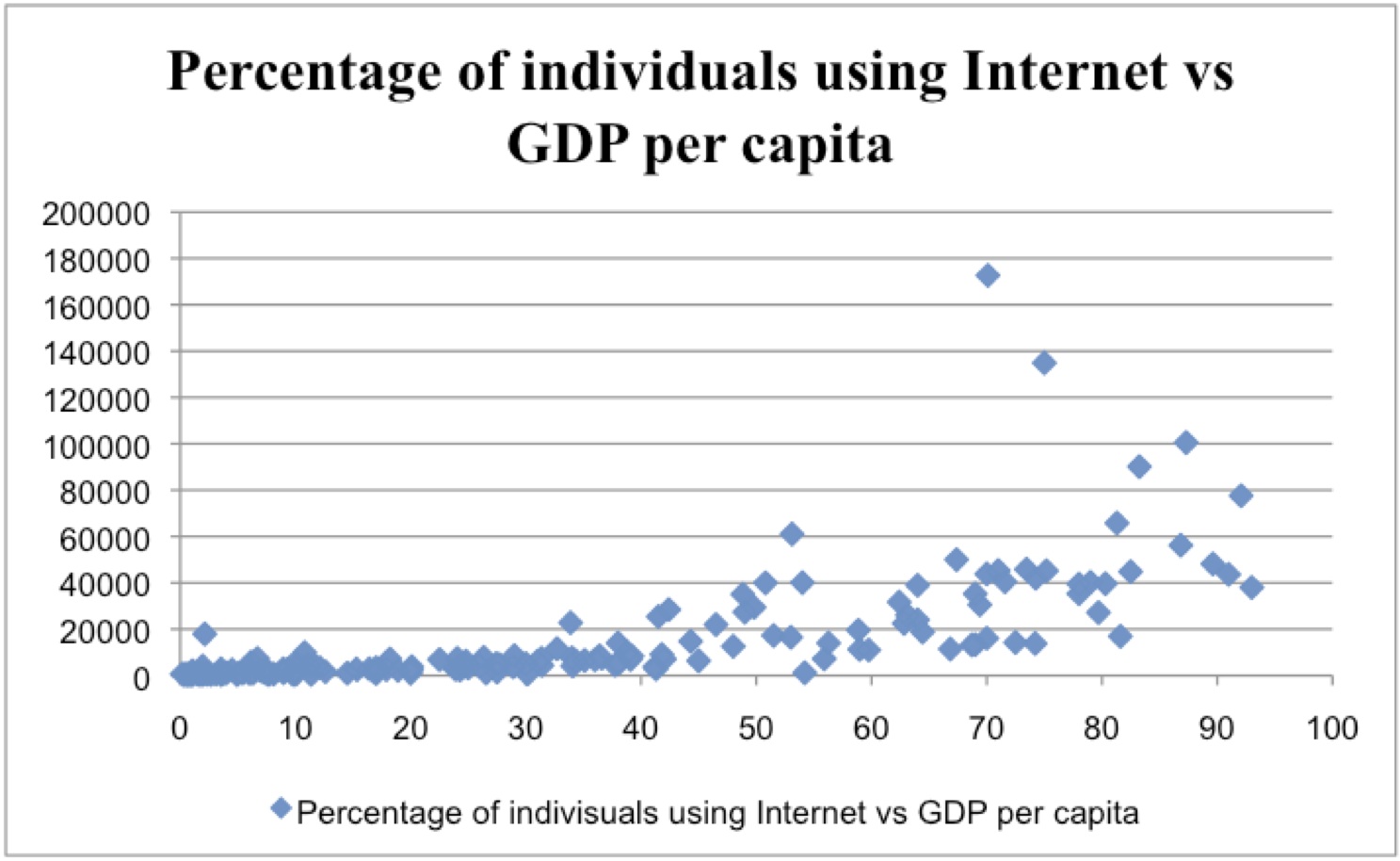
Figure 1. Relationship between percentage of individuals using the Internet and Gross Domestic Product per capita

Figures 1 shows the relationship between the percentage of individuals using the Internet (ICT, 2009) and the gross domestic product per capita (World Bank, 2009) of 204 countries worldwide. As seen in the figure, the more residents have access to the Internet, the higher GDP per capita a country holds. The correlation factor between them, which shows the relationship between the two factors, was 70.8%. This means that there is a strong relationship between the Internet access and GDP per capita. It is said that same kind of link exists between the literacy rate and GDP per capita, but according to a calculation, its correlation factor is only 36.6%. This indicated that the effect of the digital divide is stronger than that of illiteracy.

Establishing high-speed Internet access throughout a country is not an easy task. Developed skills and much investment would be required, which would be a tough burden for developing countries. What I am concerned about is that would lead to an even larger gap between the affluent countries and poor countries. Difference in economic power of the countries would enlarge the digital divide, which would make rich countries even richer.

It is easy to predict that this relationship will lead to very unfair opportunity for people within developing countries. Supports to build high-speed Internet infrastructure and teaching Internet literacy would be very important. The data indicates that its importance is equal to or even higher than that of elementary education. Although relatively high cost will be required for technology investments, strong support is required to maintain equal opportunity for people on the other side of the digital divide.

References:

ICT (2009). Free Statistics. Retrieved from http://www.itu.int/ITU-D/ict/statistics/

World Bank (2009). World Databank. Retrieved from http://databank.worldbank.org/ddp/home.do?Step=12&id=4&CNO=2

What is a “fair” society?

by Azusa Iwata

I was wondering if there is a real “fair” society in the world?  I think there are no answers to my question because how we feel about “fairness” is different, depending on the person. I would like to think more about following the question in terms of “fairness”: “your company has produced a successful product and more has ¥100,000,000 to distribute as bonus, how should you distribute it?”

At first, it seems that the successful product is the only achievement of the team that developed the product. In that sense, the company should distribute all bonuses to the team that developed the product. However I think it is unfair because the most important thing is that the company is supported by all workers. In that sense, the company should distribute the same bonus to all workers, which should be fair to all the workers. However, it also makes me feel unfair because the workers that produced the successful product spent a lot of their time to produce that successful product, compared to other workers. In terms of how much time they spent for the project, in my opinion, at first, the bonus should go to the team that developed the product like 50%. Then, CEO should get 25 % because CEO left the project up to the team that developed the product. I think CEO’s judgment was right, which deserves 25%. Finally all workers should be distributed 25% even though they were not involved in the developed team. It is because the workers are working for the company, which might have helped the team that developed the product indirectly. In this way, it is clear that all workers involve the team that developed the project not directly but invisible ways.

In conclusion, above the example of the way to distribute the bonus is just my opinion in terms of “fair” society. As it is clear, what the “fair” society is different depend on who we are. However, I think we need an undisputed “fair” society because there are a lot of social problems, such as big gaps between the rich and the poor.  I think there should be various ways to solve those problems, but a “fair” society is the first step to make the society better. In order to make a “fair” society, I think we should have the definition that can judge what “fair” in this situation is clearly. In short, we need the definition of “fair” in various situations. I hope the “fair” society that all people can admit will come in the future , which can make the society better.

For an equal society in India

by Natsumi Ichioka

After reading the article “Arnold Schwarzenegger, ally mcbeal and arranged marriages: globalization on the ground in India,” I wonder why women in India are not equal with men. In India, after independence from England, a new constitution was established in 1947. This constitution succeeded in mentioning that all Indians are equal legally. In Japan, it is said that women and men are equal, but there are some obstacles to saying that all situations are equal. I know the gender problems are so complicated and unsolvable problems. Like Japanese situation, there are also problems in India for a truly equal society. I think India has to change three things for the equal society.

First, India has to divide politics from religion. It is not a simple problem to think like this, but I think the problems which India has are all related to the religion, especially Hindu caste. Caste has caused many problems and prejudice for Indian women in the society. India is developing these days, they try to take in many developed ideas from foreign countries. I think there is a limit to coexistence between the traditional Indian culture and the developed culture, because developed cultures have a trend for the equal gender, for example, the equal employment, equal education system and so on. If India continue to change modernization, it is necessary to separate the thinking from religion.

Secondly, Indians have to solve the problem of employment for women. India is developing and women are going to work in the society. In developing society, the workforce for women is needed. Though the welfare programs are established, for example, securing time for childcare, prohibiting illegal layoffs for women and so on, these systems are not always secured. Government research states that the wages of women are lower than the wages of men. In addition, the rates of women’s layoffs are more than four times compared to men’s rates, in the same research. In this way, there is still discrimination against women laborers. These welfare systems are secured truly for the equal employment. Though they are established legally, it is nonsense that they are not adopted for all women.

Finally, the system of the marriage is too burdensome for women. From the traditional culture in India, the bride needs to give financial aid for the groom. This system is too burdensome for the bride’s family. Because of this system, girls are not welcomed. Sometime, girl babies are killed because of this prejudice. On the other hand, boys are welcomed and treated preciously. These prejudices are caused by the thinking of the religion. If these prejudices are continued, India will run into difficulties. If these prejudices are solved, the thinking of the equal between the men and the women are made. Then, Indian society is going to change for the equal society. There is no discrimination against women.

I think India need to change dramatically in these three points, the thinking of separation of politics and religion, the employment for women, and the system of the marriage. The problems which India has are so complicated. They cannot be solved easily. But for the equal society, especially for Indian women, they need to change dramatically. The women’s rights are secured in many field, India will be more powerful country in the future.

Reference

Kyoto Univ. UNICEF Club (1997, November), Retrieved December 16, 2012, from http://www.jca.apc.org/unicefclub/research/index.html

Environmental issue

by Siân Taylor

In this essay I will explain my view of the situation regarding environmental issues, and in order to do so, I will initially analyse an episode of environmental issue in Italy, that sadly became famous  all over the world.

Moreover I will give my own opinion about why things go this way, and about why, no matter how much people speak about these issues, no one really does anything in order to change  them, or even if they do, no major things really get accomplished.

Starting from about four years ago, in some cities of the southern part of Italy, the waste people produced stopped being taken to the disposal facilities and started accumulating in the middle of the streets. As time went by things kept getting worse and worse, until citizens started to get poorly from the bacteria coming from the decomposing rubbish.

Eventually the garbage was gotten rid of by shipping it, after having paid large amounts of money to the local government, to some third world Country were people “won” Italy’s waste for being poor.

Now, let us examine why this episode happened in the first place. The Italian Mafia, due to a number of corrupted interests, stopped the dustbin men from collecting the rubbish.

Due to this many people suffered for years and years living in unhealthy dangerous environments.

All of this is to state that personally I think that it’s not that environmental issues are too complex to resolve, or that common people do not care about the environment, it’s that the people who have the most power to change things have got many interests not to do so.

It is all about gaining money from it. Governments use waste disposal as a profitable business; Companies create double or more the amount of waste by overly wrapped and deceptive products, we live in a consumerist society where consumers are taught to throw away their “unfashionable” items to buy a brand new model of the same thing. And why? To make the economy go round.

To make the rich people get richer and the poor people get poorer, society is destroying the world they live in.

I am certain that if this were to be a world where money did not exist, people would live in a much healthier environment both for the body and the spirit, because it is for money that marketers create the sense of dissatisfaction in consumers, so they can buy this new item which may resolve their “problem” and make them happier for a short while, and this is, as stated before, the start of a long chain of interests that brings society to destroy the environment they and their children are living in.

Until this chain will not be broken, I think that nothing will be able to change, no matter how most people want it to.


International migration and globalization are connected

by Julia Helbing

When thinking about international migration, it came into my mind that it is somehow connected to globalization and high-tech work.

There are inevitably many poor countries. But in these countries are a lot of high-skilled workers. Because they don’t have the chance to get a proper education or a job in their country of origin, many of these workers go abroad, where they can find proper education and work. But still they take parts of their old life with them; they still want to eat food from their country of origin. So they import it from their home. Some people even opened shops just for the needs of foreign habitants, mostly foreigners, and imported the food they are used from home. As soon as normal supermarkets noticed this, they also started to offer some food from foreign countries, hoping that the immigrants would buy at their supermarket and take some other items with them. I think this is one good reason, why trade with foreign countries started and influenced globalization.

Nowadays, international migration is an all-over-the-world topic. People are going almost everywhere, because they have family in other countries, they already found a job or where they hope to find a job in the future. Many students also go abroad, to add experience and a stay abroad to their life or to learn another language and become fluent in speaking it. If they would find a job, they would also stay in this country and finish their studies there.

But going to a foreign country is really a very big step and should be considered well. When you start a new live in a country you don’t know, or you are not used to the habits, you will experience many difficulties not just concerning the language. In the other country, many things are different to the origin country, people behave different and react different. For example, whenever I go for shopping in Japan, whether it is food shopping or anything else, the employees behave different than German employees. Japanese employees seem to be friendlier, but they sometimes try to avoid speaking English with a foreign costumer. German employees seem to be a bit colder, but almost all of them can speak English or another language fluently. In Japan, you also take off your shoes when entering the fitting room, in Germany, you just keep them on.

International migrant also have strong ties to their home countries. They try to stick to their holidays, want to consume food and drinks from their own countries and they also like to speak their mother tongue at home. Of course they try to learn the language of the host country, but normally they speak it with an accent. When their children are growing, the children usually just use the mother tongue of their parents at home, but speak the host country’s language as soon as they exit the house. They find it less problematic to adapt to the behavior, language and costumes of the host country. The second or third generation of immigrants also loses the connection to their countries of origin more and more. The third or fourth generation can’t even speak the language of their grandparents anymore.

Nevertheless, immigrants have very often to fight against discrimination. Even if they can’t even speak the language of their country of origin, just because they look different, some people don’t see them as for example American habitants, despite they grew up and went to school in America. There are many laws against discrimination, but still a lot of discrimination happens, even in political environment. In Germany for example, one politician, Thilo Sarrazin wrote the book “Germany disestablishes itself” and stated that Muslims are taking away the jobs in Germany.

I think in a globalized world, there should be no space for discrimination. We can buy articles from all around the world through the internet or even in our local supermarket; a lot of foreign people are doing great jobs all over the world. And there are also some jobs that habitants born in one country don’t want to do, e.g. the care of elderly. They are happy that foreign people do this. You could say that some people don’t want to live with foreigners, but can’t live without them.