Mestizaje and the social gap

by Yuan Mingyang

Villarreal (2010) conducted research on social stratification by skin color in Mexico, and found that people with lighter skin usually have higher education than people with darker skin. Villarreal also found that people with lighter skin usually have occupations with better social status and higher salary. Navarrette (2012) also noticed that the jobs with higher salary are usually for people with lighter skin. The author suggested that people can see people with lighter skin “on television, in politics, and in academia”, while people with darker skin are often found “on construction sites, in police forces and in restaurant kitchens” (para. 11).

What’s more, the ideology of mestizaje in Veracruz, which makes people try their best to “clean the race” and lighten their skin color (Sue, 2009), may further enlarge the gap of education, financial power and social status between people with lighter skin and people with darker skin in Mexico. According to Sue, many people in Veracruz prefer lighter skin and European body features, even for those who are dating people with darker skin. Therefore, a large proportion of people in Veracruz would choose people with lighter skin as their partners. The author also mentioned that it is not acceptable for everyone to marry someone with lighter skin. The author claimed that many partners of men with darker skin who are rich or have high social status usually have lighter skin.

Since Villarreal (2010) argued that there is a stratification of skin color in Mexico, it is a reasonable conclusion that the number of poor people with darker skin is larger than the number of wealthy people with darker skin. Therefore, the descendants of this relatively small proportion will leave other people with darker skin behind, who are expected to be poor, and become people with lighter skin. As a result, the financial gap between those who have lighter skin and those who have darker skin will be enlarged. The situation in Mexico is not like that in the US where White people tend to get better jobs.

In Mexico, two trends of force enlarge the gap. People with lighter skin can get better jobs in Mexico, which means that they are wealthier. In the same time, the skin color of wealthy people is getting lighter and lighter. The ideology of mestizaje gives no chance to most of people with dark skin color in Veracruz, who are treated unequally while still believing there is only one Mexican, since there is race blindness in Mexico, according to Sue.

References

Navarrette, R. (2012, November 20th). In Mexico, racism hides in plain view. CNN. Retrievd from http://edition.cnn.com/2012/11/20/opinion/navarrette-mexico-racism/

Sue, C. A. (2009). The dynamics of color: Mestizaje, racism, and blackness in Veracruz, Mexico. In E. N. Glenn (Ed.), Shades of difference: Why skin color matters (pp. 114-128). Stanford, CA: Stanford University Press.

Villarreal, A. (2010). Stratification by skin color in contemporary Mexico. American Sociology Review, 75(5), 652-678.

Brazil’s income gap and inequality

by Nachika Fujimoto

Through official figures, we can observe the income gap In Brazil still remaining extremely high and unequal. According to the census, the richest 10 percent is still over 20 times higher than the bottom 10 percent. Though there are actions taken by the government but it is yet to reach an equal level of income gain in the country. Another consideration is the educational inequalities in Brazil. Due to the low income, not all have opportunity to attend to a school education. Majority has completed study at a high school however; still nearly 20% of the people have not completed study at a high school.

Labor saving technology has spread all around the world and is now in the hands of many individuals. Majority of the women in the world has access to the washing machine however there are still people that remains to wash by their hands. Washing with hands is very time-consuming and not all have easy access to water. Some have to walk for miles to gain access to the water and return back home with gallons of water, which they have to do for hours every week. The poorest 10% of the Brazilian does not have a washing machine. Are the people without washing machine extreme eco friendly? most likely not. Many wishes to have their own washing machine, however cannot afford one. Far too many people have no running water close by, which makes the problem worse. Theses poor people associate nearly 30% of their life related to washing their clothes or collecting water for the wash.

What I believe the government should start with is by creating an affordable education. Increase in education will open up the opportunity for the people to gain jobs and this I believe will slowly close the gap of the income gain. As well as to affordable education, government should work on making students graduate without carrying any debt; this allowing people joining into society with a highly educated knowledge. Another action that I believe better to happen is increasing the working conditions and higher wages that will lead to closing the gap between the rich and the poor. Many workers will quit their job due to hard conditions or ruin their health that makes it hard for earning gains.

In Brazil there are still massive gap between the rich and poor. Some live under a condition without a labor saving technology, such as a washing machine, on the other hand rich people live with luxury goods that has made their living conditions better than the past. Brazilian government is working to reduce the gap but yet to reach an answer.

References

世界最大の貧富格差が生み出す諸問題.(n.d). Retrieved from:  http://www.pantanal.rossa.cc/afupm/pobreza.html

UNDP (2011). Human Development Report、人間開発報告書. Retrieved from: http://hdr.undp.org/en/media/HDR_2011_JP_Summary.pdf

Colorism and affirmative action in Brazil

by Seimu Yamashita

Reading Edward Telles’ work on the social consequences of skin color in Brazil made me think whether affirmative action is truly justified. The author mentions about difficulties in having affirmative action, especially where to draw the line between potential beneficiaries and dominant group members. Without clear rules for making racial distinction, some people who have not suffered from racial discrimination might benefit from affirmative action. This is more likely to happen in Brazil than the United States since the criteria of race is self-identified in Brazil rather than determined by appearance. In addition, it is very difficult to decide when to end affirmative action. Besides such problems that make affirmative action ineffective, I believe that affirmative action promotes racial discrimination. There are three reasons why I consider it would bring negative effects.

Firstly, affirmative action policy makes racial distinction even more obvious. By officially indicating who are black and who are white, people would tend to take the opportunity to distinguish one race from the other compared to before. People might even consider it right to treat other races differently because the government does so in the name of affirmative action.

Another reason is that affirmative action would make potential beneficiaries looked down upon. For example when someone sees a “negro” (‘black’ in Portuguese) in the university, people will think that they only got into the university through the policy, rather than hard work. This would lead to people looking down on other who are given opportunities. If there is an easier way to get into university for a certain race of people, some people may think those people of a certain race do not try to study hard to normally get into university as everyone else. As another case in Japan against burakumin, some people claim that buraku people should not complain about discrimination against them as long as they benefit from affirmative action. This way of thinking would be totally nonsense and it’s the totally opposite effect to the affirmative action is intended to make. Affirmative action has a possibility to produce new types of prejudice against beneficiaries.

Lastly, it cannot be sure when to finish affirmative action. Ideally, it would be the time when there is no discrimination against a certain race that benefits from affirmative action. However, it is hard to truly admit whether discrimination still exists or not. I personally think there is such time that everyone would agree to finish it.

In conclusion, affirmative action that benefits a certain group of people would not make the effects as it intended. It would promote discrimination by considering that there is official distinction between them. It would even lower the status of the beneficiaries by providing them an advantage, for example, for promotion or enrolling the university because some people may consider all the people of the group effortlessly have achieved it. It would never be fair enough since it is impossible to decide how long affirmative action should last. In addition to the reading that claimed difficulties in making fair affirmative action, I have mentioned three reasons above to claim that it should not exist to make an equal understanding of the race. I believe that a fair understanding against all the races cannot be achieved by affirmative action but by keeping being conscious that all the races are equal.

‘You Mean Women Deserve Careers?’ Patriarchal Japan Has Breakthrough Moment

Time’s second of two articles on gender inequality in Japan …

What’s Holding Japanese Women Back

Time magazine gives Japan a one-two punch of critiques of the country’s treatment of women. First up, Sylvia Ann Hewlett …

Travel Shows Mirror Japan’s Imagined Globalization

JAPANsociology got its first mainstream media citation, in a column by Philip Brasor in the Japan Times, “Travel Shows Warp True Globalization.”

Brasor notes the parochial nature of Japanese travel shows, which often depict the world outside Japan as worthy of fear and caution. To paraphrase Jennifer Robertson, such events are about presenting the world in a way that reduces the ontological anxiety  Japanese may experience when worrying about Japan’s place in the world.

The 2020 Olympics in Tokyo follow the 2005 World Expo in Aichi, and the 2002 World Cup in Japan and South Korea. Each event was to usher in a new era of internationalization, strengthening Japan’s connection to the rest of the world. Instead, we see the more things change, the more they stay the same. The question isn’t whether Japan is connected to the rest of the world, but how the Japanese people interpret that connection.

As WI Thomas and DS Thomas wrote in 1928, “If men define situations as real, they are real in their consequences.”

Can Japanese Women Serve the Nation by Serving Tea? The Jietai, J-Jobs, and Justice

Image

by Robert Moorehead

Japan’s Self-Defense Force is joining the nation’s efforts to offer more employment opportunities for women, through this recruitment campaign. Women can get a “j-na shigoto,” or a j-job. What’s a j-job? Actually there are 3 j’s, so you know it’s good: Jietai (self-defense force), joyful, and job. “Won’t you try?” says one of the uniformed women, photographed lounging about.

If Prime Minister Abe’s efforts to recruit more women into the workforce are to be successful, employers like the Jietai might want to rethink how they treat women. Are they workers, or are they eye-candy? Can they help defend the nation, or can they answer the phones? Serve the nation or serve tea?

As Laura D’Andrea Tyson noted recently in a blog post for the New York Times, Japanese women’s employment rate is 25 points lower than men’s, and when women are working, they are paid on average 28% less for equivalent jobs. Japanese tax laws also penalize two-income families, and Japanese women face a greater “mommy tax” than women in any other OECD country.

Plus, not only is childcare rarely available, but the burden of childcare remains clearly gendered in Japan. Policy debates of how to enable more women to work discuss how women, and only women, can better work the “second shift,” balancing work and family. Such proposals ignore men completely, even though my male Japanese students often tell me they too would like to be able to have a career and raise a family.

What’s behind the move to get more women into the workforce? Japan’s aging society needs more workers. As Tyson notes:

These initiatives are not motivated by softhearted political correctness but by hard-headed economic logic. Japan needs to expand its work force, which is shrinking rapidly as a result of a sagging birth rate and an aging population. The International Monetary Fund estimates that Japan’s working-age population will fall by almost 40 percent by 2050. The share of citizens older than 65 is expected to jump from 24 percent in 2012 to 38 percent in 2050, when the ratio of the working population to the elderly population will be 1 to 1.

“Japan is growing older faster than anywhere else in the world,” the I.M.F. reports. Unless the nation can shore up its work force, it faces a long-term drag on economic growth at a time of soaring obligations for old-age entitlements.

My university classrooms are filled with intelligent, highly trained women who are looking for career opportunities that take advantage of their skills. They do not want to be asked to serve tea, or be expected to quit when they get married or have children.

They want real jobs, not j-jobs.

“Now I know what it’s like to be black!” Invisible Minorities and Privilege in Japan

by Robert Moorehead

Recently, the Japan Times ran a column encouraging readers in Japan to take advantage of their new minority status to re-examine their racial attitudes. In “What Being a Minority Allows Us to See,” columnist Amy Chavez tries to contextualize complaints about ethnic and racial inequality in Japan as reflecting the eye-opening experiences of those who, for the first time, find themselves as racial subordinates.

So far, so good. Chavez makes an important point that living abroad can place us in unfamiliar situations, and that we should apply the lessons of those situations to our lives back home. Those of us who were in the majority in our home countries, and are in the definite minority in Japan, could think about how our experiences parallel those of other minorities, and maybe we can learn some empathy.

However, digging deeper we see how this approach perpetuates problems facing racial minorities. Firstly, Chavez assumes that her readers are members of racial majorities in their home countries. As she writes,

“The Japanese are no more racist than Americans or people of many other countries. The only difference is that when you come to Japan, for the first time in your life, you are a minority and get to see what it’s like to be one.”

In one sentence, Chavez renders invisible the people in Japan who were minorities in their home countries. I doubt the Nikkeijin (overseas people of Japanese ancestry), including Japanese Americans, Brazilians, Peruvians, and Filipinos, are experiencing being in the minority for the first time. Rather, they migrate to what they’ve been told is their ancestral homeland, only to find themselves racialized as gaijin. Adding insult to injury, now they’re left out of the discussion altogether.

“After being subjects of discrimination here, we scream like spoiled children … While we have suddenly gained … an ability to see though the eyes of minorities …, we are blinded by our own self-worth and don’t suddenly empathize with other minorities struggling to achieve equality. No light bulb goes on in the head making us think: Aha! … So this is what … African-Americans in the U.S. struggle with every day!”

Does an African American need to travel to Japan to learn what African Americans in the U.S. face?

And have we learned to see through anyone else’s eyes? Is getting rude treatment from a taxi driver (as I did recently) the same as what African Americans face? Am I being stopped and frisked repeatedly? Do I risk being shot for wearing a hoodie and carrying Skittles and iced tea? Am I attending poor schools? Do I stand a greater chance of being in the correctional system than in a university? Am I more likely to live in a highly segregated neighborhood? Am I more likely to get a subprime mortgage, when I’m able to get a mortgage at all? Do I have a higher risk of heart disease or diabetes? Do I have a shorter life expectancy?

The problems Chavez refers to, like employment discrimination and racial stereotyping, are real, but they do not compare to the African American experience. Not all forms of discrimination are equal.

“Your small brush with discrimination in Japan is something that has been a lifelong battle for others who were born into a life of being a minority in our own countries. And many of them suffer far worse than we do in Japan.”

“Try being an African-American in the U.S. Or an aboriginal in Australia.”

Some readers do not need to try being an African American or an aboriginal. They are African Americans or aboriginals.

Chavez’s approach is similar to John Howard Griffin’s classic book Black Like Me, in which Griffin, a white man living in the Jim Crow South, darkens his skin to learn what it’s like to be black. Griffin recounts his experiences and shares the terrorism of Jim Crow with a white audience. But this is only half of the equation. This idea that blackness is something to be understood leaves whiteness unexamined. We study discrimination but we avoid examining privilege.

“This is the role of compassion. To accept that these problems are your own and be willing to not just admit they’re wrong, but to do something about them. Speak on the behalf of other minorities, help raise their profile. Especially you — you who have had a taste of what it’s like to be in their shoes!”

Minorities can speak for themselves, thank you. They do not need a white guy who had a racial epiphany in Japan and now suddenly understands black experiences to speak for them.

Chavez also avoids the word “privilege,” even though this is what she is trying to describe. Instead, she chastises readers for allegedly lacking compassion, and tells them to talk to minorities about their experiences. Instead of trying to understand minorities and speaking for them, how about understanding the white experience and try to dismantle the systems of privilege that give unearned advantages?

“The best way to fight discrimination is by using your experience for personal growth, and to spread the idea of compassion while working to develop a mind that is non-judgmental.”

No, the best way for those in the majority to fight discrimination is to gain a broader understanding of their role in systems of privilege, and to challenge that privilege. Non-judgmental minds that operate in systems of institutional inequality are not enough. A non-judgmental mind does not challenge the fact that the median wealth for whites in the U.S. is 20 times that of blacks, or that more black men are currently in the U.S. correctional system than were enslaved in 1850.

Don’t get me wrong, non-judgmental minds are wonderful. But we live in a world in which racial inequality is built into the very structure of our societies. Challenging this requires much more than looking in the mirror and freeing our minds. To paraphrase Canadian PM Stephen Harper, now is the time to commit sociology. If it helps, we can crank Michael Jackson and En Vogue while we do it.

I strongly recommend the work of Tim Wise, including the new documentary film, White Like Me. The film is available for online streaming until August 31. Tim’s books are also widely available in paper and electronic forms.

Enhanced by Zemanta

Separate and Unequal: The Remedial Japanese Language Classroom as an Ethnic Project

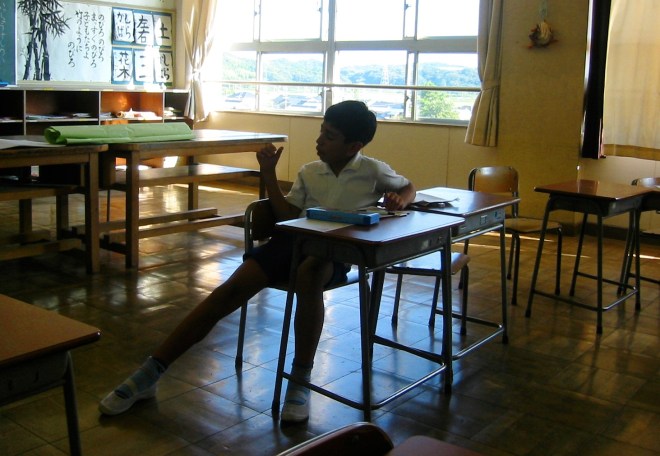
Peruvian Student Ricardo Relaxes in the Remedial Japanese Language Room

by Robert Moorehead

My article in The Asia-Pacific Journal examines the remedial Japanese language program at a school in central Japan. I argue that the program systematically denies educational resources to low-performing immigrant students. Despite the Japanese educational model of equality and inclusion, these immigrant students are tracked into a program that is separate and unequal.

Teachers explain this pattern in ethnic terms by referring to immigrant students’ supposed need not for specialized remedial instruction, but for relaxation as a break from the difficulties of learning Japanese.

To read more, please visit The Asia-Pacific Journal, a peer-reviewed, open source journal that focuses on the Asia-Pacific region. Also, check out Language and Citizenship in Japan, an edited volume published by Routledge.

DREAM Act a solution for undocumented immigrants

by Yurika Chiba

According to the U.S. Census Bureau, Mexican Americans were 10.8% of the population of the United States in 2011. There is a huge number of immigrants from Mexico in the U.S. because the distance is very close between Mexico and the U.S. In addition to Mexican immigrants, America has more than 50,000,000 immigrants. However, it is a fact that America has also a lot of “undocumented immigrants.” One of the reasons is that the pay in America is better than that in their home countries. But, why are they “undocumented”? In America, it is hard for foreigners to get VISA.

ALBS JAPAN explains that the American government does not want to increase the number of immigrants because it thinks that undocumented immigrants cause American economy a great loss. In addition, America pays careful attention to immigration after 9.11 attacks. I think that the system of immigration intake in America has a problem to increase the number of undocumented immigrants.

Of course, they are illegal immigrants because they do not have the permission to get into America. However, some undocumented immigrants are doing jobs which American citizens do not want to like the 3Ds: Dirty, Dangerous and Difficult. In fact, their workings sustain the American economy even though some American citizens discriminate against them. It is clear that a lot of undocumented immigrants have a hard time in America.

How about their children, called “undocumented children”? They do not have their own passport. They can’t prove their nationality and can’t work legally. It is difficult for them to get their own driver licenses. Before they graduate from the high school, they can take the education. However, entering the university is difficult for them because most state university do not accept their entrance and they do not have enough money to enter the private university. That is why college-going rate of undocumented immigrants is really low. I watched the video about Jose Antonio Vargas whose parents are undocumented immigrants during the class. He hadn’t known he was an undocumented immigrant until he was 16 years old. After that, he has lived in America with hiding his citizenship. He is talented. But, he could not do an internship because he did not have American citizenship. In other word, he missed a lot of chances to do what he wanted. I think these children should be given the equal opportunity to live in America because they are innocent.

In order to help these children, the American government has suggested the “DREAM Act”, the idea of giving the right of living in America. Recently, the president of America, Obama, promotes this bill. It provides permanent residency to undocumented children. For example, the condition of application is given to people who enter into America until 16 years old and have lived in there for more than 5 years. Even though there are some more conditions to apply it, this bill is really beneficial to undocumented children. However, it has not passed yet in the U.S. If it does, undocumented immigrants who contribute to America would increase more and more. I think that this bill will give advantages to both American government and undocumented children.

On the other hand, opponents against DREAM Act insist that undocumented immigrants should get the green card by the legal process. They also explain that the opportunities of having green card should be equal to legal immigrants. However, in my opinion, undocumented immigrants do not have equal opportunities from the beginning. For undocumented immigrants, having the green card is much harder than other immigrants. I think DREAM Act has very important role to correct the gap between undocumented children and documented children because they did not do wrong at all.

In conclusion, the problem of undocumented immigrants in America should be solved as soon as possible. I do not mean that American government has to force undocumented immigrants to away from the U.S. Rather, American government should consider the policy which these immigrants can live in there at ease. As one of the solution, DREAM Act needs to pass for undocumented children. If undocumented children can have the right of permanent residency, next generation can live in America as American citizens. I believe that it would lead to a positive outcome for undocumented immigrants.


References

U.S. Census Bureau:

Retrieving June 23, 2013 from

http://factfinder2.census.gov/faces/tableservices/jsf/pages/productview.xhtml?src=bkmk

ALBS JAPAN: Retrieving June 24, 2013 from http://www.usavisa.jp/howto/faq_visa07.html

NYT, Mexican Data Show Migration to U.S. in Decline: Retrieving June 24, 2013 from http://www.nytimes.com/2009/05/15/us/15immig.html?pagewanted=all

NYT, My Life as an Undocumented Immigrant: Retrieving June 24, 2013 from http://www.nytimes.com/2011/06/26/magazine/my-life-as-an-undocumented-immigrant.html?pagewanted=all