Poverty among young women: the trigger to a limited life

by Maya Hattori

In Precarious Japan, Anne Alison refers to the new types of poor people spreading in Japan. She also mentions that little attention is given to the fact that poverty exists in this country right now. I will focus on the lifestyle of the poor young women and their struggle.

The increasing poverty among young women in Japan is a serious problem that is still not recognized widely. One out of three young unmarried women are regarded as being poor, receiving less than 1,140,000 yen a year. However, most of them do not even regard themselves as poor, with the bias of living in a rich country.

First of all, why do young women fall into poverty anyway? There are many cases such as, fleeing from domestic violence, divorce, single parenting, debts or family background. Everyone has the risk to become poor someday.

Once you get poor, you no longer have many choices, which keeps you stuck in an unstable and severe life, like a vicious circle. For example, a woman in her early twenties has a child but no partner and her parents are divorced and not able to help her financially. In order to raise her child she has to earn money immediately, however, she would probably have no choice but to work as a daily employee or engage in night work, because it takes time, money and luck to get a stable job. Indeed, many young women who are in such a situation are indirectly forced to work as prostitutes, where they are provided not only a lot of money but also a day-care center and an apartment. This is more easily done than to ask the government for public assistance or other official help.

Moreover, living in poverty, many young women who are single think they are not able to get married. The idea that women can be feed by their husbands does no longer apply to this era of depression and precariousness. This also leads to the decrease of children. Another vicious circle is that children who were raised by single young women in poverty have difficulties in getting good education, considered financially, so they probably will go through the same difficulties as their mothers.

Living in Japan with minimum wage causes you many other problems as above. Though it may sound a little unequal in terms of gender when I only refer to women, it is true that young single women have a weaker position if they have children and women are more easily allured into “black businesses” because of the payment and other equipment. Therefore, the government should help those young women who suffer from poverty, in order to give them a chance to live a mature life.

Enhanced by Zemanta

Selling whiter skin for beauty

by Kohsei Ishimoto

In Evelyn Nakano Glenn’s Shades of Difference: Why Skin Color Matters (2009), Joanne L. Rondilla looks at the different techniques are used in the cosmetics industry. When looking at the Philippines, advertisements focus on ‘whitening’ the skin, because the people in the country tend to have darker skin. On the other hand, when looking at European countries, advertisements look at ‘brightening’ the skin, for there is the idea that people in these countries naturally have light skin.

When looking at these advertisements, it can be seen that to be beautiful, you must have white skin. Rondilla explains that there are many people in the Philippines who buy skin-whitening products to look beautiful, but is being ‘white’ really being beautiful? The main answer to why ‘white’ is thought to be ‘beautiful’ is colonization. To the countries that had been colonized, the European countries had been superior, fixing the image that ‘whites’ are ‘better’.

When reading Rondilla’s chapter, however, it can be seen that there are various ‘types’ of white skin. One is the European beauty that was mentioned earlier, and the other the ‘Asian beauty’. This refers to East Asian countries, such as China and Japan. Filipinos are actually looking at ‘Asian beauty’, possibly because these countries are closer to them. In Japan’s case, the country looks at being ‘white’, trying to achieve the European look. This statement can be said to be wrong however, for recently Japanese people want to be seen as individuals.

When looking at various advertisements, it can be seen that models of different skin tones are used. For advertisements that use ‘white’ women, companies state that they are the ‘result’ of the product. On the other hand, companies that use models of a darker tone state that it does not look ‘right’, telling the consumers to change by buying the product. It is a fact that many purchase skin-whitening products to gain their ‘beauty’, but exactly how close are they to their ideal image? Will consumers ever believe that they are beautiful enough? The answer to this is probably no. The cosmetics industry has control over the consumers, by selling only a small portion of a product, or changing advertising techniques to trick us into believing that our images are not yet satisfactory. When thinking about this, it is interesting to wonder why people use cosmetics in the first place. Can not having any make-up on be considered beautiful? The answer to this can be explained through society; how people see you, and how you want to be seen.

Enhanced by Zemanta

Who needs a husband?

Note from Editor: Students are reading Anne Allison’s book Precarious Japan, and sharing their thoughts on how their own future plans are impacted by the instability and insecurity that Allison describes.

by Zhang Shiwen

Work is more loyal than a husband, I think. My ibasho will be my work in the future, as well as my ibasho is my university now. The reason is simple, because if I am not a student or a worker in Japan, I cannot continue living in Japan. Moreover, I can feel that I am valuable when I get a good grade in test or I am needed by my friends, such as having a party after school or going for a trip together. In fact, when I was a student in language school, I was living like a hikikomori (Allison, 2013). I felt pressure from teachers that they want me to go to a good university. On the other hand, I did not have good friends and could not have communication with Japanese. I preferred staying in the dormitory, but I felt so lonely and meaningless at that time. Due to that, being a university student really made me comfortable and my life meaningful. Therefore, my ibasho will be my work which will give me the same value, I hope.

However, if I work in Japan, my work will betray me if I do not have a husband. 10 years later, I will be 30 years old. According to Heikinchokonneirei (n,d.), it is known that 40 years ago in Japan, I should have married by the age of 24 years. However, will it be the best time for me, a 30 years old woman 10 years later, to get married, or it will be later?

What’s more, I have watched a Japanese drama that the main character, a 30 years old Cabin Attendant who was working in a big airline company, was fired at her best period in her career because the company would pay more money to new, young employees. It means that although the situation of women employees is becoming better, women and foreigners like me are the most precarious people in Japan, as Allison (2013) notes. Due to this, even if I want to continue working, from the view of company, they may get more benefits from hiring an unskilled, low-paid youth than me, who is high-paid and skilled. Also, unmarried is looked as irresponsible to the society. Therefore, for women working in Japan, it is hard for them to say “Who needs a husband”, because the society, where the shoshika (low birth rate) is advancing, need women to have husbands!

My other ibasho is my home with my parents, so I hope to have a job which can make me come and go from China to Japan. My parents have no wish to live in Japan, but I should take care of them after they retire. Due to this, I am not sure where should I live after I retire. Therefore, if I work for a Japanese company and pay pension contributions to Japanese government every month in the future, but I finally decide to go back to China, I cannot take back all insurance money I have paid, and also I cannot enjoy the Japanese welfare system. At the same time, the Chinese government will not provide me social security because I have not paid for the Chinese pension system, so how can I feed myself after I retire?

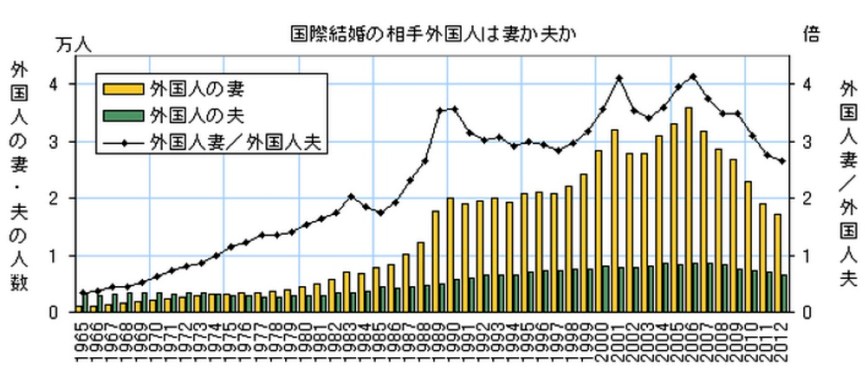
The situation will be better if I can take the right of permanent residence, while it is not very easy. However, a quick and easy way is to marry a Japanese man, which is also recommend by my parents. Therefore, is it good for foreigners to have a Japanese spouse? From Appendix A, it is known that the foreign wives are twice as common as husbands. I believe that most of them are married by love, but some Chinese wives I have known cannot speak Japanese well and seldom have Japanese friends. Caring for the children and their house are the only things they need to do.

Appendix A (Retrieved from http://www2.ttcn.ne.jp/honkawa/1190.html)

Appendix A (Retrieved from http://www2.ttcn.ne.jp/honkawa/1190.html)

In conclusion, it will continue to be hard for women in Japan to be independent from the social or familial role, as Allison (2013, p.22) notes. On the other hand, the pressure of managing both work and family became larger. Women are encouraged to work hard but precariously, and at the same time, they are blamed for not marrying.

I think it is very important for women to marry and have a family, but it should not be done for  the society or family. I means that we relay on our family for spirit,but not for pressure from parents, companies, and the society. Therefore, the government should provide an environment for women to make better choices for themselves and by themselves.

References

Allison,A. (2013). Precarious Japan. Durham, NC: Duke University Press.

Heikinchokonneirei no Suii [The change in the average age of marriage]. Keikon Rikon deta.Net [Marrige and Divorce Net.] (n.d.) Retrieved from http://www.kekkon-data.net/marriage/cnt/heikin_shokon.php

Enhanced by Zemanta

Family would be my ibasho

Note from Editor: Students are reading Anne Allison’s book Precarious Japan, and sharing their thoughts on how their own future plans are impacted by the instability and insecurity that Allison describes.

Anonymous student post

I hope to get a job as a regular worker and get married and have children for my future. Actually I have only indefinite work plans for my future, however I really hope to get a job in which I can communicate with many people because it will bring me up to talk with all sorts of people. It would make me feel narrow and uncomfortable if there is only one or two ba for me even now. My life is full and enjoyable because I have several my ba, family, friends, relative, university, workplace as a part time. All of them help me differently to have great every day and any one can’t lack in my life. Therefore I hope to get married and have my family and keep working while I can work.

Family would be my ibasho. I consider ibasho as where I can show my everything and don’t need to pretend to be tough. Family is the most suitable place to be ibasho. That’s why I hope to get married and have a family. My mother works part-time and she welcomes me whenever I come back home from school, therefore it is difficult to imagine both mother and father working full-time. However I hope to raise children and keep working. I’m not sure it would go well because I’ve never experienced the family I hope to have in my future. My father and mother are almost typical a husband and wife, my father is a sarari-man and works to support my family, and my mother is a part-time worker and does all household work.

The media often says it is getting difficult to raise children in Japanese modern society because of the insufficiency to guarantee child rearing. It is one of the serious problems that the number of children who need to go to the nursery school exceeds the actual number of the children that nursery schools can accept. It can be said that one of the causes of the declining birthrate in Japanese society is related to lack of satisfaction with such guarantees. I hope there will be a better society in which to raise children, and that the birthrate would recover.

I’ve thought family would help me anytime, even though some people consider that having family might bring more risks than staying alone. I would like to get married and raise children while continuing to work because my family would be my ibasho and working would give me the strength to get through my life.

Enhanced by Zemanta

White is right: Body decoration, skin color, and beauty in Japan

Nivea Skin Whitening

Nivea Skin Whitening (Photo credit: kalleboo)

by Saki Miyata

Body decoration is a term that describes how people change how they look from how they looked originally. This decoration of the body seems to be conducted by people in order for them to symbolize or fit into a certain group. Skin lightening is also one kind of body decoration which can be practiced worldwide. In Japan, it is not difficult to find women who use skin whitening products. The practice of skin whitening has become a very “natural” thing for women in Japan.

It has become “natural” for woman to seek whiteness since the ideal beauty of Japanese is to have a white skin. The unconscious notion of “Japanese people are originally white” creates an image of white skin as pure, young, and healthy. Which drives women to practice skin lightening as an anti-aging process.

As Mikiko Ashikari (2005) notes, in Japan, “white skin” is also seen as dominant, since having tanned skin is something to be ashamed of, unless the tanned skin is a result of some leisure activities. This could be the result of thinking “Japanese skin is originally white and expected to be white”. An example of white being dominant is when talking about skin in Japan. Saying “Your skin is white (light)” is taken as a compliment. However, saying “your skin is black” is never connected with a positive image. It is also a taboo to point out to someone that they have black skin.

Japanese usually separate their whiteness from Caucasians’, and find uniqueness in Japanese whiteness. It is true that Japan has a tradition of seeing white as a symbol of purity and beauty. However this is not the only reason for this massive boom of skin whitening in Japan. By globalizing, Japan interacted with societies that were white dominant and white superior. This dominance of Caucasians has also affected the notion of universal beauty, which sees white as beautiful. However, even though this idea was imported to Japan, it is not recognized by people that they are trying to look white, since the idea of white=beautiful was already there. The globalization of cosmetic markets has also encouraged more women to practice skin lightening.

Personally I found it interesting to find out that Japanese unconsciously think we have white skin. However when I think about it, the “fresh colour” pencil crayon is light beige, which is lighter than the average Japanese skin. Although the pencil crayon does not represent Japanese skin tone, children colour their skin with this colour. When I was in Canada, I was drawing each other’s face with my Caucasian friend. I remember feeling really offended when she used light beige colour for her and dark yellowish brown colour on mine. Although I was only 8 years old when this happened, this shows how the sence of “Japanese skin” is deeply rooted in our minds.

Reference

Ashikari, Mikiko. 2005. “Cultivating Japanese Whiteness: The ‘Whitening’ Cosmetics Boom and the Japanese Identity.” Journal of Material Culture 10(1):73-91.

Enhanced by Zemanta

The influence of women’s social advancement in Japan on my future plan

The Great Wave off Kanagawa

The Great Wave off Kanagawa (Photo credit: Wikipedia)

Note from Editor: Students are reading Anne Allison’s book Precarious Japan, and sharing their thoughts on how their own future plans are impacted by the instability and insecurity that Allison describes.

Anonymous student post

My academic interest in the IR field is peace and conflict studies, post- conflict peace-building, and the Middle East. One of my future dreams is to give peace education and human resource development for children in conflict areas by offering some artwork and developing it into critical thinking. In order to do so, I need to improve my own knowledge and skills. Therefore, I am planning to study abroad at the post-graduate school of London University, SOAS, after graduating from Ritsumeikan University. I have not decided yet whether to take a framework-making approach such as working for an international organization, or a grassroots approach, such as local staff of a NGO. However, in either way, certain period of work experience in companies is likely to be required, therefore I would once get a job in a company to have some social experience.

I think one phenomenon that Anne Alison pointed out in her book Precarious Japan, women’s social advancement in the workforce, might affect my plan at this stage. According to the statistics of the Japanese Ministry of Health, Labour and Welfare, 34.2 percent of Japanese women (one in three single women) aged 15-39 wishes to be a housewife. Similarly, survey conducted by the cabinet office shows that 51 percent of Japanese people answered that it is ideal for men to work outside as a breadwinner and women to be a housewife. This number increased by 20 points, compared to the number of the survey in 2009, among the age of 20 to 30 years old.

This tendency is due to the despairing situation for female workers to develop a career steadily in their jobs, and the recent economic stagnation. According to Anne Alison (2013), irregular workers are those who are the most precarious in Japanese society because they have minimal rights and protection, and can easily get fired. Women make up 70 percent of irregular workers, and have the worst status by experiencing the worst gendered disparity of all industrialized countries.

Although Japanese society is becoming a result-based employment, women suffer from likewise disadvantage of employment even in regular employment and full-time work. It is based on underlying sexually biased premise that men are the breadwinner and women stay home as a housewife (Alison, 2013). They only earn about 67 percent of men’s salary and around 80 percent of working women makes less than 3,000,000 yen a year. Also, 44 percent of working women receive less than the minimum wage of the year and the number of women staying in professional jobs is remarkably low. The percentage of women having managerial posts is considerably low as well. Moreover, 80 percent of women workers retire after giving birth to her first child (Allison, 2013).

In conclusion, when I look at this current situation, I guess it may be very hard for me to get a highly paid secure job and advance my career in a company, especially when I am planning to ultimately move out and change my job to work in international cooperation. Therefore I have anxiety about whether  I could successfully become economically independent from my parents and pursue my dreams at the same time. In other words, I have to work very hard not become a parasite single.

References

Alison, A. (2013). Precarious Japan. Duke University press.

Ministry of Health, Labour and Welfare. (March, 2013). Wakamono no ishiki ni kansuru chousa [statistic on youth’s consciousness survey]. Retrieved fromhttp://www.mhlw.go.jp/file/04-Houdouhappyou-12605000-Seisakutoukatsukan- Seisakuhyoukakanshitsu/0000022200.pdf

Gender Equality Bureau cabinet Office. (April,2012). Dansei ni totte no danjo kyoudousannka [Survey of male’s consciousness on gender equality].Retrieved from http://www.gender.go.jp/research/kenkyu/dansei_ishiki/pdf/chapter_1.pdf


Enhanced by Zemanta

Establishing economic and human relationships

Note from Editor: Students are reading Anne Allison’s book Precarious Japan, and sharing their thoughts on how their own future plans are impacted by the instability and insecurity that Allison describes.

Anonymous student post

There are two aspects when I consider my future plan: one is about job and economic situation, and the other is about family and human relationship. Firstly I will focus on my work plan, and secondly I will explain my family plan.

I am thinking of becoming a journalist as a full-time worker, which means I have to do job hunting. However finding a job is becoming more difficult these days because of the deep depression and irregular employment problem. Therefore, I am considering two ways to realize my dream. One way is to do job hunting while I am a university student, and the other way is to go to a graduate school, study more about journalism and do job hunting. I have already decided which company I would like to work for as a regular employee, so I do not really care the process to get in the company. Actually, the Japanese present economic situation has affected my decide of a company. These days, it is usual for women to get job and work even after they get married and give birth, so I will work as long as possible.

My second topic is about my family plan in the future. Since I am going to take care of my parents when they get old, I have to live with my parents or live close to my parent’s house. This decision may make it difficult for me to find a partner, but I want to get married with a person who has a regular job and have my first baby before I am thirty, when I have enough energy to take care of the baby. I will share the housework with my husband, as both of us will continue to work. I may have to go back to work in one year or so after giving birth, but I will try to make time to spend with family. It is said that the connection between family is becoming weaker and actually the similar thing is happening to my family now, so I want to keep the family relationship good and strong. I want to make home as each family member ibasho, the place which everyone want to come back and feel comfortable. No matter how difficult it is to keep balance of work and housework, I will try hard to live a happy life.

Enhanced by Zemanta

Future plans get complicated in precarious Japan

Partial three-quarter right front view of a cl...

Ritsumeikan University, Kyoto, Japan (Photo credit: Wikipedia)

Note from Editor: Students are reading Anne Allison’s book Precarious Japan, and sharing their thoughts on how their own future plans are impacted by the instability and insecurity that Allison describes.

by Natsuki Nakasone

Now, I am a nineteen-year-old student at Ritsumeikan University. If everything goes well, I will graduate in three years. However, I need another two years in order to get a license since I would like to become a kindergarten teacher. Therefore, in my future plan, I will go to another school while working at a company, and then I will become a teacher. This plan seemed easy to realize, but there are several problems which are affected by the precariousness of Japan.

First, recently, the rate of non-regular employees has been increasing. As Anne Allison said, after the Bubble, many temporary workers played important roles in high economic growth in Japan. This employment system has both advantages and disadvantages. The advantage is that it is able to post employees when they are needed. However, the disadvantage is that it also becomes an issue of public concern. There is a possibility that temporary workers will be fired all of a sudden. Therefore, they cannot have a stable life.

Next, the number of children has been decreasing, because the number of people who remain unmarried has been increasing. As a result of this, the demand for nursery school teachers and kindergarten teachers is decreasing, and it is not sure whether I can get an ideal job.

In addition, in Japan women can get fewer jobs than men, because there has been a stereotype that men work outside of the house and women work in the house. Even if some women are fortunate enough to get a job, they often have to leave their jobs to raise their children. In my plan, I would like to have two children, and I might be in similar circumstances. In this precarious Japan, it is difficult to realize my dreams and live an ideal life.

Lastly, I would like to mention a little bit about my ibasho. I think my ibasho is my family, so, since I am still a teenager, an ibasho for me has always been provided by others. However, in the future, I will have to find it for myself. Therefore, it is important for me to get married and to have children in order to create my new ibasho.

As you can tell from what I have mentioned, to get both ibasho and ideal work is not easy in my case. Thinking about this tells me that I am living in precarious Japan.

Enhanced by Zemanta

Avoiding becoming a Christmas cake

Note from Editor: Students are reading Anne Allison’s book Precarious Japan, and sharing their thoughts on how their own future plans are impacted by the instability and insecurity that Allison describes.

by Yuri Muramatsu

In the future, living in Japanese society may become much more severe. As Allison mentioned in her book, Japan has a lot of issues that have huge effects on our future.

First of all, Allison argued that Japanese became muen shakai (relation less society). I have some anxiety for this muen shakai situation. There is possibility that I will suffer a solitary death. I also have suspicions about Japan’s society.

First, I do not want to get married if I am over 25 years old. If I would be a “Christmas cake,” I would abandon some hope for marriage. In my opinion, I cannot be a mother if I am over 25 years old because it is difficult to raise children.

There are two main reasons. The age of 25 years and over is the important age to stabilize the position in the company that the time to be entrusted with important tasks. I do not want to miss this chance. Moreover, if I get married after the age of 25, I will give birth after the age of 26. This means I would have to take a maternity leave after 26, and that I would go back to company after 27 or over. However, taking maternity leave is difficult sometimes. This is the second reason. If I married someone over 25 years old, I would not have a chance to have children. I cannot believe this system.

In addition, it is unfair that the men should work and earn money while women should protect the family. Allison indicates that Japanese people tend to make this style of family. Women should be housewives and men should work and earn money. On the other hand, I want to continue working all through my life, even if the company tries to cut me because I am a woman.

I would like to get a job that has relationship with the Japanese social insurance system. I think Japan faces ikizurasa (difficulty of living) now, so I am happy if I could relieve this feeling. I believe that social insurance system can change Japan. Japanese society does not have a good system to support people in need. This situation directly connects ikizurasa.

That is why I want to get a job that can be changing the severe situation of Japan. Many people feel ikizurasa. I do not want to be a housewife but at the same time I would like to cherish human relationships to prevent falling into a muen shakai situation. I think my ibasho will be my local town, friends and work.

Although Japanese society may getting more worse in the future, I want to fight against an unfair society and rebuild a new system. At the same time I try to value opportunities for communication.


Enhanced by Zemanta

Enjoying work and family

Note from Editor: Students are reading Anne Allison’s book Precarious Japan, and sharing their thoughts on how their own future plans are impacted by the instability and insecurity that Allison describes.

by Yuri Kamino

I have not made a concrete plan about what I’m going to do in the future, but I vaguely imagine that in the fourth year I will fight against the glacial age of hiring, work for a company, marry someone, have babies, raise them and in the latter half, I will live a slow life with my husband, many grandchildren and dogs.

Job hunting is waiting for us and as many classmates have said, it becomes more difficult to get good work without enough knowledge. For university students, I think it is quite natural to hope to find good or top-rank work and live a better life because it costs a lot to go a university, so they desire to get work that corresponds to the money they have spent. However, personally I think it is not necessarily important to be employed in what is called a first-class company. Of course I want to get a better job, but for me, it is more essential whether I can enjoy the job at the company and handle both a career and raising children.

I have two points for my job hunting. One is that can the company be my ibasho. These days, the number of people who work oneself to death is increasing. More and more “kaisha-man or woman” sacrifice their holidays and private time. They also suffer from stress among their companies. I don’t think these situations can never be my ibasho. Maybe I will relate to the company for a long time, so I wish to keep a good relations with them.

The other point is that whether the company has a sufficient system for women to concentrate on both their job and childcare. Today, more and more women are doing great things in society, but there are still many companies which treat them as less important because they tend to retire from their jobs or take long vacations when they marry and give birth. As established by law, we can take childcare leave until our child reaches the age of 1. However under these companies, I could not pay much attention to my child. I strongly hope to build family with boundless love and wish it can be ibasho for my children.

I think that for children, family is the most important and for me, a job is essential to live more worthy life so, I am eager to seek for a way which I can meet both.

Enhanced by Zemanta