Bigakuseizukan – Who Are the Beautiful Students?

by Lilia Yamakawa

A friend asked me to go with her to a party sponsored by a website called Bigakuseizukan, Picture Book of Beautiful Students. Both the photographers and the “beautiful” students they photograph are students from Japanese universities. Since have been talking about people’s concepts of “beauty” in our Race & Ethnicity class, I thought this would be a good opportunity to do fieldwork and see what this group considers attractive, what the trends are, why students agree to be posted on the website, and why this website is popular.

In class, we discussed what beauty is and found that a majority considers one type of appearance as beauty. Like the contestants in the Miss Korea contest that we saw in class, I expected most of the students at the party to be similar: skinny chins, double eyelids, small noses. I thought there would be many people with the Japanese kawaii style, with the same brown hair, same length bangs, and wearing the fluffy white and pink cutie skirts.

It turned out not to be what I expected! Most of the people there had different styles: many different hair colors and styles, different facial characteristics, many different body types, with totally different styles of clothes. Kawaii wasn’t especially big. I was both disappointed and relieved by what I actually saw. I was in a way disappointed that I couldn’t see an expected trend with my own eyes, and also relieved to find that there were many kinds of beautiful students there.

I think this has something to do with the popularity of the Picture Book of Beautiful Students website. The models are students who might actually go to your school, and they all look different. When you look at their snapshots, you might feel that they are close to you and possible to reach. This sense of closeness would be hard to have if you are looking at a model of a magazine or on TV. Bigakuseizukan’s uniqueness is that it doesn’t show only one type of beauty considered as perfect. It really shows lots of different types of students.

Another question I had in mind was why do people say yes to being photographed and having pictures posted of them online? And why do they attend such a gathering? I had a chance to ask around yesterday. I got a lot of answers, but basically they fall into three categories. In the first category, there were many students who were running for beauty contests, such as Miss Ritsumeikan, Mr. Japan and Miss Universe. These types of people answered they did it to get their name out and remembered through the Bigakuseizukan. The second group said they tried it for their personal record and their future career. It will look good when applying for a job, which might have a lot to do with your appearance, such as newscasters and announcers. The third group was more vague, and they said there was no reason not to try it or that they just enjoyed modeling for fun. One girl said, “Well, everybody posts their selfies on Twitter and other sites like that, so why not post a better picture of yourself taken by a photographer with a real camera?”

One more thing I expected to find was that everyone would be outgoing. Instead, there seemed to be all sorts of types of personalities at the gathering, and some people seemed very quiet and reserved. I think you could probably say that they all had some sense of confidence in the way they look, though.

This fieldwork only lasted three hours, but if you were interested in finding out why people in a certain group are judged to be attractive, I think studying a group such as the Bigakuseizukan would be a good method. It would be necessary to find more things that the models have in common and to question both the beauties and the photographers in more detail.
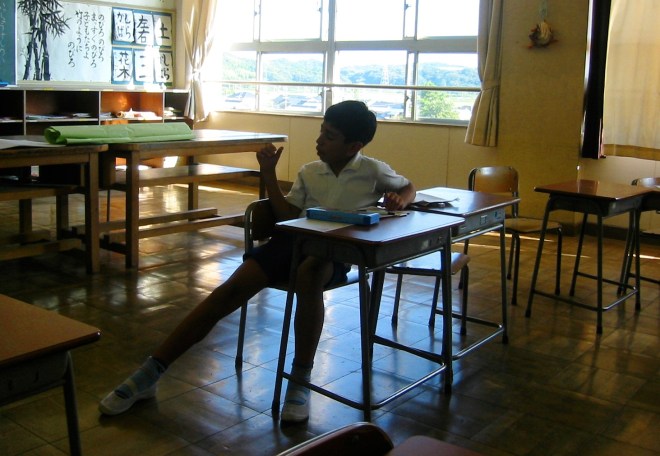
Separate and Unequal: The Remedial Japanese Language Classroom as an Ethnic Project

Peruvian Student Ricardo Relaxes in the Remedial Japanese Language Room

by Robert Moorehead

My article in The Asia-Pacific Journal examines the remedial Japanese language program at a school in central Japan. I argue that the program systematically denies educational resources to low-performing immigrant students. Despite the Japanese educational model of equality and inclusion, these immigrant students are tracked into a program that is separate and unequal.

Teachers explain this pattern in ethnic terms by referring to immigrant students’ supposed need not for specialized remedial instruction, but for relaxation as a break from the difficulties of learning Japanese.

To read more, please visit The Asia-Pacific Journal, a peer-reviewed, open source journal that focuses on the Asia-Pacific region. Also, check out Language and Citizenship in Japan, an edited volume published by Routledge.

Racism Does Not Exist?

by Hyeon Woo Lee

Discrimination between different ethnic groups is commonly reported throughout the world. Not to mention the racism against Afro-Americans in US, but also discriminations against Hafu people in Japan, unfair treatment against southeastern brides who came to Korea for marriage, etc. With no doubt such phenomena are spread widely over the world. Professor Terry Kawashima states that race works through several visual readings, or interpretations of the physical differences of a person. However I would like to raise a question of whether racism really exists. Is what we call racism really an act of discriminating other groups of people because of their physical looks? Or is there something else, some other factors that affects us but are hidden beneath the word racism?

In 1994, there was a systematic massacre of minority ethnic groups by major ethnic groups. The Hutu, a majority ethnic group in Rwanda, attacked the Tutsi, a minority group. Triggered by death of the president, Hutus started killing every Tutsi in sight. As a result, at least 500,000 people were killed. The point here is that in external physical appearance, the Hutu and the Tutsi had no difference at all. They all looked like the same black people. However Hutu accused them of being “different”. This may mean different genetics, but it doesn’t make sense since it is widely known that two members of the same ethnic group can be just as different genetically as two people from different ethnic groups. Then in this case, it is safe to say that physical racism was just an official reason, and the true reason mostly lied in the economic structure of Rwanda. The Tutsi monopolized most of Rwanda’s economy while Hutu had very little in it and was unhappy with the fact.

The history of mankind has been a continuation of conflicts, like constant war. Whether it is large or small, there was always war among different groups. The cause varies; it could be a fight for ideology, conflict over economic benefits, or even basic survival itself. However when people mention the difference in ethnicity as a cause of war, I seriously doubt it. It is not the difference that causes conflicts between ethnic groups, but it is rather the way we interpret it. All those conflicts claiming that were triggered by different ethnicities, like the case in Rwanda, actually has other reasons hidden behind the mask of racism. So come to think about it, maybe there isn’t any “true racism”, in which one is hostile to the other for the sole reason of being different, in the world. I believe that there is always something else.

Filmmaker Dave Boyle talks with Ritsumeikan students

by Robert Moorehead

Dave Boyle’s films (Big Dreams Little Tokyo, White on Rice, Surrogate Valentine, Daylight Savings) blend English and Japanese languages, and American and Japanese cultures. In this video, he discusses “Big Dreams Little Tokyo” with a class of International Relations students at Ritsumeikan University. Boyle talks about the roles of language, culture, race, and stereotypes in the film, and the choices he made as an actor and a director.

How black Americans have been distanced from other black people

by Miho Tanaka

From two articles, “Not black, but Habasha: Ethiopian and Eritrean immigrants in American society” by Habecker and “Ethnic and racial identities of second-generation black immigrants in New York City” by Waters, I found how black Americans were distanced from each other because of tension with other ethnic groups. Though second generation immigrants sometimes fit into black American culture if they interact with black American friends, many black immigrants de-emphasize their ascribed black racial identification and try not to be categorized as black Americans in the US (Habecker, 2011, p.1206). However many other ethnic groups cannot distinguish them from black Americans since their appearance is very similar to black Americans; therefore they tend to be treated just like black Americans even if they have strong identity of not being like them. In addition it is impossible for black immigrants to reform the “apparently immobile structures of America’s racial hierarchy” even though they make efforts on maintaining social distance from black American (ibid, p.1215).

I suppose how much they experience discrimination, and how much less opportunity they have are deeply connected to the darkness of their skin of color. In the Black community, the tradition of lighter skin and straighter hair are often considered to be in ‘better’ status (Williams, 2013). In this sense I can see colorism pretty much prevails in US society and the world, and their social or economic levels are often determined by how dark they are. I feel Japan is not an exception. For example Okinawan or Ainu people in Japan have been discriminated from the dominant group. Okinawan have darker skin compared with Japanese living in Honshu island and I saw Ainu people when I was in a junior high school and went to school trip, they had darker skin, too. Okinawan people are often suffering from noisy airplane of U.S. military and sometimes Okinawan girls or women are raped, and Ainu people had been segregated and now they are disappearing. I can see that Japanese society also adopts colorism.

On a large scale, we should notice how colorism forms the structure or hierarchy of this world. I feel the darker skin people have, the more poor area they live in. When we think of black immigrants who rarely assimilate into the other culture which white or lighter skin colored-people control we should think about how colorism effects on their lives and their opportunity and how it is sustained in the world.

References

Habecker, S. (2011). “Not black, but Habasha : Ethiopian and Eritrean immigrants in American society” (pp.1200-1219). In Ethnic and racial studies. London : Routledge.

Waters, C. M. (1994). “Ethnic and racial identities of second-generation black immigrants in New York city” in International Migration Review. Vol.28, No.4, pp.795-820

Williams, C. (2013). Colorism : The war at home. Retrieved on June 13th 2013 from http://www.ebony.com/news-views/colorism-the-war-at-home-405#axzz2W6aYYoEN

Invisible Immigrants

by Ayano Tsukada

New York City is a city of minorities and immigrants. Unlike other cities like Los Angeles or Miami where one ethnic group makes up majority of the immigrant population, New York receives immigrants from all over the world. Their identities vary among the ethnic groups as well as within the groups. Here I would like to focus on second-generation Black Immigrants in New York City because they become invisible in two ways:

  1. The government does not track the second-generation of immigrants (They become Americans officially);
  2. The second-generation immigrants lack their parents’ distinctive accents and they look very similar to native-born Black American.

If they don’t tell their ethnicity, they can easily be seen as native-born Black Americans or act like native-born Black Americans.

But they don’t react to this situation in a same way. They adopt different types of racial and ethnic identities. Mary Waters, in her survey in New York City, found that there are three types of racial and ethnic identities adopted by Black immigrants: Black American identity; Ethnic or hyphenated national origin identity; and Immigrant identity. These identities are related to different perceptions and understandings of race relations and of opportunities in the United States. Second-generation immigrants with Black American Identity tend to see more racial discrimination and limits to opportunities for Blacks in the United States and disagree with parental judgements that there are strong differences between Black Americans and Immigrant Blacks. Those with Ethnic Identity tend to see more opportunities and rewards for individual effort and initiative and agree with their parents’ idea that Immigrant Blacks are better than Black Americans. Those with Immigrant Identity take a more neutral stance, but they are more like visible immigrants since they are likely to have immigrated recently and have distinctive accents and styles of clothing.

The interesting fact revealed by Water’s study is that these second-generation immigrants are aware of the generalized negative view of Blacks in the United States and yet some choose to be part of them while others try hard to differentiate themselves from Black Americans. What we can see from the fact is that they are helping to maintain the structure of racism in the United States. Second-generation immigrants with Black American identity are doing so by accepting the stereotypes of Blacks and those with ethnic identity do so by differentiating themselves from Black Americans.

So they are not challenging the current system.

They are making racism and colourism in the United States craftier and more invisible.

Reference

Waters, Mary C. 1994. “Ethnic and Racial Identities of Second-generation Black Immigrants in New York City.” International Migration Review 28(4):795-820.

by Robert Moorehead

I recently came across the writing of Akemi Johnson, a fellow Fulbright scholar who writes on issues of race, gender, and power in Okinawa. Johnson adeptly connects her experiences as the child of a Japanese American mother and a WASP father with the challenges the women and men of Okinawa face in dealing with the presence of US military bases in the prefecture.

Her website, akemijohnson.com, provides links to several articles that she has published, including a brilliant piece in the Kyoto Journal. She is currently working on a literary nonfiction book based on her experiences in Okinawa. Check out her work!

Mestizaje, Racism and Blackness in Veracruz, Mexico

by Isabel Cabañas Rojas

“Latin America is a region of mixture”. Many cultures, religions and races are gathered; all condensed in one major community, unified under one idea: we are mestizos. Every country has their own particular characteristics though, but despite historical or regional small differences, we are all mestizos, latinos, sons of a common history and memory derived from the presence of Spaniards and Native Americans. At least this is what we are told since childhood.

This assumption is probably one of the most powerful discourses still present nowadays, that defines our identities, nationally and as Americanos, even transcending internal boundaries within the region. A very powerful and, yet, dangerous discourse, for it hides a latent reality that has enabled discrimination and the suffering of many, a big ‘minority’, who does not enter in this category, as are the descendants of African slaves.

This has happened in many countries of Latin America; however, the case of Mexico is very emblematic: its historical trajectory of mixture has only accepted the presence of Spaniards and Indigenous populations, and has denied and silenced a whole history of sub-Saharan African migration and its role on the Mexican society. Because of Mestizaje, and its strong presence as a national ideology since the nineteenth century, the presence of Africans started to blur, for economic and social reasons. Until today being ‘black’ escapes the limits of being Mexican, and Mestizaje has come to hidden the phenotypic features that is better to erase, by a process of whitening, in order to belong.

As Sue (2009) explains, Mestizaje has become a national ideology category, dynamic and diverse, which makes really hard the analysis of color in the Mexican society, as almost everybody can be included on it (Sue, 2009, pp. 114-115). Thus, in a practical level, Mestizaje is a denial and elimination of any difference, as “we are all mestizos”.

Veracruz–along with the localities of Guerrero, Oaxaca and Tabasco–is one of the historical settlements of African people in Mexico, since the fifteenth century. Therefore, their descendants today, even though very mixed with the local population of Indigenous and Spaniards, have a skin and background of African features, which they try to hide so as to be part of a society that also has segregated them socially and economically (Velásquez & Iturralde Nieto, 2012, pp. 110-113). In a Survey made by the National Council to Prevent Discrimination (2011) around 15% of the interviewees think that their rights have not been respected because of skin color (National Council to Prevent Discrimination, 2011, p. 41).

This case of Afro-Mexicans in Veracruz, and the outcomes of their skin-colors for their daily life, challenges the notion of mestizaje, which not only has shaped the history and culture of Mexico, but of all the countries of Ibero-America; and sheds new light on other issues, such as Racism and Discrimination. Any discussion on Race and discrimination is, in paper, not pertinent, because Mexico became a race-blind country. How, then, can we address racial minority needs if they theoretically do not exist?

References

Martínez-Echazabal, L. (1998). Mestizaje and the Discourse of National/Cultural Identity in Latin America, 1845-1959. Latin American Perspectives, 25 (3), 21-42.

National Council to Prevent Discrimination. (2011). National Survey on Discrimination in Mexico, Overall Results [ENADIS, 2010]. Mexico.

Sue, C. (2009). The Dynamics of Color. Mestizaje, Racism, and Blackness in Veracruz, Mexico. In E. Nakano Glenn (Ed.), Shades of Difference. Why Skin Color Matters (pp. 114-128). Stanford University Press.

Velásquez, M. E., & Iturralde Nieto, G. (2012). Afrodescendientes en México. Una historia de silencio y discriminación [Afrodescendants in Mexico. A history of silence and discrimination]. Consejo Nacional para Prevenir la Discriminación.