Pakistani student’s parents file complaint against classmates over bullying

by Robert Moorehead

From the Mainichi Shimbun:

The parents of a 13-year-old Pakistani junior high school student in Takamatsu have filed a criminal complaint with police, accusing their son’s classmates of bullying and injuring him.

A male Pakistani student at a public junior high school in a town in Kagawa Prefecture was bullied and seriously injured by his classmates, his parents alleged in a complaint filed on Feb. 18 with prefectural police.

The parents requested on the same day that the town’s board of education investigate the case and take measures to prevent a recurrence as they claim the student has been racially abused by four of his classmates since last spring. However, the education board denies bullying took place at the school.

According to the parents who held a news conference, the student was verbally bullied about the color of his skin by four of his classmates ever since he entered school last April. The parents claim that the students would make racist comments that their son’s skin was “dirty” and that they told him to “go back to his home country.”

The student was also physically bullied repeatedly by his classmates. Last November, one of the four classmates tripped him over when he was running in the hallway, severely injuring his legs and face. Since that incident, the student reportedly has to use crutches to walk.

The student’s 41-year-old father said, “We asked the homeroom teacher and vice principle multiple times to improve the situation but they failed to take any action.”

Original Japanese article:  http://mainichi.jp/select/news/20130219k0000m040116000c.html

60,000 and counting

by Robert Moorehead

On Thursday, February 7, 18 months after I started the site, JAPANsociology.com got its 60,000th view. In an era in which the video for Gangnam Style gets over 1.3 billion views, and videos of my son’s friends playing games on their computers get over a half million views, that might not seem like a lot. But for an academic site that posts students’ work, plus their professor’s, that’s pretty significant. It certainly beats treating students’ work like a secret, handed into their professor to be graded, returned, and then buried in a drawer.

On to the next 60,000!

Peoplemovin – A Visualization of Migration Flows

by Robert Moorehead

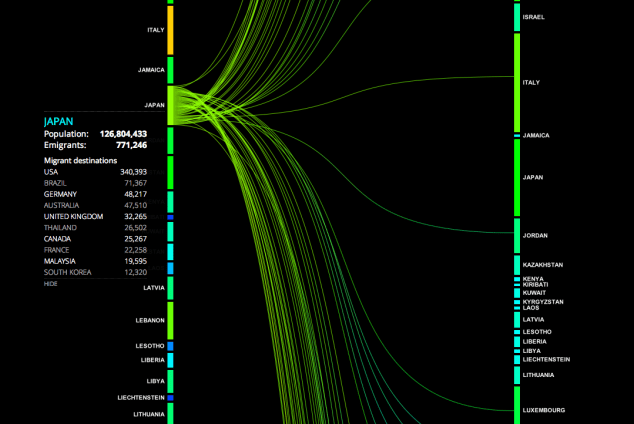
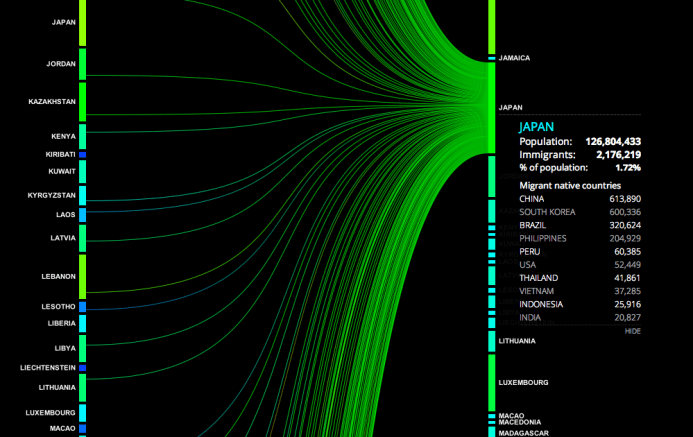
This is a short post that’s a heads-up to check out the site peoplemov.in, which provides visualizations of global migration. You can see data from 2010 on emigration and immigration flows for countries around the world. (Clicking on the pictures in this post will take you to the site.)

Migration into Japan

The top five source countries for immigrants to Japan are China, South Korea, Brazil, and the Philippines, and Peru. For Japanese emigrants, the site shows the top five destinations are the US, Brazil, Germany, Australia, and the UK.

I’ll leave the debate as to whether those “in-migrating” are “immigrants” or something else for another post. For now, emigrants are those going out, and immigrants are those going in. I know many in Japan say that Japan is not a country of immigration, and thus has no immigrants. Rather, it has “foreign workers,” “migrant workers,” dekasegi, etc. “A rose by another other name would smell as sweet.”

Migration out of Japan

Migration out of Japan

by Robert Moorehead A brilliant sociological look at one of my favorite comics, Calvin and Hobbes.

Tristan Bridges's avatarInequality by (Interior) Design

Bill_WattersonOne of my favorite sociologists is Bill Watterson.  He’s not read in most sociology classrooms, but he has a sociological eye and a great talent for laying bare the structure of the world around us and the ways that we as individuals must navigate that structure—some with fewer obstacles than others.  Unlike most sociologists, Watterson does this without inventing new jargon (or much new jargon), or relying on overly dense theoretical claims.  He doesn’t call our attention to demographic trends (often) or seek to find and explain low p values.

Dad pollRather, Watterson presents the world from the perspective of a young boy who is both tremendously influenced by–and desires to have a tremendous influence on–the world around him.  The boy’s name is Calvin, and I put a picture of him (often in the company of his stuffed tiger, Hobbes) on almost every syllabus I write.  Watterson is the artist…

View original post 1,266 more words

What Are You Anyways?

by Robert Moorehead

Somehow I’d missed seeing the brilliant videos of Jeff Chiba Stearns until now. These videos explore the ins and outs of being a Canadian of mixed Japanese ancestry, including the common query, “What are you anyways?” In Japan, that same question would be “Nanijin?”

Click on the picture above to see the 10-minute animated film “What are you anyways?” You should also visit One Big Hapa Family, in which the filmmaker explores these identity questions for his extended family.

From the filmmaker’s site:

Follow the adventures of the Super Nip as filmmaker Jeff Chiba Stearns explores his cultural backgrounds growing up a mix of Japanese and Caucasian in the small Canadian city of Kelowna, BC. This short classically animated film looks at particular periods in Jeff’s life where he battled with finding an identity being a half minority – from his childhood origins to the epic showdown against the monster truck drivin’ redneck crew.

“What Are You Anyways?” is a humorous yet serious story of struggle and love and finding one’s identity through the trials and tribulations of growing up.

More info at http://www.meditatingbunny.com
Please like http://www.facebook.com/chibastearns

Ishinomaki—Then and Now

by Robert Moorehead

Filmed in Ishinomaki in November, 2011, this documentary includes interviews with survivors of the earthquake, tsunami, and nuclear disasters of March 11. This moving documentary is the recipient of Best Documentary and the Grand Prix prize at Super Shorts Film Festival, 2012.

The video is also available in the following languages:
Portuguese: vimeo.com/41279189
Italian: vimeo.com/40420477

The filmmakers have also released “The Women of Fukushima,” a documentary film that examines the experiences of eight women whose lives have been changed by the disaster at the Fukushima Dai-Ichi nuclear power plant. This disaster has compelled these women to become activists in the social movement against nuclear power in Japan.

My Japanese students often tell me that there are no social movements in Japan, and that Japanese people don’t participate in such events. Not only does this view negate the existence of 60 years of protest in what is now Okinawa prefecture, but it also views the people who participate in such movements as somehow different from everyone else in Japan.

The “Women of Fukushima” challenges this view, by giving viewers a feeling of connection with these women. Hopefully this connection will compel more Japanese to speak up and demand a safer future for them and their children.

“The Women of Fukushima” is available for online rental and purchase (for only $8) at women-of-fukushima.com.

“Only immigrants can save Japan”

Face of change: Hidenori Sakanaka, the former Justice Ministry bureaucrat and Tokyo Immigration Bureau chief fears the nation is on the brink of collapse, and says “we must welcome 10 million immigrants between now and 2050.”

by Robert Moorehead

“Only immigrants can save Japan”

Hidenori Sakanaka, the former head of the Tokyo Immigration Bureau, is back in the Japan Times calling for revolution in Japan. This revolution involves opening the door to a much larger influx of immigrants into Japanese society. While I agree with Sakanaka that immigration would bring Japan a much-needed influx of workers, entrepreneurs, farmers, etc, his calls tend to fall on deaf ears. What’s the right analogy here? Is he more Chicken Little or Don Quixote? Neither is very flattering, no matter how on target Sakanaka might be.

The article gives one example of an area in which immigration might help boost the Japanese economy. “Japan’s farming population declined by 750,000 to 2.6 million in the five years to 2010; their average age is 65.8. Fisheries and manufacturing, he says, face similar attrition.” What will happen to Japan’s farming industry when the current generation of elderly farmers retires or passes on? Who will tend the fields? The same can be said for the fishing industry.

Generations of youth have moved from the countryside to the cities in search of greater work opportunities. Even in the cities, young Japanese workers have turned away from low-level factory jobs, creating the opening (and need) for foreign labor. To compensate for declines in the fishing industry, rural areas prostituted their lands to Japan’s power industry for the construction of nuclear power plants. Now, between a rock and a hard place, these areas need to decide which is worse, continued risks of meltdowns caused by earthquakes and tsunami, or having foreigners in their midst working and investing in the fishing industry.

Critics of Sakanaka’s plans rightly note that large-scale immigration to Japan would change Japanese society. However, large-scale population declines, combined with a rapidly aging society and few employment opportunities for Japan’s youth will also change Japanese society. Change is the constant. Deal with it.

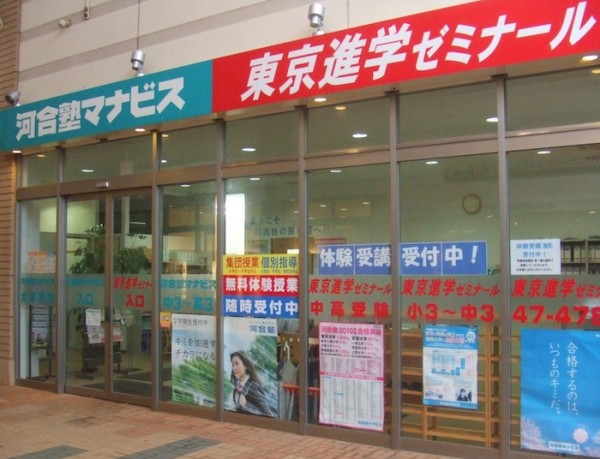
In Japan, you get the education you (the consumer) pay for

Image

Reposted from the Japan Times blog “Yen for Living,”  written by Philip Brasor and Masako Tsubuku

Last week, the Organization for Economic Cooperation released a list that ranked the 31 member countries with “comparable data” in terms of public spending on education as a percentage of gross domestic product. Japan came in last at 3.3 percent. The average percentage was 5.0, with Norway at number one with 7.3 percent. However, in terms of private spending as a proportion of all expenditures on education, Japan came in third out of 28 OECD member countries with comparable data, at 33.6 percent. Only South Korea and Chile were higher.

These findings were based on data from 2008, which means they don’t take into consideration recent changes implemented by the Democratic Party of Japan. The most relevant change in this regard is the government’s decision to waive tuition for high school students by paying subsidies to local governments. High school is not mandatory in Japan, and even public high schools require fees of some sort. These subsidies will probably change the OECD’s rankings when it compiles a list for public spending in 2011, but it may not have any effect on the list for private spending. One of the reasons the DPJ pushed the tuition-free policy is because the party recognizes that in the current job climate even entry-level, minimum-wage service employment requires a high school diploma. The days when junior high school graduates were solicited for factory jobs and other blue collar work is long gone. But compared to many of the other costs that parents pay to have their children educated, public high school tuition is almost like a drop in the bucket. According to education ministry figures for 2006, the average publichigh school student paid ¥112,000 a year in tuition, which is certainly high for lower income families; but at the same time, the average public high school student also paid ¥176,000 a year for outside cram schools, or juku. Altogether, parents paid on average ¥520,000 a year in education costs for a child if he or she went to public high school, which is about half the cost for private high school students, who paid on average ¥1,045,000 a year (including ¥785,000 tuition and ¥260,00 for juku).

But it’s really in elementary and junior high school where costs mount, since you have to start “investing” early on to guarantee that your child will get into a name brand school, which in turn guarantees a better job down the line; or so the thinking goes. This starts in kindergarten, which is also not mandatory in Japan though almost every Japanese child attends. It costs about ¥500,000 for 2 years, mostly in “incidental fees,” for public kindergarten, ¥1 million for 2 years of private kindergarten; though some local governments, like Shizuoka Prefecture’s, subsidize kindergartens, thus bringing the cost down considerably. About 80 percent of Japanese kindergartens are run by private entities.

On average, parents spend a total of ¥2.76 million per child for all six years of elementary school if the child goes to a public institution, and ¥8 million if the school is private. Strictly speaking there is no tuition for public elementary and junior high schools, but there are lots of incidental costs, including lunch, which typically runs to ¥40,000 a year, and kyoikuhi, or “educational fees” for things like field trips and supplemental materials (textbooks are free) that run to about ¥55,000 a year for elementary school and ¥130,000 for junior high school.

But it’s juku where the real money — and the difference — is. The whole point of juku is to prepare a student for the next level of education by giving him or her the tools to pass entrance tests, which means the closer to graduation the child gets, the more money is spent. It is also where public school clients outspend private school clients, at least on average. A public junior high school student spends ¥471,000 a year while the private junior high school student spends ¥1,269,000; but public students spend about ¥20,000 more per year on juku than do private students. That’s because almost all public junior high school students have to take entrance tests for high schools, while about half of private junior high school students will matriculate to the high school affiliated with their junior high school (and some will even go on to the affiliated university). Private schools are profit-making businesses, so it’s against their interest to discourage continuing students with entrance exams.

Only 6.7 percent of junior high-age students attend private schools, and juku is considered such an integral part of a public school student’s education that many local governments provide funds to lower income families so that they can pay for juku. Since 2008, Tokyo has provided up to ¥150,000 a year for juku to students whose family receive welfare, the idea being that such subsidies are necessary to “break the cycle of poverty.” The education credo in Japan guarantees that the juku and private school industries will always prosper. Last year jukus raked in ¥371 billion in revenues.

Update (Sept. 25): The education ministry yesterday released the results of its annual survey of how many families receive supplemental educational assistance for elementary and junior high school students. Supplemental assistance is money to pay for things such as school excursions, stationery and other materials that students have to pay for themselves. It is given to students on welfare or those from low-income families. In 2010, 1.55 million students received the supplemental assistance, which is about 15 percent of all elementary and junior high school students. That’s 60,000 more students than in 2009. When the survey was started in 1995, the number who received assistance was about 716,000. Osaka prefecture has the highest portion of students receiving assistance, about 28 percent.

Married Women Want (Men) to Work

by Robert Moorehead

On June 4th, the Japan Times took a bold step in favor of women’s rights by demanding that Japanese society make it easier for women to balance work and family. In its editorial, the newspaper rightly notes that many Japanese women (86% of those surveyed) would like to work and raise their children, but find balancing the two almost impossible.

So, the Japan Times, in all its enlightened wisdom, advocates a “cool modern” solution (to borrow Arlie Hochshild’s term): companies and the government need to make it easier for women to work both jobs.

“In simple terms, women need to leave the workplace to pick up their kids from school and daycare centers, and take care of them at home. Several hours of childcare will not interfere with total working hours if companies find ways to accommodate their female employees.”

What’s missing from this discussion? Men. The words “men” or “fathers” don’t even appear in the article.

“The future will demand more responsiveness in all areas of organization [except from men, who are incapable of picking up their children from school and daycare centers]. For Japan to move forward both economically and socially, companies must organize themselves in new ways [just as long as women still have the entire responsibility of taking care of the children].”

“The answer to the famous question ‘What do women want?’ is clear — to work. [And what do men want? They also want women to work! At home! At school! At work!]” Besides, who wants dad picking up the kids from daycare? They get in the way of his after-work drinking sessions, and he can’t take them with him to the hostess bar … unless he gets the hostess to be his babysitter … Ah, a Japanese twist on the old solution to men avoiding raising their children? Filipinas get to be both hostesses and domestic workers at the same time?

Seriously, the Japanese economy could meet much of its future employment needs by opening its workforce up to the better half of its population. But simply adding a second shift onto Japanese women’s already busy days isn’t a solution.

Student Essay Contest – Reimagining Japan

This is from nipponnomirai.jp. Contest winners can receive 250,000 yen or an iPad 2.

McKinsey & Company recently convened 80 thinkers in and outside of Japan to share their perspectives on the future of the country. The process evoked candid and creative answers that came together to form the book Reimagining Japan: The Quest for a Future That Works.

To celebrate the publication of this special book and add to its rich mosaic of ideas, McKinsey & Company is organizing an essay contest. Participants are asked to select one of six essay themes addressing the future of Japan (details below), and submit essays of no more than 2,000 English words or 4,000 Japanese characters. The grand prize winner will be awarded ¥250,000, and five runners-up each will receive an iPad2. Winning student essayists will be recognized at an awards ceremony and their essays will be published on the Reimagining Japan website, http://www.nipponnomirai.jp.

Eligibility

【Student division】The contest is open to individuals of any nationality enrolled in an undergraduate or graduate university program in Japan, and to Japanese nationals enrolled in an undergraduate or graduate university program in abroad as of October 31, 2011

【General public division】The contest is open to individuals of any nationality who are living in Japan and to Japanese nationals who are living abroad under age 31 as of October 31, 2011

Submissions

Students are required to complete the online submission form and submit essays online and also send a copy by postal mail. The contest deadline is October 31, 2011* (submissions must be postmarked no later than October 31, 2011).

* Deadline has been extended to October 31 from September 30.

-Online: Please visit http://www.nipponnomirai.jp and click on the “apply” button to send your essay via e-mail (in .doc or .docx format) with your
①Name
②Address
③Telephone
④E-mail address
⑤Gender
⑥Date of birth
⑦Name of school/company
⑧Faculty&Major/department
⑨Class level(*student only)
⑩Theme
⑪Division(Student or General public)
-Postal address: Essay Contest Office, McKinsey & Company, Inc., Japan Roppongi FirstBuilding, 9-9, Roppongi 1-chome, Minato-ku, Tokyo 106-8509, Japan (please include your name, address, and telephone number)

Essays must be prepared in MS Word in either English or Japanese, and be no more than 2,000 English words or 4,000 Japanese characters in length. This count excludes any footnote citations or bibliography. The file size should be 10MB or less. Essays will not be returned after the contest.

Themes

Essays must cover one of the following six themes:

  1. Reimagining Japan “My vision” (the overall theme of Reimagining Japan)
  2. Revamping Japan’s economy
  3. Japan’s role in a globalized world
  4. Recapturing Japan’s leadership in technological innovation
  5. Developing the future leaders of Japan
  6. Revitalizing Japanese society

Judges

  • Tadashi Yanai, Chairman, President, and CEO of Fast Retailing Co., Ltd.
  • William H. Saito, President of InTecur Inc.
  • (We are going to expand our list of judges before the end of the contest)

Winner notification

McKinsey & Company will notify winners by post an announcement on the websites in December 2011.

Awards

The grand prize winner will be awarded ¥250,000, and five runners-up will each receive an iPad2. Winning participants will be recognized at an awards ceremony, and their essays will be published at http://www.nipponnomirai.jp and other selected websites of McKinsey & Company.

All participants will be invited to a planned gathering with judges and senior McKinsey & Company consultants.

Conditions

Only one submission will be accepted per student. Students must work independently (no joint submissions). The work must be original and not previously published.

All participants who submit an essay agree that McKinsey & Company is permitted to display their essays on websites, and publish them in upcoming books and periodicals by McKinsey & Company.

The Reimagining Japan essay contest, essay submissions, and contest results are separate and unrelated to McKinsey & Company’s recruitment process. All decisions made by McKinsey & Company in relation to the essay competition are final.

Contact

McKinsey & Company, Inc., Japan, Essay Contest Office

–E-mail: nipponnomirai@mckinsey.com
–Address: Roppongi First Building, 9-9 Roppongi 1-chome Minato-ku, Tokyo 106-8509, Japan

Contest organizers

McKinsey & Company, Inc., Japan; Shogakukan