Japanese as Identity

We have to think that there is the possibility that encouraging people to use English may destroy Japanese identity. I am Japanese. One of my identities as Japanese is that I speak Japanese. The nature of this language, I think, is related to Japanese traditional feature. Japanese people beat around the bush by using various Japanese expressions, which can be connected with the fact that they are very sensitive to the situation. I feel, although this kind of Japanese national character is often criticized by foreigners and even Japanese, this is good character of Japanese, and the language, Japanese, plays a important role in protecting Japanese cultures.

On the other hand, as internationalization, English is in the important position all over the world. Of course, in Japanese Society, the ability to speak English is significant. In fact, Japanese school gives high priority to English education and many companies like Rakuten encourage workers to speak English.

Taking account of the above, I would like to consider the relationship between English and Japanese in Japanese Society. Yukio Tsuda, the professor in Tsukuba University, will insist that Japanese government should enact the legislation of protecting Japanese at work. By making English the common language in workplace, he points out, some problems are caused. These are the lack of right to use Japanese and the social disparity by the ability to use English. Some people speak English well and can apply themselves to this environment, and other people strongly refuse English and cannot do this. He implies that it is strange that those who are lack of English ability can mean people who cannot keep up with the globalization or internationalization. He also thinks that protecting Japanese means growing up our patriotism. For many people his suggestion may be extreme example. But it is certain that the increase in the opportunity of using English causes something we have to deal with.

I like English and speaking English is vital in various environments. However, I think the time is coming when we think carefully about our languages in Japanese society. Working environment has influence on daily life like home. In the future, that the conversation at home by Japanese family is filled with English can be not rare. Moreover, talking in English may be more normal than that in Japanese in the long run. Will it be natural? What do you think about the position of English and Japanese in our society? Japanese people who will speak Japanese in Japanese society are originally not minority, but international society could make them minority in the future.

by Shinya Shimatani

Minorities and the Constitution

It has seemed that most ideas of minority were created arbitrarily. For example, Sugihara struggled with the bad images of “Zainichi” in “Go”.  I can agree that these do not apply to almost all of the “Zainichi” and we may try to see as what we think they are, which means that we should not put any bad meanings to the minority. Then, we need to think carefully about how to treat minority groups in reality. Can we deny the concept of minority? Is it possible to take the legal framework of minority away from one country?

What I want to say in this post is not that “Ainu” or “Okinawan” people are struggling with their identities because they are in a minority group even though they have a Japanese nationality, and what the Japanese identity is, but that it is inevitable to create “minority” unless you believe that we, all people who live in this earth, are totally equal, sharing same value, culture, and denying the coexistence of  nations.

Then, I want to focus on how the Japanese constitution treats minorities, or foreigners. Since  it is only applicable to Japanese people, people who have a Japanese nationality, it is not supposed to guarantee the rights of non-Japanese. This is a intentional, but unmalicious creation of minority. Even if you say that human rights are natural, and inalienable rights, it is almost impossible to undermine the principle of popular sovereignty. For example, foreign residents are not allowed to have a suffrage by its nature. However, considering article 98, many people believe in theory that since some foreigners are domiciled in Japan and their lives can get directly effected by their local government , local suffrage should be allowed to them. Actually, the Constitution does just mention that “ The people have the inalienable right to choose their public officials and to dismiss them.” in article 15, and does not ban giving the voting right by law.

Then, what can they do? How about the degree of  their freedom in Japan? There are still lots of limitation of rights. Freedom of entry, re-entry, and stay are not guaranteed. The reason is that every state have its sovereignty and right to protect its  security from others, or foreigners. Even if you get permitted to enter one country, it does not mean that you can stay there, and (even if) you are free to leave, it does not mean that you are free to come back to the country.

Regardless of a matter of good or bad, creation of minority is unavoidable. As Sugihara said in the movie that the word of “Zainichi” implies that they are supposed to return to their country, this is totally true. However, the point of this problem is not the word itself, but the false interpretation of the significance. This would be the most difficult and perpetual problem.

※ Article 15 :  The people have the inalienable right to choose their public officials and to dismiss them.All public officials are servants of the whole community and not of any group thereof. Universal adult suffrage is guaranteed with regard to the election of public officials.

In all elections, secrecy of the ballot shall not be violated. A voter shall not be answerable, publicly or privately, for the choice he has made.

※ Article 98 : This Constitution shall be the supreme law of the nation and no law, ordinance, imperial rescript or other act of government, or part thereof, contrary to the provisions hereof, shall have legal force or validity.The treaties concluded by Japan and established laws of nations shall be faithfully observed.

by Kudo

Illegal Immigrants in Japan and the world today

There are many illegal immigrants in Japan today, and also illegal immigrants with fake official documents. I want to see how nations should try to treat immigrants and their own citizens, and think about how the world can change its policy towards non-nationals.

To draw a line between Japanese and non-Japanese people, there is one big question. What makes a person Japanese? Japanese government takes Jus sanguinis, that is, right of blood. Therefore, to become a national in Japan on the official document, you have to have a Japanese national in your family. Then how close does that family member have to be? You have to have Japanese person among one of your grandparents or parents on the official document. However, it is possible, for example, that a person in Peru “happens to have Japanese grandfather” and buy or make fake document so that they can work officially and get the equal rights in Japan. That crime was popular at the beginning of 1990 when the Japanese Government accepted Nikkei Peruvians.

It is a cunning idea, but they want to make their life better if there is a chance. But why does a state limit their citizens? It is because the government want to put people under their control and do not want any social or economic problems. For example, tax, crimes, unemployment, etc. Now, Jus sanguinis or Jus soli (right of land) are the only ways that the government can control people in this world where nation-states are the mainstreaming concept. However, world is becoming much smaller in internationalization. And people have to pursue their economic gain because they will lose if they do not earn enough in capitalism. I am not saying that all the immigrants should be accepted in Japan whether they are legal or illegal. But I do not think an immigrant has to be treated as second citizen when they pay full tax, either.

Therefore I think it would be great if states can see people of their own record, not by their blood or historical heritage. Then it may make people’s lives better. I know it is too ideal, but then blood won’t be an obstacle in life.

by Kumi Nakamura

Blinded by Education

Education is a powerful tool that could impact our philosophy. Education is often argued to be the cornerstone of a society; and indicator that determines the future of that country. I used to think that education could opens up our eyes to the truth, but I found out that it could also blind us.

I once got into an argument with a friend who is a Zainichi Korean. We met during a study abroad program in our freshman year and got along just fine. I often asked him about his childhood because I never had an opportunity to meet someone who went to Chosen school. It was fascinating to hear how things were taught, and how students mix a Japanese word with a Korean sound, and create a new word. Then, I asked him how he saw the current situation in North Korea. He replied that North Korea is on its way, and that all the stories about the hardship people in North Korea is forced to live under, are lies.

At first, I thought he was joking. There are researches and interviews with North Korean escapees that strongly suggest that North Korea is far from being well off. But he wasn’t. He continued that even though it seems hopeless now, North Korean policies are aiming for an enriched development in the long run (like 100 years). He argued that most of the education around the world is lead by the U.S., and the U.S. is trying to make North Korea appear evil—and that, I, as a Japanese, never questioned if there is truth in the education. After a while, we concluded that if, as he argued, I am skewed in my perception on North Korea, then I could claim vice versa and say that his perception is just as skewed as mine. It was not the best agreement, but we could not find any alternative.

He also mentioned that his children would go to Chosen school to learn the history of Chosen and Zainichi, because pretending to be something else would cause more pain for them, and that the memory of Zainichi suffering in Japan should not be forgotten.

This was in our freshman year, so things may be different now. But I think that there are as many Zainichi Koreans who would agree with my friend as who would disagree. I do not necessarily think that children need to go to Chosen school in order to remember the Zainichi history, and that children should be given the choice to choose what education they want to receive. But I could see how his parents, who suffered from discrimination far more visibly than today, would have wanted him to avoid such hardship.

I believe that education is a form of perspective, and we must be cautious of how our education makes us think. Easy as it sounds, I cannot be certain that I could ever think in the same manner as my friend about North Korea. But at least we should try to accept various ways of thinking before reacting to them—who knows where the truth lies.


Changing our thinking about identity

Zainichi Koreans had been discriminated against. The first or second generations of them really know the hardness of living as Zainich in Japan. On the other hand, the third and fourth generation of them have grown in Japan same as other Japanese. They also have been suffered from discrimination, but their problems are related to identity rather than discrimination. They would think and think again about their identity: “Am not I Japanese? Am I Korean?” I think there are some hints in plural society, the US.

“Cultural Pluralism” is one of the thought that deal with plural society. It said that ethnicities are always being re-made. Ethnicities are not fixed, but they keep changing. Glazer and Moynihan said in ‘Beyond the Melting Pot’, that Ethnicities “are continually recreated by new experiences in America”. They meant Irish American are not same as Irish in Ireland. In the light of these, I would say Zainichi Koreans are neither Japanese nor Korean; they are “Zainichi Koreans”. They are different from Korean in Korea because they did not grow up in Korea with Korean culture. They grew up in Japan same as Japanese, but they are quite different from other Japanese because their background is in Korea. If they really want to be Japanese and cannot, it would be bad for them and really unfair. However, at the same time, they do not have to be Japanese. They can be different and claim their right and identity. Who have to change their way to think is rest of Japanese. They need to accept diversity in Japan.

by Nana Uno

Immigration in Norway

Back when I lived in Norway I didn’t really have any problems with immigration. The town I lived in, despite only having a population of about 2000 people, had a lot of immigrants – with many of them being from Chile. Some of my best friends growing up had parents from another country, and my mother worked as a Norwegian language teacher for foreigners. Once a year, there would be a market where they sampled food from all over the world. This enabled me to experience a lot of different cultures in a relatively small community. When I moved away to one of the bigger cities in Norway in order to start studying at the university I realized how different the situation was there. Not all the immigrants got the proper follow-up while they were learning the language, and many immigrants had problems getting jobs because of their cultural backgrounds or their lack of knowledge of the language. I also noticed that people I talked to sometimes reacted negatively to the topic of immigration. Norway is a wealthy country, and one of the reasons people against immigration usually give for not wanting more people to enter the country is “having to pay tax which is in turn given as support through the welfare system and sent back to the home country of the immigrants”, among other things. On the other hand, since immigrants sometimes have such a hard time finding jobs, what other choice do they have than to rely on the support from the state?

On the 22nd of July 2011, a bomb went off in the capital of Norway, in one of the parliament buildings. On the same day, a youth camp for the Norwegian Labor Party was attacked when a man opened fire on the attendees. Before the attack on Norway, the right-wing parties in favor for closing the borders and letting less people into the country had experienced a boost in voters, but after the attack the left-wing parties gained more support. An election that had been scheduled beforehand was to take place not long after the attack, and was carried out despite the disturbances the country had faced. The election showed less support for the parties that fought the most for less immigration. The attacker claimed he had done it in defense of the “Islamic invasion” that was about to overtake the country. This fierce stance against a different culture and immigration in turn led to harsh criticism against the right-wing parties’ previous campaigns and advertisements for shutting down the borders and not allowing more immigrants into the country.

Another case that gained a lot of attention in Norway is the writer Maria Amelie, who after writing a book about being an illegal immigrant in Norway despite having lived there for almost 10 years, was deported from the country. After the publishing of the book she was arrested and deported to Russia. This case sparked a discussion on treatment of immigrants and how their stories often went unheard, but also made Norwegians question the current laws for immigration and asylum. Some claimed the Maria Amelie-case overshadowed some of the other immigrants in more dire need of support, but in the end it also put a focus on immigration in the media. The case also led to political debates, and changes made to the rules for applying for permits for staying in the country. Following this, Maria Amelie was allowed back into Norway on a work permit in April, 2011.

The country has faced hardships recently, but I believe the recent events have made an impact on people’s views, and I think it’ll be interesting to see how Norway’s stance on immigration develops from now on.

by Sindre Berg

China: The Waterloo of McDonald’s

Do you know what KFC restaurant is? I think for Japanese maybe they have an impression of it but compared with McDonald’s, it will soon be nothing to speak of. It is not strange as there are 3736 McDonald’s restaurants and only 1,137 KFC restaurants in Japan. Globally, McDonald’s is the world’s largest food and beverage group and the parent of KFC, Yum Brands Inc., is always defeated by McDonald’s in most markets even though it owns many big brands like KFC, Pizza Hut and etc. However, there is one exception, China. Maybe for people in other countries, it is amazing to find there are about 3200 KFC restaurants and it is almost 3 times of McDonald’s. Also KFC takes great advantages of market share. Obviously, McDonald’s met the Waterloo in China. But, why is that? As far as I am concerned, it is a result of the two groups’ different attitudes towards Chinese local food culture.

KFC restaurants in China are selling Chinese style meals sets

Professor Robert mentioned that the way of Hong Kong McDonald’s treating leftovers is actually a kind of mixture and combination of two different cultures. I regard it as a consequence of compromise of foreign culture and local culture. At the beginning, both KFC and McDonald’s came to China holding the same wish to make western food a new significant character in the meals of Chinese. But unfortunately, they underestimated the power of Chinese local food culture. Some Chinese did try to eat western fast food but as the price of Chinese food is furthermore affordable in 1990s, and rice is still the main character on dining-tables of Chinese, the two groups met a very odd situation as a Chinese phrase goes, they ” fail to adapt the local climate ” They had to make changes to survive in this emerging market. The first one started to make changes is KFC. As some Chinese prefer hot food, its first attempt was made to develop the Hot Chicken Burger only for Chinese Market in 1992, which is universally acceptable at that time and still popular now. Through the development of 30 years, now KFC restaurants are even selling Chinese style meals sets (The staple food of the sets are rice) in China. The culture of KFC was shaped by local culture greatly. However, compared with KFC, the localization process of McDonald’s is not that strong, and it chooses to insist on its own developing style in Chinese market. McDonald’s is much “pure” as a western fast food restaurant.

Though reasons for the success of KFC in China actually also include some other factors, I still think its development strategy of localization is the most important one and it does fit the market of China. Chinese fast-food market, as a local practice, retained a sense of agency in the face of global economic forces and even influenced the global forces itself. The cultural impact of McDonald’s is really powerful, but it seems that Chinese food culture owns more tenacious vitality than McDonald’s expected. Cultures are interacting all the time, so we must try to find the balance of it otherwise we will be surely swallowed in the wave of accelerating globalization.

by. John Wang

 Reference

Introduction to KFC in China and Japan

China: http://www.kfc.com.cn/kfccda/About

Japan: http://japan.kfc.co.jp/qa/kfc.html#F02

China: http://career.mcdonalds.com.cn/join/index.aspx?sub=1

Japan: http://www.mcdonalds.co.jp/company/index.html


Cultural Capital in Japanese Education

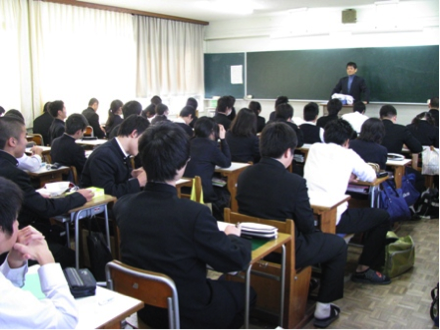
What is the most difficult thing for an IR student who takes class for GS students is that he or she needs to express oneself in class.  I’m one of such students and have a little trouble to expressing my own ideas in the class.  Of course, I know that one of the main reasons is from my poor English.  However, I think that the problem is the difference between education system in Japan and that in other countries like America, which influences how students behave in the class.  Also, Japanese people have a different view to express their own ideas.

First, in Japanese class room, a teacher just teaches and expects students to listen to the lecture silently.  Japanese educational system puts more importance on listening to the teacher’s lectures and gaining knowledge from teacher rather than expressing their own ideas and learning from other students’ ideas as well.  Students sit on a chair, listen to a lecture, and take notes silently.  Also, questioning or expressing their own ideas in the middle of the class is not welcomed by the teacher.  Some teachers see students who do so as an interrupter of the class and annoy them.  Eventually these students are labeled as troublemakers.  There is seldom discussion time or opportunity to express their opinions for students.


Second, Japanese people are tend to hesitate to sticking out.  The Japanese proverb that has been saying for a long time is a good example that “The nail that sticks up gets hammered down.”  This means that: (1) people are jealous of, hate, and disturb a person, who is distinguished in study or talented, (2) a person who sticks out are punished by others.  Japanese people regard speaking out in front of many people as a sticking out.  Therefore, students are not willing to express their own ideas in the classroom because they don’t want to be “hammered down.”

For these reasons, Japanese students are not accustomed to speaking out their own ideas in the class and tend to have difficulty to express their own ideas.

In terms of other country’s cultural capital, Japanese cultural capital seems so silly and incomprehensible, however in Japan, it is the cultural capital.  I didn’t realize a cultural capital of Japanese education system until I took a class for the GS.  There’s a different cultural capital in the class, so I spend a little hard time and sometimes cannot help think that Japanese cultural capital is so inferior to others in the class.  However, I think that Japanese cultural capital is not entirely negative but still positive.  Japanese people are not good at sticking out and expressing their own ideas, but they can listen to other’s ideas well.  Also, Japanese are not so assertive and have room to accept other’s good ideas.

Thus, each cultural capital is capital in that culture, someone who is unfamiliar to that culture may have difficult time.  I think that we don’t have to evaluate which cultural capital is superior or inferior, but the most important thing is “When in Rome, do as the Romans do.”

by Mayumi Kurosawa

Picture

Retrieved from (http://image.search.yahoo.co.jp/search?p=%E6%8E%88%E6%A5%AD&aq=-1&oq=&ei=UTF-8)

Men’s Fashion Differences – Japan and America

Nowadays, people’s fashion and hairstyle has changed, compare to that of in 100 years ago. It is notable especially for Japanese people. For instance, many Japanese men have long hair and clothes are sometimes even similar to what women usually wear. One of my friends in America told me that they are so weird. He seemed to not be able to understand why many Japanese men do not look like “men.” He also said that they are so gay. Well, I do not think so, because I am Japanese and live in Japan for 18 years. I would like to think about the difference of values of fashion between American men and Japanese men.

First, let’s think about the American style. What image do you have on American men’s fashion? For me, their fashion is very simple in good way. For their casual style, they wear relaxed jeans, T-shirts, and sneakers. Their hair style is much shorter than Japanese men’s. It is about the value so I do not think there are not specific answers. I think they do not mean they are not interested in fashion, but that simple style is comfortable for American men. Of course some men enjoy their fashion, wearing pierces, necklace, or dying their hair. However, I feel American men focus on what they want to wear rather than how they want to be seen by surroundings.

On the other hand, Japanese men’s styles are completely opposite. We rather care how we are seen by surroundings. If we think our legs are so short, we wear boots, though I heard some American think this is so gay. Japanese men wear tight shirts, pants, and jackets, which look like women. Even some men do make-up on their face so that they create strong impressions. Think about the past, in 100 years ago in Japan men had no time to enjoy their fashion because social rule was very strict. They were not even allowed to have long, dyed hair. However, the time has changed and it is now less strict to express their favorite styles.

As you read, there is a big difference of values between American and Japan. I noticed that this topic is deeply related to the social norms. If the society allows men to enjoy less strict fashion, they can do so. Even one of my friends wants to be a girl so he wears clothes like a girl. Perhaps the time will come that big strong American men start to wear girl’s costumes in few decades later.

by Takeshi Sakagami


References

http://www.americafe.net/maki/82/ 「日本人男性はゲイっぽい?」

http://norizo.com/ny/nynow/200011/hm.html 「ニューヨークの今日この頃」


Temples in Taiwan


This picture took in front of the Dajia Jenn-Lann Temple, in Chinese name 大甲鎮瀾宮. This temple consecrates the most famous deity of the sea, Mazu. The enormous popularity of Mazu in Taiwan is evidenced by the more than 400 temples dedicated to her and by processions in which her icon is carried on a palanquin to spread her blessings. Also, such spectacles can be seen all over the island, known as the “Dajia Mazu Pilgrimage”, which snakes through several counties in central and southern Taiwan for eight or nine days in the third lunar month depends on Mazu’s birthday that usually begins in March or April.

When did the temple appear in Taiwan? It can be traced back to the early immigrant society, during the Qing dynasty (1644-1911). The immigrants, most of them came from Fukien province in China, had to across the Taiwan Strait riskily. In order to keep themselves from harm during the dangerous trip; they carried with their sacred images, incense for the deities or amulets to seek for spiritual protection. For example, most of the ships carried image of Mazu, to assure calm weather and safe passage. Later on, as the immigrants and their new villages started to flourish in Taiwan, then naturally they started to feel a need to show gratitude for the deities’ divine assistance that had blessed them. So, they began to build temples to providing homes for the deities to worship. Temples play the roles which are memorial buildings, sanctuaries for the deities, and centers of faith for believers. Also, temples became community centers to strengthen connections between believers as well as normal citizens, especially in rural areas. Since, special ceremonies are held by temples on deities’ birthdays. Generally we refer these carnival-like events as temple festivals. Often each event will consists of “welcoming the deities”, “an inspection tour by deities”, “chanting of sutras”, and “outdoor stage performances of Taiwanese opera or glove puppet shows” to entertain the deities. Temples provide the place for people to prepare the festival together, to worship, to bless and to enjoy.

Besides, to attend regular religious services at one location, small outdoor or indoor shrines of local deities are also very common, and often can be spotted on roadsides, parks, neighborhoods, and almost everywhere. These small pockets of religious atmosphere let people stop by and pray informally anytime. Many homes and businesses may also set up small shrines of candles, figurines, and offerings. For instance, some restaurants may set up a small shrine to the Kitchen deity who protects the success in a restaurant business. Students may visit a shrine to the Learning deity for good luck before a test. People in Taiwan, their lives strongly connect with temples; I think it’s because the need of the whole society then created the existence of unique religion. Of course, it’s totally different from Buddhism or Taoist, because it blends all elements together at first, and diffused into society even more deeply. This religion is called “popular beliefs” that whenever people feel the need to seek divine assistance they will just visit a temple.

References

Picture retrieved 17th December, 2011, from http://www.flickr.com/photos/dans180/5601742094/in/set-72157600112213625/.


by Ying Yu Lin (Linda)