Shadow of Foxconns

Two weeks ago, Professor Robert told us something about capitalism and the inequality between workers and big corporations. During the class, I could not help but remember again about the topic I discussed with my GSC classmates about the “14 jumpers in Foxconn” issue. It was really impressive and this issue is a very typical example of global expansion of capitalism with the development of globalization. Many workers are in fact under the shadows of “Foxconn”s.

Foxconn, a very famous Taiwan-registered corporation, is the world’s largest maker of electronic components including printed circuit boards. Also, it is a representative factory of some of the most famous multi-national corporations like APPLE, SONY, DELL and so on in Guangdong, China. From January 23rd, 2010 to November 5th, 2010, 14 workers chose to jump off the building and died in this year because of the huge working pressure they were under. When the attraction was caught, Chinese people are surprise to find that the extremely bad working condition and working pressure is not the worst thing to those workers. In the agreement between the workers and foxconn factory, except for the basic eight-hour work request, workers were requested to sign an attached agreement which showed that they would volunteer to work overtime. Some of them were willing to sign the attached files for their monthly pay is only about 1300RMB (about 200 US dollars) which is a little bit higher than the minimum wage standard made by the Government of Guangdong Province. Most of these workers are peasant-workers and such little money sometimes even affords the basic cost of a whole family in a village of China. Besides, for many workers at the bottom of the company, their jobs are really boring. The only thing they can do is to repeat the same movement millions of times. With such kind of conditions, it will not be hard for us to imagine why workers would have the thought to jump off the buildings. In my opinion, it is still not the worst thing. We have a Foxconn factory in Guangdong Province, so how many “Foxconn”s are there in China? How many “Foxconn”s are there all over the world? It is certainly countless. Foxconn is just the tip of the whole iceberg.

Factories like Foxconn maximize profits by enlarge surplus value created by workers. To achieve this, they move manufacturing productions to developing countries so that they can decrease the manpower cost. In my opinion, as the normative system to govern the economic system was not completely established and people were anxious for success, many problems have arisen when developing countries were attracting foreign investment especially in 1990s. The conflicts between workers and corporations exist all the time. People have the right to make profit, but I think that humanity and moral standards are something basic beyond it. Since most of them actually do not have the ability to change it, we should pay more attention to this group of people and help them going out of the shadow of Foxconns.

Reference:
富士康员工跳楼坠楼事件_环球网(Chinese, means Foxconn issue_huanqiu website) accessed at http://www.huanqiu.com/zhuanti/tech/fushikang/

by John Wang
‘I Fought the Law and the Law Won’ — Protestors and the Framing Struggle

by Alex Bitcon

With over two million hits, the UC Davis pepper spray YouTube video has definitely gone viral. But what did the viewers tune in to see? Students rallying against high university fees? Or to see a group of people get pepper sprayed?

The article ‘The art of reframing political debates’ by Ryan and Gamson (2006) that we looked at in class suggests that social movements spend large amounts of money and time trying to perfect a ‘winning’ message.  For protest participants and observers, this translates to something very tangible and persuasive on the day. But what about the people that rely on the news media for their information? Ultimately a different set of objectives (to sell newspapers, appease advertisers etc) brings about a very different framing agenda.  This is evident when you look at the news headlines following the UC Davis protest such as ‘Pepper spray incident prompts protocol appraisal’, ‘UC Davis suspends officers’ and ‘Anger rises as police pepper-spray protestors at UC Davis’. The ‘new’ issue is police brutality and you have to read three or four paragraphs in to find out what the original protest was about. Conflict and controversy are a lot sexier; getting more hits and selling more newspapers. Plus it allowed the media to repackage an issue that was nearing the end of its newsworthiness.

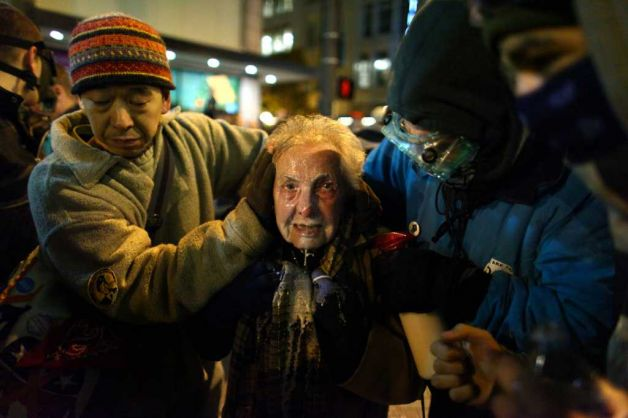
Media theorists refer to this as the protest paradigm, where violence and conflict is highlighted and protestors are framed as in ways that neutralise their message. Imagery, quote selection and headlines are all employed to frame-build and frame-set. Coming up to New Years Day there were a lot of ‘photos of 2011’ galleries online and you may have noticed the famous photo of an 84 year old Occupy Seattle protestor after being pepper sprayed. There are no visual cues to what the protest was about or where she is.


This issue really reinforces the challenges of frame control in the current media climate. Sustaining collective efforts is hard when contextual cues separate, for example, this protest from the wider ‘occupy’ movement. It also becomes easier for your protest to be trivialised. Nandos gimmick anyone? (Lt John Pike flavour – ‘5,000,000 Scovilles served directly into your face, while you sit’). It’s hilarious (sorry – it is!), trivialising and accessible without needing to know the background to the protest. It is also makes you wonder what the 2 million YouTube viewers really came to see…

Identity Crisis of Biethnics Living in Japan

In Japan, the numbers of biethnic children are increasing due to the increase of international marriages. The term Biethnic comes from the article, An identity based on being different (Oikawa et al. 2007), which is pointing at those who have a Japanese parent and a non-Japanese parent, which in Japan is usually called “Haafu” (Half), “Mix”, or “Double”. The terms “Haafu” (Half), “Mix”, or “Double” are taken negative to some biethnics so the author have chosen to use the term “biethnic” to describe them which will be more neutral. These biethnic children face identity crisis living in Japan because of their appearance.

Biethnics who have a parent that is non-Asian will face the difficulties of having non-Asian appearance which makes them stand out of the homogeneous society in Japan. Even those who have been living in Japan their entire lives, those who have a Japanese cultural identity, cannot blend into the Japanese society easily because of their non-Asian look (Oikawa et al. 2007, 642). On the other hand, those who have a parent that is non-Japanese but Asian will blend in the Japanese society very well because no one notices that they are biethnic. However, when they show their non-Japaneseness, they will face difficulties trying to make others understand that they are biethnic (Oikawa et al. 2007, 638).

In the research by Oikawa, she has discovered that there are three types of reactions in order to identify who they are, which are: Unique Me; Model Biethnic; and Just Let Me Be Japanese.

Unique Me is those “who do not like to be stereotyped and who wanted to be seen as unique individuals (Oikawa et al. 2007, 644)”. There are many positive stereo types towards biethnics (such as pretty/handsome, stylish, tall, bilingual, etc.), but to Unique Me, this does not mean anything. They think that although they are biethnics, it does not mean that everyone is the same. Unique Me does not want to be categorized as one type of biethnic.

Model Biethnic is those “pleased to be associated with the prevalent stereotypes, most of them being positive, of Biethnic individuals in Japan (Oikawa et al. 2007, 644).” Model Biethnics prefer to been seen as the stereotypes mentioned beforehand, since it makes them seen as special people.

Just Let Me Be Japanese, are those who want to be treated like Japanese and they even wished that they looked more Japanese. This appears to those who have been living in a complete Japanese society for their entire life and they are completely Japanese inside.

These different reactions towards their biethnic identity appear to be not permanent. Biethnics change reactions over time, and sometimes fit into two different categories depending on the identity crisis they are going through. Identity crisis cannot be avoided among the biethnics.

Sources:
Oikawa, Sara, and Tomoko Yoshida. “An Identity Based on Being Different: A focus on Biethnic Individuals in Japan.” International Journal of Intercultural Relations. 31. (2007): 633-653.

by Rashel Phillips

Special Recognition of Third Culture Kids in Japan

The number of Third Culture Kids (TCKs) has increased its number due to globalization. TCKs are children who have lived in more than two countries other than their parents’ countries until they turn eighteen. In 1998, it was  estimated that there may be over four million TCKs globally. Considering that this estimation has been made over a decade ago, it can be expected that this number has grown significantly. Although the numbers of TCKs are growing, not many countries recognize them. However, in the study of TCKs, Japan is often raised as a good example of dealing with TCKs. Japan gives special recognition for Japanese TCKs as kikokushijo and provides special programs for them.

In the past, kikokushijo did not have a positive image, since many of them were “westernized” which caused them to lose some of their Japanese identity and that they looked arrogant to the Japanese. However, recently, their status is changing because their ability of languages and cross-cultural skills is starting to be valued (Fail et al. 2004, 325).

According to Goodman, kikokushijo are commonly defined as those “Japanese children who have lived overseas (Normally thought of as the “West”) for such a long period of time that they have lost many of their Japanese cultural traits; have certainly forgotten many of their Japanese-language skills; and have become imbued with non-Japanese ways of behaving, most notably with Western ideas of individualism (Goodman 2003, 178).” However, this is just the general definition to the term kikokushijo. There are many children that do not exactly fit this definition but still are considered kikokushijo. Goodman gives five general features that those who are considered kikokushijo have in.

1. Both parents of a kikokushijo are Japanese.
2. They went overseas before they are twenty years old.
3. They went overseas because of their father’s temporarily post overseas.
4. They have been overseas for more than three months (This is because if it is less than three months it is more like being a tourist than a kikokushijo).
5. When they return to Japan, they will enter schools that are part of the mainstream education system rather than going to an international school.

Because of Japan’s recognition of the existence of TCKs, Japan has created programs for them so that they will have to face fewer difficulties coming back to the Japanese society. Programs for kikokushijo were created because the Japanese felt sympathy for them since they did not choose to go overseas but had to go overseas due to their parents’ business. Since these kikokushijo have missed a large part of the Japanese education, it is hard for them to catch up to it. This would be a huge problem for the kikokushijo because in Japan, education is very important and in order to have a good job in the future, people must go to college. However, with the lack of the Japanese education kikokushijo have, it will be very difficult for them to enter college or even to high school as there are exams for applying for high school as well. As a result, many schools, including colleges, have considerations for the kikokushijo having special allowances to enter schools. Nowadays, there are many schools which have sections “for the kikokushijo”. Being kikokushijo in Japan is now a privilege because they have special education advantages.

Sources:
Eakin, Kay Branaman. According to my passport, I’m coming home. Washington, D.C.: U.S. Dept. of State, Family Liaison Office, 1998.
Fail, Helen, Jeff Thompson, and George Walker. “Belonging, identity and Third Culture Kids: Life histories of former international school students.” Journal of research in International Education. 3. (2004): 319-338.
Goodman, Roger, C. Peach, A. Takenaka, and P. White, eds. Global Japan: The experience of Japan’s new immigrant and overseas communities. New York, NT: RoutledgeCurzon, 2003.

by Rashel Phillips

Is My Future Secure?

I am majoring in Japanese and International Business as well as a minor in Asian Studies in America. Of course, when we go to college, we are going in order to find a job making good money, but also trying to find something we will enjoy doing for the rest of our lives. I chose Japanese as a major, but once I truly thought about having just a major in Japanese, I couldn’t come up with many job opportunities.  So that is why I decided to study International Business as well. Needless to say, Business isn’t my cup of tea, but it is educational and opens a whole new world of opportunities once I graduate.

Now, having experience in big business, I can’t say that I like it, but the pay is good, work is not as physically demanding, and it keeps the kids fed (I don’t truly have any kids…). Working at this Appraisal Management Company for a few years, I have truly felt the life of a college graduate, minus the loan payments. The stress involved in business is beyond explanation at times, especially when a client calls in with nothing but complaints and you don’t know exactly how to make them happy anymore. You can also be the best worker there, working the most hours, and having the highest production, but the old lady sitting next to you is making twice your salary. You stress yourself to no end to make sure you don’t lose your position when layoffs come through.  To this day I will never forget the fear of receiving the call to come to the presentation room (means you’re about to lose your job). Everyone was on edge and worked as hard as they could, making the environment at work not very bright and sunny.

The point I’m trying to make is, job security/insecurity can play a massive role in the way you perform or the way a business runs. Being on the job knowing that in two weeks a new group of people are going to be let go leads you to work like a mule. In Japan they even have a word for this kind of work, KAROUSHI 過労死, means “Death from Overwork”. It’s sad that this is a vocabulary word well known in Japan, but I guess it’s possible! Japan is a prime example of people being overworked without extra pay, without full job security (especially in the beginning of their career), and without time off in years to spend time with family. The stress from work reflects back onto families more than people realize. I believe that Japanese families tend to fall in that category more often than not.

In conclusion, I’m not 100% sure that I will have the job of my dreams when I get out of college, but I know that I want to relate my work with the Japanese language. My biggest worry is that I would not be able to support a family in the future. I want my family to have things, not to JUST get by. I think we all share this same hope. I wish you all the best!

by Aaron (AJ) Glass

The Outlook on Tohoku

We all know of the “Great East Japan Earthquake” that happened earlier this year and how devastating it was. It has had a massive effect on the Japanese economy, but I also want to talk about some of the other effects it has had on Japan and other countries in the sociological aspects.

First point I would like to talk about is the relief efforts the world has put forth to help Japan in their time of need. It is truly something that is hard to express in words. This picture is a map of the countries of the world that offered assistance to Japan by either donating or by sending rescue squads to Japan in their time of need. This has been a very hard year for Japan, and it was great to see how the world came together to aid them.

The international response to the events that took place in the Tohoku region have been mixed through media. Due to the news and media coverage in foreign countries during the earthquakes, tsunamis, and radiation people’s view on Japan has changed in good and bad ways. From my own personal experience, the news broadcasted in America about the radiation and lack of food in Japan was blown out of proportion in my opinion, and because of this, I was forced to return back to America even though I was living in the Kansai region. Many countries, when they heard that the earthquake had occurred in Japan, they believed that the whole country was in jeopardy. It was not only American media, but many other students studying abroad were called back to their homes, especially Europeans. This also cancelled many study abroad options this year for foreigners going to Japan due to liability issues.  This is just one of the international results from the Tohoku events that took place.

Another important point I would like to bring up for discussion is the fact that many people who lost their home have had to go through hard times in recovery and some have had to resort to moving to different places in Japan. Also, think about the effect this has on the children of those regions that were hit the most. I’m sure their lives have been completely changed due to the earthquake. I understand that this is a hard topic to talk about, especially for Japanese people, but I would like to see how everyone views the events that took place and how they were handled or broadcasted in your countries. When a disaster strikes a country like this, think of the drastic changes that take place in families and countries. I believe that countries, through help form the rest of the world, pick themselves up and become stronger because of disasters such as this.

by Aaron (AJ) Glass

To Be “Japanese”

I think that many Japanese people tend to distinguish between Japanese and so-called Gaijin. As Japan is consisted by 98% of japanese people and almost all people in Japan speak japanese as a first language. Some people sometimes insist that japan is a racially homogeneous nation, which is not true. And the rest of the people in Japan are mainly from Korea or China, so it’s hard to figure out that they are not Japanese unless they speak. However when we see those who seem to be from Europe or Africa, we say “oh there is a gaijin over there”, even though they have been officially allowed to live in Japan or were born in Japan.

To be recognized as a Japanese, we have to look like Japanese or eastern Asian. For example, Bobby Ologon is one of the most famous gaijin in Japan. He’s lived in Japan for many years, speaks Japanese very well, has a citizenship and his real name is Konda Bobby. However when he show up on the TV, we see him as a gaijin and nobody treats him as a Japanese.

What about Hafu? The most famous Hafu is probably Becky. She is actually from kanagawa and one of her parents is British. she is the same as other japanese people except for having a british parent, however many Japanese would think she is a bit different. Is it because she is a Hafu? That’s not true. Rie Miyazawa, for example, Is also a Hafu of Japanese and Dutch parents, but we would’t think she is different at all. We even think she is an actress who represents Japan. The difference between Becky and Rie Miyazawa is only their looks. Becky doesn’t have Asian tastes, but Rie Miyazawa does.

I do think that many Japanese tend to judge others from how they look. Japanese usually feel relieved by acting just like the same as others, and we tend to dislike those who stand out.  I think this way of thinking is a bad heritage from our ancestors. This idea could lead to bullying or discrimination. We could hurt their identities.We have to get rid of this way of thinking to create a better society.

by Yuya Kuori

Not Your Ordinary American Blend

A couple weeks ago, I walked into a Starbucks store in Kobe. While I was waiting in line, a staff came around offering new beverage – Azuki Matcha Latte. Azuki Matcha Latte, as the name suggests, is a hot latte beverage made of green tea, red beans, and steamed milk. Although I didn’t end up buying it, I was awed by the creativity and originality of Starbucks Japan. Yet this is not the only limited-edition sort of drink created by Starbucks Japan. Twice a year or so, the company launches a number of drinks unique to Japan: the popular Sakura beverage series that comes out every spring, the regular Green Tea Cream Frappuccino, and this season’s special Soy Houjicha Tea Latte.

Starbucks’s such attempts to blend in the Japanese culture into their worldwide recipe is one daily life example that demonstrates the peaceful fusion of foreign and local culture. In this time of globalization, as we all hear repeatedly, there are increasing clashes between local culture and the massive influx of foreign culture. In many parts of the world, this foreign culture is often from the west, America in particular. Some worry that this expansion of global cultural hegemony – of the US, for example – will uproot the traditional local values.

The concern holds true, but only to a certain extent. It is undeniable that historic traditions are now no longer of daily routine but of special events; that time-honored traditional values are indeed no longer as rigorous or revered as they were in the past. However, I think the Starbuck examples show the successful cases in which global forces did not take over local culture but rather, were peacefully incorporated into it.

As James L. Watson says, we – as a culture or nation – maintains our self-agency that ‘filters’ such global forces. How strong or resilient the filters are, it depends. Global forces from the outside transforms what is inside, just like we see Starbucks standing in the middle of Gion, Kyoto, the ancient capital of Japan. But at the same time, what is inside changes how this outside force is going to be accommodated, just like we see Green Tea Frappuccino.

The possibly disastrous forces of culture hegemony can be – and are – absorbed into local practices, resulting in distinctive fusion. When Starbucks Japan’s board of directors approved the idea of Azuki Matcha drink, it was probably purely for business purposes. But the chain of thoughts behind the decision that it would be profitable was that the drink contains uniqueness of Japan. So next time when you are at a Starbucks cafe, why not try this small drink with some very significant meaning? 🙂


by KyungYeon Chung

Revoking Our Labels: Impact on the Social Images

The process of labeling is at the heart of our communication, because labeling, or naming, is about differentiating one group from the rest (male and female, up and down, right and left, arms and legs, etc). The names help us to share the context of what we want to convey, and makes our communication efficient. In fact, the power of label is so strong that it could have a strong impact on how we perceive the world.

In terms of society, we have a horrific history of creating social hierarchy based on racial labels. Japan is no exception, where the society is segmented and ranked, and social labels categorize us by means of appearance, by profession, hobbies and so on. Also, social groups are often given labels in order to separate the majority and the minority. For example, being called a Japanese-Peruvian is not saying that you are Japanese AND Peruvian, but rather categorizing you into something other than Japanese or Peruvian. I believe that today, such labels are used for discriminatory purposes in a very dangerous way.

Many experts such as Alexander, the author of “The New Jim Crow”, suggests that poverty and incarceration are integrated into certain community in the United States and Britain through forming a social structure where target community is easily oppressed under the name of “law and order”, and blinding the rest of the society through deliberate negative connotation to target cultures. Both in Britain and United States have stereotypes that connect violence, crime and drugs to Black, Latino, Arab and young communities (Alexander, 96). It is not only the ethnic profiling by the police that is spreading the negative image to certain people. It is the underlying recognition penetrating through the society that makes society blind and slow to react to the condition that these communities face.

I believe a similar pattern can be seen in Japan as well, where we discriminate against certain social groups only based on the group they belong to. For example, Chinese are seen as extremely wealthy or extremely poor, Zainichi Koreans has a long history of being blamed for all types of crimes, and these images are subconsciously reminded through news media and rumors. Of course, many of us know that such prejudice is false but I believe that the collective stereotypes are rooted deep inside our society, and it will not go away overnight. At the same time, I am not a believer of under-labeling. Calling all Zainichi and Peruvian-Japanese as just “Japanese”, and treat them as if they are no different, is disrespecting their background and oppressing their identities. We must continuously recognize the strength of labels, and try to assess the positive/negative connotation that is attached to it. This may not be the best solution, but I believe the society could only change when each member is consistently trying to change. Perhaps we will someday be able to accept differences in social groups as a fact, rather than treating them as “exceptions” of our society.

Works Cited
Alexander, Michelle. The New Jim Crow. New York: The New Press. 2010. Print.

by Nanako Kurioka

Why people in Japan chose to put billboard for foreigners?

Anonymous student post

Because we live in an island country, I think in Japan people don’t normally see foreigners especially outside Tokyo and Kyoto area. This situation makes them conspicuous. As a result, even they commit a crime less than Japanese do, people feels like they are committing a crime more than Japanese do. We think they are dangerous. Therefore, putting some kind of billboard is essential for them. On the other hand, I strongly doubt that telling that message can stop them from doing suspicious behavior.

In general, people in need of money cause criminals. For instance, they steal money or break into someone’s house. From this point of view, they have no reason to care such a billboard. They just need money and are desperate. However, foreigners coming Japan don’t know the fact that Japanese people differ from other people in that they don’t see foreigners often. No wonder that they don’t feel welcome. To change this situation, we can use an example of EU and the United States. However, sometimes people say that learning other culture or language is easy to say but in Japan we don’t have such a precious opportunity. I think that Government should make a plan. In fact, Japanese people have a kind of allergy when they talk to foreigners. We know better than anyone else. So, I show you two examples. Students in EU are recommended to learn at least 2 languages other than their native languages.  There are 27 countries in EU now. In addition, there are a lot of races. A lot of races mean that they have their own culture and perspectives. We can say that making EU work is very difficult. So, people need to know each other. In Japan, we don’t have many race or chance to meet and talk to them. Unlike the United States and EU, people tend to stay Japan and don’t go abroad.

Therefore, we don’t care much about foreigners. In the United States, there are many races in a class. People discuss a lot of things together and talk about their own culture. They gradually understand and make friends. In Japan we live in an island, so we don’t have opportunity to do things as I said above. People can go abroad to learn other cultures or languages or take classes that many nationalities are in.  I really think that people need to make chances themselves.

Sources
http://ec.europa.eu/languages/languages-of-europe/index_en.htm
http://www2.ttcn.ne.jp/honkawa/2794.html