Is equality feasible in Japan? -from a perspective of election-

by Miki Imamura

Japan is supposed to be a democratic country. We choose our representatives by election; those who are elected decide how to carry our national policy and how to spend our tax. As a nation, we share equality in selecting our representatives by having a suffrage. (I would like to put the issues of suffrage for immigrants aside at this time; because it would be a long discussion.) However, I think equality is not feasible, or we are making it unfeasible in Japan. We have just finished our election for the House of Representatives. I saw unfeasible condition of equality in this election by two elements, which are nations not exercising equality of access and constituency system making our equality unfeasible.

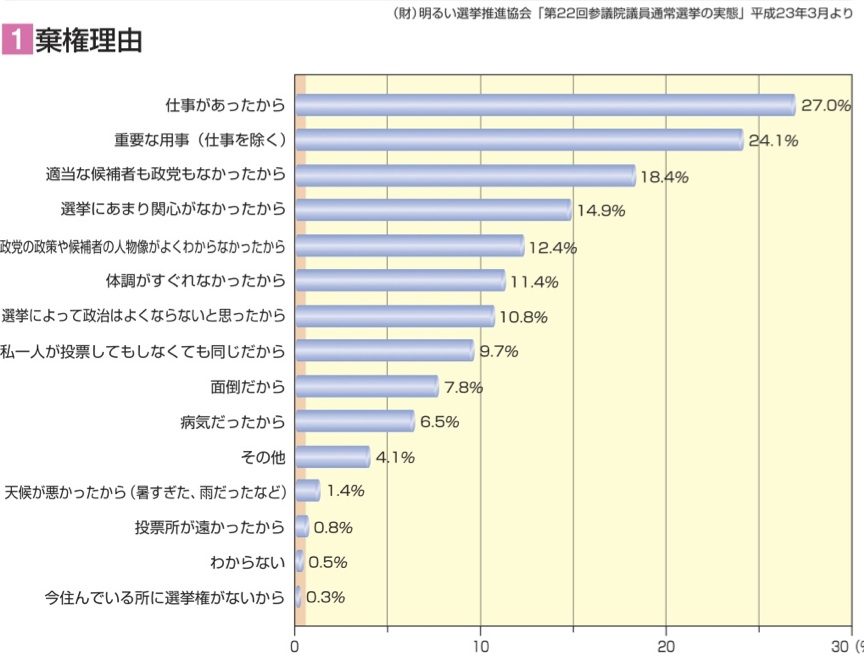
Election is the chance for nation to choose how we want Japan to be like. However, at the election we have just finished, only 59.32% of electors voted. According to the Ministry of Public Management, Home Affairs, Posts and Telecommunications, the most common reason for abstention is that election is not that important things for them. Personally, most of my friends who do not vote say that they do not know about politics and they think their absence of one vote would not be affect the results.
graph http://www.soumu.go.jp/main_content/000153570.pdf 目で見る投票率 総務省 選挙部

Including me, there are probably few people who has strong policy opinion about current political issues such as TPP, Nuclear power plant, and Japanese defense with full understanding of the issues. Some of them may think that making a decision is not their job, that is politician’s jobs. I think this is renounce of equality of access. Election is admirably access of equality for making our day life policy, however, more than 40% of population renounce it.

Secondly, Japanese constituency system creates quite a lot of wasted vote. Japanese constituency system is electoral system comprised of single-seat constituencies and proportionally represented multiple-seat constituencies. The numbers of seat for single-seat constituencies are 300, for proportionally represented multiple-seat constituencies are 180.


graph2http://www.yomiuri.co.jp/election/shugiin/2012/ 衆院選2012 YOMIURI ONLINE

As you can see that number of seats won by the Liberal Democratic Party at the proportional representation is about 30%. However, 80% of the seats had taken by Liberal Democratic Party at the single-member electorate system. In addition, only one candidate is elected in the single-seat constituency system, therefore there are full of wasted vote below second place. Approximately 37.3 million votes of all 300 single-member electorate system became wasted vote, which is 56% of all votes at the single-member electorate system. (時事通信, 2012) More than 50% of votes are wasted. Even though the single-member electorate system is effective to have stable political situation, ignoring more than 50% of votes are not feasible to exercise the equality of nations.

In conclusion, equality in Japan in its election matter cannot be said feasible. Nations make it feasible and system make it feasible. Nation has to improve its understanding level for national issues and consider its importance of being part of policy making. Constituency system should be changed to make sure that at least less than 40% of votes would be wasted. The majority of votes must not be wasted. Japan supposed to be a democratic country, however in its election matter, equality cannot be said it is feasible.

Works Cited

時事通信. (2012, 12 17). 死票率56%に上昇=民主は惨敗で8割超―衆院選【12衆院選】. Retrieved 12 20, 2012, from Yahoo!ニュース: http://headlines.yahoo.co.jp/hl?a=20121217-00000160-jij-pol

For an equal society in India

by Natsumi Ichioka

After reading the article “Arnold Schwarzenegger, ally mcbeal and arranged marriages: globalization on the ground in India,” I wonder why women in India are not equal with men. In India, after independence from England, a new constitution was established in 1947. This constitution succeeded in mentioning that all Indians are equal legally. In Japan, it is said that women and men are equal, but there are some obstacles to saying that all situations are equal. I know the gender problems are so complicated and unsolvable problems. Like Japanese situation, there are also problems in India for a truly equal society. I think India has to change three things for the equal society.

First, India has to divide politics from religion. It is not a simple problem to think like this, but I think the problems which India has are all related to the religion, especially Hindu caste. Caste has caused many problems and prejudice for Indian women in the society. India is developing these days, they try to take in many developed ideas from foreign countries. I think there is a limit to coexistence between the traditional Indian culture and the developed culture, because developed cultures have a trend for the equal gender, for example, the equal employment, equal education system and so on. If India continue to change modernization, it is necessary to separate the thinking from religion.

Secondly, Indians have to solve the problem of employment for women. India is developing and women are going to work in the society. In developing society, the workforce for women is needed. Though the welfare programs are established, for example, securing time for childcare, prohibiting illegal layoffs for women and so on, these systems are not always secured. Government research states that the wages of women are lower than the wages of men. In addition, the rates of women’s layoffs are more than four times compared to men’s rates, in the same research. In this way, there is still discrimination against women laborers. These welfare systems are secured truly for the equal employment. Though they are established legally, it is nonsense that they are not adopted for all women.

Finally, the system of the marriage is too burdensome for women. From the traditional culture in India, the bride needs to give financial aid for the groom. This system is too burdensome for the bride’s family. Because of this system, girls are not welcomed. Sometime, girl babies are killed because of this prejudice. On the other hand, boys are welcomed and treated preciously. These prejudices are caused by the thinking of the religion. If these prejudices are continued, India will run into difficulties. If these prejudices are solved, the thinking of the equal between the men and the women are made. Then, Indian society is going to change for the equal society. There is no discrimination against women.

I think India need to change dramatically in these three points, the thinking of separation of politics and religion, the employment for women, and the system of the marriage. The problems which India has are so complicated. They cannot be solved easily. But for the equal society, especially for Indian women, they need to change dramatically. The women’s rights are secured in many field, India will be more powerful country in the future.

Reference

Kyoto Univ. UNICEF Club (1997, November), Retrieved December 16, 2012, from http://www.jca.apc.org/unicefclub/research/index.html

Globalization and Westernized Japanese Women

by Anonymous

Today, the world is more globalized, and more and more people, culture, religion, things, and money are spreading over the countries. We can find cell phones, TV, computers, and also McDonald’s in almost every country. So, what is globalization? For me, globalization seems like the westernization of the world because it spreads things that are made by western countries in most cases. Moreover, westernization reaches people, like many people including Japanese want to be like western people. Especially, recent Japanese women are westernized by globalization.

In Japan, many women dye their hair and wear makeup and they envy long legs or arms. I think these features come from image of the Western. Unconsciously, we came to have the idea that western outlook is good and beautiful, bright skin, blond hair, big eyes, blue eyes and nice shape of body. In fact, models in magazines for young women often look like westerners, and it might be one reason for westernizing Japanese women. However, we have to remind ourselves that this phenomenon sometimes brings health damage. For instance, some Japanese women put colored contact lens in their eyes to make them blue or big, but it sometimes hurts their eyes. And there is the way to make eyes bigger that put eye liner as close to mucous membrane as possible, but it also hurt their eyes.

While Japanese women mimic western women, it is a famous story that western men like Japanese women. It is said that they are fascinated by black hair and sharp eyes, but also they are surprised at too much makeup Japanese women do. So there is the gap about pretty Japanese women between themselves and others. However, many of Japanese women have complex with their outlook especially small eyes and flat faces so they cannot stop using makeup, and I think these complexes are come from the adoration of the West.

I cannot say “stop westernizing your face” because I am one of the women who want to make eyes bigger. I think western women who have big eyes, sculptured face and long legs and arms are beautiful. Globalization might change concept of beauty in Japan. It means that women who have small eyes and round face like otafuku were considered as beautiful women in Japan in the past. On the other hand, the image of beautiful women in today’s Japan is like western women, and the concept flowed into Japan with progress in globalization. Although I think the Western is cool, it is sad that if we totally lose Japanese beauty. So I think we should find reconsider about Japanese beauty and figure out Westernized Japanese beauty as a new concept.

Social Networking

by Julia Helbing

“Social networking … it’s the way the 21st century is communicating today!” (WISN 2011)

A social network is a social structure of individuals or organizations. You can find them between people, like families and friends, but you can also find them using the internet on for example social networking sites.

I think that this quotation became a very true quotation over the last years. Nowadays, people all over the world use social networks, especially social media, to communicate or trade all over the world. They became very famous because every action and interaction is happening in the very same minute. If you order a book on Amazon in England, but you are in Japan, the seller will still get a notification about your order just some seconds after you placed it. Social networks are also very important in the product of designing, e.g. a new shoe. I saw a report on TV about the Adidas Designer Team. They have laboratories all over the world and still manage to work together hand in hand. If the work in America is done at nighttime, the design and all progresses are forwarded to Europe. In Europe, it is daytime so the work can be continued without any delay.

Social networks bring the world closer together. It is very easy to communicate with business partners even if you are located far away. In some business branches it became very common to hold business meetings online, especially with Skype. You can talk to each other in real time, and thus can make urgent decisions in the blink of an eye. This is very important concerning that some business transactions need such urgent decisions to react to changes in the environment. But Skype also became a very useful tool for everyone. I use it to talk with my family in Germany. I also spoke with my family via Skype when I was in Germany too, because you cannot just call, but also video chat with your partner.

With the expansion of the usage of social networks, the usage and the number of social media has also increased. Millions of people have created a Facebook account, to share their thoughts with friends and families and to stay in contact with them. The same happened to Twitter, many people set up their accounts to tell the people what they are up to or what is just happening. Many musicians or politicians also use social media nowadays, which is ought to bring them closer to people that are interested in following those people.

In my opinion, the world today could not work without social networks like it is working now. Many business processes would take a lot more time, which will affect production process in the end. It would also affect the life of every people. We are used to the usage of social networks every day. If they would be limited or very hard to reach, I think many people would have to change their lifestyle.

Sweatshops and Foreign Investment

by Yukari Deguchi

Economic gap is the defect of capitalism. Thanks to its benefit, certain companies have grown up, the rich became much richer, and the poor became much poorer. That’s why there are many sweatshops. In free market, some big companies pursue cheap labor force to reduce the cost. The famous fashion brand GAP is one of the examples of such companies. GAP doesn’t have any own factories. All products are made by subcontracted factories in developing countries, which have many cheap labor forces, and loose labor regulation. The majority of these workers are young women and children from poor households because they weren’t educated and they have little sense of human right. When the fact of exploitation was exposed by NGOs in 1990th, GAP canceled the contracts with such factories.

The victim of exploitation is not only human, but also animal. The world’s famous McDonald’s industrialize the food and animals to reduce cost and to pursue the quantity and speed. MacDonald’s modify the genes of chicken to grow up bigger and faster. The chickens are reared by confined to so narrow cages with many others. Farmers who contract with these fast food companies have to purchase new expensive machine to obey the companies’ command. So the farmers carry a huge debt loan. The exploitation can be seen easily in everywhere in supply chain.

Thanks to the NGOs and civilian resistance, these big companies cancel the contracts with the factories to eliminate exploitation. But when the factories fold up, where will the workers go next? Who will employ them? How they live? It’s not the solution to cancel contract to protect the companies brand. We can easily imagine what will happen to the workers; they will be employed in other sweatshops.

Why did they choose such works? Why the companies can get cheap labor force? The answer is that the workers have no choice to live because of many various kind of gap. So that would be pointless to criticize only the factories and companies. It’s not the only simple problem about human rights.

Then, we have to face to a question; what’s the difference between sweatshops and foreign investment? Why are there sweatshops while other developing countries get benefits of foreign investment? I’d like to explain this question with the information from other classes.

Do you know Great Mekong Subregion (GMS) Project by the Asia Development Bank? It is one of the biggest economic blocks and includes six countries around the Mekong river; Thailand, Cambodia, Laos, Burma, Vietnam, and China. To make logistics more efficiency and to promote free trade, the big economic highways were built and the countries are trying to achieve the elimination of tariffs through AFTA (Asia Free Trade Association). There are many business chances in GMS, and companies and business persons all over the world pay attention to it. Some big companies have already expanded into it, and these businesses are not exploitation, of course.

So what is the difference between these countries and those which have sweatshops? I think these successful countries are now playing a part of world free market as good partners of big companies and countries. So companies can’t ignore their voice. On the other hand, areas and countries which have sweatshops―such as poor African countries, Latino countries, and some less-developed countries in Asia―are usually excluded from world free market.

The cause of sweatshops is in the structure of world economy. It’s deep and difficult problem to solve. But what we, the consumer, should do is to know the process of making and carrying the products, I think.

References

『大メコン地域地域協力―経済回廊が変える国境経済―』工藤年博、2007

Food, Inc. American Vista, 2008

The Risks of Globalization

by Noriko Abe

I have studied various effects of globalization in class. I always have a good image of globalization and I often use the advantage of globalization in my policy recommendations. However, I saw many risks brought from globalization in this class. Therefore, I focused on various risks brought from globalization.

First, I raise the advantage of globalization. Globalization promotes economic liberalization. India actually developed their economy because the country changed their economic policy from controlled economy to liberal economy. It is thought that the variation of strategy which companies take has broadened. Also, new information technologies have proliferated. People’s lives have been made more convenient all over the world. More and more people go to foreign countries for business, sightseeing, and other reasons. I think that each human in the world gradually has his mind to try to know humans in other area and country because of globalization.

On the other hand, many experts fear the dangerousness which globalization causes. I pick up the report written by the World Economic Forum (WEF). The World Economic Forum is an independent international organization committed to improving the state of the world by engaging business, political, academic and other leaders of society to shape global, regional and industry agendas. The World Economic Forum showed the Global Risks 2012 report on January 11th, 2012. The Global Risks reports are showed every year and the reports, which focused on the findings of a survey of 469 experts and industry leaders, outlined top five global risks in terms of likelihood in the next 10 years. This year’ s report says severe income disparity, chronic fiscal imbalances, rising greenhouse gas emission, cyber attacks and water supply crisis from a higher rank. This year’s report shows a shift away from worries about the environment to concerns about a breakdown in society and economies. I think this means that effects of globalization have become more serious from superficial problems. Also, the report believed these risks threaten global growth as they drive nationalism, populism and protectionism at a time when the world remains vulnerable to systemic financial shocks, as well as possible food and water crisis. It is strange that the world, which has originally nationalism, populism and protectionism, do globalization in pursuit of the progress and the result return to nationalism, populism and protectionism.

The usefulness of globalization is large, but we also have to look the measure for the problems which globalization cause. The measure goes to protectionism. We may not change our today’s life, so we have to rethink ourselves in globalization.

Reference

‘Global Risks 2012 – Seventh Edition’, World Economic Forum, <http://www.weforum.org/reports/global-risks-2012-seventh-edition&gt;

Filipinos and Asian Beauty

by Hsinmin Wang

Compared to other Asian countries, Philippines might be the most multi-colonial country. Successively occupied by China, Arabia, Spain, the U.S., and Japan, constructing the special attitude toward Asian aesthetic and global market. According to a report made by UNEP, in 2004 nearly 40% of women surveyed in the Philippines used skin lighteners. Compare to 61% in India, 77% in Nigeria, the figure seems nothing to be surprised at. But when we started to investigate the reason behind Filipinos using skin lighteners, we will discover the role of Asian beauty in Philippines beauty market. Not just pursuing for Eurocentric phenotype, but more likely to follow the step of East Asian countries, and trying to emerge in immigrant society. But how is these beauty standard constructed?

Joanne Rodilla discusses the use of Michele Reis’s racially ambiguous face in L’oreal advertisements. In fact, the endorser of L’oreal  changed to Fan Bingbing in 2010. Once you look at her picture, you can easily discover that she has the typical face Rondilla describes: glowing white skin, jet-black, and large, double-lidded, almond-shaped eyes. Though I can’t jump to conclusions that the fashion style inclines to Chinese aesthetic, but it does reflect more or less the changing marketing strategy.

There is a wide-spread saying, “There are no ugly women, only lazy ones.” This reflects the idea that once you are away from the sun, you won’t get dark; and with this kind of slogan “high technology to repair, illuminate and brighten your skin,” women with darker skin become a symbol of lacking of self-control, self-discipline and will power. Thus, skin color becomes a reflection on job prospects, earning potential, and social status.

In skin lightener advertisements, we are continually watching Asian girls get skin color discrimination in their life, jobs, and family circles; then it all magically disappears after she uses the product. Sometimes we feel ridiculous, sometimes we feel unbelievable, sometimes we feel overstated; but what if these stories truly happened in your daily life? I think while these advertisements are trying to affect people’s aesthetic, somehow it reflects the real life situation.

All that you can be

by Hsinmin Wang

As a woman, what do you want? The eternal desire of beauty, to satisfy self-esteem, getting better occupations and a happy marriage? Believe it or not, you can get all of these as long as you have a light skin tone. Just spending several pennies buying a bottle of skin lightener, woman can achieve whatever you want. “Because you’re worth it.”

It is the message we get from our daily life, a image constructed by beauty merchandisers.

In Shades of Difference: Why Skin Color Matters, Evelyn Nakano Glenn discusses three questions: 1) “How is skin lightening interwoven into the world?” 2) “What are the media and messages, cultural themes, and symbols used to create the desire for skin-lightening products among particular groups?” 3) “How do consumers learn about, test and compare these products and what they seek to achieve?”

I’d like to categorize the attitudes toward global trade of lighteness into three discourses: beauty discourse, public health discourse and global marketing discourse. Assuming you have already read this chapter, this article composes of criticism of the book.

Shall we regard there is an invisible manipulation of people’s aesthetic?

Beauty discourse

The main idea of aesthetic comes from each country’s culture and ideology. “White is right” is comprised of culture and ideology, though nowadays scholars tend to assert that people’s preference on lighter skin is the outcome of colonial racial ideology, but I want to highlight the importance of culture influence here. In fact, we can also discover the highly valued “white is good” culture in history. White means noble, purity, innocence and intellect whereas black means lazy, evil, and ignorant, isn’t it just like the image of angel and satan? Angel can give anything you want and ask nothing in return but Satan will take away one’s soul.

Public health discourse

Obviously frights over mercury, hydroquinone, corticosteroid and peroxide couldn’t beat up the eagerness on demolishing black pigment and melanin. When authority severely banned the toxic in skin lighteners, it neglect the reason behind the demand on these products—color discrimination.

Yes, I swear I know the importance of healthy skin., but what if I can only get what I want from lighter skin color? I admit that I don’t like when scholars talk about skin lightener always trying to emphasis the toxic chemical ingredients in cosmetics and skin care products. It made me feel that they view woman trying to lightening their skin as a ridiculous behavior. In my personal opinion, toxic skin productions are not only a public health but connoting social hierarchy problems.

Global marketing discourse

It’s impossible not to mention the role of mass media and internet in global markets. Especially with the rising of social media, in one hand it enhances the influence of mass media, on the other it spreads the concept of western aesthetics to the world and changes people’s outlook. Under marketing strategy, audiences believe we can control our own body, the body is changeable. Look at those celebrities, they must have done something to make their skin tone so different. I recognize the beauty industry’s marking strategy is not only to change the aesthetic but to provoke a concept that one’s body is one’s property which can accumulate social capital. In a way encouraging people to chase the “improvement” of body.

To summarize the pursuit of skin lightening, I regard these behaviors more likely to fulfill Maslow’s Hierarchy of Needs. For safety (employment); belonging (sexual intimacy) and esteem (confidence), and unfortunately the beauty merchandizer penetrates it.

The appeal of skin lighteners in South Africa: a racial and gender issue

by Joana Ito

In 1991, most skin lighteners were banned from the South Africa’s market, as a result of the Black movements’ criticism against the structural racism, allied to the arguments of health concerns. However, as a report of UNEP showed in 2008, the racial and medical arguments were not sufficient to erase the appeal of the skin lighteners: 35% of the women in South Africa were still regular users of skin lightener products.

The racial/color discrimination element regarding the use of skin lighteners can be clearly identified, as the lighter skin is valued more, while the darker skin is considered less desirable. For that reason, consumers of skin lighteners in South Africa are in many occasions described as “sellouts”, who act against the interests of black as a whole, by denying their own “blackness”; and often accused of committing “racial betrayal”. It is relevant to note however that, as the consumption of skin lighteners is concentrated in the female population, the discussion around the use of these products cannot be limited to the issue of political awareness of race, nor in terms of racial pride and shame.

The behavioral change regarding the use of skin lighteners faces many obstacles, as the appeal of these products is based on multiple factors. According to Thomas (2009), the use of skin lighteners is mostly related to utilitarian motivations (such as for better social position, job and marriage opportunities) and to abstract perceptions of beauty, influenced by both traditional pre-colonial values, and the values rooted in the historical past of colonization, segregation and apartheid. Consequently, when the question of the use of skin lighteners is presented in narrow terms of white-black discrimination, it may exclude the consideration of constraints and limitations that many of those women could face, if they were not to confirm to the socially constructed ideals of beauty. According to Glenn (2008), while men are more likely to be considered valuable when they have wealth, education and other forms of human capital, women are considered valuable when they are physically attractive, even if they lack other capital. For that reason, the relative cost to “not betray the race” and not use skin lighteners, in this case, can be considered higher for black women, as their life opportunities may be more affected by the beauty standards of their society.

To modify the individual perceptions of self-esteem and pride regarding their own race is a first step to tackle the remaining racial discrimination challenges in South Africa. Nevertheless, when the parameters of physical attractiveness and beauty defined by the society can strongly influence the life opportunities of the women, the problem is not only about race, but also about gender. If the aesthetic parameter (determined by a male dominated society) were less relevant to determine the social position and value of these women, wouldn’t they feel less compelled to use skin lighteners and have more incentive to become more “loyal” towards their own race?

References:

Glenn, E. N. (2008). Yearning for lightness: Transnational circuits in the marketing and consumption of skin lighteners. Gender & Society, 22(3), 281-302.

Thomas, L. (2009). Skin Lighteners in South Africa: Transnational Commodities and Technologies of the Self.” In Evelyn Nakano Glenn, ed., Shades of Difference: Why Skin Color Matters. Palo Alto: Stanford University of Press, 188-209.

UNEP (2008). Mercury in products and wastes. Geneva, United Nations Environment Programme, Division of Technology, Industry and Economics, Chemicals Branch.

Tackling the misleading conception through positive government intervention movement

by Satoru Kishi

There are mainly three factors that have caused Filipinos to believe in the misleading conception that ‘dark meant you were lower class, ugly and unimportant’ (p.61), pressuring them to utilize skin-whitening cream. The first cause was the historical colonization by the Spanish and Americans, which lasted for approximately 500 years. During this period, Filipinos were discriminated against and taught that they were inferior to the ‘whites or the western people’. This notion did not disappear due even after the decolonization era, due to what was carried out by companies. They used this false notion created in the colonial era and saw it as a business opportunity. They advertised and brainwashed the community that “darkness is evil or not good”. This misbelief boosted the demand for skin-lightening cream, a market area for companies to make money.

In the late 20th century, the globalization further intensified, and the western value of beauty spread across the globe, destroying the traditional values in some developing countries. All of these three factors, directly or indirectly, have contributed in encouraging Filipinos to consume massive quantities of skin-lightening cream. As of 2003, over 50% of Filipinos have used them, and they consume over 2 million as a whole. If this continues, it will gradually lower their self-esteem.

In order to prevent this, it is necessary to take action. One solution is that the government could put effort in consolidating a Filipino/Asian Movement through indirectly regulating what figurative person can appear on media and advertisement. This is an extreme method. Another way is to establish and promote the notion of Filipino Beauty that is different from Asian Beauty or the sense of Western Beauty. If it becomes successful, this will strengthen self-esteem and identity of its citizens.

Challenging the author’s definition of ideal Asian beauty

Joanne Rondilla describes the Filipino notion of an ideal Asian beauty or ‘the right kind of Asian’ as follows: “white skin, jet-black hair, and delicate, almond-shaped obsidian eyes” (p. 68).

To challenge this notion, I conducted the survey. One of my Japanese friends at Ritsumeikan answered the characteristics of Asian women, which differed from Korean and Chinese students who took the survey as well. The survey is attached below. Despite the fact that the result of the survey may not be reliable, since it is not asked to a large number of people, this generates questions to the author’s depiction of notions of Asian Beauty.

To conclude, there is no identical notion of ideal Asian Beauty throughout Asia. I am taking a survey for Race and Ethnicity Class to find out whether the notion/image of Asian beauty is same in all places.

Survey questions:

Gender:

Nationality:

Q1: Please describe your image/stereotype of Asian Beauty. What kind of facial characteristics/phenotypes should that woman have? (Including hair, skin tone and shape of eyes, nose, mouth, eyebrows and etc. )

Q2: Who would best suit the term Asian Beauty?

Thank you for answering our survey.