Can Japan Solve Pay Inequality in the Global Economy?

by Yuri Kasai

Globalization influences each country’s economy and individual salaries. The Lehman Shock of 2008, which happened with the collapse of housing bubble, affected many countries with the economic downturn and led to the global financial crisis. This accident reduced the value of currencies such as the Euro, and European countries suffered from economic recession.

Japan has had the economic downturn of manufacturing companies due to the strong yen. After the Lehman shock, the Great East Japan Earthquake in 2011 affected the world economy again. Many materials and parts supply companies in Eastern Japan area stopped production and Asian economies were disappointed. The exchange of countries’ production, stock and finance occurred. Because we made the global economic system, we cannot escape from the global economy and from competing with each other.

In the result of global competition, some companies have an economic downturn and reduce employment and salaries. This brings about pay inequality. The inequality of salaries in Japan will be mainly these two:

  1. contract employees v. regular employees, and
  2. women v. men.

Contract jobs in Japan are other jobs than regular employees and have the fixed period of employment, shorter time of work, and fewer responsibilities than regular employment (Takeishi, 50). Around 44.2% of contract employees choose this work style, for the reason that they can find no post of regular employment in any companies, according to the questionnaire survey conducted by the Ministry of Health, Labor and Welfare in 2006 (Takeishi, 51). 45.8 % of all companies have the system to change from contract employment to regular employment. Some companies pay the same salary of graduate recruitment for the former contract employees, and others pay the salary of the former contract employees considering about the practical knowledge.

About gender, it is difficult for women to follow the same course as men to be promoted. Only women who have the potential to do good work can be promoted and many women cannot get the management job. There is a big salary gap between men and women.

According to Kenworthy, the countries who have relatively low tax burdens, should ‘allow relatively low wage at the bottom of the earnings distribution’ in order to increase the employment of private sectors. If people with zero or single-earner households at the low end of the distribution, getting a new earnings relative low will push up the income of the household. And, this will reduce income inequality among households. Japan is the country who has relatively low tax burdens compared to Norway. Kenworthy’s idea is effective for many contract employees to get a better salary than today.

Japan is a relatively low taxation country. Considered about national burden rate of taxation, Japan is 38.5% compared to Norway’s 55.4%, Denmark 67.8%, and Sweden 58.9% in 2010, according to the Japanese Ministry of Finance. However, is Kenworthy’s idea effective to Japan? I want to discuss about solution of pay inequality in the concept of Japanese social welfare and the economic situation.

How about equalizing the system of government? Given the philosophy of government, the government has the role to equalize the income and reduce the inequality. Taxation has the role to equalize the inequality of wage. Japan’s low Gini index shows that Japan cannot redistribute the income. Japan needs to reconsider the income tax system and care about national pay inequality. Reduction of minimum wage is not considered about a way to solve inequality wage in Japan and the rise of minimum wage is often considered a good way. However, if the wage increases, the number of employment will decline and unemployed people will increase. Additionally, decision of minimum wage is conducted by the local or central government, not considering the situation of employees. The minimum of wage is decided in no political way. In Japanese system, taxation is a effective way to equalize pay inequality other than decrease of minimum wage.

Secondly, considering about the recent economic situation, the government should not allow the minimum of salary down depending on the economic situation.

Japanese monetary value, Japanese stock value is lower because most of investors who are foreign investors, hesitate to invest in Japan’s stock or money and observe if Japan’s manufacture companies will recover from economy recession of the earthquake. If they can see a little evidence of recovery, they can buy Japanese stock and national debt. Before they do, the economy cannot grow and salaries cannot increase. In this reason, we have to wait for a good season to grow the economy. Or, if we cannot see any growth, with the increase of consumption tax to 8%, the government maybe take the low-price policy and companies would keep the employment at the same level. Reduction of minimum tax will not happen, in my opinion.

Pay inequality becomes a bigger problem with the global economy, although there are many ways to solve the inequality problem and it is difficult to find an effective way to each country. We have to think about how we can equalize inequality in order to make more stable domestic economy and protect people’s life because we will face the risk of widespread of economy recession from the connected world and will face more competitive global market.

References

Takeishi, Emiko. “About the Convert System From a Contract Employee To a Regular Employment” Japanese Employment Research Magazine, 573, 50-53, 2008 April. 18 Dec, 2013.

Ministry of Finance, The bar graphs of OECD countries’ national burden rate of tax, 2010, http://www.mof.go.jp/tax_policy/summary/condition/238.htm. 18 Dec, 2013.

Thoughts about the Internet and Morality

by Seiichiro Itoyama

The internet has, I believed, more or less crippled and degraded our sense of morality. Morality, I define as is our ability to predict and judge the outcomes of our actions either satisfying nor satisfying a predetermined or unseen result.

In the physical reality that we inhabit, actions (most of the time) come with consequences, however good or bad they may be. An example would be “theft.” If you go into a CD store and steal a whole bunch, the scanner would detect the bar code attached to your CD and will go off, setting the security guards, and possibly the police into action. What about listening to a unofficial music video (one of those with still images, only streaming music) not provided by the artist him or herself, but rather uploaded by someone on youtube. What if you go one step further and download the full album from Piratebay.

In all the examples, your essential outcome to be gained from the action is listening to the music. The wholly unique thing about the internet is that there are no consequences that come with your actions within the internet (yes the police can track your IP address and arrest you, but what are the chances). It is only action and result, nothing more, cut and dry.

Although our society has tried to reinforce physical morality into the information age, it has no doubt had little to no effect, when it comes to regulating behavior on the internet that can call into question our physical moral perspectives, such as online piracy. Why has it had little effect? Because it was and is too late. The notion that the internet, the technology which drives our information age bends our physical moral perspective has become justified by mostly the users (and creators) of the internet. Maybe this is because the internet hasn’t had much time to mature yet, since it’s only been 60 years since the concept has been around and implemented.

As the title of the post states, this is just a thought that has been in my mind for a while, and I do not have any resolution about this issue. However, I believe that both the creators and users of the technology must have absolute conviction, responsibility and belief to drive the moral standard of how the technology can be used.


Environmental Racism – A problem with no visible solution

Save our water

Save our water (Photo credit: uusc4all)

by Jonas Horvei

The world as we know it is still very much an unequal society.  It is unequal because how others will treat us in our lives is already to a certain extent pre-determined on the day when we are born. Where we are born, our nationality, our family’s background, one’s looks, and the color of one’s skin and so on all plays different in how others will perceive and treat you. A few weeks ago I learned of another new concept related to inequality and discrimination called “Environmental Racism”. According to the USlegal (2013) definition, environmental racism can be defined in the following way:

Environmental racism refers to intentional or unintentional targeting of minority communities or the exclusion of minority groups from public and private boards, commissions, and regulatory bodies. It is the racial discrimination in the enactment or enforcement of any policy, practice, or regulation that negatively affects the environment of low-income and/or racially homogeneous communities at a disparate rate than affluent communities. (2013, USLegal)

Hand in hand with the concept of environmental racism, we also have the concept of environmental justice. In short, environmental justice can be said to be a movement’s response to solve the issues of environmental racism. It is more or less a social movement who strives to put an end to environmental racism, or at the very least to create a more even distribution of both the benefits and burdens.

According to the basic principles of Environmental justice, the movement strives towards the following goals:

  • For everyone to be protected from environmental harm
  • The elimination of environmental threats
  • That everyone has the freedom to participate in environmental decision making

Whether it is possible to realize these ideals or not is a completely different question. What we can conclude so far though is at least, that social movements such as these do help, and they do have results. Pellow and Brulle (2007) describe in one article how the environmental justice movement has been able to fight against cases of environmental racism in the United States. They describe first how researchers managed to provide conclusive evidence that there was in fact a large bias in hazardous waste sites being located in communities where the majority of the citizens were minority groups. Through years of long battles the environmental justice movement helped stop the construction of over 300 garbage incinerators in the United States just in the period short period from 1985-1998. At the same they also influenced the large decline of municipal waste and medical incinerators also in the United States.

In such cases, we can clearly see that social movements do provide a very important element on the local level to stop the construction of sources of hazardous emissions. They highlighted the issues of environmental racism, and the dangers associated with chemical waste incinerators. Without the environmental justice movement, it is hard to say what the situation would be like, but it is evident that social movements do help.

As can be observed, the movement of environmental justice in America has had a strong impact on American society and has had a positive effect, whereas many of the most hazardous polluters have either been shut down or forced to relocate, and has made it difficult in the creation of new such polluting sources in America. Nevertheless even with such incredible results achieved, I cannot help but having this pessimistic view that there is still a long way to go and that future outlook certainly might not exactly be optimistic as many are to believe.

Then comes the problem, what do we actually do with the waste? With larger volumes of waste being produced, where do we put it, what do we do it? We put it somewhere else and ignore the problem. In my opinion, it seems like we are simply witnessing a relocation of the problem itself, that is to say that the problem is instead being transferred to somewhere else. Due to the influence of globalization, more and more industries take the leap abroad, often to developing countries. In such countries not only are labor costs cheaper, the emission restrictions are often much more relaxed. As a result the developed country can remove its pollution problem from its own border, while at the same time gaining profit from not having it in locating it their home country. So even if we might see an improvement in terms of hazardous waste and pollution in our local culture, it does not necessarily mean that the problem has disappeared. In fact in many cases it is highly likely just that it has simply been relocated somewhere else. America does it, Japan does, China does it, even Norway does it, and every country is guilty of it. For instance you have the case of Thor Chemicals, Inc, who during the 1980s moved its mercury reclamation processing facility from the corporation’s home in England to a village in South Africa. (Harper, Rajan 2004, p.3) Cases on international scale where the Northern countries move production, or move the waste disposal to southern countries are unfortunately far too common.

Then what is the solution to environmental inequality and environmental racism? Environmental emissions, pollution and hazardous waste are some of the biggest problems we are facing on a worldwide scale. There is no easy fix, it is as simple as that. Stricter restrictions, finding more environmental friendly solutions, raising awareness of the problem, and stopping making companies benefit from polluting rather than operating environment-friendly are some of the solutions off the top of my head. That is how we I believe we can minimize the problem. As long as issues of environmental pollution exist, inequality will also exist. As sad as it may sound, this is a natural part of human nature, we discriminate against those who are different. As long as we can get away with it, we discriminate, and as long as it remains more profitable to dump waste in neighborhoods with minority groups, or shipping off tons of waste to the Philippines or Bangladesh, environmental inequality will persist, without taking into account the health of other human beings that do not belong in our local environment.

References

Harper, Rajan. “International Environmental Justice: Building the Natural Assets of the World’s Poor.” University of Massachusetts, August 2004. Web 18.December. 2013. http://www.peri.umass.edu/fileadmin/pdf/working_papers/working_papers_51-100/WP87.pdf

Brulle, Pellow. “Poisioning the planet: the struggle for environmental justice” the American sociological association, 2007. Web 18 December. 2013.

Fast food and globalization: between export and adaptation of flavors

Japanese McDonald's fast food as evidence of c...

(Photo credit: Wikipedia)

by Marin Enault

Every 3 hours a new McDonald’s restaurant opens in the world. This simple figure allows us to glimpse the power of the fast food chains, a pure product of the globalization. To study the influence and the development of these restaurants allows us to see most clearly the face of globalization. If we understand this concept as “the emergence of worldwide markets and communications that increasingly ignore national boundaries”, it is interesting to notice that at the same time as they ignore national barriers, these multinationals also adapt themselves to countries’ specificities. It then seemed interesting to me to study these restaurants. First of all I shall concentrate on the creation of the fast food as a consequence of globalization. Then, the opposite viewpoint will be examined, that is how fast food owes or wishes to adapt itself to local frames.

Globalization in the culinary domain is the export of a food and its specialities towards foreign countries. More particularly, in the field of the fast food it is necessary to notice the major origin of this export: the United States. In the post Second World War Era, the United States has exported its culture massively, in particular its culinary culture. So the first one McDonald’s outside the United States opened in 1967 in Canada, before arriving in 1971 in Europe (the Netherlands). Since then, the burger has continued to see growth in popularity.

Nowadays the chain McDonald’s possesses more 31,000 restaurants in 120 different countries. This increase in importance comes along with a standardization of the tastes. The plurality of the tastes is questioned by these multinationals, creating a unique taste, intended for mass production. Acculturation for some, the superior power of the industry of the fast food exports its idea of  food. So, the “Big Mac” is known all over the world and acts like an ambassador of American cooking, to the detriment of the rich local cooking, passed from generation to generation. Through the globalization, fast food proposes a standardization of the cooking and export the same culinary standards everywhere around the world.

Nevertheless, if the fast food is well and truly a product of globalization, it remains dependent on the host country’s culture. If globalization allows a distribution without barrier, it is left by standards which do not fade. To conquer new markets, restaurant chains have to adapt their product. The unique taste does not any more succeed in seducing only by its exotic image. The first adaptation that fast food have to make concern the product in itself, that is its taste. McDonald’s very early understood this necessity, so the examples of “glocalization” are not lacking. This neologism born in Japan proposes a new definition of the globalization. It is a concept allying the global trends to the local realities: think global but act locally.

So, to seduce the French consumers, fervent followers of their national food, McDonald’s proposed burgers with real French bread (McBaguette) and with real cheese, benefiting from a label checking their French origin (AOC: controlled designation of origin). Outside Europe, this strategy has a lot of success, particulary in Asia. So, Indonesia possesses a burger with rice (McRice) whereas Japan possesses its own teriyaki burger. This glocalisation of products is a new fact entering in a global protest movement of the permanent Americanization of fast food. Firms are no more content with exporting the same product but begin to analyze the real demands of countries, in particular to mitigate a lack of novelty.

The second adaptation also establishes itself on a deeper request of the consumers but in another domain: religion. So, Indian McDonald’s burgers do not possess pork but chicken, to not hurt the faith over this animal. Globalization also pulls a plurality of the religions mixed within the same country. North Africa mmigrants’ strong presence in France, often of Muslim faith, brought the chain of fast food Quick to propose burgers with hallal meat. This adaptation made for the various religions proves well that globalization creates its own limits. A unique product is not exportable any more in the same way everywhere around the world.

Globalization thus allowed the fast food industry to develop. Nevertheless, if during numerous years, fast food meant Americanization of the tastes, things changed. It is necessary to see from now on this phenomenon between globalization and glocalization: export while adapting itself to the local cultures. This movement was impulsed by the customers, not being satisfied with an unwavering uniqueness of products.

What is interesting with the study of the fast food in touch with the globalization is that it does not concern only the food, but much more the culture. The phenomenon of globalization cannot break all the barriers to create a homogeneous international culture. To convince yourself, you just have to eat sushi outside Japan. If the taste is different from the original one, it remains that we eat them with chopsticks. So the export of the cultural codes is often easier than that of the tastes, that what explains the new importance given to the glocalization in fast food restaurants.

Distortion or evolution of culture?

by Anna Dreveau

In our globalized world, information is transmitted, exchanged and shared throughout a big part of the planet. As information is shared, so is culture. Movies, TV shows, books and even commercials from different counties would be known across the world and deliver a certain reflection of its country of origin. However, this image of the culture do not get the same treatment as it is used to in its own country: should we be talking about “distortion” of culture and condemn it?

If the distortion of culture is considered as negative – as the choice of the word “distortion” clearly conveys – what about the evolution and mixing of cultures? Being exposed to other cultures has inspired local artists in a different way than if they would have been without globalization. Music is mixing genres with Da Arabian MC, as they took Black-American Hip Hop and Arabic poetry. They revitalize what Hip Hop has been – a music of protest – and while letting aside what it became – merchandised music –, mixing traditional Arabic poetry and Palestinian way to write songs to convey a message that is fully them, but similar to Hip Hop messages used to be.

This mix of cultures thus enrich every single cultures involved and create something new, part of a more globalized culture.

Nevertheless, the fear about distortion can be real. Steve Derné have written an article about culture globalization in India. He describes the attitude of middle-class Indian people towards Western views about gender roles. While being exposed to a culture promoting women liberation and love marriage, they refuse those same principles, as they would rather stick to the traditional gender roles and arranged marriage. However, they are more than accepting toward the image convoyed by action movies as they stress male domination and violence, which find echoes in Indian culture.

By only taking a part of what American culture proposed about gender role, India get to stick with its traditional values, reinforce them and does not change in any way while America values get impoverished in foreign soil.

Those thus are extreme reactions; one is understanding and adapt the culture and its own to create something new and even more striking while the other is closing its understanding of other cultures to only select what suit him best. The biggest difference between Da Arabian MC and those middle-class Indians is not only open-mindedness and also their feeling of closeness with the other culture. Da Arabian MC choose to work with Hip Hop music because they feel that Black-American back then suffer from the same fate they are currently coping with.

Yet, middle-class Indians do not have the means to stick to love marriage, as parents still play a very important role in young couples’ life and thus see those egalitarian ideas as completely foreign. However, as Steve Derné mentions in his article, give them the means (i.e. high income class Indians) and even Indians will be more than willing to accept those new ideas, as they convey something that can find echo in their economic and living situation.

Transforming a culture while it is sent overseas seem to be the fate of those undertaking globalization. Whether it is just a interpretation restriction, an evolution by mixing cultures, culture changed for the people who will receive them. When you think about it, it is not so different from interpretation of books. As books are written, the author was hinting a certain message but the readers can not see it. It can interpret it in a completely different way, but can you say that it is the wrong way to interpret it if it makes sense with the content of the book ? Umberto Eco stresses something though: do not ignore parts of the book to make it suit your own message. This criticism can transposed to middle-class Indians way of interpreting American culture, which is too restrictive to bring the positive effects of being opened to others cultures.

Humans keep discriminating and ruining for themselves

Factory

(Photo credit: TimothyJ)

by Marius Brusegard

Chuck Laszewski mentions the catchphrase “Environmental racism” in his article “The sociologists’ take on the environment”. This phrase means that people with less influence or wealth have to suffer from environmental hazards caused by landfills, hazardous waste dumps and dirty factories. Laszewski further claims that numerous reports have proved conclusively that environmentally hazardous businesses have been overwhelmingly established in poor or minority neighborhoods, hence the phrase “environmental racism”. Politicians were able to bring dirty factories etc. into these areas by claiming that it would increase the tax base and create jobs. Indeed jobs were created, but according to sociologist David Pellow, referred to by Laszewski, these dirty facilities were producing poor economic results, jobs hazardous to the workers, and a new source of toxic emissions in the neighborhood.

These types of environmental hazards have been placed in these areas most likely because of the knowledge about how environmentally damaging the hazards really are. I find it hard to believe that helping these poor areas grow economically was an important part of the siting process of these environmentally hazardous businesses. I find it likely to believe that the economic growth and increase of jobs for the respective communities were used solely as arguments to convince the people of these areas to accept having these environmentally hazardous businesses placed in their areas. This means that the influential and wealthy people are knowingly forcing the less fortunate people to live in an environment damaging for their health. Even if people wanted to move away from this new environment, most of them probably can’t afford it. After all, many of them are living in these areas because they can’t afford living anywhere else. If they were to move to another area within their price range, chances are that they would eventually have to move again for similar reasons.

Another aspect that I find disturbing is that by building these factories etc. in poor areas with lack of jobs, it makes the areas dependent on these factories. There have been some cases of this happening in my home country, Norway. Factories were built in small communities and these communities then experienced economic and social growth. Naturally, many people in these towns got jobs at the factories, and the population even grew because of people moving there for work. However, after several years, the market changed and there were either no more need for the factories, or they were relocated somewhere else more beneficial to the factory owners. This caused a lot of people to lose their jobs, and their lives were abruptly changed. People were forced to move in search for work, schools had to be shut down, and the formerly vivid towns had transformed into so-called “ghost towns”.

The fact that people do not want to have these hazardous factories in their own neighborhoods testifies how dangerous they are. In order to get rid of these problems, we would have to stop producing products that creates hazardous waste, and go over to using natural products as far as possible. However, this means that the human race would have to take some steps back from today’s modern society. But moving backwards does not seem to be something the human mind is set to do, even if this way of moving backwards could result in a healthier and longer lasting environment for the future.

“Gaijin” to Japanese: What Japanese Often Expect from Foreigners

by Satona Kato

comediansTerry Kawashima argues that people have a consciousness about race, and this consciousness depends on their background. We can see this by comparing various ways of thinking about shojo manga characters by Western people and Japanese people.

In Japan, many people put the people who are not Asian (Japanese, Korean, Chinese, South East Asian) into one category called “gaijin”. Many Japanese people do not think about the country where the “gaijin” were born. Furthermore, they tend to stereotype that sort of people have specific skills. In Japan, some of the people who are unilaterally labeled as “gaijin” have experiences that they are wounded or feel alienated, especially the people who are multiracial or who were born and grown up in Japan.

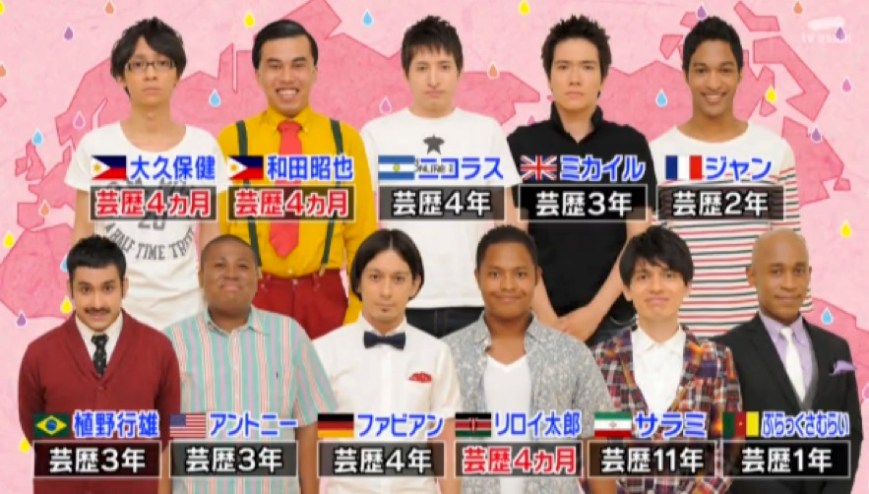
As you know, in Japan, multiracial models on TV have been popular. Recently, multiracial comedians become popular as well. They do not act like fashion models. They make people laugh by talking the story about the incident happened around them only because they are multiracial. First, Japanese are surprised that they can speak fluent Japanese and cannot speak English or another foreign language. Japanese also laugh at the characteristics the multiracial comedians share with other Japanese.

They had had many troubles and unique experiences which happened just because they are “hafu.” If we listen to their stories, we can know how hafu people are treated by Japanese. For example, Anthony, he is one of the ‘hafu comedians’. He is American and Japanese. People laugh at the fact that his hometown is Tokyo and his father managed a Sushi shop. He has knowledge about sushi because his home is sushi shop, but when he goes to a sushi shop, the master of sushi shop offered him ‘California roll’ and he was surprised. He has had other interesting experiences. He is bad at English, and when he was an elementary school student, he decided to go to English conversation school. On his first day of English conversation school, when he entered the classroom, other students misinterpreted him as an English teacher and they said “Hello, how are you?” to him.

I want to tell you about one more ‘half comedian’, Ueno Yukio. He was laughed at because of his obvious Japanese name. He is Brazilian and Japanese. When he plays soccer, the opposing team judged Yukio was a good soccer player by his appearance and many defenseman surrounded him. The opportunities to watch TV programs in which many ‘half comedians’ gather and talk about the things often happen around them are increasing. According to them, following things often happen: 

  • are judged to be foreign people
  • are often stopped by the police 
  • are asked by Japanese to sing foreign songs 
  • are laughed at by Japanese when they sing Japanese songs
  • are often expected to have high athletic ability
  • have difficulty getting a part time job
  • are invited to BBQ parties or Halloween parties
  • are called ‘Bob’ or ‘Michel’ 
  • are treated as tourists everywhere

Of course their nationality is Japanese and most of their hometown is Japan. Why they are laughed? Why do Japanese people stereotype their abilities? When Japanese look at people who look like “gaijin’’, Japanese often expect some specific skills because they have some assumptions. They think that people who have white, black, or other foreign appearance have foreign names and can speak foreign languages, and cannot speak Japanese at all.

It is true that hafu people are not a majority in Japan and many Japanese have little familiarity with thinking about race. That’s why people have expectations about the skills hafu people have. If hafu do not have these skills, Japanese laugh at them and hafu are unilaterally discouraged. 

Behind the Trend of Huge Eyes in Japanese Anime

by Yukako Ikezoe

There have been controversial debates going on about why characters in Japanese manga have huge eyes. Do such huge eyes in Manga mean that Japanese people are craving for them?

Having read Terry Kawashima’s piece, “Seeing Faces, Making Races: Challenging Visual tropes of Racial Differences”, I also started wondering why the eyes of characters in Japanese manga are big, even though I had never strongly questioned that before. Readers from Western countries might have wondered about the looks of characters in Manga because the characters’ features are similar to the features Caucasians have, including round eyes or blond hair.

Thinking about the real purpose of this kind of trend from the perspective of Japanese myself, I would say that is not because Japanese strongly desire to get big eyes like Caucasians, but rather because big eyes are one of the most important techniques to express characters’ minds and make it easier for readers to observe its minute movements, since only iconography and visual languages are used to let readers read what characters are thinking. Therefore readers can easily read characters’ thoughts by looking at their facial expressions with unique movements of their eyes.

There is a proverb “目は口ほどにものを言う” ,meaning that “the eyes are the window of the mind”, or “the eyes say more than the mouth” in English. This thinking also makes us consent to the trend of large eyes in Japanese Manga. Making up for sounds or animation which enable us to understand situations and feelings of characters more easily, various movements of eyes are also a center tool for writers as well as for readers. Using large eyes can be considered as one of the essential tools or techniques to add affluent expressions on characters.  Inspired by Disney cartoons, Osamu Tezuka known as a talented Japanese manga writer, also started using that technique in order to emphasize greater expressions of characters. His works then have been the basis for all manga today. In spite of the fact that the way of drawing characters was also influenced from the West, a reason is not always the strong desire of Japanese towards Caucasians, but rather Japanese manga writers adopt the Western styles into their drawings.

I am always amazed by that technique when reading manga since characters with various expressions on eyes give plenty of punches and enable me to empathize with the manga world in which only visual languages and pictures are used. Japanese writers uniquely use huge eyes as a technique to add greater emotions on characters, which is still putting many manga fans from all over the world into a trance today.

References

Tabatha Butler.(2013). How Walt Disney Influenced Anime. Retrieved from http://themovieblog.com/2013/how-walt-disney-influenced-anime/

Mimicking the non-existent

Anonymous student post

Body alterations are a strange thing. Just the words themselves—“body alterations”—make them seem so foreign to our lives, like they’re not something natural. Yet looking at people throughout my life has made me realize that body alteration has become the norm for many people, and desired by, perhaps, many more. If we were to look at how many people use make-up, have surgery, aim for a different body weight/composition, or even just get a piercing, we would see just how widespread this notion of changing our bodies is.

Yet, after reading Terry Kawashima’s (2002) article on racial indicators, I find body alterations strange in another sense. Kawashima discusses this idea of mimicry, in particular the mimicry of “white” traits by Japanese people, arguing throughout her paper that this is not the case for most of Japanese society. But it raised an interesting question about mimicry in relation to body alterations for me: When someone aims to alter their body, is it because they are trying to mimic something or someone else?

This can be a tricky question to navigate, as some will find it too broad a question while others will point out that there are as many reasons for changing one’s body as there are people. Despite this, I can’t help but feel that, at least from what I’ve seen and read, the answer just might be yes, but not in the way that the question is worded. The cautious reader will be skeptical, and thus, I suppose, explanations are in order.

Part of my answer is reinforced by some particular experiences of mine. Growing up with sisters can be difficult, especially when they are constantly attempting to put make-up on and dress fashionably, even when it makes you late for school. Anxiety, I learned, fueled my sister’s actions; she wanted to look “normal”, and thus she would groom herself constantly. For her, body modification was a way of becoming invisible. This resonates with my own experience growing up with raised bumps on my back. My mother, in all honesty, was more worried about them than I; she blamed them for the way I dressed and the activities I gave up when I was older, as well as for my shy and withdrawn personality. She went so far as to offer me a chance to have plastic surgery. Unable to explain to her (or myself) why my scars were not a problem to me, I consented.

After having plastic surgery on only two bumps, and after having grown up with more time to mull over that experience, I’ve realized that my mother believed I couldn’t think of myself as “normal” while I had something “subnormal”, especially when she saw the anxieties my sister held. Body modification, in this context, meant to her an attempt to elevate myself back to “the standard”.

Broadened to a larger scope, we can see in other’s experiences through things like blogs and academic literature that body modification extends across the board. It affects how people relate their body to race, gender, age, culture, health, and all these other touchy subjects that people seem afraid to address sometimes. And—again, from what I’ve seen and read—I think that all these changes that we make to our bodies has something to do with trying to obtain an ideal. In the end, it’s difficult to say that there’s some definitive “real” thing that people try to mimic, because most of the things I’ve listed are just social constructs. Race doesn’t biologically exist, health is relative, and age is reliant on different perceptions of time. In the end, perhaps all people are really trying to do is aim for something that’s not really obtainable because it does not exist in any measurable way. So in a way, we are trying to mimic something; it’s just not something that we can point to and say “there it is”.

Curiosity, slow down!

tattoo_1038

(Photo credit: doviende)

by Sheena Sasaki

Curiosity is one of the important phenomenon to how individual acts. I believe that sharing of culture is not taking place only to understand each other for world peace, but also with curiosity towards things which you are unfamiliar with. With curiosity, people are attracted to unknown cultures of the communities outside of theirs.

When I lived in the United States, I saw many non-Japanese having tattoos of kanji (Chinese/Japanese word character) as part of their fashion. One of my friends also had kanji tattoo as well. He told me that he had strong interest in Japanese cultures and traditions and would like to major in Japanese practices in the future. His curiosity was the base of his view of what he wanted to do in the future.

He also proudly said that he chose by himself the kanji he asked to have tattooed on his body. What he wanted as his tattoo was “ogre.” In kanji, it is written as “鬼 (oni)” My friend did not know the kanji for the word, but the tattooist told him that he knew. The reason my friend was interested in this kanji of oni was its definition and meaning behind the single word. The word does not simply mean “ogre” or “monster.” It also refers to ghosts and souls of dead people, something hidden and invisible, something of abnormal physical characteristic, and something which curses people. All of this definition combined created the monster of oni. Although I am not the person who deeply knows and practices my country’s culture, I felt proud to some extent. However, at the same time, I also felt some uneasiness when I took a glance at his tattoo. As I wrote, the kanji for oni is “鬼,” but what was tattooed on his arm was “豚,” which means “pig” or refers to some who is very fat.

This type of small misunderstanding is seen often. I have also seen people walking around in kimono with right side crossed bottom which is how dead bodies wear kimono. I remember my kimono teacher saying, “I am very happy that many people outside of Japan began to hold interest into kimono, but I feel sad at the same time when I see wrong practice of kimono wearing is widely known.”

It seems that some people fulfil their curiosity just by touching or experiencing only the atmosphere of the unknown culture. I believe the wrongly mimicked cultures make people uneasy or to some extent sad since to them, it may mean to them that foreigners do not really have interest and understanding to their culture. Mimicry may be a first step to knowing the new culture; however, stopping at the stage of mimicry strikes people as incongruous. This sense is similar to when your name is wrongly remembered. You know that the person did not purposely misremember the name, but you still feel some uneasiness. Curiosity helps people to hold interest into cultures they have never practiced. Meanwhile, small curiosities may lead to misunderstanding or wrong practices of certain cultures.