Neighborhoods of Brooklyn

Introduction

Do you know the city of Brooklyn? Brooklyn is a borough, which is familiar with its nickname ‘Crooklyn, Brooklyn’, which is located in New York City, in the south west of Manhattan. The independent “city”, with the third largest population after New York, Los Angeles, and Chicago, is said to be the most famous city in the United States, and known as the most city of immigrants.

Features

By its history of settlement and city project, the city is consisted of lots of neighborhood of various immigrants, including Caribbean, Russian, Orthodox Jew, Irish, Chinese, Italian, (of course) African American, and more variety of people. As a collection of multi-ethnic neighborhoods, Brooklyn raises many excellent cultures within people’s ethnicity. In addition, they’re different not only in cultural aspect, but also economical, demographical, ethnical and sociological aspect. (Kenneth T. Jackson, Introduction P.2 L.29-32)

Marty Markowitz (Foreword L.5-7) says “The American dream is made up of stories of immigrants who created successful business; in Brooklyn, entrepreneurs built neighborhoods with their dreams.” As he said, many relevant things, for example, art, music, movie, sport, architecture and etc have been fascinating to the world. Brooklyn also brings up one of the most spread cultures in globalization era, which is called hip hop.
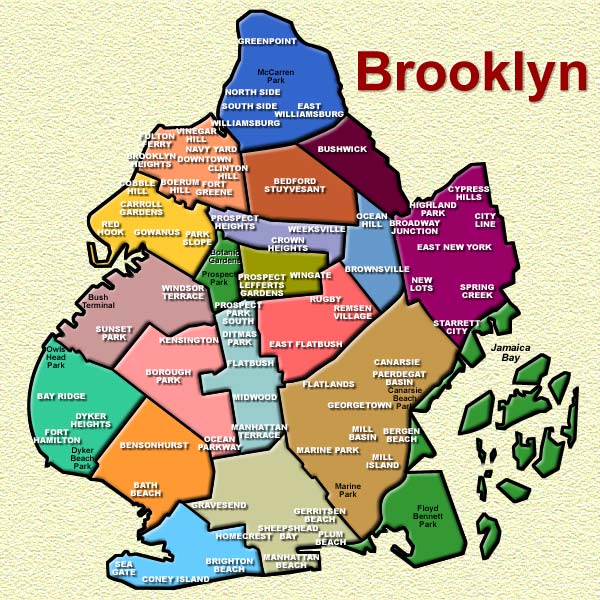
So far, I guess your image of this city is like, glittering, fascinating, full of variety, and kinds of these ideas. Yes. This is true; however there is also a difficulty to be in the most immigrants-city.

Multicultural co-existing

One of the merits of being full of variety may be expressed in the word ‘creativity’; however, variety also may cause conflict and trouble. In the movie ‘Do the Right Thing (1989)’, Spike Lee clearly describes this problem, which is the reality of Brooklyn.

In the movie, many types of people (immigrants) like, African American, Italian, Korean, White American and more are living together in one neighborhood. At the end of the story, frustration between people reached to the top, and this led to a riot. African Americans burned Italian’s Pizza store, one African American was killed by the police, and some guys threatened Korean couple by saying ‘Next is your turn!.’ In this scene Korean husband desperately yelled ‘No! We same!! I’m Black!!’

This movie shows the difficulty of multiculturalism or multicultural co-existing. Living together in multiculturalism might cause many conflicts between people with different cultures. Spike Lee describes how various and active Brooklyn is, but also he introduces us how complex and troublesome it is.

“Do the right thing: 11 out of 12”:

Reference & Source

“the neighborhoods of Brooklyn second edition”,
”Foreword” by Marty Markowits,
“Preface” by Osborn Ellion and Micheal E. Clark,
“Introduction” by Kenneth T. Jackson

by Yuki Atsusaka

Racial discrimination against Korean in Japan

I’d like to write my opinion why Korean living in Japan was harshly discriminated based on my father’s experience.

My father is Korean with permanent residence in Japan, and so I’m ‘Hafu’ having Japanese nationality. My parents have been hidden the fact that my father is Korean until I discovered his passport when I was about fourteen. Recently my father and his brothers

sometimes start to talk about the story at the time Korean discrimination often occurred which is unimaginably cruel. The reason why they’ve been hidden the fact is that they were afraid of me talking about Korean and being bullied by Japanese. In any case, I’ve never been bullied because of what I am. Even though I was told earlier about my father’s nationality, my ‘Japanese’ friends also knew it, they would never bully me. How and why should I be bullied due to it?

There is not much appearance different between Japanese and Korean. Moreover my father including me cannot speak Korean at all. In my opinion, the reason of the discrimination is the historical problems between these two countries. The hostility between Korean living in Japan and Japanese has been handed down from generation to generation. In fact, I cannot deny that my father doesn’t have good intentions to Japanese. Some Japanese elders may also have the feeling that Korean living in Japan is inferior, because most of them were forced to come to Japan to work by Japanese. But in my or our generation, I think that none of us has hostility each other at all.

In today’s Japanese society, I think more and more Japanese people tend to have good intentions to Korea. Korean thrives in Japanese show business, and both Japanese and Korean travel often each country than before. And I consider or hope that oppositions between Japanese and Korean come to the end in our generation

by Masahiro Hatoyama

Media and Society: A Less Optimistic View

How many days can you go without watching television or without using the internet? Perhaps our answers would vary accordingly. But if we really think about it and answer with utmost honesty, we would all probably end up with a somewhat similar answer – not very long.

People of today’s generation are, in my opinion, immensely media-dependent. We rely on various media platforms for our daily dose of information, communication, and entertainment. In most countries, most households would probably own at least one television set, and some households would also have access to cable television and the internet. Hence, it becomes quasi-impossible to remain completely uninfluenced by the media’s sometimes subtle and sometimes blatant magnitudes of influence – since most children literally grow up with the television screen as their babysitter.

In short, the media can influence our way of thinking – our concepts of beauty, class, and society; it can shape our political views and opinions on certain issues; it can set the trend for our lifestyles, and mold our choices as individuals and as members of a larger society. At the same time, it can also swerve our attention away from the important issues; perhaps some of today’s teens wouldn’t care about social and political issues for they are too engrossed with the entertainment aspect of the media. As an audience, we mostly have a one-way relationship with the traditional media; we accept what we are given. Hence, we accept the dominant culture that the media spreads upon its audience.

Renowned journalism professor Maxwell McCombs stressed the media’s great potential for agenda-setting. For McCombs, the news media in particular can “set a nation’s agenda, to focus public attention on a few key public issues.” Hence, in my own opinion, the media can choose to magnify and spread a certain culture or ideology while minimizing or completely ignoring the existence of other cultures.

Edward Said, a distinguished cultural critic, wrote the book “Orientalism” wherein he discussed how Asia has been viewed in a certain way – with racism and prejudice. This stereotype is a result of the dichotomy created by the West – wherein the non-Western is called the “Other.” I borrowed Said’s idea and applied it in the context of the media and society – the media created a hierarchy of cultures, hence labeling one as the dominant ideology or the norm, and all the rest as the “other” culture outside the norm, perhaps deemed as the less important one. This is clearly an example of how globalization and its effects on the media can undermine cultural diversity. The way it works is very subtle and yet the effects are tremendous – we go home, watch TV, surf the internet, read, sleep, interact – this cycle may seem normal, but what we don’t realize is that within our daily media consumption, certain ideologies are being inculcated within us. We are heavily influenced and we don’t even realize it.

For many years, it has become apparent that the media has fostered the dominance of one culture – the Western culture – thus, giving birth to the westernization of the global media. Most of today’s media filled with Western tones – values, ideas, and perspectives. This is a manifestation of how globalization was able to homogenize the prevailing media culture. One could even argue that the media was able to spread cultural imperialism, in which Western ideals are strongly represented as universal, hence trampling over local cultures and individuality. Western depictions of non-western imagery can also be flawed and biased. As a media student, I have observed that stereotypes still persist within the popular media – most of which are discrimination based on class, race, ethnicity, culture, religion, sex, and gender. This is highly detrimental because it can lead to a misunderstanding of one’s own culture, hence compromising one’s holistic understanding of the world, in favor of praising and adapting Western ideologies.

Going back to my earlier statement – the media is everywhere we go, each country has its own media empires. If we examine the dominant media culture across the globe, it is difficult to ignore the fact that these media and cultural products may physically exist in different countries, hence within different cultures embedded within different societies; however, their geographic locations do not determine the type of ideology they emanate from, as well as the type of culture they disseminate. Instead of the local contributing to the global, it seems that the global is merely penetrating the local – a one-way process in which Western values are forced upon most societies. It seems that there is a continuous cycle of cultural monopolization within the media industry as a whole.

How long can you go without watching television or without using the internet?

by Fritz Rodriguez

To whom do Cities Belong?

Do cities belong to those who bring in more money or those who live there? I think the former. I want to illustrate this point with the example of my hometown city; Dalian, China.

Dalian is a coast city in northeast China. It is not very big but kind of developed comparing with most cities in China. Although the economy of Dalian is growing rapidly, it seems that it has little effect on people’s living standard. The wage level of Dalian is not very high, but the price level always stays ahead in China cities price level ranking list. Because of its beautiful coast sceneries and less-polluted environment, Dalian is orientated to be a tourist city. However, I do not think this can be the reason of low income and high consumption.

The high house prices in Dalian should be mentioned. The average wage is 3000 RMB/month, and the average house price is 6000 RMB/square meter. There are many people who come from Dalian who go out and work in some big cities in which they can earn more money and live better, such as Beijing and Shanghai, because they believe they cannot afford the high house rent in Dalian. At the same time, people that are from some smaller cities are trying to live in Dalian, so they come to Dalian and work there. They feel good to live in a relatively nice and developed city and earn more than in their hometown. Their emersion intensifies the reduction of wages, since bosses can give them lower wages than local workers and also make them happy. Thus I feel Dalian people don’t have the ‘right to the city’, because it is not them who can make decisions of the city’s development direction, but someone that have power or money such as the government and investors who set up companies in Dalian.

Moreover, I want to give another simple example. I’m not sure if you know the Summer Davos in China? It is a global economic forum. In the summer of years 2007, 2009, 2011, the Summer Davos is held in Dalian. There were people from the 500 top companies around world coming to Dalian. However, my example is not about Davos but the environment during the Davos period. We can easily find that when Davos is coming, the whole Dalian city will become much cleaner than ever. It makes people feel the clean environment is only made for people who will attend Davos, but not for the people who live in Dalian all their life. In addition, almost all of fairgrounds are forbidden as they are thought to damage the appearance of Dalian city. This makes some inconveniences to people’s living.

Generally speaking, I think the city belongs to the ones who bring in more money and the development of the city is also for them. People who live in a city do not really have a ‘right to the city’.

by Xue Wang