I don’t know it, so I don’t like it

“They speak a different language, they wear different clothes and even worse, they eat food I never saw before! I can’t understand them at all, so how come they are living here, disturbing my peaceful lifestyle which I lived for 20 years? I wish they would just disappear and go back to the country they originally came from.”

These are the thoughts a native citizen might think when he is faced with the unknown lifestyle of immigrants settling in the neighborhood.

Negative feelings against someone based on their membership in certain groups (such as ethnical groups) or better called prejudices have accompanied humanity since we exist. Easily established, prejudices may lead to stereotypes, a belief that associates a group of people with certain traits. Which is to say, that without checking up whether what we perceive is really truth, we assume another group of people as similar in certain aspects over a stable period of time. And those are the traits that may trigger fear, anger and hate towards them. If these negative feelings towards a group grow stronger and stronger, they can be reinforced by peers or experience that were made with a member of the group. In this state of mind, people may express their negative feelings through actions. This negative behavior directed against people because of their membership in a particular group, or mostly called discrimination, is the reason why intercultural misunderstandings and violence all over the world are strengthened.

So at the end of the day, we have to ask ourselves how we can prevent the construction of discrimination. One answer would be to eliminate the whole vicious circle by stopping the development of stereotypes. The things that annoy native citizens may only be a result from wrong perception and anticipation, so they must not necessarily be accurate.
Most of the time, there is a gap between what one assumes to be right and correct and the actual behavior of the other group, which is perceived as a threat to one´s self-esteem. Unluckily, groups are too often seen as fixed entities, which promotes the exaggeration of intragroup similarity and intergroup differences.

In my opinion, governments and local authorities should try to solve the problem by encouraging Decategorization and Recategorization of thoughts. If the local citizen pays less attention on categories and intergroup boundaries but also perceives the immigrants in the neighborhood as individuals, he might recategorize his conception of groups. As this allows him to develop a less fixed sense of perception, he might still think the immigrants around the block are unpleasant, but he may start to interact with the ones living right next to him. He will gather more information about how these people really live and therefore understand what lies behind the surface.

In other words, contact between groups can be the key. Modern architects already take account for this by constructing new environments where poor and rich, immigrants and locals, black and white can live in the same neighborhood. Because of daily interaction, it is harder for prejudices to be built up. However, if we think of Farmingville in NY, where Mexican immigrants living among Americans caused many problems, contact is just the first step.

It is essential to take a look at the motivation and social structures underlying a person’s actions. And this is by no means something we should leave to authorities only, as it is us that build up stereotypes and therefore it must be us that help reducing them.
Of course, this is an enormous task and everyone must do an effort to achieve the goal of living in a world without prejudices. Just because it is difficult, however, doesn’t mean it is impossible.

by Julia Semineth

Multiculturalism a failed sociological phenomenon?

The answer straight away: No.

The most dynamic nations regarding economy, science and arts on this earth are multicultural.

This includes nations like the the USA, Israel, Canada, Australia and almost all EU countries and. Additional to this you also can see China and other emerging powers like India or Brazil as quite multicultural.

 As contrast: Anywhere where one “authoritarian culture” tries to block all the cultural influences from outside, stagnation and decline is more likely.

You can see that in most Arab countries, North Korea, Pakistan and in general, in areas where one group tries to ideologically or religiously particularly stay “clean”.

Not to long ago, many heads of states with a multicultural policy -mainly in Europe- declared their political approach as failed.

Since I am from Germany, let us focus on this case.

To quote Chancellor Merkel: multiculturalism had ‘failed utterly’.

Yet, it is more concrete that there is a long history of success, which just needs a new adjusted framework, not only to support immigration and migration but also challenges its participants and prevent parallel society-system within a state!
Nowadays one out of five people in Germany has foreign roots and the proportion of people with foreign origin is increasing – and so is the need for more money for education.

This was completely clear from the beginning!

An economist could tell you this without thinking. With the target to make profit, you need to invest your money.

The history of Germany always was, is and will be characterized by German citizens emigrating or foreigners immigrating. This can be for work, housing, marriage, wealth and cultural reasons.

In addition to that the first half of the 20th century with its millions of forced migrations during and following the two world wars created a even more multicultural society, which was working very well.

Learning from that, the key of multiculturalism comes from the efforts, not to separate but to integrate and still provide freedom for own cultural aspects.
Only then, when there was a successful integration, the enrichment opportunities due to multiculturalism can be realized.

by Anonymous

Japanese Immigration Policy in the Future

“Japanese must enact a new immigration law so it will allow us to bring in many immigrants.” Japan Times reported the interview of Tokyo Gov. Shintaro Ishihara at the Tokyo metolopolitan Government building. In this interview, Ishihara answered his view of politics for immigration in Japanese society. “Since we are not a homogeneous people because our ancestors can be traced back to Korea, China, Mongolia, whether the number of foreigners increases or not in Japan is irrelevant. Because of labor shortages as society rapidly ages, we need more foreign residents to make up for our labor shortage.” He favors accepting foreign residents in Japan to strengthen our aging society. However, even if he favors positive immigration policy, he opposes the idea that gives the right to vote in local elections to long-term foreign residents. “Such a thing is impossible, must not happen and is dangerous because regional issues influence the state” he said. If foreign residents want to participate in local politics, they should become naturalized Japanese citizens, he said in the interview.

Do you think the immigration policy that Ishihara proposed is the best policy which Japanese government should proceed to? Should we accept more immigrants just for making up for labor shortage? We do not have to treat them as citizen but just as labor, and we do not have to guarantee their right as citizens? What does he mean “they should become naturalized Japanese citizens”?

I think the idea of Ishihara is very conservative and it is far from the ideal policy which we have to proceed to with regards to immigration policy. First of all, even if he thinks our country is not homogenous society because of the diversity of our ancestors, our society is still very homogeneous with regards to national politics; for instance, it makes much of the interest of Japanese and neglects the right of non-Japanese people. It regards Japanese society as if homogeneous country and still many non-Japanese people are eliminated from in various social situations. Actually, our society has much cultural diversity. According to the statistics from the Ministry of Justice, the number of population those who do not have Japanese citizenship (what is called “Gaikokujin” in Japanese) is over 2 million. The number has been increasing and will continue to increase in the future. Considering these situations, we cannot say our society as homogeneous, and we cannot continue our national politics which limit the right of non-Japanese people any more. It is much more the case if we have more immigrants with some immigration policy in the future.

Though Ishihara answered that it is impossible to allow long-term foreign residence to have right to vote in local election, I think his idea is impossible in reverse. If more immigrants will live in Japan, inevitably we will have various issues related to them. We will have more children who have non-Japanese parents in schools; we will have more workers who are not Japanese at stores. If we have more immigrants, it does mean that they play more important role in our society. If we have more immigrants, we will not be able to ignore their right such as voting right even if they are not permanent residence.

It is easy to say that we will accept more immigrants because we need more labors amid the rapid aging society; however, before we accept them as labors in Japanese society, there are many issues with which we have to tackle. We will need to change our national policy so that people who are from outside of Japan have more right in Japanese society. Not only ensuring their right, we also have to create social supporting system which new immigrants will be able to start their live in Japanese society smoothly. We also have to create environment where Japanese people can live together with immigrants; for instance by offering more cultural education in schools. Just making immigrants naturalized Japanese citizens will not be our solution.

by Shunsuke Ochi

Is Politics Killing Multiculturalism?

“Immigration and multiculturalism are issues that this government is trying to address, but for far too long ordinary Australians have been kept out of any debate by the major parties. I and most Australians want our immigration policy radically reviewed and that of multiculturalism abolished. I believe we are in danger of being swamped by Asians. Between 1984 and 1995, 40% of all migrants coming into this country were of Asian origin. They have their own culture and religion, form ghettos and do not assimilate. Of course, I will be called racist but, if I can invite whom I want into my home, then I should have the right to have a say in who comes into my country.”

Former Australian Member of Parliament, Pauline Hanson (1996)

Politicians are big players in the immigration debate. In the New York Times article we discussed in class, the author suggests that lack of inclusive government policy on immigration creates ‘parallel cultures’ preventing migrants from joining the national community. Arguably the blame should not stop there. Particularly in countries where voting is non-compulsory, immigration debates are often characterised by heavily loaded rhetoric designed to foster a culture of fear and votes at the ballot box.

The above excerpt comes from the maiden speech of former Australian Member of Parliament, Pauline Hanson to the House of Representatives in 1996. While the speech was heavily criticised by fellow politicians and the wider Australian public, Hanson’s One Nation party went on to win nearly one quarter of votes in the Queensland state election two years later. Every country probably has their own ‘Pauline Hanson’. US Republican presidential hopeful Herman Cain recently mentioned his ideal border protection fence would be “20 feet high, with barbed wire, electrified. With a sign on the other side that says it can kill you”. Fellow candidate Michele Bachmann also has strong views on immigration, on record saying “not all cultures are equal…not all values are equal”.

And while the names may be different, the rhetoric is not. These people coming to our country, stealing our jobs, ruining our way of life. The language is highly emotive and elicits a stronger emotional response than fact-based discussion. It is particularly effective in times of high unemployment where the concept of our jobs becomes my job, and the reason why I can’t pay my mortgage and feed my family. It is also extremely dangerous, normalising racist attitudes and igniting violence against migrants.

Luckily for Australia, Pauline Hanson has resigned from parliamentary duties. Somewhat worryingly she is still a fixture of Australian culture, reaching the final of Dancing with the Stars and currently starring in the local version of Celebrity Apprentice. Her speech stands testament to the influence of political rhetoric on the immigration debate. Should politicians feel any responsibility for national cohesion? Is winning more votes really worth jeopardising the safety of newly arrived migrants?

by Alex Bitcon

Job hunting with a foreign name in Germany?

In Germany there are a lot of people who have come from Turkey to work here and eventually decided to stay. Those families have names that sound completely different from German names, and the children of those families sooner or later come across the problem of job hunting with a foreign name.

For people who have “strange” sounding names, job hunting can be really hard I think, because employers who see and read those names might have negative reactions. They would probably doubt whether the person can work as well as German people, or whether the qualities he wrote in his résumé are actually all true.

In reaction to that, German politicians once debated removing the picture from all résumés before they reach the people who decide whom to employ. In doing so they wanted to establish more equality among job-seekers, because they would not be judged based on their (maybe foreign) looks any more. Also the employers would no longer be able to prove their suspicions that the person with a foreign name looked foreign and therefore had to be a foreigner.

Not many people know it but the picture is one of the most important things in a résumé, because it triggers a lot of emotional reactions and completes the impression of the person we are looking at. So the politicians believed that it would be welcomed by everybody if they decided to officially forbid pictures in résumés.

But it had the opposite effect because now the most important thing in a résumé would be your name and that is, in contrast to a picture, something you cannot change as freely as you want. Of course mostly foreign people would have a disadvantage because of that but German people started to worry as well because there are also German names that are most unpopular and trigger negative associations.

In the end the politicians refrained from discussing this topic any further and the process of job hunting did not change. But I think it made many people realize that it is not just your name that counts in the end, but also the picture you send in along with everything else. In fact, it probably has an even bigger impact than the name.

So I think people do not have to change their name in order to get a job but maybe their pictures …

by Julia Lohmann

Keep the Ties or Not?

I come from China, and I am also a student of a university in Sweden. I meet many immigrants there, because the city that I dwell in is said to be a place in which the Swedish government put immigrants. I don’t know if that’s true, but when I traveled to the north part of Sweden, I felt there were not as many immigrants as the city I live in.

My landlord family is from China originally, and all the family members are immigrants in Sweden now, including the third generation. My landlord and his wife can speak Swedish, Chinese and their hometown accent very well, their daughter can speak Swedish fluently and a little Chinese, but their grandson can only speak Swedish. In my opinion, though they have Swedish citizenship, this family has not lost the ties to China yet. For example, the landlord couple go back to China once a year, and when I asked the reason for this, they said “we are Chinese, and we have relatives in China. We want to celebrate some festivals with them.” In China, people have the custom to celebrate the festivals with the whole family. My landlord family will invite some students who are also from China (like me) to celebrate the festivals together. We cook together, eat at one big table and talk in Chinese, which makes everyone feel we are in China instead of Sweden. As immigrants, they have lived in Sweden for 30 years, but they still enjoy the feeling of speaking Chinese and the Chinese atmosphere. I think this is because they grew up in China, and there is a strong lifestyle in their deep mind. However, for their later generations, the ties to China are weaker and weaker. Though the old couple tries to push their children to learn Chinese language and customs, the children seem to be unwilling. They may believe that they are Swedish, not Chinese, and they can live well in Sweden without knowing Chinese things.

As a foreign student in Sweden, I haven’t learned Swedish language or know many Swedish customs. But when I came back to China in summer holiday, my family members joking said “hey you are Swedish now”. Then a strange feeling appeared to me and I said a little angrily “I’m Chinese” to them. I don’t know why I got the anger, but I felt it was so uncomfortable to be “Swedish” when I knew little about Sweden.

Thus I think whether people, especially the immigrants want to keep the ties to their homeland or not, is depending on how they identity themselves. They can choose which lands’ culture and customs they want. For instance, if a person identity himself as a Swedish, he will absorb Swedish culture and customs, and the point is finally he is Swedish indeed.

by Xue Wang

Language and the Sense of Belonging

The importance of language became apparent to me while visiting Hawaii in 2005, where I briefly talked to a cab driver who was one of the few natives that could still speak Hawaiian. When the Americans invaded Hawaii, speaking the native language was forbidden, and so it was forgotten by most people. However, she still remembered the language and told me that it gave her a sense of connection to her roots.

I can only imagine being forbidden to speak Swedish, the sense of loss I would feel. Language is strongly connected to one’s identity, and I would imagine that one feels a gap without one’s native language. Language also affects me while being in Japan, since I do not speak Japanese and therefore do not really feel a connection to the country. Perhaps this feeling is very individual, but it is frustrating not being able to communicate with people on a daily basis. Not learning Japanese while being here is a personal decision, but I sometimes wish that I knew the language in order to connect more with people and my experience here.

St. Joseph’s Women’s Health Centre in Toronto dealt with the topic of the importance of language when they interviewed women that have migrated to Canada about their experiences. In their report, they discuss the relationship between migration/resettlement and attachment, and language plays a big part in this. The women faced difficulties participating in society on many levels, including work. One woman said: “The fear I have right now is if I start working. Now it’s time for me to do something, something for me, and …see if I can work with the community, and I’m a little bit afraid because I’ve never done that in English before, and, I’ll be forced to take that step and it’s not easy. You know, it’s uncomfortable.”1

Another woman talked about the significance on a daily basis of her native language of Arabic. To her, it was more than just a language since it was connected to religion and prayer. She even went so far as to say “without Arabic I can’t function, I can’t be.”1

A third woman expressed her concern about connecting with people: “How can I be funny in English? Really, if I were to try, I would be so self-conscious. While in my own language I can say one thing and be funny, and everybody would be laughing. You know when you should be frivolous, when you should be serious. It’s everything is there, planned for you, as though life is known to you. Life is not really known to you in this country…And it never will be.”1

To sum up; Language is important in order to feel a sense of connection and belonging to oneself, to others and to a country, but learning a new language is not just about learning a language, it is about taking on a whole new culture and everything that entails.

by Erika Selander Edström

1) http://www.attachmentacrosscultures.org/impact/index.html

Neighborhoods of Brooklyn

Introduction

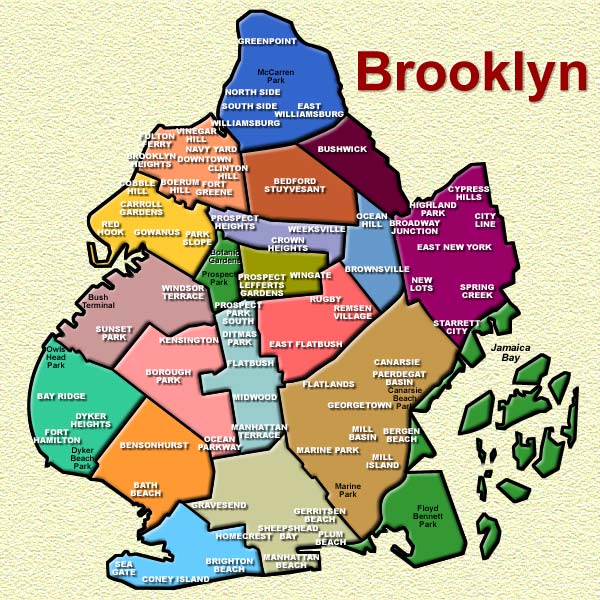
Do you know the city of Brooklyn? Brooklyn is a borough, which is familiar with its nickname ‘Crooklyn, Brooklyn’, which is located in New York City, in the south west of Manhattan. The independent “city”, with the third largest population after New York, Los Angeles, and Chicago, is said to be the most famous city in the United States, and known as the most city of immigrants.

Features

By its history of settlement and city project, the city is consisted of lots of neighborhood of various immigrants, including Caribbean, Russian, Orthodox Jew, Irish, Chinese, Italian, (of course) African American, and more variety of people. As a collection of multi-ethnic neighborhoods, Brooklyn raises many excellent cultures within people’s ethnicity. In addition, they’re different not only in cultural aspect, but also economical, demographical, ethnical and sociological aspect. (Kenneth T. Jackson, Introduction P.2 L.29-32)

Marty Markowitz (Foreword L.5-7) says “The American dream is made up of stories of immigrants who created successful business; in Brooklyn, entrepreneurs built neighborhoods with their dreams.” As he said, many relevant things, for example, art, music, movie, sport, architecture and etc have been fascinating to the world. Brooklyn also brings up one of the most spread cultures in globalization era, which is called hip hop.

So far, I guess your image of this city is like, glittering, fascinating, full of variety, and kinds of these ideas. Yes. This is true; however there is also a difficulty to be in the most immigrants-city.

Multicultural co-existing

One of the merits of being full of variety may be expressed in the word ‘creativity’; however, variety also may cause conflict and trouble. In the movie ‘Do the Right Thing (1989)’, Spike Lee clearly describes this problem, which is the reality of Brooklyn.

In the movie, many types of people (immigrants) like, African American, Italian, Korean, White American and more are living together in one neighborhood. At the end of the story, frustration between people reached to the top, and this led to a riot. African Americans burned Italian’s Pizza store, one African American was killed by the police, and some guys threatened Korean couple by saying ‘Next is your turn!.’ In this scene Korean husband desperately yelled ‘No! We same!! I’m Black!!’

This movie shows the difficulty of multiculturalism or multicultural co-existing. Living together in multiculturalism might cause many conflicts between people with different cultures. Spike Lee describes how various and active Brooklyn is, but also he introduces us how complex and troublesome it is.

“Do the right thing: 11 out of 12”:

Reference & Source

“the neighborhoods of Brooklyn second edition”,
”Foreword” by Marty Markowits,
“Preface” by Osborn Ellion and Micheal E. Clark,
“Introduction” by Kenneth T. Jackson

by Yuki Atsusaka

Media and Society: A Less Optimistic View

How many days can you go without watching television or without using the internet? Perhaps our answers would vary accordingly. But if we really think about it and answer with utmost honesty, we would all probably end up with a somewhat similar answer – not very long.

People of today’s generation are, in my opinion, immensely media-dependent. We rely on various media platforms for our daily dose of information, communication, and entertainment. In most countries, most households would probably own at least one television set, and some households would also have access to cable television and the internet. Hence, it becomes quasi-impossible to remain completely uninfluenced by the media’s sometimes subtle and sometimes blatant magnitudes of influence – since most children literally grow up with the television screen as their babysitter.

In short, the media can influence our way of thinking – our concepts of beauty, class, and society; it can shape our political views and opinions on certain issues; it can set the trend for our lifestyles, and mold our choices as individuals and as members of a larger society. At the same time, it can also swerve our attention away from the important issues; perhaps some of today’s teens wouldn’t care about social and political issues for they are too engrossed with the entertainment aspect of the media. As an audience, we mostly have a one-way relationship with the traditional media; we accept what we are given. Hence, we accept the dominant culture that the media spreads upon its audience.

Renowned journalism professor Maxwell McCombs stressed the media’s great potential for agenda-setting. For McCombs, the news media in particular can “set a nation’s agenda, to focus public attention on a few key public issues.” Hence, in my own opinion, the media can choose to magnify and spread a certain culture or ideology while minimizing or completely ignoring the existence of other cultures.

Edward Said, a distinguished cultural critic, wrote the book “Orientalism” wherein he discussed how Asia has been viewed in a certain way – with racism and prejudice. This stereotype is a result of the dichotomy created by the West – wherein the non-Western is called the “Other.” I borrowed Said’s idea and applied it in the context of the media and society – the media created a hierarchy of cultures, hence labeling one as the dominant ideology or the norm, and all the rest as the “other” culture outside the norm, perhaps deemed as the less important one. This is clearly an example of how globalization and its effects on the media can undermine cultural diversity. The way it works is very subtle and yet the effects are tremendous – we go home, watch TV, surf the internet, read, sleep, interact – this cycle may seem normal, but what we don’t realize is that within our daily media consumption, certain ideologies are being inculcated within us. We are heavily influenced and we don’t even realize it.

For many years, it has become apparent that the media has fostered the dominance of one culture – the Western culture – thus, giving birth to the westernization of the global media. Most of today’s media filled with Western tones – values, ideas, and perspectives. This is a manifestation of how globalization was able to homogenize the prevailing media culture. One could even argue that the media was able to spread cultural imperialism, in which Western ideals are strongly represented as universal, hence trampling over local cultures and individuality. Western depictions of non-western imagery can also be flawed and biased. As a media student, I have observed that stereotypes still persist within the popular media – most of which are discrimination based on class, race, ethnicity, culture, religion, sex, and gender. This is highly detrimental because it can lead to a misunderstanding of one’s own culture, hence compromising one’s holistic understanding of the world, in favor of praising and adapting Western ideologies.

Going back to my earlier statement – the media is everywhere we go, each country has its own media empires. If we examine the dominant media culture across the globe, it is difficult to ignore the fact that these media and cultural products may physically exist in different countries, hence within different cultures embedded within different societies; however, their geographic locations do not determine the type of ideology they emanate from, as well as the type of culture they disseminate. Instead of the local contributing to the global, it seems that the global is merely penetrating the local – a one-way process in which Western values are forced upon most societies. It seems that there is a continuous cycle of cultural monopolization within the media industry as a whole.

How long can you go without watching television or without using the internet?

by Fritz Rodriguez

To whom do Cities Belong?

Do cities belong to those who bring in more money or those who live there? I think the former. I want to illustrate this point with the example of my hometown city; Dalian, China.

Dalian is a coast city in northeast China. It is not very big but kind of developed comparing with most cities in China. Although the economy of Dalian is growing rapidly, it seems that it has little effect on people’s living standard. The wage level of Dalian is not very high, but the price level always stays ahead in China cities price level ranking list. Because of its beautiful coast sceneries and less-polluted environment, Dalian is orientated to be a tourist city. However, I do not think this can be the reason of low income and high consumption.

The high house prices in Dalian should be mentioned. The average wage is 3000 RMB/month, and the average house price is 6000 RMB/square meter. There are many people who come from Dalian who go out and work in some big cities in which they can earn more money and live better, such as Beijing and Shanghai, because they believe they cannot afford the high house rent in Dalian. At the same time, people that are from some smaller cities are trying to live in Dalian, so they come to Dalian and work there. They feel good to live in a relatively nice and developed city and earn more than in their hometown. Their emersion intensifies the reduction of wages, since bosses can give them lower wages than local workers and also make them happy. Thus I feel Dalian people don’t have the ‘right to the city’, because it is not them who can make decisions of the city’s development direction, but someone that have power or money such as the government and investors who set up companies in Dalian.

Moreover, I want to give another simple example. I’m not sure if you know the Summer Davos in China? It is a global economic forum. In the summer of years 2007, 2009, 2011, the Summer Davos is held in Dalian. There were people from the 500 top companies around world coming to Dalian. However, my example is not about Davos but the environment during the Davos period. We can easily find that when Davos is coming, the whole Dalian city will become much cleaner than ever. It makes people feel the clean environment is only made for people who will attend Davos, but not for the people who live in Dalian all their life. In addition, almost all of fairgrounds are forbidden as they are thought to damage the appearance of Dalian city. This makes some inconveniences to people’s living.

Generally speaking, I think the city belongs to the ones who bring in more money and the development of the city is also for them. People who live in a city do not really have a ‘right to the city’.

by Xue Wang