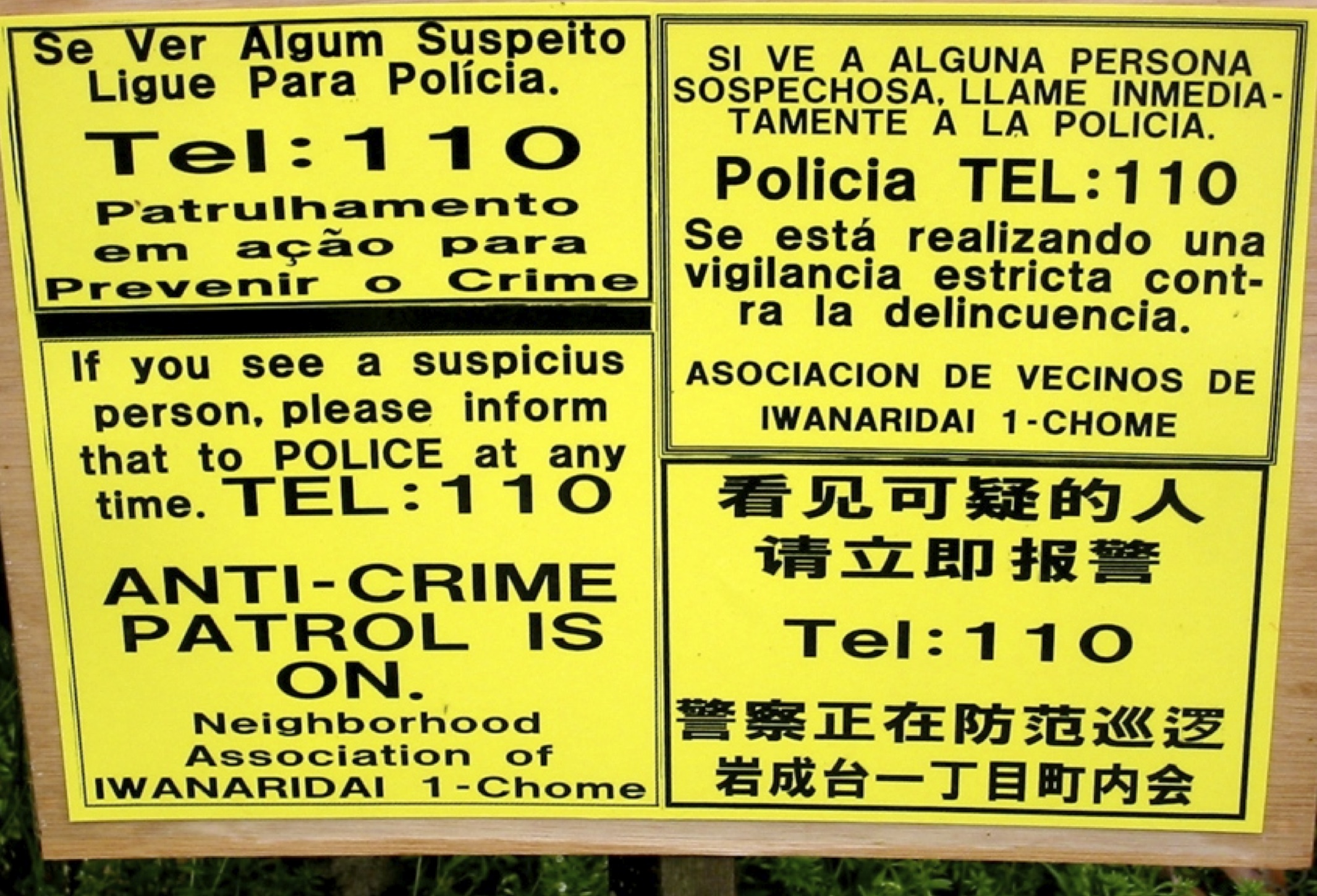
Why people in Japan chose to put billboard for foreigners?

Anonymous student post

Because we live in an island country, I think in Japan people don’t normally see foreigners especially outside Tokyo and Kyoto area. This situation makes them conspicuous. As a result, even they commit a crime less than Japanese do, people feels like they are committing a crime more than Japanese do. We think they are dangerous. Therefore, putting some kind of billboard is essential for them. On the other hand, I strongly doubt that telling that message can stop them from doing suspicious behavior.

In general, people in need of money cause criminals. For instance, they steal money or break into someone’s house. From this point of view, they have no reason to care such a billboard. They just need money and are desperate. However, foreigners coming Japan don’t know the fact that Japanese people differ from other people in that they don’t see foreigners often. No wonder that they don’t feel welcome. To change this situation, we can use an example of EU and the United States. However, sometimes people say that learning other culture or language is easy to say but in Japan we don’t have such a precious opportunity. I think that Government should make a plan. In fact, Japanese people have a kind of allergy when they talk to foreigners. We know better than anyone else. So, I show you two examples. Students in EU are recommended to learn at least 2 languages other than their native languages.  There are 27 countries in EU now. In addition, there are a lot of races. A lot of races mean that they have their own culture and perspectives. We can say that making EU work is very difficult. So, people need to know each other. In Japan, we don’t have many race or chance to meet and talk to them. Unlike the United States and EU, people tend to stay Japan and don’t go abroad.

Therefore, we don’t care much about foreigners. In the United States, there are many races in a class. People discuss a lot of things together and talk about their own culture. They gradually understand and make friends. In Japan we live in an island, so we don’t have opportunity to do things as I said above. People can go abroad to learn other cultures or languages or take classes that many nationalities are in.  I really think that people need to make chances themselves.

Sources
http://ec.europa.eu/languages/languages-of-europe/index_en.htm
http://www2.ttcn.ne.jp/honkawa/2794.html

Why Japanese don’t know about “Ainu”? and We need to protect them

Anonymous student post

It is obvious that Japanese don’t know about Ainu people. If you ask Japanese Ainu people, you will get short answer such as people living in Hokkaido or “I don’t know”. We live in Japan and why is this happening?  I assume that Japan has a lot of history issues. Therefore, government doesn’t teach contemporary history. They don’t want any trouble about history. Moreover, it is not easy to know diverse culture and how to deal with it, when we live in an island. People and government officials don’t turn their eyes to culture and they don’t try to teach culture problem or Ainu. Also, members of the Diets are not willing to take any kinds of act because they are very afraid of losing their rights or seats. For example, in India, native was protected by having 41 seats in the Diet. But to have certain percentage of seats in the Diet, somebody is going to lose their jobs. This makes them to hesitate. Moreover, I think people in Japan don’t care history or a native since we are not interested in Ainu or any other history things. In addition, people don’t go to vote, this is critical issue now in Japan. There are a lot of people complaining about politics, pension, heavy tax or leadership in politics, but people who don’t go to vote for those problems are not helping anything. Low voting rates means that politician don’t behave well. As I said above, politician which don’t work for Ainu  should change. They need to discuss Ainu rights in the Diet more. I don’t clearly remember that we studied Ainu. However, people need to know our own history and a minority race. A minority race means that those tribes are decreasing, if people don’t care so much. Once they are gone, there is no way to turning back, but what worries me the most is that I have never seen they actually talk about Ainu essentially. I saw several pages on the Internet, saying Ainu talked in the Diet one time or members of the Diet decided Ainu as aboriginal people. However, unlike the United States or Australia, we don’t have law that protect Ainu.

Sources

http://allabout.co.jp/gm/gc/294051/

McDonaldization

Nowadays, large chains such as McDonald’s, Starbucks, Pizza Hut and Subway can be found pretty much in all parts of the world. While most of them offer affordable, quick meals, they also have a tendency to sell unhealthy food. Another side effect of the chains growing so big is how they have come to control the food market and diets of millions of people. Since they are cheap, it’s easier for people to buy their meals there – at the same time, when people end up eating there all the time, it’s not good for their health.

One of the main driving points behind the McDonald’s chain is how everything is supposed to be the same – yet you can find different things in different parts of the word. For example, in the McDonald’s in Japan you can buy Teriyaki burgers, and the McFlurries tend to have different flavors depending on where you go. So even though the stores essentially sell the same products all over the world, they also offer products aimed at the population of the country it is located in. Another example of this can be found in the Japanese Starbucks, where they sell matcha lattes, and so on. This might have contributed to the chains gaining popularity in the countries they’ve settled in.

Back in my home country, we don’t have a lot of the big chains yet. Places like Starbucks, Subway, KFC and Pizza Hut have yet to set root in my home country. What surprised me at first is how people would react when they found this out. Some would react with disbelief and ask me what we actually do have back there, while others would express how they believed it was a good thing that it hadn’t been overtaken by big chains yet. Back home I didn’t really think about it much, but after traveling a bit and coming to Japan I realized how much of an impact certain chains have made on the world. Take McDonald’s for instance, you can pretty much find them in any part of the world. And while it might be nice to have somewhere to go where you know what the food will be like, regardless of which part of the world you’re in, it’s still kind of overwhelming to think about how large the franchise has become to achieve this.

How is it that chains like these manage to spread out and become this big? And how will they continue to shape the food market from now on?

by Sindre M. Berg

Are the Social Networking Sites Taking Over?

Over the last couple of years, social network sites such as Facebook, Twitter, MySpace and so on have gained a tremendous amount of popularity, and it’s become more unusual for people not to know or have heard of these sites than otherwise. Why have these pages become so popular? One of the reasons Facebook has been able to become as successful as it is, is probably because of how it satiates our natural curiosity. Through simple pages of information and pictures you feel like you can get to know people and their interests better, creating the illusion that you know them better than you actually do. The social network sites can also give off the illusion of having more friends than one actually has.  Because how many of the people listed as a friend on a social network site is someone you can count on in a dire situation?

Social network sites might make it easier to stay in touch with people, although they aren’t the only methods of doing so. There are several programs one can use for chatting with people individually. Why then, should there be a need for adding people on a social network page? One possible reason is how the social network sites make it easier to share information with several people at the same time, instead of contacting them one by one.

Before Facebook and Twitter, a lot of my friends would use Livejournal – a page for writing journal-like entries and finding people with shared interests. While this page has not grown to the size of Facebook, it still has a pretty large community of users. It functioned as a diary of sorts, and you could choose who had access to the entries you posted. Soon everyone had Facebook and Twitter though, and if you didn’t have one you were missing out. And that’s how the situation has become nowadays. If you don’t use any of the social network sites, you’re not “following the times”. When did it become like this? I’ve experienced people around me who initially had no desire to get Facebook or similar pages end up getting it in the end anyway, because if one does not have at least one way of communicating through these social network sites nowadays, one is essentially left with the short end of the stick.

The social network sites seem to have become almost essential in a way to keep in touch and up to date with recent happenings. Whether this is a good or bad thing, however, remains to be seen.

by Sindre M. Berg

Another Type of Japanese Minority

Do you know the town called “Kamagasaki” in Osaka?  It’s so-called Japanese slum where many homeless people, day laborers have lived long time ago. I suppose that there are some who haven’t ever heard about this town because the name of this place was changed to “Airin-chiku (愛隣地区)” as a political term by Osaka government. However, most of the residents and those who know this place well call it Kamagasaki.

In this town, there are not only residents but also plenty of supporting organizations and most of them are organized by those who don’t live in Kamagasaki. Why are there so many supporting organizations? Why don’t they band as one big organization to support Kamagasaki residents? The reason is that each organization has each idea of their activities. Some of them appeal the right to work and live stably, while others insist on the right to live on the streets. For us, who have our own houses, it’s too hard and cruel to be forced to live on the streets. If I ran into such situation, I would surely aim to rehabilitation. Therefore, we tend to expect that Kamagasaki people also hope to work and work stably. However, not all Kamagasaki people hope so.

Before I explain the reason, I need tell you another story.

They have their favorite song named “Kamagasaki Ninjo (釜ヶ崎人情―kamagasaki  heart)”. In its lyrics, it have a phrase―”Koko ha tengoku kamagasaki (means, here is heaven, Kamagasaki)”. Why is Kamagasaki heaven although people can’t work and live without any problems and are forced to live on the streets? I sometimes go there to work as a volunteer, and I cannot possibly think that I want to live there. Kamagasaki, which is like a hell, is a heaven to the residents. This difference of thoughts between them and us makes Japanese labor problem complicated, tells us the difficulty in resolving, and creates supporting organizations with various ideas.

Now, bring the topic around the reason why they think Kamagasaki is heaven. Japanese society use many laborers to build infrastructures in the term of rapid economic growth and after finishing it, our society excluded them as disposable labor force and have ignored them. Such people lie in Kamagasaki. Therefore, the hell is Japanese society rather than Kamgasaki for those people. There, they can get a few job such as day labor and somehow manage to squeeze. They can also walk around the town not as a poor person but a resident. This is the reason why Kamagasaki people sing “here is heaven, Kamagasaki”, and appeal not rehabilitation but the right to live on the streets.

Profound social problems, especially local ones such as Kamgasaki problem, villages with nuclear power plants, and Okinawan base problems, always have differences of thoughts between outsiders and concerned people. In these local problems, concerned people are usually minority. They are neither immigrants nor minority ethnic groups, but they are also Japanese minority. To understand those minorities’ thoughts and to solve the local problems, the outsiders should know that there are differences of thoughts between them and concerned people.

by Yukari Deguchi

To Marry Zainichi in Japan

In Japan, if you want to marry someone, you have to take many necessary steps for it. “Marriage is not the problem of your own but the problem of houses” is Japanese marriage and every Japanese thinks that they have to get their parents’ permission to get married. I think so too. By the way, if your partner was “Zainichi Korean”, do you think your parent allow you to marry with them?

Michihiko Noguchi, professor of sociology at Osaka City University, asked 7500 Kyoto citizens “ If you have a child, what will you do if they are from Douwa, Zainichi Korean, Japanese foreigners and impaired people?” In result, the most case that they tell their child to think again was impaired people and the second was Zainichi Korean. How can this happen?

Japanese are tending to be nervous about neighbors and family. And also Japanese have their special “personal space” and they don’t like to get inside of it, especially elder people. In Noguchi’s writing, the percentage of people doesn’t care about their partners situation getting higher that their age get higher. I think this is the biggest reason why it is difficult to marry with Zainichi people in Japan. Most of these things are their assumption and some people say these prejudices are past things. But now I feel things are getting more extreme. Young people have understanding of other countries culture so that they don’t care where ever their partners come from or even they are Zainichis. Either way, I think it is impossible to get away the discrimination of Zainichi in Japan. Even it get better, I think it is too difficult to forget the conflict between Japan and Korea. So we, the young people, have to think more about the relationship between two countries and try to know more about each other.

Source
http://blhrri.org/info/book_guide/kiyou/ronbun/kiyou_0144-02.pdf
2012年1月3日

結婚差別に影響を与える要因についてー二000年京都市民意識調査からー
野口 道彦
http://www.ism.ac.jp/kokuminsei/index.html
2012年1月3日
日本の国民性調査

by Kyoko Yamada

Brazilian Children in Mie Prefecture

My cousin and grandparents family lives in Mie prefecture, where there are many Brazilian workers and their family. The reason why there are so many Brazilian workers is because Mie prefecture and Sao Paolo, Brazil have a sister-city relationship among each other. From the beginning of 20th century to 1960s, many Brazilians have migrated to Japan for work. Since then, there has been a promotion of wide-ranging exchanges, such as in the areas of culture, sports, and technological fields. However, what I see in Mie is different to what is said; the Brazilian immigrants and the local people in Japan lives nearby but there are the discriminations and prejudice visible, which are the sufferings minorities often face.

In Mie, there are many manufacturing companies which need cheap labor working for a long time, so that the product costs can be kept low. My cousin is now 10 years old now, and at the school he goes to, there are about 30 Brazilian students, about 10 students classified into 3 classes. They are the “sansei” or “yonsei”, who’s ancestor has came to Japan as migrant workers who decided to settle in Japan living with their family. Most of them acquire a permanent resident visa and a while later, obtain Japanese nationality. Most of the Brazilian students in my cousin’s school spoke Japanese fluently than Portuguese; since they were born and raised in Japan, just like any other people called “zainichi.”

However they belong to a Japanese school speaking in Japanese, at first when they enter elementary school, they tend to stay together with the Brazilian friends and not hang out with others. In other words, the Japanese children keep a distance from them. This situation continues until they graduate. What I saw was shocking; when I went to school to pick up my cousin, in the playground, there were many children playing soccer and dodge ball who were only Japanese, and the Brazilian children group were shoved by the corner, passing the soccer ball to one another. After school, I asked my cousin how they stay with the Brazilian group, he said that “they don’t speak that much and play with us so we don’t stay with them. They look so different and don’t feel like we are in the same classroom.”

As we went home to my grandparents’ house, my grandmother said the same thing, that they are so different. Also, she said that they are said to be noisy in night, not following the rules and making the environment bad. This is exactly what we learnt and saw in looking at the class of zainichi and Nikkei, the cases we saw in the Koreans and Filipinos; especially since where my cousin lives is at the country side, people have the prejudice from the beginning and recognize them as “foreigners.”

I feel miserable that these problems are occurring close to me. When I go to Mie again, I would like to talk to my relatives more deeply, and persuade how their attitude is wrong and rude.

Source
International Affairs Office, Department of Social and Cultural Affairs.
Mie Prefectural Government, n.d. Web. 22 Dec. 2012.
<http://www.pref.mie.lg.jp/KOKUSAI/HP/sistercities/brazil/index.htm&gt;

by Shiori Miyake

Looking at Japanese Characteristics

From my experience living in several countries and traveling around the world, I myself felt lots of differences between Japan and other countries, which are the way they live, their sense of values, their common sense and so on. I started to realize the characteristics of Japan and Japanese people objectively by comparing with other countries. In order to avoid the conflict which may happen from these differences, I want to show the Japanese characteristics which I have felt from my experience.

I think one of the biggest difference of Japanese and foreigners are Japanese people are more collectivism than individualism. In order to have a good relationship with other people, they often have to care about the others. Therefore, it seems that they put more emphasis on harmony with others rather than having their own determined attitude. This phenomenon is quite different from other countries because it seems that they put more emphasis on having their own thoughts and their own opinions. Japanese people are also unlikely to attract attention in order to maintain their harmony. There is a Japanese term called “KY” (空気読めない) which means not to read the atmosphere. If you act or speak something which does not really fit into that situation, you may be called “KY” by others which I think it is peculiar characteristic of Japanese.

Other characteristics of Japanese people are that they are polite, calm, and shy. Of course everybody is not like that but I think it tends to be like that when I compared with foreigners. What I see the difference the most is the service toward the customers. People treat customers as if they were gods in Japan. It rarely happened when I lived in Paris. However, it may be a big stress for workers because their services are highly expected by the customers. Also, I think many foreigners think Japanese people are very shy. For example, when I went to American school, I was surprised because many students were often speaking in class. I remember that I rarely could speak in class because I haven’t taken classes that students have to give their opinions in front of the people. Therefore, I think Japanese people are not really good at giving their opinions in front of the people compared with foreigners.

These are only some examples of the characteristics of Japanese people but I think it is important to know about it because not knowing anything about people who live in different country may provoke conflict and it could also be obstacle of communication. I want foreigners especially those who are willing to live in Japan to know how Japanese people are and try to understand about our character! (Of course, I want to emphasis that not all the Japanese people are like this. I just want to present the general character of them.)

by Mao Shukunobe

Why Does Discrimination Against Ethnic Groups Occur in Japan?

In this class, we learn about the existence of many ethnic groups in Japan. However, they all have common point that they have been discriminated against or experienced bad treatment in Japanese society. I want to look the reasons of the discriminations mainly and consider if it is possible to accept them easily in Japanese society.

I want to classify the reason of discrimination in two categories; psychological perspective and sociological perspective. First of all, psychological perspective is to discover the factor of discrimination in inside of human beings. I think we all have a feeling of wanting to have a higher status than other people. For example, maybe I want to gain more money than other people or I want to get higher score in exam than other people. Also, I think we tend to want to have people who are weaker than us. For example, even though you could not get higher score than your friend, if there are other friends who got lower score than you, then you do not need to suffer a lot from a feeling of inferiority. Also, we may feel proud of ourselves by bulling the weak people. Another aspect of psychological perspective is that it may be difficult for people to accept different way of thinking or sense of values. There is a risk of leading to the thought of “antiforeignism” that people cannot accept the new way of thinking and cling to the traditional thoughts. Therefore, even though ethnic groups increase more in Japan, they may show the reluctance toward them.

Now, I want to see the sociological perspective. Japan is said to be as a “collective society” which means to attach high value to the collectiveness and accommodativeness of people. It is important for us to work or act together so that it can rally the society efficiently. However, because of this characteristic of Japanese people, I think we tend to exclude the eye-grabber things or people. Japan is also a country which is a more ethnically homogeneous nation compared with other nations. When I lived in Paris, I saw many ethnic groups every day and it was a normal sight. However, it is very rare thing in Japan to see that many ethnic groups though they are increasing day by day. Therefore, because of the characteristic and situation in Japan, it may be difficult for them to accept minorities’ way of thinking or sense of values easily and in bad way, it leads to discrimination.

By the advance of globalization, ethnic groups may increase more in Japan and it might be normal to see them. However, I think it takes time to accept them in Japan because our way of thinking may be different fundamentally. Also, if they increase more, there might be the problems of employment, criminals, communication, or many other problems. Therefore, I think discrimination against them cannot be solved easily and there are still many tasks to implement a multicultural state in Japan.

by Mao Shukunobe

US Military Bases in Okinawa

In yesterday’s “Japanese Society” class, we learned and had a discussion about Okinawan identity and the topic of the discussion turned to the American military bases. And the discussion reminded me the experience I had when I visited Okinawa and talked with the people there last summer. So I would like to write about the experience.

I took a three-day trip to South Okinawa by myself and learned about the military base issue. Before the trip, I had thought that the people in Okinawa had been annoyed by the bases and American soldiers and had expected to see demonstrations against the bases at various places. But I was wrong. Although there are a lot of military bases and American soldiers in Okinawa, when I asked them how they felt about it, their responses were quit different from what I thought it would be: although they said that it had better be removed, they do not seem to belief that it would really come true. Except those who have participated in campaigns against the bases, ordinary Okinawan, such as housewives, salaried workers, farmers, bus drivers and students, they did not demand the removal of the bases.

To be sure, when something happens like the rape of a girl by an American soldier in 1995, they become furious and demand that the bases should be removed. However, in their daily life, they don’t really care about that. They talked with me about the bases jokingly.

I think it’s because they have no choice but to accept the bases. In the video we watched in the class, a lady said that Okinawan can’t live without bases, because they depend on bases for their livelihood. For example, Okinawan government can get grants from the Japanese government and the residents can get jobs. Under such a condition, if they protest against the bases, they have to give up their jobs as well. For the Japanese governments and the people in other prefectures the relationship between America and Japan is a very complicated matter, I think.

I found it’s only an image constructed by the historical education in Japan and the mass media. I’m not meaning that bases should be accepted, but we shouldn’t forget that there is a great gap between what the people in Okinawa think about the base issue and what other Japanese people think about it.

by Yukari Deguchi