American teacher in Japan under fire for lessons on Japan’s history of discrimination

by Robert Moorehead

From the Washington Post:

Miki Dezaki, who first arrived in Japan on a teacher exchange program in 2007, wanted to learn about the nation that his parents had once called home. He taught English, explored the country and affectionately chronicled his cross-cultural adventures on social media, most recently on YouTube, where he gained a small following for videos like “Hitchhiking Okinawa” and the truly cringe-worthy “What Americans think of Japan.” One of them, on the experience of being gay in Japan, attracted 75,000 views and dozens of thoughtful comments.

Dezaki didn’t think the reaction to his latest video was going to be any different, but he was wrong. “If I should have anticipated something, I should have anticipated the netouyo” (spelling corrected from original post), he told me, referring to the informal army of young, hyper-nationalist Japanese Web users who tend to descend on any article — or person — they perceive as critical of Japan.

But before the netouyo put Dezaki in their crosshairs, sending him death threats and hounding his employers, previous employers and even the local politicians who oversee his employers, there was just a teacher and his students.

Dezaki began his final lesson with a 1970 TV documentary, Eye of the Storm, often taught in American schools for its bracingly honest exploration of how good-hearted people — in this case, young children participating in an experiment — can turn to racism. After the video ended, he asked his students to raise their hands if they thought racism existed in Japan. Almost none did. They all thought of it as a uniquely American problem.

Gently, Dezaki showed his students that, yes, there is also racism in Japan. He carefully avoided the most extreme and controversial cases — for example, Japan’s wartime enslavement of Korean and other Asian women for sex, which the country today doesn’t fully acknowledge — pointing instead to such slang terms as “bakachon camera.” The phrase, which translates as “idiot Korean camera,” is meant to refer to disposable cameras so easy to use that even an idiot or a Korean could do it.

He really got his students’ attention when he talked about discrimination between Japanese groups. People from Okinawa, where Dezaki happened to be teaching, are sometimes looked down upon by other Japanese, he pointed out, and in the past have been treated as second-class citizens. Isn’t that discrimination?

“The reaction was so positive,” he recalled. For many of them, the class was a sort of an a-ha moment. “These kids have heard the stories of their parents being discriminated against by the mainland Japanese. They know this stuff. But the funny thing is that they weren’t making the connection that that was discrimination.” From there, it was easier for the students to accept that other popular Japanese attitudes about race or class might be discriminatory.

The vice principal of the school said he wished more Japanese students could hear the lesson. Dezaki didn’t get a single complaint. No one accused him of being an enemy of Japan.

That changed a week ago. Dezaki had recorded his July classes and, last Thursday, posted a six-minute video in which he narrated an abbreviated version of the lesson. It opens with a disclaimer that would prove both prescient and, for his critics, vastly insufficient. “I know there’s a lot of racism in America, and I’m not saying that America is better than Japan or anything like that,” he says.

Also on Thursday, Dezaki posted the video, titled “Racism in Japan,” to the popular link-sharing site Reddit under its Japan-focused subsection, where he often comments. By this Saturday, the netouyo had discovered the video.

“I recently made a video about Racism in Japan, and am currently getting bombarded with some pretty harsh, irrational comments from Japanese people who think I am purposefully attacking Japan,” Dezaki wrote in a new post on Reddit’s Japan section, also known as r/Japan. The critics, he wrote, were “flood[ing] the comments section with confusion and spin.” But angry Web comments would turn out to be the least of his problems.

The netouyu make their home at a Web site called ni channeru, otherwise known as ni chan, 2chan or 2ch. Americans familiar with the bottommost depths of the Internet might know 2chan’s English-language spin-off, 4chan, which, like the original, is a message board famous for its crude discussions, graphic images (don’t open either on your work computer) and penchant for mischief that can sometimes cross into illegality.

Some 2chan users, perhaps curious about how their country is perceived abroad, will occasionally translate Reddit’s r/Japan posts into Japanese. When the “Racism in Japan” video made it onto 2chan, outraged users flocked to the comments section on YouTube to attempt to discredit the video. They attacked Dezaki as “anti-Japanese” and fumed at him for warping Japanese schoolchildren with “misinformation.”

Inevitably, at least one death threat appeared. Though it was presumably idle, like most threats made anonymously over the Web, it rattled him. Still, it’s no surprise that the netouyu’s initial campaign, like just about every effort to change a real-life debate by flooding some Web comments sections, went nowhere. So they escalated.

A few of the outraged Japanese found some personal information about Dezaki, starting with his until-then-secret real name and building up to contact information for his Japanese employers. Given Dezaki’s social media trail, it probably wasn’t hard. They proliferated the information using a file-sharing service called SkyDrive, urging fellow netouyu to take their fight off the message boards and into Dezaki’s personal life.

By Monday, superiors at the school in Japan were e-mailing him, saying they were bombarded with complaints. Though the video was based almost entirely on a lecture that they had once praised, they asked him to pull it down.

“Some Japanese guys found out which school I used to work at and now, I am being pressured to take down the ‘Racism in Japan’ video,” Dezaki posted on Reddit. “I’m not really sure what to do at this point. I don’t want to take down the video because I don’t believe I did anything wrong, and I don’t believe in giving into bullies who try to censor every taboo topic in Japan. What do you guys think?”

He decided to keep the video online, but placed a message over the first few sentences that, in English and Japanese, announce his refusal to take it down.

But the outrage continued to mount, both online and in the real world. At one point, Dezaki says he was contacted by an official in Okinawa’s board of education, who warned that a member of Japan’s legislature might raise it on the floor of the National Diet, Japan’s lower house of parliament. Apparently, the netouyu may have succeeded in elevating the issue from a YouTube comments field to regional and perhaps even national Japanese politics.

“I knew there were going to be some Japanese upset with me, but I didn’t expect this magnitude of a problem,” Dezaki said. “I didn’t expect them to call my board of education. That said, I wasn’t surprised, though. You know what I mean? They’re insane people.”

Nationalism is not unique to Japan, but it is strong there, tinged with the insecurity of a once-powerful nation on the decline and with the humiliation of defeat and American occupation at the end of World War II. Japan’s national constitution, which declares the country’s commitment to pacifism and thus implicitly maintains its reliance on the United States, was in some ways pressed on the country by the American military government that ruled it for several years. The Americans, rather than Japan’s own excesses, make an easy culprit for the country’s lowered global status.

That history is still raw in Japan, where nationalism and resentment of perceived American control often go hand-in-hand. Dezaki is an American, and his video seems to have hit on the belief among many nationalists that the Americans still condescend to, and ultimately seek to control, their country.

“I fell in love with Japan; I love Japan,” Dezaki says, explaining why he made the video in the first place. “And I want to see Japan become a better place. Because I do see these potential problems with racism and discrimination.” His students at Okinawa seemed to benefit from the lesson, but a number of others don’t seem ready to hear it.

Here’s my response: I applaud Dezaki-sensei for his efforts to raise students’ awareness of issues of racism and discrimination in Japan. In my classes at Ritsumeikan, I’ve found students very open to learning about Japan’s modern history, of which they are unfortunately often ignorant. Students have told me that they have gone home after class and asked their parents about the Burakumin, Zainichi Koreans, and other groups. The fact that many of these students grew up in the Kansai area, which is home to many Burakumin and Zainichi, shows how students in high school are not being taught even local history, let alone national history. Of course, many of my students also pass as mainstream Japanese, preferring to conceal their ethnic ancestries rather than constantly out themselves as non- or mixed-Japanese.

As for present-day issues of discrimination, we should not confuse the absence of slurs with the acceptance of minorities. Buraku children still face low expectations and stereotypes from teachers. They are also less likely to attend high school, to graduate from high school or university. They are also more likely to receive government welfare benefits. Plus, groups such as the Zainichi, South Americans, Chinese, and Filipinos routinely face discrimination in employment, education, and other realms of social life. Much of this happens discretely, but it still happens. And let’s not forget the right-wing sound trucks and Zaitokukai protests against Zainichi and other non-Japanese.

I also applaud Desaki-sensei for bravely not giving in to the netouyo. Like Desaki, I’m an American teaching in Japan and I consider this place home. And just like sometimes you have to tell to a friend or family member something they don’t want to hear, Japan needs to hear about problems it would rather ignore. As a country with the third-largest economy and tenth-largest population in the world, Japan is not a child that needs to be protected. It can handle the truth, even if the netouyo would rather avoid it.
1.62 million single jobless Japanese socially ‘isolated’: study

by Robert Moorehead

From The Japan Times:

A total of 1.62 million single unemployed people between the ages of 20 and 59 were “isolated” in Japanese society in 2011, according to a new study released Sunday.

The study defined as “isolated” those who fell within the age parameters and were not employed, receiving education or married, and who were alone or only in contact with family members on two consecutive days of the year.

(This bears repeating: All it takes to be officially “isolated” is being single and either unemployed or not in school, and staying home for two consecutive days.)

Based on surveys conducted by the Internal Affairs and Communications Ministry every five years, the study estimated that some 2.56 million single people in the 20-59 age bracket were not working or studying in 2011. Of those, 1.62 million were judged to be “isolated” from society, a 45 percent spike from the 1.12 million seen in 2006.

The study, led by University of Tokyo professor Yuji Genda, was commissioned by the education ministry-affiliated Japan Society for the Promotion of Science.

“‘Isolated’ people tend to lose the will to find a job, and they are highly likely to end up in a financial bind,” Genda said.

He pointed to the urgent need for the central and local governments to assist such people by sending counselors to visit their homes and by introducing other measures to curb the rising social security costs engendered.

Meanwhile, a government white paper has shown that the total number of people aged 15 to 34 who were not in employment, education or training in 2012 stood at 630,000.

Experts have warned that the growing number of older single people without work is an emerging issue that especially needs to be addressed by the government.

(I’m not denying that social isolation can be a serious problem. The Japanese economy provides few opportunities for those who, for whatever reason, are not on the traditional employment paths. But you would think that the truly isolated spend more than just two days in a row at home.)

Pakistani student’s parents file complaint against classmates over bullying

by Robert Moorehead

From the Mainichi Shimbun:

The parents of a 13-year-old Pakistani junior high school student in Takamatsu have filed a criminal complaint with police, accusing their son’s classmates of bullying and injuring him.

A male Pakistani student at a public junior high school in a town in Kagawa Prefecture was bullied and seriously injured by his classmates, his parents alleged in a complaint filed on Feb. 18 with prefectural police.

The parents requested on the same day that the town’s board of education investigate the case and take measures to prevent a recurrence as they claim the student has been racially abused by four of his classmates since last spring. However, the education board denies bullying took place at the school.

According to the parents who held a news conference, the student was verbally bullied about the color of his skin by four of his classmates ever since he entered school last April. The parents claim that the students would make racist comments that their son’s skin was “dirty” and that they told him to “go back to his home country.”

The student was also physically bullied repeatedly by his classmates. Last November, one of the four classmates tripped him over when he was running in the hallway, severely injuring his legs and face. Since that incident, the student reportedly has to use crutches to walk.

The student’s 41-year-old father said, “We asked the homeroom teacher and vice principle multiple times to improve the situation but they failed to take any action.”

Original Japanese article:  http://mainichi.jp/select/news/20130219k0000m040116000c.html

60,000 and counting

by Robert Moorehead

On Thursday, February 7, 18 months after I started the site, JAPANsociology.com got its 60,000th view. In an era in which the video for Gangnam Style gets over 1.3 billion views, and videos of my son’s friends playing games on their computers get over a half million views, that might not seem like a lot. But for an academic site that posts students’ work, plus their professor’s, that’s pretty significant. It certainly beats treating students’ work like a secret, handed into their professor to be graded, returned, and then buried in a drawer.

On to the next 60,000!

Peoplemovin – A Visualization of Migration Flows

by Robert Moorehead

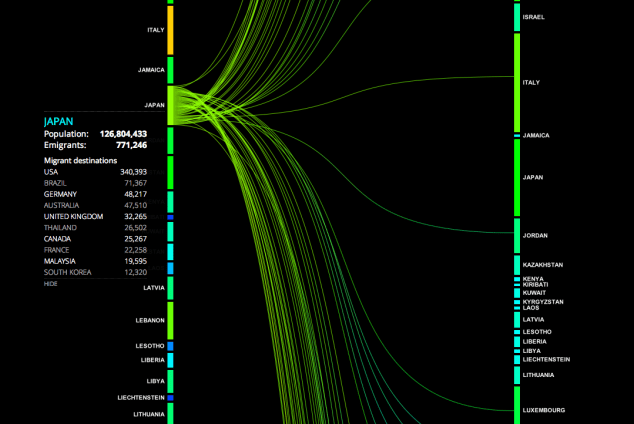
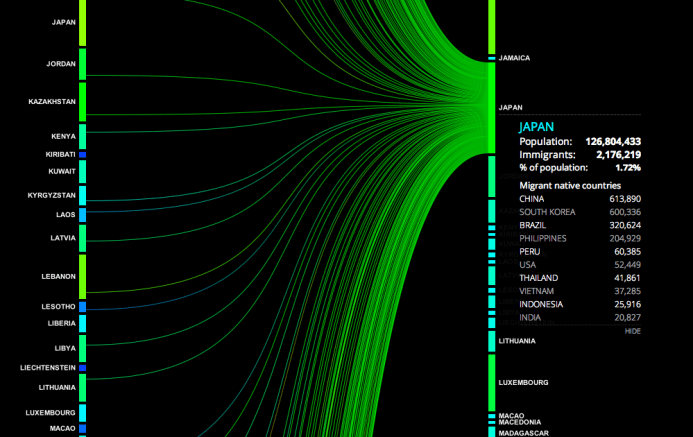
This is a short post that’s a heads-up to check out the site peoplemov.in, which provides visualizations of global migration. You can see data from 2010 on emigration and immigration flows for countries around the world. (Clicking on the pictures in this post will take you to the site.)

Migration into Japan

The top five source countries for immigrants to Japan are China, South Korea, Brazil, and the Philippines, and Peru. For Japanese emigrants, the site shows the top five destinations are the US, Brazil, Germany, Australia, and the UK.

I’ll leave the debate as to whether those “in-migrating” are “immigrants” or something else for another post. For now, emigrants are those going out, and immigrants are those going in. I know many in Japan say that Japan is not a country of immigration, and thus has no immigrants. Rather, it has “foreign workers,” “migrant workers,” dekasegi, etc. “A rose by another other name would smell as sweet.”

Migration out of Japan

Migration out of Japan

by Robert Moorehead A brilliant sociological look at one of my favorite comics, Calvin and Hobbes.

Tristan Bridges's avatarInequality by (Interior) Design

Bill_WattersonOne of my favorite sociologists is Bill Watterson.  He’s not read in most sociology classrooms, but he has a sociological eye and a great talent for laying bare the structure of the world around us and the ways that we as individuals must navigate that structure—some with fewer obstacles than others.  Unlike most sociologists, Watterson does this without inventing new jargon (or much new jargon), or relying on overly dense theoretical claims.  He doesn’t call our attention to demographic trends (often) or seek to find and explain low p values.

Dad pollRather, Watterson presents the world from the perspective of a young boy who is both tremendously influenced by–and desires to have a tremendous influence on–the world around him.  The boy’s name is Calvin, and I put a picture of him (often in the company of his stuffed tiger, Hobbes) on almost every syllabus I write.  Watterson is the artist…

View original post 1,266 more words

Unfair Advantages for Non-Japanese?

Tokyo-based game developer James Kay

by Robert Moorehead

A headline in today’s Japan Times boldly claims that “expat game developers have an unfair advantage in Japan.” The writer, Brian Ashcraft, interviews expats who develop apps for the iPhone, and notes their optimism for the potential riches available in this industry. So where’s the unfair advantage for expats, and the implied discrimination against the Japanese?

Submitting apps for the iPhone requires navigating the site iTunes Connect, which is in English. This is more difficult for developers who have a limited English skills. And that’s unfair? Is Apple discriminating against non-English speakers? Are Japanese developers languishing due to their limited English skills? Are English-speaking expats unfairly stealing work from Japanese developers?

We’ll never know, as the article isn’t even about this. Rather, it’s a puff piece about a few expat app developers who live and work in Japan. I used to write similar “life of a foreigner” articles for the Chubu Weekly back in the mid-1990s. Since such articles are rather boring (my own articles included), the Japan Times editors spiced it up with a sensationalist headline claiming unfair advantages for expats.

But why print such a headline? The Japan Times publishes in English, thus its readership is heavily skewed toward the expat communities. But are these readers looking for signs of their superiority, or to have their pillows fluffed by the local English rag? What other unfair advantages do expats have? Perhaps this could be part of a series of articles, each with a sensationalist headline, on the unfair glories that expats reap in Japan and around the globe. Next up, Peruvians have an unfair advantage over Japanese when it comes to reading and writing in Spanish.

What Are You Anyways?

by Robert Moorehead

Somehow I’d missed seeing the brilliant videos of Jeff Chiba Stearns until now. These videos explore the ins and outs of being a Canadian of mixed Japanese ancestry, including the common query, “What are you anyways?” In Japan, that same question would be “Nanijin?”

Click on the picture above to see the 10-minute animated film “What are you anyways?” You should also visit One Big Hapa Family, in which the filmmaker explores these identity questions for his extended family.

From the filmmaker’s site:

Follow the adventures of the Super Nip as filmmaker Jeff Chiba Stearns explores his cultural backgrounds growing up a mix of Japanese and Caucasian in the small Canadian city of Kelowna, BC. This short classically animated film looks at particular periods in Jeff’s life where he battled with finding an identity being a half minority – from his childhood origins to the epic showdown against the monster truck drivin’ redneck crew.

“What Are You Anyways?” is a humorous yet serious story of struggle and love and finding one’s identity through the trials and tribulations of growing up.

More info at http://www.meditatingbunny.com
Please like http://www.facebook.com/chibastearns

Ishinomaki—Then and Now

by Robert Moorehead

Filmed in Ishinomaki in November, 2011, this documentary includes interviews with survivors of the earthquake, tsunami, and nuclear disasters of March 11. This moving documentary is the recipient of Best Documentary and the Grand Prix prize at Super Shorts Film Festival, 2012.

The video is also available in the following languages:
Portuguese: vimeo.com/41279189
Italian: vimeo.com/40420477

The filmmakers have also released “The Women of Fukushima,” a documentary film that examines the experiences of eight women whose lives have been changed by the disaster at the Fukushima Dai-Ichi nuclear power plant. This disaster has compelled these women to become activists in the social movement against nuclear power in Japan.

My Japanese students often tell me that there are no social movements in Japan, and that Japanese people don’t participate in such events. Not only does this view negate the existence of 60 years of protest in what is now Okinawa prefecture, but it also views the people who participate in such movements as somehow different from everyone else in Japan.

The “Women of Fukushima” challenges this view, by giving viewers a feeling of connection with these women. Hopefully this connection will compel more Japanese to speak up and demand a safer future for them and their children.

“The Women of Fukushima” is available for online rental and purchase (for only $8) at women-of-fukushima.com.

Skin Colour, Gender and Marriage in India

by Isabel Cabaña Rojas


When the moment comes to look for reasons of why Indians conceive beauty as they do, it seems that nobody can come up with a clear explanation. Many argue that the ideal of fairness has existed since ancient times, manifested in the stories and myths from Indian gods and spirits, where darkness and light were in battle for the primacy of the world. Whereas some others state that, more than that, the presence on history of British colonizers, and the socio-economic structure they established in India, pervaded all the cultural spheres, including the ideals of beauty. But, regardless of the origins of this particular and powerful feature of Indian culture, is interesting to notice how deeply rooted is in the daily life of Indian, especially women, who define their life according to this value, the value of being ‘fair’. As Philips (2004) points out, fairness has become a ‘symbolic capital’ that is ‘disempowering’ women, particularly in their freedom and election to marry someone. The fact that in India marriages are arranged emphasises more the power of skin colour on their lives, because both are things, at the end, women cannot choose.

For men the things are not much different either. For them, white skin is also a value and an attribute worth to fight for, but the responsibility of achieve this colour is less strong than in women. A dark-skinned man can still have chances to marry a fair-skinned woman… the other way around, no way! So when thinking on the relevance of race in the contemporary Indian culture, and its linkage with marriage (and all the industry surrounding it) one should necessarily connect it with gender. And somehow with social class. Inasmuch as I wonder how strong this really is in the general culture in India: is this situation in all the regions of this country? Are people living in rural areas really concerned about their skin colour? Is it a middle/high class issue? As, supposedly, a post-colonial heritage, fairness is at some point linked with belonging to a certain social level, that of the ruling class in opposition to the darker working class of Indians.

But, what seems very important here is the role that new generations, especially those of Indian descent abroad (as Indian Americans, for example) will have in the perpetuation of this custom. There are people already criticizing what this perception of colour is doing to the culture, especially to women (and not only in the social sense, but also in health, considering the massive use of bleaching creams). According to Vaid (2009), in the Indian Diaspora, at least in the United States, there are no signs that this is something to be left behind.

References

Gosai, A. (2010, July 19th). India’s myth of fair-skinned beauty. The Guardian online.

Guha, S. (2010, March 23th). India’s unbearable lightness of being. BBC News.

Philips, A. (2004). Gendering Colour: Identity, Feminity and Marriage in Kerala. Anthropologica, 46(2), 253-272.

Vaid, J. (2009). Fair Enough? Color and the Commodification of Self in Indian Matrimonials. In E. Nakano Glenn (Ed.), Shades of Difference. Why Skin Color Matters (pp. 148-165). Stanford University Press.

Vaidyanathan, R. (2012, June 5th). Has skin whitening in India gone too far? BBC News-Magazine.