Can Japanese Women Serve the Nation by Serving Tea? The Jietai, J-Jobs, and Justice

Image

by Robert Moorehead

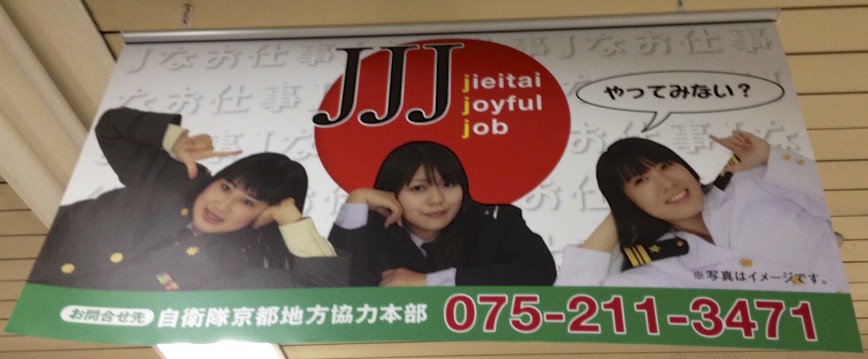
Japan’s Self-Defense Force is joining the nation’s efforts to offer more employment opportunities for women, through this recruitment campaign. Women can get a “j-na shigoto,” or a j-job. What’s a j-job? Actually there are 3 j’s, so you know it’s good: Jietai (self-defense force), joyful, and job. “Won’t you try?” says one of the uniformed women, photographed lounging about.

If Prime Minister Abe’s efforts to recruit more women into the workforce are to be successful, employers like the Jietai might want to rethink how they treat women. Are they workers, or are they eye-candy? Can they help defend the nation, or can they answer the phones? Serve the nation or serve tea?

As Laura D’Andrea Tyson noted recently in a blog post for the New York Times, Japanese women’s employment rate is 25 points lower than men’s, and when women are working, they are paid on average 28% less for equivalent jobs. Japanese tax laws also penalize two-income families, and Japanese women face a greater “mommy tax” than women in any other OECD country.

Plus, not only is childcare rarely available, but the burden of childcare remains clearly gendered in Japan. Policy debates of how to enable more women to work discuss how women, and only women, can better work the “second shift,” balancing work and family. Such proposals ignore men completely, even though my male Japanese students often tell me they too would like to be able to have a career and raise a family.

What’s behind the move to get more women into the workforce? Japan’s aging society needs more workers. As Tyson notes:

These initiatives are not motivated by softhearted political correctness but by hard-headed economic logic. Japan needs to expand its work force, which is shrinking rapidly as a result of a sagging birth rate and an aging population. The International Monetary Fund estimates that Japan’s working-age population will fall by almost 40 percent by 2050. The share of citizens older than 65 is expected to jump from 24 percent in 2012 to 38 percent in 2050, when the ratio of the working population to the elderly population will be 1 to 1.

“Japan is growing older faster than anywhere else in the world,” the I.M.F. reports. Unless the nation can shore up its work force, it faces a long-term drag on economic growth at a time of soaring obligations for old-age entitlements.

My university classrooms are filled with intelligent, highly trained women who are looking for career opportunities that take advantage of their skills. They do not want to be asked to serve tea, or be expected to quit when they get married or have children.

They want real jobs, not j-jobs.

“Now I know what it’s like to be black!” Invisible Minorities and Privilege in Japan

by Robert Moorehead

Recently, the Japan Times ran a column encouraging readers in Japan to take advantage of their new minority status to re-examine their racial attitudes. In “What Being a Minority Allows Us to See,” columnist Amy Chavez tries to contextualize complaints about ethnic and racial inequality in Japan as reflecting the eye-opening experiences of those who, for the first time, find themselves as racial subordinates.

So far, so good. Chavez makes an important point that living abroad can place us in unfamiliar situations, and that we should apply the lessons of those situations to our lives back home. Those of us who were in the majority in our home countries, and are in the definite minority in Japan, could think about how our experiences parallel those of other minorities, and maybe we can learn some empathy.

However, digging deeper we see how this approach perpetuates problems facing racial minorities. Firstly, Chavez assumes that her readers are members of racial majorities in their home countries. As she writes,

“The Japanese are no more racist than Americans or people of many other countries. The only difference is that when you come to Japan, for the first time in your life, you are a minority and get to see what it’s like to be one.”

In one sentence, Chavez renders invisible the people in Japan who were minorities in their home countries. I doubt the Nikkeijin (overseas people of Japanese ancestry), including Japanese Americans, Brazilians, Peruvians, and Filipinos, are experiencing being in the minority for the first time. Rather, they migrate to what they’ve been told is their ancestral homeland, only to find themselves racialized as gaijin. Adding insult to injury, now they’re left out of the discussion altogether.

“After being subjects of discrimination here, we scream like spoiled children … While we have suddenly gained … an ability to see though the eyes of minorities …, we are blinded by our own self-worth and don’t suddenly empathize with other minorities struggling to achieve equality. No light bulb goes on in the head making us think: Aha! … So this is what … African-Americans in the U.S. struggle with every day!”

Does an African American need to travel to Japan to learn what African Americans in the U.S. face?

And have we learned to see through anyone else’s eyes? Is getting rude treatment from a taxi driver (as I did recently) the same as what African Americans face? Am I being stopped and frisked repeatedly? Do I risk being shot for wearing a hoodie and carrying Skittles and iced tea? Am I attending poor schools? Do I stand a greater chance of being in the correctional system than in a university? Am I more likely to live in a highly segregated neighborhood? Am I more likely to get a subprime mortgage, when I’m able to get a mortgage at all? Do I have a higher risk of heart disease or diabetes? Do I have a shorter life expectancy?

The problems Chavez refers to, like employment discrimination and racial stereotyping, are real, but they do not compare to the African American experience. Not all forms of discrimination are equal.

“Your small brush with discrimination in Japan is something that has been a lifelong battle for others who were born into a life of being a minority in our own countries. And many of them suffer far worse than we do in Japan.”

“Try being an African-American in the U.S. Or an aboriginal in Australia.”

Some readers do not need to try being an African American or an aboriginal. They are African Americans or aboriginals.

Chavez’s approach is similar to John Howard Griffin’s classic book Black Like Me, in which Griffin, a white man living in the Jim Crow South, darkens his skin to learn what it’s like to be black. Griffin recounts his experiences and shares the terrorism of Jim Crow with a white audience. But this is only half of the equation. This idea that blackness is something to be understood leaves whiteness unexamined. We study discrimination but we avoid examining privilege.

“This is the role of compassion. To accept that these problems are your own and be willing to not just admit they’re wrong, but to do something about them. Speak on the behalf of other minorities, help raise their profile. Especially you — you who have had a taste of what it’s like to be in their shoes!”

Minorities can speak for themselves, thank you. They do not need a white guy who had a racial epiphany in Japan and now suddenly understands black experiences to speak for them.

Chavez also avoids the word “privilege,” even though this is what she is trying to describe. Instead, she chastises readers for allegedly lacking compassion, and tells them to talk to minorities about their experiences. Instead of trying to understand minorities and speaking for them, how about understanding the white experience and try to dismantle the systems of privilege that give unearned advantages?

“The best way to fight discrimination is by using your experience for personal growth, and to spread the idea of compassion while working to develop a mind that is non-judgmental.”

No, the best way for those in the majority to fight discrimination is to gain a broader understanding of their role in systems of privilege, and to challenge that privilege. Non-judgmental minds that operate in systems of institutional inequality are not enough. A non-judgmental mind does not challenge the fact that the median wealth for whites in the U.S. is 20 times that of blacks, or that more black men are currently in the U.S. correctional system than were enslaved in 1850.

Don’t get me wrong, non-judgmental minds are wonderful. But we live in a world in which racial inequality is built into the very structure of our societies. Challenging this requires much more than looking in the mirror and freeing our minds. To paraphrase Canadian PM Stephen Harper, now is the time to commit sociology. If it helps, we can crank Michael Jackson and En Vogue while we do it.

I strongly recommend the work of Tim Wise, including the new documentary film, White Like Me. The film is available for online streaming until August 31. Tim’s books are also widely available in paper and electronic forms.

Enhanced by Zemanta

Separate and Unequal: The Remedial Japanese Language Classroom as an Ethnic Project

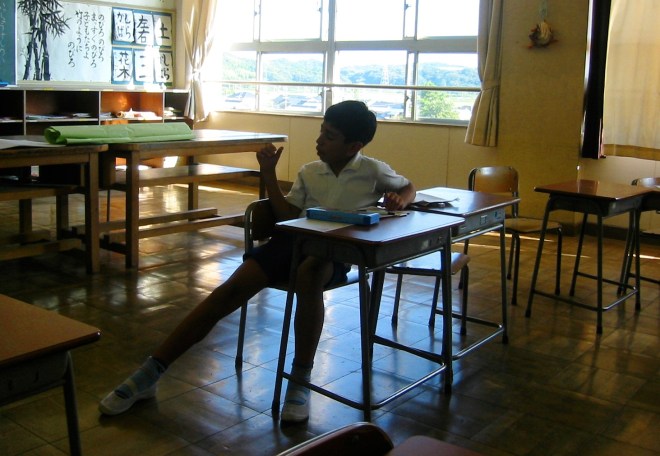
Peruvian Student Ricardo Relaxes in the Remedial Japanese Language Room

by Robert Moorehead

My article in The Asia-Pacific Journal examines the remedial Japanese language program at a school in central Japan. I argue that the program systematically denies educational resources to low-performing immigrant students. Despite the Japanese educational model of equality and inclusion, these immigrant students are tracked into a program that is separate and unequal.

Teachers explain this pattern in ethnic terms by referring to immigrant students’ supposed need not for specialized remedial instruction, but for relaxation as a break from the difficulties of learning Japanese.

To read more, please visit The Asia-Pacific Journal, a peer-reviewed, open source journal that focuses on the Asia-Pacific region. Also, check out Language and Citizenship in Japan, an edited volume published by Routledge.

Learning to read hiragana, katakana, kanji, and the air

Celebrate Diversity!by Robert Moorehead

With the spring semester now over, I’ve been thinking about the challenges of getting students to think differently about incorporating non-Japanese into Japanese society. The arguments students make and the ones sociologists usually cite in the research literature are like two roads that never meet.

As I’ve written before, students’ view of Japanese history seems to skip the roughly 100-year period between the Meiji Restoration and the Tokyo Olympics—nothing important happened in Japan between the 1860s and the 1960s, did it? Based on this, students often claim that Japanese people have little to no experience interacting with people of different cultural backgrounds. Plus, Japan is an island and thus was inaccessible to other groups. The invention of boats around the world apparently didn’t impact Japan … but I digress.

Students also state that Japan, unlike other countries, is a “high-context culture,” meaning that much communication in Japan is unspoken. Meanings are implied, and understanding those meanings requires reading between the lines and reading the context of the situation. Those who can’t “read the air” (空気を読む or “KY”) are treated as socially inept and may struggle in their social interactions.

This is a fair point, as communication in Japanese proceeds somewhat differently compared to communication in English, Spanish, or other languages. But, can’t people learn to “read the air”? Is Japanese culture so byzantine, so complex and inscrutable that non-Japanese can’t simply figure out how to talk to people?

Students also claim that because Japanese are not used to interacting with “KY” people, they can only accept people who are just like them. Interacting with non-native Japanese speakers and people who can’t “read the air” is too much work, so non-Japanese are just out of luck.

This inherently conservative argument could be extended to justify excluding pretty much anyone. Japanese women want a right to equal opportunities for employment? Too bad. They could never really understand men’s particular communication style, and their presence might make men uncomfortable—no more sex jokes in the workplace—so women will just have to settle for serving tea and lower pay. The disabled want to work? Sorry, accommodating their needs could be inconvenient, so they’ll just have to stay home. Okinawans and the Ainu want to express their cultural and linguistic distinctiveness in mainland Japan? Sorry.

This approach dismisses the rights of the individual in support of the rights of the majority. That is, the majority only has to respect the individual rights that are convenient. This approach fits with the LDP’s planned revisions to the Japanese Constitution. As Lawrence Repeta notes, these revisions would subordinate individual rights, such as free speech and free assembly, to the demands of public interest and public order.

On the one hand, I should be thanking students for their honesty. But do researchers cite any of these ideas when analyzing immigrant incorporation? I just finished teaching a course on international migration, and we spent the semester reviewing the sociological literature, including the main schools of thought, and issues of gender, education, transnationalism, citizenship, among others.

And not once in that literature did anyone talk about “high-context cultures,” or the whether interacting with cultural others might be too inconvenient.

So, have sociologists missed the boat? Are we just talking in circles, clueless as to the real issues?

Or is communicating across cultural and linguistic lines simply a fact of life for many people on the planet? Don’t we have to make all sorts of adjustments every day, even if we don’t have any foreigners in our midst? We communicate across lines of class, gender, age, and sexuality all the time, so why should we treat communicating across cultural lines as some special case?

As famed anthropologist Harumi Befu (2001) has noted, the United States is often held up as the main contrast to Japanese society. The US is multicultural and a nation of immigrants, while Japan is neither of those things. In the US, people complain about the challenges of diversity, like struggling to pronounce new names, understanding various accents, and talking with people who are still learning English. But … so what?

Seriously, so what? Is learning new names and using a modicum of patience to interact with non-Japanese really that difficult? Is “reading the air” really that complicated? Are foreigners really that inept at communicating in Japan?

Is it more difficult than figuring out how to pay for health care and pensions for Japan’s elderly, when Japan’s population is dropping and postwar boomers are retiring?

Since Commodore Perry’s black ships forced open Japan to international trade, Japan has gone through the Meiji Restoration, imperial expansion across much of East Asia and the Pacific, multiple wars, fire bombing, nuclear attacks, defeat, occupation, democratization, reconstruction, development into a global economic power, bubble economies, inflation, deflation, stagnation, population booms and declines, earthquakes, tsunami, and nuclear disasters.

Change is the constant. In light of all that, talking to foreigners seems like it should be the least of their worries.

References

Befu, Harumi. 2001. Hegemony and Homogeneity: An Anthropological Analysis of Nihonjinron. Melbourne: Trans Pacific Press.

Osaka March Against Racism

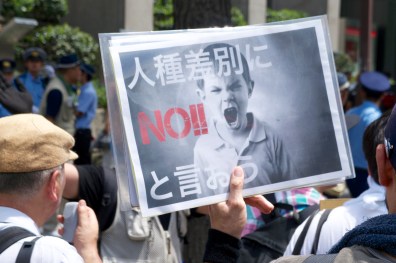
Say No to Racism!

Say No to Racism! Click the photo to view the photo set on Flickr.

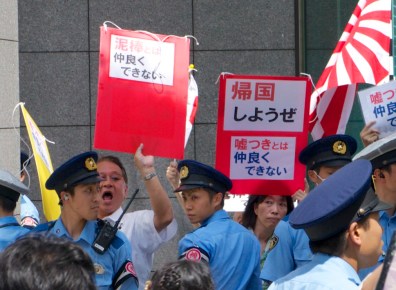
Anti-foreigner protesters hold signs calling for foreigners to leave the country.

Anti-foreigner protesters hold signs calling for foreigners to leave the country. Click the photo to view the photo set on Flickr.

by Robert Moorehead

As the acquittal of George Zimmerman was announced in the US, we were on our way to Osaka, to participate in the March Against Racism. On a hot, sunny day, hundreds marched in protest against the recent hateful anti-Korean demonstrations in Osaka. The march started with speakers blasting Sam Cooke’s “A Change Is Gonna Come,” and instantly we felt at home.

Rainbow flags flew, Korean and Japanese drums were pounded, and marchers carried signs calling for an end to discrimination and a celebration of diversity. In a country where a myth of homogeneity is celebrated, calls for the celebration of diversity are rare.

We ran into a few small pockets of hate, where racists held signs demanding the foreigners leave the country. One man even followed the march, holding an imperial Japanese flag, standing alone while hundreds raised peace signs (and one guy kept flipping him the bird).

The Zimmerman ruling sickens me, but the march was just the right medicine.

Click on the photos below to open a photo gallery.

Click here to view our photos and videos on Flickr.

Why Does Skin Color Matter in Indian Marriages?

by Sho Hamamoto

It seems that having fair skin still matters in Indian marriages. Many Indian men and women are suffering from an obsession with fair skin. Why is it important to have fair skin in Indian marriages? There are three possible reasons for the obsession. Jyotsna Vaid (2009) mentions maintaining the purity of the bloodstream of the upper castes and an association between darker skin and lower class working under a hot sun. India is a very strict class society due to the caste system and sensitive to social classes. This is one of reasons why the percentage of arranged marriages in India stands at 90%. Arranged marriages prevent marriages between different classes. Skin color is one of class symbols. As Glenn mentions, there is an association between darker skin and lower class working under a hot sun in India. Due to the fact that skin color represents one’s class in India, people prefer fair skin (upper class) to darker skin (lower class).

Agrawal (2012) provides another reason for the preference for fair skin is a mind-set by British rule. Under the British rule, Whites were superior to Indians (darker skin people). The legacy of British rule may still remain in the Indian society and create an image that lighter skin is superior to darker skin.

Lastly, media is a major contributor to creating an image that lighter skin is better than darker skin. In media including TV programs, ads, and movies, lighter skin tends to be described as a sophisticated feature. People on media tend to have fair skin and those media create an ideal image of people. As a result, people have had an image that lighter skin is more sophisticated than darker skin.

As seen above, skin color still matters in India marriages because of a strict class society in India, British rule, and an image that fair skin is sophisticated created by media. It is not easy to change the situation because you have to change the structure (class society, media and so on).

An interesting point is that an association between fair skin and “a sophisticated image” can be seen in many other countries, such as Japan, China, Korea, and Singapore. Why is the sophisticated image of fair skin shared in different countries? Personally, a class society has much to do with this phenomenon. Darker skin may be linked to lower class working under a hot sun while fair skin is linked to upper class. This historical image has created the sophisticated image of fair skin and media has bolstered the image. This can be an explanation for the shared image of fair skin in many different countries.

References

Agrawal, V. (2012). Why Indian men want fair skin brides? Retrieved from http://www.bollywoodshaadis.com/article/lifestyle–health/relationships/why-indian-men-want-fair-skin-brides

Glenn, E. (2009). Shades of difference. Stanford: Stanford University Press.

Lancy. (2013, April 15). Does skin color really matter in Indian marriages?. Retrieved from http://browse.feedreader.com/c/Makeup_and_Beauty_Home/390094216

Statics Brain. (2012). Arranged/forced marriages statistics. Retrieved from http://www.statisticbrain.com/arranged-marriage-statistics/

Why Indian Men want Fair Skin Brides from www.bollywoodshaadis.com

Marrying not for One’s Self but for Others: Hinduism in India

flag

by Aya Murakami

“We believe in Love Marriage. But we cannot marry someone who have different customs, religion, speak different language. ”

Different ethnic groups, religions and language exist in India, where has the 7th largest area and 2nd largest population in the world. In India, there are over eight religions, complex social stratification system called caste, and more than 15 language is spoken in different areas. Since different religions have very different cultures, I will talk about Indian Hindus in this post, which accounts for 80% of the total population in India, and consider their ideas towards marriage. (When I mention “Indian” in this post, it refers to “Hindu”.)

Arranged marriage is very popular in India. There are newspaper ads and internet matrimonial service has been becoming popular. Currently, I live with several Indian students and I asked them about this matrimonial service. Most of them have visited one of these websites and told me which factors they look at when choosing the partner.

  1. Caste
  2. Economic Class of the Partner and his/her family
  3. Job Status for Men/Appearance for Women

The same religion and the same caste are absolute requirement, and better economic class is preferable, they told me. But, the third comes job status for men and appearance for women. Job status for men is related to economic class, however, what is exactly “appearance” means? Which characteristics Indians put importance on?

  1. Fair
  2. Slim
  3. Facial Features

Having “Fair” skin is the most and very important feature of appearance, Neha and Tanushree, two Indian girls told me. Although there is a famous skin lightening cream called Fair & Lovely, Neha who belongs to the highest caste, Brahmins, said that skin-lightening cream is barely used in her caste since most of the people have “fair” skin. General idea of skin tone in India is that the lower the caste the darker people’s skin tone becomes and the darker their skin tone the more likely people use skin-lightening cream.

family

“It is not about how you feel, it is about how it will affect your family and how it will portrait your family in the society.”

Coming back to the Indian Hindu and their marriage, through reading books and talking with my Indian friends, I realized that they often used the word “we” instead of the word “I”. I thought that it represents the idea that first priority for Indian people is not how they feel but how the others feel. Thus, when it comes to marriage, their first concern not whether or not they love someone but how their society and families judge them. That is one of the reasons why arranged marriage is popular than love marriage in India. Religion, caste, economic class and appearance, each factors plays important role in Indian marriage. Marriage determines social status of Indian’s family in their society, thus arranged marriage is considered as necessary to carefully consider how well the partner can represent the family in the society.

Racism Does Not Exist?

by Hyeon Woo Lee

Discrimination between different ethnic groups is commonly reported throughout the world. Not to mention the racism against Afro-Americans in US, but also discriminations against Hafu people in Japan, unfair treatment against southeastern brides who came to Korea for marriage, etc. With no doubt such phenomena are spread widely over the world. Professor Terry Kawashima states that race works through several visual readings, or interpretations of the physical differences of a person. However I would like to raise a question of whether racism really exists. Is what we call racism really an act of discriminating other groups of people because of their physical looks? Or is there something else, some other factors that affects us but are hidden beneath the word racism?

In 1994, there was a systematic massacre of minority ethnic groups by major ethnic groups. The Hutu, a majority ethnic group in Rwanda, attacked the Tutsi, a minority group. Triggered by death of the president, Hutus started killing every Tutsi in sight. As a result, at least 500,000 people were killed. The point here is that in external physical appearance, the Hutu and the Tutsi had no difference at all. They all looked like the same black people. However Hutu accused them of being “different”. This may mean different genetics, but it doesn’t make sense since it is widely known that two members of the same ethnic group can be just as different genetically as two people from different ethnic groups. Then in this case, it is safe to say that physical racism was just an official reason, and the true reason mostly lied in the economic structure of Rwanda. The Tutsi monopolized most of Rwanda’s economy while Hutu had very little in it and was unhappy with the fact.

The history of mankind has been a continuation of conflicts, like constant war. Whether it is large or small, there was always war among different groups. The cause varies; it could be a fight for ideology, conflict over economic benefits, or even basic survival itself. However when people mention the difference in ethnicity as a cause of war, I seriously doubt it. It is not the difference that causes conflicts between ethnic groups, but it is rather the way we interpret it. All those conflicts claiming that were triggered by different ethnicities, like the case in Rwanda, actually has other reasons hidden behind the mask of racism. So come to think about it, maybe there isn’t any “true racism”, in which one is hostile to the other for the sole reason of being different, in the world. I believe that there is always something else.

Filmmaker Dave Boyle talks with Ritsumeikan students

by Robert Moorehead

Dave Boyle’s films (Big Dreams Little Tokyo, White on Rice, Surrogate Valentine, Daylight Savings) blend English and Japanese languages, and American and Japanese cultures. In this video, he discusses “Big Dreams Little Tokyo” with a class of International Relations students at Ritsumeikan University. Boyle talks about the roles of language, culture, race, and stereotypes in the film, and the choices he made as an actor and a director.

Who is described as an attractive person?

by Sakiko Yasumi

Every single month I buy fashion magazines to check what this season’s trend is. I recognize myself as one of the fashion industry’s consumers. The magazines I always buy are imported from US or UK to check the lovely clothing and make-up products introduced in the magazines. Of course all of fashion models appearing in magazines I have are foreigners. If someone had asked me this question before taking this class, “Are you yearning to whiteness?” I might have said “probably, because I think they are beautiful”.

In today’s Japanese society, it is no exaggeration to say that we are not watching TV programs and checking fashion magazines without seeing ‘hafu’ models (in this essay, when I say a “hafu”, it means the mixed person with Caucasian and Japanese). “Hafu” fashion models have been required for TV industries, and girls watching TV programs and checking fashion magazines started to yearn to hafu models due to their “attractive-looking”. Here are three questions: what is “hafu”?, why are Japanese yearning to whiteness?, and what is the definition of “attractiveness” for people in Japan?

According to Wikipedia, The word hafu is used in Japanese “to refer to somebody who is biracial, i.e. ethnically half Japanese”. This definition is that hafu people have two identities but each identity is forced to cut in half to fit in one person, then the person with mixed races becomes considered as a “hafu”. Because Japan is an island nation, had closed the door to foreigners almost for 200 years, and forced Ainu and Okinawa to assimilate into central Japan, there were few mixed people of Japanese and other countries’ ancestries. I think its Japan’s past foreign policy is a main cause of a stereotyped concept which many of Japanese still have.

To answer the second question: “why are Japanese yearning to whiteness?”, we have to think with the third question, “what is the definition of attractiveness for people in Japan”. I found the typical idea of attractiveness for Japanese from the reading “Seeing Faces, Making Races: Challenging Visual Tropes of Racial Difference” by Terry Kawashima, who mentions that girls with “the round eyes and shortish, smallish noses with vertical height are defined as symbols of attractiveness” in Japan. This type of thinking is sticking into our head, and it is a cause of our one-sided idea of attractiveness and having the feeling of yearning to whiteness which is applicable to our general ideal of attractiveness. This could the reason why hafu models become greatly popular in our society, especially for girls.

However, the concept of person’s attractiveness has been changed through reconsidering of Japanese beauty. From 2006 or 2007, two enterprises, Shiseido and Kracie, started to deal in the hair-care products which emphasize Japanese beauty called “TSUBAKI”and ”ICHIKAMI”. These two products stress their concept “Japanese women are beautiful” by using many famous and popular Japanese actresses and models. It has been highly effective. I think this is one of the best ways to make people to realize that Japanese beauty promotes our attractiveness.

To sum up, I don’t mean that whiteness is not attractive, but instead of claiming that, all kinds of skin color, hair style/color, face, body shape are attractive. Thus, there is no need for Japanese women to pursue and yearn to the whiteness. Being yourself and having confident of being Japanese women are the best.