
수능: [pronounced: Soo-nung] University Entrance Examination in Korea, the hurdle every Korean high school student must pass. On the day of the exam, sometime in November, the entire nation is on alert: mothers pray in temples and churches; flight schedules are delayed in the morning; police cars are called for those running late, etc. It’s like the SAT in America, but of a much, much higher importance and national highlight. To foreigners who do not know about the Korean education system, it must look bizarre how a single examination can have such significance in society. And why is that so? Well, long story short, getting high grades on the Exam allows an entrance to a brand-name university, which is believed to guarantee a successful career in the future.
In Korean society, a degree from a high-ranking university has always been looked up to – like as a social norm. You might argue that it is not only in Korea that famous universities are highly regarded. But it is quite more than that. It doesn’t matter much whether a student is actually capable; if you didn’t get into one of such brand-name schools, too bad, you will never achieve the proud social status given to graduates of those schools. Did you not feel well on the Exam day and get a low score as a result? Too bad, you’ve just been given a negative label as an ‘unsuccessful’ student. Likewise, such social norms dictate the way people think of education. From the age as early as 10 (or younger), children are sent to numerous academies, cram schools and to private schools so that they can get high scores on the University Entrance Exam. It is not uncommon that young and bright 19-year-olds sacrifice a year of their youth, just to take the test one more time; or in extreme cases, to commit suicide out of desperation.
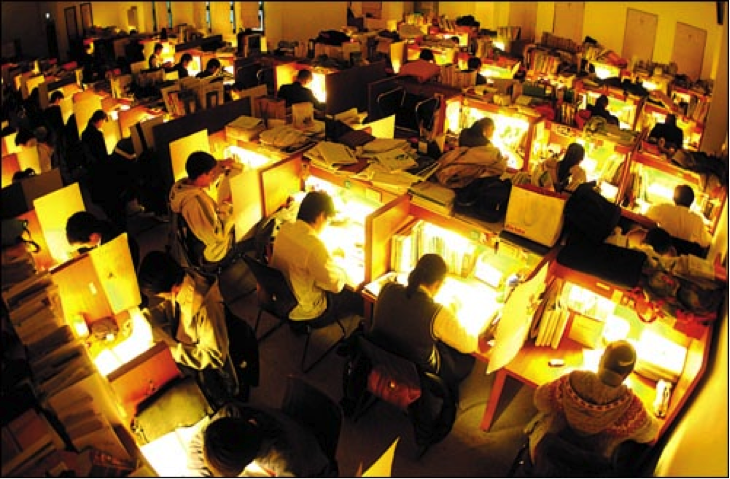
Typical "study rooms" where students pay monthly to have a single desk and quiet setting for studying
I think this is one good example of how we develop the sense of ‘self value’ through socialization. Ordinary students in Korea are raised in social settings in which studying to get high grades, and thus attending a ‘good’ high school and university are considered the best thing you can achieve as a student. Playing sports or music is pursued as a hobby only seldom. Even for myself, it was only after I came to Japan and attended an international school that I discovered I could manage both academics and club activities.
This is not to downgrade universities or students in Korea and their efforts, but just to address the ridiculous amount of pressure imposed upon them due to inflexible social norms. Instead of enjoying their “青春” (youth) to maximum, students are overwhelmed by the society’s expectations. Having grown up in such settings, students are socialized to follow the system, without many other ways out. Just imagine how many different skills and dreams could have been discovered, had the system been different. Recently, there have been many proposals for reforms, as well as positive changes in people’s views on the current education system. Hopefully, a better future is waiting for younger generations.
PS. This year’s Exam just took place on November 10th. A big cheer for those finally freed of the shackles!

"Thanks officer!": A student, running late, is hurriedly getting off of a police car 10 minutes before the exam begins
by KyungYeon Chung
 JAPANsociology