How much do you know about hafu in Japan? Hafu means that they have a Japanese parent and a foreign parent. Actually, I have never thought about hafu, because there were no hafu around me and there are not many mixed blood people in Korea (I am a Korean). However, through my English class, I have learned a lot regarding hafu and how Japanese society treats hafu. I read some articles stories about how hafu are treated in Japan, how do they feel and so on.
There are bunch of hafu who are suffering from the way they are treated in Japan and even in some other countries. Even if hafu have Japanese nationality and fluency in the Japanese language, Japanese people divide them into non-Japanese because of their non-Japanese look. Although many hafu have Japanese nationality by law, they have difficulty to fit in Japanese society and to be admitted by other Japanese as Japanese. Then, is the law not an important thing? Why are they treated differently in Japan?
On occasion, a fixed idea plays a more powerful role in treating people. Japan is so-called a homogeneous society and that is why Japanese people feel uncomfortable with others and fine it hard to understand others. Many of hafu said that they feel they belong in Japan and try to fit in Japanese society. However, somehow Japanese people do not recognize them as Japanese. Therefore, the most important thing to change the situation facing hafu is conversion of the way people think about hafu.
To change over the way people think about hafu, people should reconsider that all of us have a unique gene which is make us different from others and at the same time we all have something in common. To put it simply, people should stop othering hafu and dividing them into non-Japanese due to the foreign look so that the situation facing hafu will be improved. Letting people know regarding hafu might be a very useful work to make new progress and improvement for hafu such as The Hafu Project.
In addition, making more interchange programs with hafu in school educations helps students to understand hafu and expand their point of views. Without any information about hafu, it is hard to understand them. Even if the situation facing hafu in Japan seems difficult to be solved, globalization is widely spread in Japan and many of Japanese young people have an open-minded and flexible attitude, hence, the situation could be improved in Japan.
With the efforts of hafu, change of times, and conversion of a fixed idea, hafu could be provided better environment to live in Japanese society without being othered or classified.
In Japan, there are a lot of hafu increasing the number year by year. This is because an increasing number of international marriages.
Probably we imagine people with white or black skin and big eyes. This means we unconsciously imagine non- Asian people. This is the symbol of how we are not get used to see other races in our daily life.
I have been thinking about hafus are little different from foreigners in terms of their identity. Japanese in Japan has no difficulties to define them. Foreigners are aften treated as foreigner, however, in their hometown in other countries, they are never treated as foreigner. What about hafu in Japan?
My friend‘s father is American and she looks completely American. However she speaks fluent Japanese and she uses only Japanese in daily life. She said that when she enters staff room in university, they are suddenly in a hurry and start looking for a parson who can speak English. She feels strange and always says “I can speak Japanese” in Japanese fluently. We treat people with the first appearance. My friend thinks this is little disadvantage because she feels like treated as a foreigner even if her identity is Japanese at least living in Japan since she were born. In addition, Japanese people think she can speak English fluently.
She said in the US, she is often treated very friendly at first sight as American because of the appearance. What I found interesting and strange is that once he/she knows about that she is hafu Japanese, some people do not regard her as a complete American.
I was astonished because I have thought since the US is multiracial nation, the hafu is not big problem.
What I would like to insist is that like my friend, hafu can face the unconsciousness about their identity. I regard her as Japanese but I do not know if she thinks herself as a Japanese or American. Even if she thinks herself as an American, it does not matter because nothing changes between us just because of citizenship.
I think that because of this unconsciousness of identity, hafu feel more friendly with hafu. When hafu people feel alienated, in their mind there are three kind of people which is Japanese, Foreigner and Hafu.
I was so worried how to remove their uneasiness or difficulties in Japan because I have many hafu friends and this was my first time to think about their identity and how they feel about themselves.
In my opinion, we do not have to treat them as a special. Their identity is theirs and we do not have right to decide it. What is different is just an appearance for me.
There will be more and more international marriage and more and more hafu in Japan and in the future, my child can be hafu and his/her friend can be hafu as well.
We can cope with this problem easier following times. I have no clear way to solve their difficulties but I would like to do something since this is very familiar problem for me.
Recently, in Japan there are a lot of “hafu” who is one parent is a foreigner who is white people. Their faces are different from so-called “Japanese” and they are often thought as a foreigner in Japan, because consciousness of Japanese people is “Japanese is Japanese”. This means that people think Japanese has a similar face as Asian ethnicity, so they are thought as a foreigner. Another reason why people think they are foreigner is also that Japan is said to be a mono-racial country. Hafu is rare to ordinary Japanese. These facts result in that situation in Japan.
Hafu has a Japanese citizenship, and they have lived in Japan since they were born. Some of the hafu has an identity as a Japanese citizen. However Japanese people have a consciousness as mono-racial country. This is a serious problem to hafu. In order for them to be accustomed to Japanese society comfortably, Japanese government should create a class about multiculturalism or different culture from the elementary school. By taking a class in the early period of children, they can understand or learn hafu or another culture and foreigner. International school is a good example. In our class, we watched a movie about discrimination and the identity of hafu. In the movie, one hafu said that his company forced him to use his French name because he could be forgiven by customer when he mistook. This is a terrible discrimination. I think that the boss of him who forced him to use the name hasn’t touched another culture or foreigner in his childhood and he doesn’t understand the feeling of them. If he understood the feelings, he would not say such a terrible thing. In Japan, a lot of people don’t have an opportunity to contact with foreigners who have different culture and racial background. This contributes to that discrimination indirectly, so it is important for children to take the class.
I think that it is difficult for us to change this situation because Japan is said to be a mono-racial country and people don’t have a consideration as to foreigner or hafu even today when globalization has progressed. Besides, Japan doesn’t have a lot of immigrants and the policy toward foreigner is also hard or rigid. I don’t intend to say that Japan should take an action drastically to multiculturalism because the measures about it are not prepared for. However Japanese education should be changed to multiculturalism because globalization is progressing now and from now, more people will come to Japan from foreign countries. In addition to it, the number of the hafu will increase more and more. According to it, for children to take the class must be so valuable and to be a person who can understand foreign stuff is important.
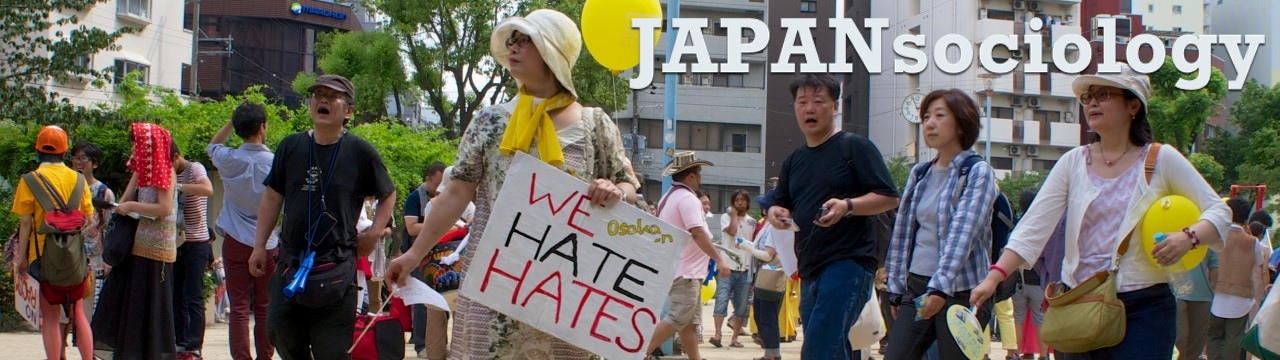
A video of a Japanese girl speaking at an anti-Korean rally in Tsuruhashi, Osaka, has recently gone viral. In the video, the girl calls for a “Tsuruhashi Massacre,” akin to the Nanking massacre by Japanese troops in World War 2. Yelling into her microphone, she tells Koreans to leave Japan before they are killed for their alleged arrogance.
The sight of a junior high school-age girl proudly proclaiming her hatred of an ethnic group and her desire to kill members of that group is chilling. The Zaitokukai and other right-wing groups have the support of a small portion of the Japanese population, but where is the outcry against such calls for violence? In times like this, quotes from Martin Luther King, Jr., fill my head. As Rev. King told us:
“History will have to record that the greatest tragedy of this period of social transition was not the strident clamor of the bad people, but the appalling silence of the good people.”
It’s depressing enough to see a young girl as one of the “bad people,” but we shouldn’t be surprised by open expressions of hate by groups like this. But how do we respond? Do we look the other way? Do we post a comment on a website, saying how terrible it is, and then move on? As Rev. King wrote:
“He who passively accepts evil is as much involved in it as he who helps to perpetrate it. He who accepts evil without protesting against it is really cooperating with it.”
So if we follow Dr. King’s call to action, how do we respond? Do we take up arms against our oppressor?
“Darkness cannot drive out darkness: only light can do that. Hate cannot drive out hate: only love can do that.”
Do we organize our own rallies? In my case, I will be making this a topic of conversation in every one of my classes. Year after year I have Japanese students tell me they had no idea such protests were occurring in Japan—but now that they know, what will they do about it?
“Nothing in all the world is more dangerous than sincere ignorance and conscientious stupidity.”
Some have replied with the Japanese saying “Netta ko wo okosuna” (Don’t wake a sleeping baby). It’s similar to the English saying “Let sleeping dogs lie.” If we ignore the problem, it will go away. But will it?
“Freedom is never voluntarily given by the oppressor; it must be demanded by the oppressed.”
My students sometimes think I’m pushing them to become radical activists (sometimes?), but I’d like to think that I’m pushing them to start living.
Let’s turn the lens from racial stereotypes Japan to those in the United States, to appreciate Douglas Kim’s music video “I’m Asian American.” Parodying Ben Fold’s “Rockin the Suburbs,” Kim takes on the stereotypes that all Asians look alike and don’t speak up, that they’re all on track to becoming doctors, pressured by Amy Chua’s Tiger Mothers, and ignored by Asian American women.
As Kim writes in the YouTube description of his video, “Our friendly neighborhood American Asian is just a regular guy trying to get through life in America without getting hated on by Asians and Americans, is that too much to ask?”
I’m thinking of showing this video in my upcoming class on Race and Mass Media, between the Slanted Screen and Better Luck Tomorrow. For my Japanese students, these American stereotypes of Asians are completely foreign. My students often struggle to imagine the experience of being in the minority and subject to such stereotypes. When I’ve shown clips of yellow-face characters like Mr. Yunioshi from Breakfast at Tiffany’s or Long Duk Dong from Sixteen Candles, I expected students to get angry. Instead, they dismiss the images as simply inaccurate. Some even say they understood that others might stereotype the Japanese and other Asians, just like the Japanese and other Asians stereotype other people.
At first, I was struck by how seemingly blasé they were to the images, but gradually we realized that these images were but one of many images of Asian people that those living in Asia see everyday. They see Asian actors playing every role, from doctors and lawyers, to janitors, mechanics, and office workers. From this perspective, seeing one ridiculous caricature might not seem like such a big deal.
In the US, on the other hand, Asian characters in film and on television have been much fewer and farther between. So those few portrayals carry much greater weight—just there are few non-Japanese on television and in film in Japan, and many foreigners seethe when they see a gaijin playing the fool. Tarento (performers) such as Bobby Ologun and Rola make viewers laugh with their misspoken Japanese and silly expressions, and the ability to entertain others is a great thing—but not at the exclusion from other performing other types of roles.
Kim’s video highlights the stereotypes of Asian Americans, and then smashes them, like the cello he destroys at the end of the video. And just as his Tiger Mom shifts to rocking out with him, hopefully Kim’s viewers will come to see past the stereotypes.
Here are the lyrics:
Let me tell y’all what it’s like
Being Asian we all look alike
It’s a bitch if you don’t believe
Read about it in a magazine
Sham on
I’ve got Tiger momma on my brain
So intense that I can’t explain
All alone in my Asian pain
You know they’ll punish me if I complain
I’m Asian American
And my friends are all pre-med
I’m Asian American
Get a B and I’ll be dead
I’m Asian American
I take the grades and face the facts
Some advisor with computers puts me on some shitty track
I’m pissed off but I’m too polite
When Asian girls all want a guy who’s white
Mom and dad you made me so uptight
Can’t ever party on a Friday night
Don’t know how much I can take
Give me something I’m allowed to break
I’m Asian American
Doing what my parents said
I’m Asian American
And it made me talented
I’m Asian American
I write on facebook and face the facts
Typing wall posts on computers is the only way I mack
In a haze these days
I’m cursing my poor eyesight
And I can feel something’s not right
I can feel someone’s trapped me in a lame cliche
Sending dirty vibes my way
Cause I would not be their robot
And I would not be a white collar slave
It wasn’t my idea
Never was my idea
Just drove to the store for some ramen and jap chae
Y’all don’t know what it’s like
Being Asian we all look alike
It gets me real pissed off and makes me wanna say
“Oh hello! Being Asian American has had profound unique effects on one’s psychological disposition, and as such, they’re not always able to effectively communicate their feelings in a way that doesn’t seem contrived, irrationally angry, oh thank you, or insecure. Wait, what’s that…”
Stuck in someone else’s song
I’m Asian American
Where the pho do I belong
I play some ball and face the facts
Can’t just sit behind computers
Gotta take it to the rack these days
After protests by local non-Japanese residents, the Genky store in Minokamo, Gifu prefecture, has taken down the signs that warned foreign customers that they were being watched as potential criminals.
My Portuguese skills are limited, so hopefully a reader can help translate the video. I am encouraged by the response of the local non-Japanese community in standing up for their rights, and by the fact that the store management responded to those concerns.
Stereotypes are harder to maintain when the person the stereotypes supposedly describe is standing right in front of you. In that case, we sometimes fall victim to what Tim Wise has called “enlightened exceptionalism.” That is, have prejudiced views about a group but making an exception for individual members of that group. This approach lets prejudiced whites vote for Barack Obama, while still holding racist views of African Americans. In this case, clerks at the Genky store might have said to the protestors, “Of course the sign doesn’t describe you. It refers to other foreigners.”
The protestors used the uncomfortable tension the staff likely felt when confronted with protests to their advantage, in demanding that the signs be taken down and in rewarding the removal of the signs with applause. In so doing, they hopefully have taken a step toward turning a foe into an ally. But whether the staff at Genky will still watch non-Japanese customers with suspicion or not, at least that suspicion is no longer publicly posted for all the world to see. The public posting of the signs reproduced and reinforced negative stereotypes of foreigners in Japan.
Here is an update to my recent post on the American teacher who is being challenged for his lessons on racism and discrimination in Japan. Medama-sensei has posted an update, explaining why he will not be taking down his videos. Ganbare, sensei! And thank you for speaking truth to power.
Miki Dezaki, who first arrived in Japan on a teacher exchange program in 2007, wanted to learn about the nation that his parents had once called home. He taught English, explored the country and affectionately chronicled his cross-cultural adventures on social media, most recently on YouTube, where he gained a small following for videos like “Hitchhiking Okinawa” and the truly cringe-worthy “What Americans think of Japan.” One of them, on the experience of being gay in Japan, attracted 75,000 views and dozens of thoughtful comments.
Dezaki didn’t think the reaction to his latest video was going to be any different, but he was wrong. “If I should have anticipated something, I should have anticipated the netouyo” (spelling corrected from original post), he told me, referring to the informal army of young, hyper-nationalist Japanese Web users who tend to descend on any article — or person — they perceive as critical of Japan.
But before the netouyo put Dezaki in their crosshairs, sending him death threats and hounding his employers, previous employers and even the local politicians who oversee his employers, there was just a teacher and his students.
Dezaki began his final lesson with a 1970 TV documentary, Eye of the Storm, often taught in American schools for its bracingly honest exploration of how good-hearted people — in this case, young children participating in an experiment — can turn to racism. After the video ended, he asked his students to raise their hands if they thought racism existed in Japan. Almost none did. They all thought of it as a uniquely American problem.
Gently, Dezaki showed his students that, yes, there is also racism in Japan. He carefully avoided the most extreme and controversial cases — for example, Japan’s wartime enslavement of Korean and other Asian women for sex, which the country today doesn’t fully acknowledge — pointing instead to such slang terms as “bakachon camera.” The phrase, which translates as “idiot Korean camera,” is meant to refer to disposable cameras so easy to use that even an idiot or a Korean could do it.
He really got his students’ attention when he talked about discrimination between Japanese groups. People from Okinawa, where Dezaki happened to be teaching, are sometimes looked down upon by other Japanese, he pointed out, and in the past have been treated as second-class citizens. Isn’t that discrimination?
“The reaction was so positive,” he recalled. For many of them, the class was a sort of an a-ha moment. “These kids have heard the stories of their parents being discriminated against by the mainland Japanese. They know this stuff. But the funny thing is that they weren’t making the connection that that was discrimination.” From there, it was easier for the students to accept that other popular Japanese attitudes about race or class might be discriminatory.
The vice principal of the school said he wished more Japanese students could hear the lesson. Dezaki didn’t get a single complaint. No one accused him of being an enemy of Japan.
That changed a week ago. Dezaki had recorded his July classes and, last Thursday, posted a six-minute video in which he narrated an abbreviated version of the lesson. It opens with a disclaimer that would prove both prescient and, for his critics, vastly insufficient. “I know there’s a lot of racism in America, and I’m not saying that America is better than Japan or anything like that,” he says.
Also on Thursday, Dezaki posted the video, titled “Racism in Japan,” to the popular link-sharing site Reddit under its Japan-focused subsection, where he often comments. By this Saturday, the netouyo had discovered the video.
“I recently made a video about Racism in Japan, and am currently getting bombarded with some pretty harsh, irrational comments from Japanese people who think I am purposefully attacking Japan,” Dezaki wrote in a new post on Reddit’s Japan section, also known as r/Japan. The critics, he wrote, were “flood[ing] the comments section with confusion and spin.” But angry Web comments would turn out to be the least of his problems.
The netouyu make their home at a Web site called ni channeru, otherwise known as ni chan, 2chan or 2ch. Americans familiar with the bottommost depths of the Internet might know 2chan’s English-language spin-off, 4chan, which, like the original, is a message board famous for its crude discussions, graphic images (don’t open either on your work computer) and penchant for mischief that can sometimes cross into illegality.
Some 2chan users, perhaps curious about how their country is perceived abroad, will occasionally translate Reddit’s r/Japan posts into Japanese. When the “Racism in Japan” video made it onto 2chan, outraged users flocked to the comments section on YouTube to attempt to discredit the video. They attacked Dezaki as “anti-Japanese” and fumed at him for warping Japanese schoolchildren with “misinformation.”
Inevitably, at least one death threat appeared. Though it was presumably idle, like most threats made anonymously over the Web, it rattled him. Still, it’s no surprise that the netouyu’s initial campaign, like just about every effort to change a real-life debate by flooding some Web comments sections, went nowhere. So they escalated.
A few of the outraged Japanese found some personal information about Dezaki, starting with his until-then-secret real name and building up to contact information for his Japanese employers. Given Dezaki’s social media trail, it probably wasn’t hard. They proliferated the information using a file-sharing service called SkyDrive, urging fellow netouyu to take their fight off the message boards and into Dezaki’s personal life.
By Monday, superiors at the school in Japan were e-mailing him, saying they were bombarded with complaints. Though the video was based almost entirely on a lecture that they had once praised, they asked him to pull it down.
“Some Japanese guys found out which school I used to work at and now, I am being pressured to take down the ‘Racism in Japan’ video,” Dezaki posted on Reddit. “I’m not really sure what to do at this point. I don’t want to take down the video because I don’t believe I did anything wrong, and I don’t believe in giving into bullies who try to censor every taboo topic in Japan. What do you guys think?”
He decided to keep the video online, but placed a message over the first few sentences that, in English and Japanese, announce his refusal to take it down.
But the outrage continued to mount, both online and in the real world. At one point, Dezaki says he was contacted by an official in Okinawa’s board of education, who warned that a member of Japan’s legislature might raise it on the floor of the National Diet, Japan’s lower house of parliament. Apparently, the netouyu may have succeeded in elevating the issue from a YouTube comments field to regional and perhaps even national Japanese politics.
“I knew there were going to be some Japanese upset with me, but I didn’t expect this magnitude of a problem,” Dezaki said. “I didn’t expect them to call my board of education. That said, I wasn’t surprised, though. You know what I mean? They’re insane people.”
Nationalism is not unique to Japan, but it is strong there, tinged with the insecurity of a once-powerful nation on the decline and with the humiliation of defeat and American occupation at the end of World War II. Japan’s national constitution, which declares the country’s commitment to pacifism and thus implicitly maintains its reliance on the United States, was in some ways pressed on the country by the American military government that ruled it for several years. The Americans, rather than Japan’s own excesses, make an easy culprit for the country’s lowered global status.
That history is still raw in Japan, where nationalism and resentment of perceived American control often go hand-in-hand. Dezaki is an American, and his video seems to have hit on the belief among many nationalists that the Americans still condescend to, and ultimately seek to control, their country.
“I fell in love with Japan; I love Japan,” Dezaki says, explaining why he made the video in the first place. “And I want to see Japan become a better place. Because I do see these potential problems with racism and discrimination.” His students at Okinawa seemed to benefit from the lesson, but a number of others don’t seem ready to hear it.
Here’s my response: I applaud Dezaki-sensei for his efforts to raise students’ awareness of issues of racism and discrimination in Japan. In my classes at Ritsumeikan, I’ve found students very open to learning about Japan’s modern history, of which they are unfortunately often ignorant. Students have told me that they have gone home after class and asked their parents about the Burakumin, Zainichi Koreans, and other groups. The fact that many of these students grew up in the Kansai area, which is home to many Burakumin and Zainichi, shows how students in high school are not being taught even local history, let alone national history. Of course, many of my students also pass as mainstream Japanese, preferring to conceal their ethnic ancestries rather than constantly out themselves as non- or mixed-Japanese.
As for present-day issues of discrimination, we should not confuse the absence of slurs with the acceptance of minorities. Buraku children still face low expectations and stereotypes from teachers. They are also less likely to attend high school, to graduate from high school or university. They are also more likely to receive government welfare benefits. Plus, groups such as the Zainichi, South Americans, Chinese, and Filipinos routinely face discrimination in employment, education, and other realms of social life. Much of this happens discretely, but it still happens. And let’s not forget the right-wing sound trucks and Zaitokukai protests against Zainichi and other non-Japanese.
I also applaud Desaki-sensei for bravely not giving in to the netouyo. Like Desaki, I’m an American teaching in Japan and I consider this place home. And just like sometimes you have to tell to a friend or family member something they don’t want to hear, Japan needs to hear about problems it would rather ignore. As a country with the third-largest economy and tenth-largest population in the world, Japan is not a child that needs to be protected. It can handle the truth, even if the netouyo would rather avoid it.
The parents of a 13-year-old Pakistani junior high school student in Takamatsu have filed a criminal complaint with police, accusing their son’s classmates of bullying and injuring him.
A male Pakistani student at a public junior high school in a town in Kagawa Prefecture was bullied and seriously injured by his classmates, his parents alleged in a complaint filed on Feb. 18 with prefectural police.
The parents requested on the same day that the town’s board of education investigate the case and take measures to prevent a recurrence as they claim the student has been racially abused by four of his classmates since last spring. However, the education board denies bullying took place at the school.
According to the parents who held a news conference, the student was verbally bullied about the color of his skin by four of his classmates ever since he entered school last April. The parents claim that the students would make racist comments that their son’s skin was “dirty” and that they told him to “go back to his home country.”
The student was also physically bullied repeatedly by his classmates. Last November, one of the four classmates tripped him over when he was running in the hallway, severely injuring his legs and face. Since that incident, the student reportedly has to use crutches to walk.
The student’s 41-year-old father said, “We asked the homeroom teacher and vice principle multiple times to improve the situation but they failed to take any action.”
Women’s social progress has been wider since the government decided the Equal Employment opportunity law in 1980. Until then, I guess there was a stereotyped against women that work in society as same as the men. After the Equal Employment opportunity law, the society is getting familiar with the women because some laws were introduced like the law for child-care leave. I can say 1980’s was a big factor of starting the new society for the women. From the reference that I write below page, the number of the household that is made by only men’s employee has been clearly decreased since 1980. I can guess there was effect of the Equal employment opportunity law as I stated upward. The number of the household that is made by only men’s employee decreased around half number from 1980 to 2006 but the number of the household that is made by both men and women’s employee has been increasing since 1980’s. We can see the situation from the reference that the number of the household that is made by both men and women’s employee is more than he household that is made by only men’s employee.
The number of women’s social progress has been increased and the system of society is getting g familiar with women than before. However can we say is the Japanese society really familiar with the women? After the globalization, depression, women would go out of house to work in the society but if they do, who care their children? I think that child care is the biggest problem in women’s social progress because lack of the child care makes declining birth rate and actually the declining birth rate is deeply getting decreased today. Today preschool is one of the big factors for the women’s social progress. A lot of family/ household need preschool to leave their children to work in the society however lack of the preschool is getting serious. Today, the reference says that number of the children who have to wait for entrance to preschool is around twenty thousand every year. If parents cannot leave their children to the preschool, how do they care their children doing work?
One solution to care children is expansion of the preschool but it is not easy because of the lack of nurse also. I think that our society have to start to do new project for women and their children. Second solution I guess is focus on the elders who retires from their work. As I stated below, Japanese society has a problem of the declining birth rate, and we are having increasing elders. I guess there are so many elder people who want to work after their retirement of their work. If we can do this project, it would be good for the women who want to work and the elders who want to work more. However I guess that this project still has problem. Actually preschool needs a license to take care of the children but if we focus on the elders, how should we care them? We cannot let elders do full-dress style of preschool. Also we have to find the elders who have enough strength to take care of children. We still have a lot of problems to care the children and that connects to the women’s social progress. To be more familiar country with everyone, I think we have to try to find the solution.
References
“男女雇用機会均等法”http://law.e-gov.go.jp/htmldata/S47/S47HO113.html (accessed 2nd on December )

 JAPANsociology