Jiko sekinin? Ringing an alarm about the country

by Minami Ichiji

“Jiko sekinin” (individual responsibility) is a word one hears a lot in Japanese society. Although, as Anne Allison (2013) points out, “Japan is at war caused by the deregulation and restructuring that have been acted as government policies”. According to Allison, “Yuasa (cofounder of the Reverse Poverty Network) sees poverty as a form of war.” Also, she says “it is a war that the state and society is waging by endangering and not fulfilling its commitment to the people-that of ensuring the right to a “healthy and culturally basic existence” that all citizens are entitled to under Article 25 of the constitution.”

After the end of the bubble economy, the Japanese government made much of a few corporations abandoning a large majority of workers. Allison explains as follows:

aligning with (and protecting) big business, privatizing more and more of (what once were) government services under the banner of “individual responsibility” (“jiko sekinin”), and investing too little in social programs, including welfare (for, but not only, the newly flexible labor force with low wages).

She criticizes severely. I am of the same mind that they must protect workers in more weak position from an impact of economic decline. Certainly, when “jiko sekinin” is used in punishing me for my wrong doing, we need to bring up the idea. But, that applies under serious mistake.

“Nevertheless these workers are accused of been lazy with few support,” from Akagi Tomohiro’s work, which Allison quotes (2013). The wrong policies are the main factor, so rather than some person who is driving forward might be punished “under the banner of “individual responsibility” (jiko sekinin)” (Allison 2013). Despite that, according to Allison (2013), Akagi says “lacking will and contributing to the lowering of the GDP” person is accused of.

In fact, the disparity between people succeeding in receiving full welfare and those who are denied or displaced is becoming bigger with continuous deregulation and restructuring. I agree with Allison’s thought that a situation that increasing number of youths engaging in irregular work is precarious as a crisis. They feel superfluous, they regard themselves as what could be replaced. Furitā or irregular work (hiseikikoyou) leads to but not only material poverty also an absence of affirming oneself. Allison states, “Japan was slipping into mud.” She rings an alarm about the country that is transforming into the land where an ordinary person could be the net café refugee.

If there were those who persist in raising the GDP, they should bring a measure that could gain confidence into effect. What the most important is supporting people to get a decent work and giving a full welfare, regardless of an employment pattern.

References

Allison, Anne. (2013). Precarious Japan. (pp.35,47,51-52) Durham, London : Duke University Press.

Enhanced by Zemanta

Poverty among young women: the trigger to a limited life

by Maya Hattori

In Precarious Japan, Anne Alison refers to the new types of poor people spreading in Japan. She also mentions that little attention is given to the fact that poverty exists in this country right now. I will focus on the lifestyle of the poor young women and their struggle.

The increasing poverty among young women in Japan is a serious problem that is still not recognized widely. One out of three young unmarried women are regarded as being poor, receiving less than 1,140,000 yen a year. However, most of them do not even regard themselves as poor, with the bias of living in a rich country.

First of all, why do young women fall into poverty anyway? There are many cases such as, fleeing from domestic violence, divorce, single parenting, debts or family background. Everyone has the risk to become poor someday.

Once you get poor, you no longer have many choices, which keeps you stuck in an unstable and severe life, like a vicious circle. For example, a woman in her early twenties has a child but no partner and her parents are divorced and not able to help her financially. In order to raise her child she has to earn money immediately, however, she would probably have no choice but to work as a daily employee or engage in night work, because it takes time, money and luck to get a stable job. Indeed, many young women who are in such a situation are indirectly forced to work as prostitutes, where they are provided not only a lot of money but also a day-care center and an apartment. This is more easily done than to ask the government for public assistance or other official help.

Moreover, living in poverty, many young women who are single think they are not able to get married. The idea that women can be feed by their husbands does no longer apply to this era of depression and precariousness. This also leads to the decrease of children. Another vicious circle is that children who were raised by single young women in poverty have difficulties in getting good education, considered financially, so they probably will go through the same difficulties as their mothers.

Living in Japan with minimum wage causes you many other problems as above. Though it may sound a little unequal in terms of gender when I only refer to women, it is true that young single women have a weaker position if they have children and women are more easily allured into “black businesses” because of the payment and other equipment. Therefore, the government should help those young women who suffer from poverty, in order to give them a chance to live a mature life.

Enhanced by Zemanta

The problems of the homeless and refugees

by Hitoshi Haruki

In this class, I have learned about refugeeism, such as net café refugees and homelessness. Especially I have been interested in homelessness. Homeless people have little money because they often do not work as full-time employees, but instead have part-time jobs.

These days many people tend to think homeless people do not deserve human rights. For example, homeless people do not have a home, so they use fast-food restaurants as a place to sleep. They buy a cup of coffee, which is 100 yen, and they stay in a fast-food restaurant all night. For fast-food restaurants, these customers are troublesome because the homeless are shabbily clothed, and customers dislike homeless people. Furthermore, homeless people may be malodorous, so restaurants want to kick homeless people out. I think this action is legal, but the method used to remove homeless people from the restaurants and the correspondence of homeless people should be very careful. In McDonald’s, they made a notice about refusing entrance of homeless people. Some people criticize this as a violation of human rights. I agree with that criticism, because homeless people have the right to enter McDonald’s. That being said, I still think homeless people should not use fast-food restaurants to stay overnight.

According to Anne Allison, in this situation homeless people have no hope and I agree with that idea, so the government should help homeless people so they can have hope for the future. I suggest that the government should help many homeless people to work as regular employees. For instance, the government can increase the number of employment offices and government offices should hire homeless people. Another good idea is to give companies subsidies if they hire homeless people.

In some developing countries, wars are currently happening, and people who live there are in danger. Under the threat of losing their lives they may decide to escape from their country. So, there are many refugees in developing countries. For some people it is inevitable to be refugees. When refugees leave their countries, they have to find new connections such as workplaces. However, many refugees cannot work for a good company. They work in dangerous places and have to do hard work. Moreover, they get less information about workplaces than normal citizens. Therefore, they are less likely to get a good job.

To summarize, these days the number of refugees in Japan such as homeless people and net café refugees as well as the refugees in developing countries rise. In response the government should work quickly to create a policy to deal with homelessness. Also, refugees are less likely to get a good job because they do not know a lot of information about workplaces. Thus, people must think of methods to solve this problem.

Enhanced by Zemanta

Jiko Sekinin: cold-blooded responsibility

by Marina Furuichi

First of all, I need to think of the meaning of “jiko sekinin”. In a Japanese dictionary, there are two meanings: to have responsibility for one’s own behavior and to have responsibility for only own fault. We often use this word in various situations, in accordance with the situation.

Now, I think there are some pros and cons of “jiko sekinin”. First, I’m going to state pros of “jiko sekinin”. I think that people aren’t allowed to pass things back to someone when people use the word. In other words, we must make up our mind to have responsibility for our own behavior. In Precarious Japan, Anne Allison says:

Related to this, others see in hikikomori a rejection of the dictum to be independent (jiritsu)-becoming stronger in today’s atmosphere of jiko sekinin (individual responsibility).

In this context, I think that having consciousness that we must have responsibility for our own behavior leads us to be independent. This is good point. On the other hand, there are some cons. One is the case in which people who should be responsible for others uses the word “jiko sekinin” to avoid one’s own responsibility. Another bad point is this: people who have power use the word as an excuse to ridicule some people who are weak.

Now, I think that “jiko sekinin” is used to justify “muen shakai” (society in which individuals are isolated and have weak personal links between each other). There is a following reason. Recently, I often see some people those who insist that they are unrelated to other who fail or are in trouble using the word “jiko sekinin”. I feel that they are very cold-blooded persons. Japan has precarious environment such as “muen shakai” because there are such people. Anne Allison says:

Basically, these are: aligning with (and protecting) big business, privatizing more and more of (what once were) government services under the banner of “individual responsibility” (jiko sekinin) and investing too little in social programs, including welfare (for, but not only, the newly flexible labor force with low wages).

Today, there are some people who don’t get enough wages to live sufficiently in Japan. Most of them work at part-time jobs or are non-regular workers. They have a lot of problems. However, the Japanese government doesn’t save such people because they think it is “jiko sekinin”. I think that we never simply say that everything is “jiko sekinin”. We should not say that because it is possible that we may abandon some people those who have problem they can’t solve by their own ability before we realize it.

Reference

Allison, Anne. 2013. Precarious Japan. Durham, NC: Duke University Press.

Enhanced by Zemanta

Struggles of living in Japan on minimum wage

English: Homeless man, Tokyo. Français : Un sa...

English: Homeless man, Tokyo (Photo credit: Wikipedia)

by Teppei Funatani

In my opinion, if people live poor lives, there are three steps that they have to overcome.

First, uneasiness for my future. Living in Japan costs a lot of money. Food, rent, medical expenses, and so on. Also we should pay about 15,000 yen every month for a pension when we reach 20 years old. How do I manage my everyday life if I can only earn minimum wage?

In the article “Homeless face uphill fight to get life back,” a man who was in his mid-40s worked for a data management company as a temporary worker and earned only 160,000 yen a month. He lived alone and had no hope for his future. As this article tells you, if you live hand-to-mouth, there is no room in your mind to think about your future. You can barely support yourself and this vicious circle probably never ends unless a miracle happens.

Next, apathy of my life. Let’s imagine that even though you work as hard as you can, you can only get the lowest salary yen a day and you cannot get a bonus. It is likely that you will lose interest your job and don’t want to work anymore. It is natural that you complain about your lower salary, although you work as long as white-collared workers do. However, you soon realize that your dissatisfaction does not bring you anything and you have no choice but to give up.

Finally, a sense of despair for everything. As above, you feel anxiety for your future at first, and next you give up having hope. And you come to the final stage of your poor life. As Anne Allison said in her book Precarious Japan, because of depression and insecurity over jobs, the number of people who commit suicide has remained around 30,000 ever since 1998 (2013). The number of unemployment was 2,460,000 people in March, 2014 (Statistics Bureau, May 5, 2014). Even in large companies, a lot of employees are fired. It is easy to imagine that you lose your job and be homeless. This idea gradually is damaging your heart and you think that your hopes for the future come to nothing. Then you decide to commit suicide.

References

Anne Allison. 2013. Precarious Japan. Durham, NC: Duke University Press.

Homeless face uphill fight to get back life. (May 20, 2014). Retrieved from http://the-japan-news.com/news/article/0001271711

Labour Force Survey, Monthly Result-March 2014-. (May 2, 2014). Retrieved from http://www.stat.go.jp/english/data/roudou/results/month/index.htm

Enhanced by Zemanta

The struggles of unstable life

by Marie Fudaba

I’m living a happy and stable life in Japan. My stable life is all thanks to my parents. I was born in a two-parent family and both of my parents work. My father has his own business and my mother teaches many children piano. They work hard for my family. Therefore, I have enough to live on and receive enough food every day. I can also attend Ritsumeikan University because my father has saved money for my college education since I was born. Owing to their stable wages, I can be free to study what I want. However, Japanese society has serious problems in that irregular employees struggle. Particularly, many single mothers are suffering from an unstable life now in Japan. In my future, if I am a single mother and work as an irregular worker and earn minimum wage, I will struggle with two things.

First, I will have trouble making a living. An irregular worker’s income is less than a regular worker’s. The minimum wage is a monthly income of approximately mere 100,000 yen in Japan even if you work hard full time. However, 80 percent of single mothers in their twenties earn less than 1,140,000 yen a year. The wage is far from sufficient to live with stability because single mothers have to cope alone with a child in a low-paid environment. They have the potential but they cannot afford the money living costs, such as rent and the cost of food. There were incidents in which children died because their single mother did not give the child enough food, because of her serious financial trouble. Moreover, the Japanese government raised the sales tax recently. This must makes worse the difficulties of making a living.

Second, I will struggle with the expenses of bringing up children. Even if my child wants to go high school or university, I will not able to pay school expenses because the entrance fee and tuition are too expensive. Therefore, my child needs to sacrifice the desire to go to university for economic reasons. Although there is a scholarship system, a single mother may feel stressed out and strapped because under the scholarship system, families have to pay back the money with interest. If I am a single mother, I must felt guilty about it because my economic reasons could wreck child’s dreams and future.

Actually, there are many people who are suffering at the minimum wage in Japan. However, the Japanese social security system is too weak. Japanese government should beef up social security and provide a basic level of subsistence through it.

Enhanced by Zemanta

Jiko sekinin—does it help us?

by Tomoki Bischel

Is jiko sekinin (individual responsibility) a good thing? For a long time I have thought of it not as a good thing but more of a matter of course. Therefore, I was for jiko sekinin. A few experiences made me think this way. One of them was during junior high school. Two classmates of mine had started a fight during lunch break and the teacher got very disappointed about this and decided to make us stay late after school and discuss about this topic, saying it was rentai sekinin (group responsibility). However, although I was for jiko sekinin, reading Anne Alison’s book gave me a new point of view: the aspects of jiko sekinin being a bad thing. So, I have decided to sort out the pros and cons of jiko sekinin in order to make things clear.

One of the pros of jiko sekinin is the aspect that helps us have responsibility over what we do. Being told that what you do is up to you, and that you have to take responsibility for it, people will stop to think if what there about to do is sufficient. So, in a way, jiko sekinin can act as a sort of legal force and help us not do the things we should avoid.

However, there are cons to this, and the biggest con, I believe, is that it can turn to something very cruel. This connects to what Anne Allison mentions in her book. Too much coercion can cause stress against people and start to build fear against society in them and be unable to feel at ease. Therefore, looking at this aspect, it may be said that jiko sekinin is one of the reasons of this precarious Japan that we live in now. However, does this tell us that we should lose the idea of jiko sekinin?

As I mentioned, jiko sekinin has both sides of the coin, and both sides have a really important role. So, what can we do or what should we do? I believe that just ignoring the idea of jiko sekinin will not solve the problem but cause more. What we need to do is to respect human-to-human relationships, and try to help each other above the idea of jiko sekinin. Although this may sound very vague, I strongly believe that this is very important and in the future, jiko sekinin will be something a lot better for the society than it is now.

Enhanced by Zemanta

Living on minimum wage in Japan

Minimal Minimum Wage

Minimal Minimum Wage (Photo credit: PropagandaTimes)

by Tomohiro Doi

I am talking about minimum wage in Japan. In Japan, the minimum wage is determined. However, this tackling is relieved with Abe’s government and the workers are difficult to work and live and it is easy to run companies for the administration. Namely, it is easy to live for the administration and it is difficult to live for the workers in Japanese society.

If I get minimum wage in the future, if I am living by myself, it might not have any problems. However, if it is a part time work, in my old age, it is uneasy because it do not have social security and an employee pension. And if I get married to somebody and I become parent in the future, it is hard to support my family. In other thing, Japanese society will become the age of a declining birthrate and aging population more and more in the future. Households what the son support the son’s parents will increase. If I support my parents, it will be hard to manage to make a living more and more.

To think this problem about if I get minimum wage, first in Kyoto, the minimum wage is about 773 yen. In this wage, for instance, I work five days for a week and work for eight hours for a day. And its simple total is 6,184 yen for a day. For a week, its total is 30,920 yen. For a month, its total is 154,600 yen. However, this is simple total. If I am a part time worker, it is very difficult to work every day and to get 154,600 yen for a month because a non-regular employee is not stable, for instance even if the non-regular employee is taken on, it is rather difficult to get work and to get money.

Now, to think this, for example, I live in Kyoto in minimum wage. First, the most important thing is the place of live what is house. The market of house rent is about 40,000 yen. To deduct house rent from revenue, it is about 114,600 yen. Others one, most important thing is food. For a month, it is thought it is about 45,000 yen. This is 500 yen each a one meal and 1500 for a day. And the power, gas and water rate is collectively about 7000 yen. Therefore, what is left is 62,600 yen. At first sight, it has a surplus. However, it is extremely hard and it is as I say above so this life will be very harsh.

Enhanced by Zemanta

Who needs a husband?

Note from Editor: Students are reading Anne Allison’s book Precarious Japan, and sharing their thoughts on how their own future plans are impacted by the instability and insecurity that Allison describes.

by Zhang Shiwen

Work is more loyal than a husband, I think. My ibasho will be my work in the future, as well as my ibasho is my university now. The reason is simple, because if I am not a student or a worker in Japan, I cannot continue living in Japan. Moreover, I can feel that I am valuable when I get a good grade in test or I am needed by my friends, such as having a party after school or going for a trip together. In fact, when I was a student in language school, I was living like a hikikomori (Allison, 2013). I felt pressure from teachers that they want me to go to a good university. On the other hand, I did not have good friends and could not have communication with Japanese. I preferred staying in the dormitory, but I felt so lonely and meaningless at that time. Due to that, being a university student really made me comfortable and my life meaningful. Therefore, my ibasho will be my work which will give me the same value, I hope.

However, if I work in Japan, my work will betray me if I do not have a husband. 10 years later, I will be 30 years old. According to Heikinchokonneirei (n,d.), it is known that 40 years ago in Japan, I should have married by the age of 24 years. However, will it be the best time for me, a 30 years old woman 10 years later, to get married, or it will be later?

What’s more, I have watched a Japanese drama that the main character, a 30 years old Cabin Attendant who was working in a big airline company, was fired at her best period in her career because the company would pay more money to new, young employees. It means that although the situation of women employees is becoming better, women and foreigners like me are the most precarious people in Japan, as Allison (2013) notes. Due to this, even if I want to continue working, from the view of company, they may get more benefits from hiring an unskilled, low-paid youth than me, who is high-paid and skilled. Also, unmarried is looked as irresponsible to the society. Therefore, for women working in Japan, it is hard for them to say “Who needs a husband”, because the society, where the shoshika (low birth rate) is advancing, need women to have husbands!

My other ibasho is my home with my parents, so I hope to have a job which can make me come and go from China to Japan. My parents have no wish to live in Japan, but I should take care of them after they retire. Due to this, I am not sure where should I live after I retire. Therefore, if I work for a Japanese company and pay pension contributions to Japanese government every month in the future, but I finally decide to go back to China, I cannot take back all insurance money I have paid, and also I cannot enjoy the Japanese welfare system. At the same time, the Chinese government will not provide me social security because I have not paid for the Chinese pension system, so how can I feed myself after I retire?

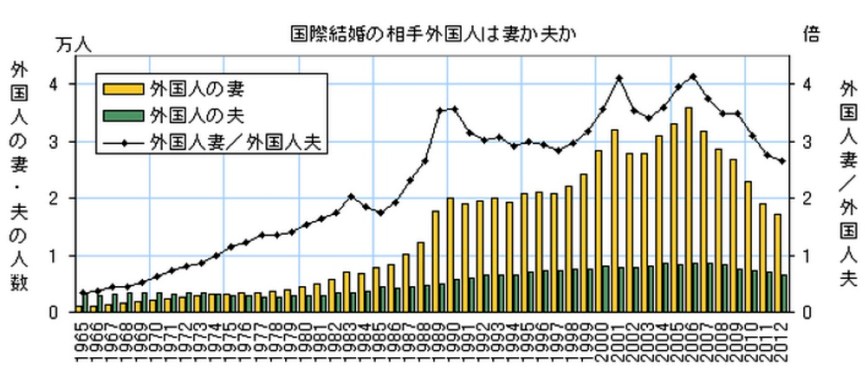
The situation will be better if I can take the right of permanent residence, while it is not very easy. However, a quick and easy way is to marry a Japanese man, which is also recommend by my parents. Therefore, is it good for foreigners to have a Japanese spouse? From Appendix A, it is known that the foreign wives are twice as common as husbands. I believe that most of them are married by love, but some Chinese wives I have known cannot speak Japanese well and seldom have Japanese friends. Caring for the children and their house are the only things they need to do.

Appendix A (Retrieved from http://www2.ttcn.ne.jp/honkawa/1190.html)

Appendix A (Retrieved from http://www2.ttcn.ne.jp/honkawa/1190.html)

In conclusion, it will continue to be hard for women in Japan to be independent from the social or familial role, as Allison (2013, p.22) notes. On the other hand, the pressure of managing both work and family became larger. Women are encouraged to work hard but precariously, and at the same time, they are blamed for not marrying.

I think it is very important for women to marry and have a family, but it should not be done for  the society or family. I means that we relay on our family for spirit,but not for pressure from parents, companies, and the society. Therefore, the government should provide an environment for women to make better choices for themselves and by themselves.

References

Allison,A. (2013). Precarious Japan. Durham, NC: Duke University Press.

Heikinchokonneirei no Suii [The change in the average age of marriage]. Keikon Rikon deta.Net [Marrige and Divorce Net.] (n.d.) Retrieved from http://www.kekkon-data.net/marriage/cnt/heikin_shokon.php

Enhanced by Zemanta

The future is fluid and invisible

Note from Editor: Students are reading Anne Allison’s book Precarious Japan, and sharing their thoughts on how their own future plans are impacted by the instability and insecurity that Allison describes.

by Kota Yanigadani

The future is not fixed, it is fluid and invisible, but still we can have a plan on our future and even try to realize the future. My future is after working at some professional workplace about security or conflict resolution, working, as a world citizen, to reduce violence in the world, correct injustice, and thus end poverty in the world. Therefore, in this post, connections between my future plans and Anne Allison’s vision of Japan are mentioned.

First of all, the current precarious condition in Japan does not have a big influence on my plan superficially. According to Allison, the mainly aging population, people in solitude in  gray zones, lower positions for women, and the typical company employment system are precarious conditions in Japan. On the aging population and seniors, I do not think the truth is so serious because technology is progressing rapidly. Robot industry can solve work forces in the future, and robot can be the catalyst for people and seniors. From this point, I do not think these are related to helping people suffering from poverty and violence. Also, the typical company employment does not have an influence on my future, because as today’s plan, I do not plan to work as a company man.

Second, my ibasho is actually my family and university. University is ba for me to prove myself, and I always feel comforted by being at home. However, what makes my identity is not my nationality. Recently, I have felt as if I am a cosmopolitan, which means I have strong global, world citizenship. To put it simply, while my ibasho is my family and ba is my university, my identity is not Japanese, but world citizen.

Finally, still I have more habits as Japanese compared to other nationalities, and Allison’s view on Japan is really common to me. The most similar vision is that Japan has a strong vertical relation among people. For example, when we meet people being older than us, we usually use keigo, which is polite communication tool in Japan, and we use more polite keigo when we talk with boss in our workplace. When I met president of our company at my workplace, actually I had the most polite posture and used clear keigo.

In addition to this, there is common system in Japanese company called nenkojoretsu, which Allison mentioned. This system is the longer you work in a company, the higher position and salary you can have. However, recently due to this system, a lot of people, especially young people have been fired and some bosses are really incapable, since they do not have much experience of competing for survival in their companies. I believe the system of vertical society and nenkoujoretsu have given rise to one kind of precarious condition in Japan today.

In conclusion, a unique style of society in Japan actually has an impact on my future plan, even though that seems this impact is not a big deal. Family is my ibasho, which should be common to many people. Given the company, because it is too typical to be a company man, working as a salary man is not first-choice for me as I said. Basically, I do not want to end my life too normally, which is to work in a company, to have a family, to see grandson, to end life happily. Instead of this, I always think I would like to make some change, or do some big things, which led to my quite big future plan. In that sense, some condition of Japan like Allison said might have a big impact on my future plan.

Enhanced by Zemanta