Japan’s Self-Defense Force is joining the nation’s efforts to offer more employment opportunities for women, through this recruitment campaign. Women can get a “j-na shigoto,” or a j-job. What’s a j-job? Actually there are 3 j’s, so you know it’s good: Jietai (self-defense force), joyful, and job. “Won’t you try?” says one of the uniformed women, photographed lounging about.
If Prime Minister Abe’s efforts to recruit more women into the workforce are to be successful, employers like the Jietai might want to rethink how they treat women. Are they workers, or are they eye-candy? Can they help defend the nation, or can they answer the phones? Serve the nation or serve tea?
Plus, not only is childcare rarely available, but the burden of childcare remains clearly gendered in Japan. Policy debates of how to enable more women to work discuss how women, and only women, can better work the “second shift,” balancing work and family. Such proposals ignore men completely, even though my male Japanese students often tell me they too would like to be able to have a career and raise a family.
What’s behind the move to get more women into the workforce? Japan’s aging society needs more workers. As Tyson notes:
These initiatives are not motivated by softhearted political correctness but by hard-headed economic logic. Japan needs to expand its work force, which is shrinking rapidly as a result of a sagging birth rate and an aging population. The International Monetary Fund estimates that Japan’s working-age population will fall by almost 40 percent by 2050. The share of citizens older than 65 is expected to jump from 24 percent in 2012 to 38 percent in 2050, when the ratio of the working population to the elderly population will be 1 to 1.
“Japan is growing older faster than anywhere else in the world,” the I.M.F. reports. Unless the nation can shore up its work force, it faces a long-term drag on economic growth at a time of soaring obligations for old-age entitlements.
My university classrooms are filled with intelligent, highly trained women who are looking for career opportunities that take advantage of their skills. They do not want to be asked to serve tea, or be expected to quit when they get married or have children.
I recently came across the writing of Akemi Johnson, a fellow Fulbright scholar who writes on issues of race, gender, and power in Okinawa. Johnson adeptly connects her experiences as the child of a Japanese American mother and a WASP father with the challenges the women and men of Okinawa face in dealing with the presence of US military bases in the prefecture.
Her website, akemijohnson.com, provides links to several articles that she has published, including a brilliant piece in the Kyoto Journal. She is currently working on a literary nonfiction book based on her experiences in Okinawa. Check out her work!
Jeffrey and Ivan have just released another powerful video on Fukushima—this time from inside the evacuated zone with some farmers who have refused to leave. It’s a powerful, moving look at the damage inflicted by the nuclear disaster, and the lives affected by it.
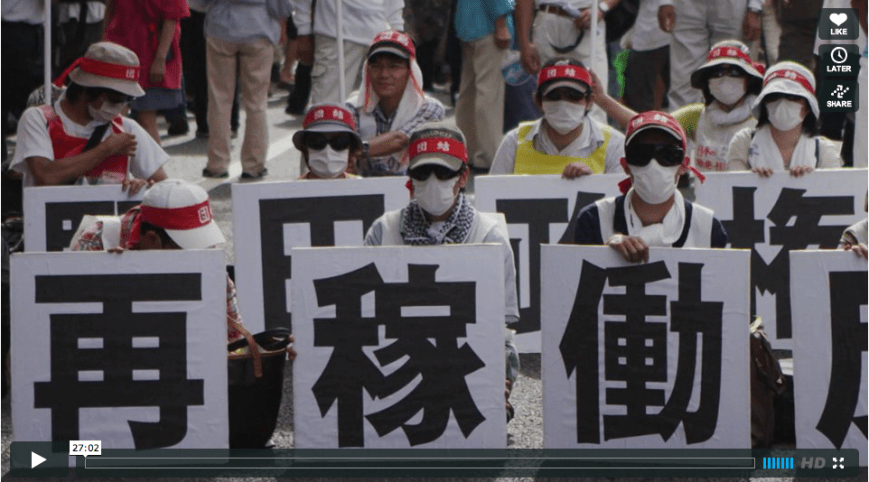
The documentary “Women of Fukushima” is available for free online viewing this week.
by Robert Moorehead
To highlight the ongoing difficulties experienced by many in Japan, the wonderful and inspiring documentary ‘Women of Fukushima’ is available for free online viewing this week. To see the documentary, click on the image above and you’ll be taken to vimeo.com.
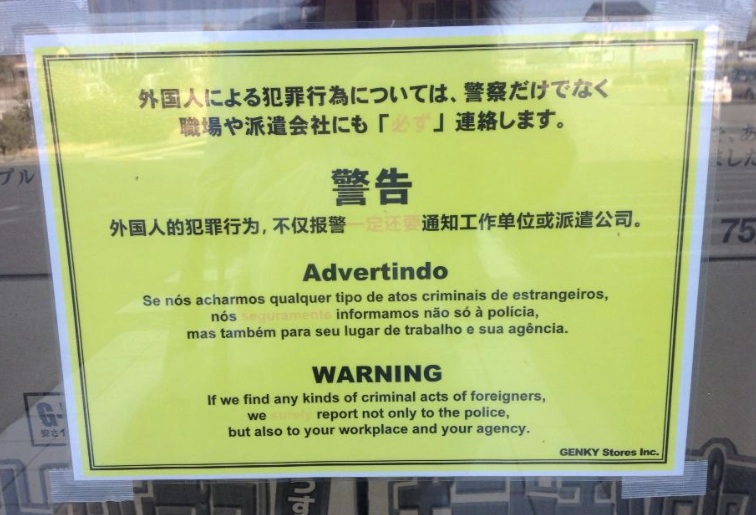
After the posting of signs alerting foreign shoppers that they’re being watched for crimes at Genky markets, the Cabinet Office has announced the results of a poll on Japanese attitudes towards foreign residents of Japanese descent (Nikkei Teijū Gaikokujin). (Here’s a link to English coverage in the Japan Times.) 1,883 Japanese people responded to the survey, out of 3,000 asked, completing short structured interviews. The results of the survey are encouraging, with 80.9 percent of respondents stating that they would accept Nikkei into their communities. However I wonder about social desirability effects, or the extent to which people are saying what they think will make them look good. Is this a case of tatemae over honne?
The survey asked respondents if they knew that there were Nikkei living in Japan, and how they knew this. Nearly 53 percent the respondents either knew that Nikkei were living in Japan, or had heard about it. 46 percent answered that they did not know that this group was living in Japan. The fact that Nikkei are concentrated in industrial regions of the country may account for the high percentage of Japanese who were unaware that this group is here. (At its peak in 2007, nearly 400,000 South Americans were registered residents in Japan. Much of this population is either of Japanese descent, or is a family member of someone of Japanese descent.)
Only 16.7 of respondents who knew of the existence of Nikkei in Japan (that is, about 9 percent of all respondents) knew or had worked with someone who was Nikkei. Nearly 73 percent had heard about this group on TV, and 48 percent had read about them in the newspaper. Having less than one out of 10 respondents actually know someone who is Nikkei means that the Nikkei remain vulnerable to negative depictions in mass media. The National Police Agency fuels this situation by continuing its inaccurate connection of foreigners with crime. Fear sells newspapers and funds budgets.
88 percent of respondents state the Nikkei need to learn the language, and nearly 92 percent state they need to learn Japanese culture and customs. More specifically, when asked how much of the Japanese language and culture Nikkei should know prior to coming to Japan, 46 percent responded that the Nikkei should know enough to be able to live independently (fujiyū shinai). Another 42 percent responded that they should know the bare minimum to get by in their daily living. 41 percent answered that the Nikkei should be familiar with Japanese culture and customs before coming, while another 50 percent think they should at least learn this after they arrive. These points seem fairly obvious. Economic security and social mobility in Japan require learning the Japanese language and culture, and the Nikkei are adapting. Assimilation happens every day, in many little ways, even by those who might be opposed to “turning Japanese.”
The survey then examines respondents’ support for government policies to facilitate this assimilation, including programs for Nikkei kids in school, interpreters at Hello Work employment centers, and skills training for Nikkei workers. The survey did not include any discussion of how much money respondents would want the government to spend on these programs. 87 percent of respondents stated that special policies to facilitate the integration of the Nikkei should be either maintained (nearly 60 percent) or increased (27 percent).
The most surprising result was that nearly 81 percent said that they were open to accepting Nikkei into their local communities. 30 percent said they would accept them, and nearly 51 percent replied that they were somewhat open to accepting them (“Dochirakatoieba, ukeiretai“). Nearly 13 percent said they would prefer not to accept Nikkei into their local communities.
So what does this mean? What does it mean to ‘accept’ Nikkei into your community? Can they rent an apartment in your building? Work in your company as something other than a manual laborer? Can they join your social groups? Can they marry your daughter? And what are the conditions of this acceptance? Are they welcome as long as they act Japanese?
On the one hand, I’m encouraged by the support for Nikkei in Japan. It’s certainly better than if they had said the opposite. But … I’m skeptical. South Americans in Japan, Nikkei and non-Nikkei alike, have told me very clearly that they do not feel included in Japanese society. Instead, borrowing some phrases from Eli Anderson’s The Cosmopolitan Canopy, they’re perpetually ‘on probation.’ In this provisional status, any misstep can be used against you as a sign of the fact that you’ll never fit in. You can enjoy a certain bonhomie with Japanese, but there’s always that chance that you’ll make a mistake with the language or do something else wrong—and those faux pas could out you as a perpetual gaijin (foreigner/outsider). There’s always the risk of the gaijin moment, in which a Japanese person calls you out on your foreign status by calling you gaijin (or the gaijin‘s dressed up cousin, gaijin-san) or posting signs in stores warning all customers that gaijin are being watched as potential criminals.
Scholars have noted that surveys are better at reflecting respondents’ public performance of attitudes about minority groups, than at accurately measuring people’s “real” views. We’ve become really good at hiding what we think, and instead we present a front stage image of ourselves that tries to make us look good. Survey techniques that pursue the issue with flexible follow-up questions reveal more negative views, as do in-depth interviews. In Japanese, these presentations of self are defined as tatemae (your front stage performance) and honne (your true beliefs). So to what extent do these questions reflect respondents’ real views? Ethnographic research on this topic reveals persistent barriers to the fuller integration of non-Japanese into Japanese society. People will often say they’re open to having other groups live in Japan, but when push comes to shove, foreigners remain on probation.
Hopefully government officials will use this survey to promote further initiatives to empower the Nikkei (and hopefully other non-Japanese) in Japan. Publicly conducting the survey, posting it on the Cabinet Office website, and releasing it to the press, may indicate that the government is testing public support for such initiatives.
“WARNING If we find any kinds of criminal acts of foreigners, we SURELY report not only to the police but also to your workplace and your agency.” – GENKY Stores Inc (a drugstore in Kani-shi, Gifu-ken, dated February 28, 2013, taken by HSD, courtesy of shared links on Facebook through SM)
by Robert Moorehead
Arudō Debito posted the above picture on his blog, debito.org, as another example of the persistent stereotype that connects foreigners with crime. As other posts on my blog have shown, this stereotype is not unique to Japan and is inaccurate. Simply put, foreigners are no more likely to commit crime than the native-born are. Debito’s blog points out that instances of shoplifting are increasing in one demographic group: elderly Japanese are committing shoplifting in increasing numbers. However, their crimes are often depicted in much nicer ways, as crimes of loneliness.
As a foreign resident of Japan, shouldn’t I also be on the lookout for crime? And shouldn’t I be looking out for all crime, and not just the tiny percentage committed by the country’s tiny foreign population? If non-Japanese are less than two percent of the population, shouldn’t we really be focusing on the other 98 percent? Something tells me they’re committing way more crime. Drawing on the Occupy Movement, maybe foreigners’ rallying cry should be “We are the 98 percent.”
When I lived in the city of Kasugai, in Aichi prefecture, most homes in my quiet suburban neighborhood were decorated with crime-watch signs in Chinese. The fact that there was no crime wave, Chinese or otherwise, was irrelevant, as was the fact that this supposed threat made up only 0.5 percent of the city population. Rumor had it that years earlier, someone had their home had broken into, and the alleged perpetrator was Chinese.
Following the logic that if one is guilty, all must be guilty, many homes in Kozoji New Town were festooned with signs in Chinese from their neighborhood associations, warning that residents would report anyone who looked suspicious (and Chinese) to the police. While an occasional sign was in Japanese, most were not. The enterprising neighborhood association of Iwanaridai cast a broad net over most foreigners in the area, putting up crime multilingual watch signs in Portuguese, Spanish, Chinese, and English.
Beyond perpetuating stereotypes that foreigners are somehow more likely to commit crime, these signs equate not being Japanese with crime and being Japanese with being law-abiding. They warn Japanese to be on the lookout for foreigners, and they warn foreigners that they’re being watched. They’re also an affront to our (shared?) humanity.
Update: The issue has prompted a video response on YouTube:
In the same spirit as my last post in which I pleaded for sales of my book (well, the book in which I wrote a chapter), this post gets at the challenge of accurately measuring the impacts of our academic work. Inevitably, some statistical measure of our work gets created, reducing our professional lives to a series of numbers. But how accurate are those numbers? What do they measure? How can they reflect the quickly changing ways in which we’re sharing ideas? If we’re going to be reduced to numbers, how can we make sure that those numbers help us, rather than hinder us?
I read. A lot. Still I’m constantly amazed at how little of the massive amounts of information available to me I’m actually able to absorb. It is no surprise that this is an affliction shared by the research community. Scientific research is available for public consumption in ways that would have seemed unimaginable just a few short years ago and the sheer volume can be overwhelming.
“In growing numbers, scholars are integrating social media tools like blogs, Twitter, and Mendeley into their professional communications. The online, public nature of these tools exposes and reifies scholarly processes once hidden and ephemeral. Metrics based on this activities could inform broader, faster measures of impact, complementing traditional citation metrics.”
These alternative metrics, or altmetrics as they are commonly referred to, are increasingly gaining credence as a way to track the sphere of influence of social media in the scientific community. It…
Last year, I published a chapter in the book Language and Citizenship in Japan. The fine folks at Routledge released the book in hardcover and Kindle formats, and now we’d like to see the book in paperback. Why? Because the hardcover book costs $116, and the Kindle edition $100. Only libraries will purchase the book at that price, and I’d like to see the book on more people’s shelves. We do this work not for book royalties, but to spread and share ideas.
Routledge generally sells paperbacks at a fraction of the the cost of hardcovers, and a paperback edition would likely bring the price of the Kindle edition down, also. The lower the price, the more likely people will buy the book and order it for classes—and the more our ideas will be part of the debates.
To get the magic paperback edition released, Routledge first needs to sell 200 copies of the hardcover. We can get there if more libraries purchase the book. So, if your library doesn’t already have it, then please encourage them to order it. This link gives you the information your library will need to order the book from Routledge: http://www.routledge.com/books/details/9780415897228/
Here’s a blurb about the book:
The relationship between language and citizenship in Japan has traditionally been regarded as a fixed tripartite: ‘Japanese citizenship’ means ‘Japanese ethnicity,’ which in turn means ‘Japanese as one’s first language.’ Historically, most non-Japanese who have chosen to take out citizenship have been members of the ‘oldcomer’ Chinese and Korean communities, born and raised in Japan. But this is changing: the last three decades have seen an influx of ‘newcomer’ economic migrants from a wide range of countries, many of whom choose to stay. The likelihood that they will apply for citizenship, to access the benefits it confers, means that citizenship and ethnicity can no longer be assumed to be synonyms in Japan.
This is an important change for national discourse on cohesive communities. This book’s chapters discuss discourses, educational practices, and local linguistic practices which call into question the accepted view of the language-citizenship nexus in lived contexts of both existing Japanese citizens and potential future citizens. Through an examination of key themes relating both to newcomers and to an older group of citizens whose language practices have been shaped by historical forces, these essays highlight the fluid relationship of language and citizenship in the Japanese context.
It’s an excellent book, with engaging chapters written by leading scholars that are appropriate for general and academic audiences. If I weren’t already in the book, I’d definitely buy it—in paperback. And if my library didn’t have it, I’d push them to order it.
I’ll avoid for now any existential whinging about the fact that we can’t even sell 200 copies of a fine book. It’s depressing, and I’d rather not think about it. But this is a reflection of the tight market for academic books, where good books don’t get ordered because of shrinking budgets. Less expensive editions of books don’t get published because the more expensive editions didn’t sell, thereby discouraging people even more. It’s a downward spiral. But we can try to stop this downward trend by promoting each others’ books, and by gently nudging our librarians toward the texts that we want to read.
Miki Dezaki, who first arrived in Japan on a teacher exchange program in 2007, wanted to learn about the nation that his parents had once called home. He taught English, explored the country and affectionately chronicled his cross-cultural adventures on social media, most recently on YouTube, where he gained a small following for videos like “Hitchhiking Okinawa” and the truly cringe-worthy “What Americans think of Japan.” One of them, on the experience of being gay in Japan, attracted 75,000 views and dozens of thoughtful comments.
Dezaki didn’t think the reaction to his latest video was going to be any different, but he was wrong. “If I should have anticipated something, I should have anticipated the netouyo” (spelling corrected from original post), he told me, referring to the informal army of young, hyper-nationalist Japanese Web users who tend to descend on any article — or person — they perceive as critical of Japan.
But before the netouyo put Dezaki in their crosshairs, sending him death threats and hounding his employers, previous employers and even the local politicians who oversee his employers, there was just a teacher and his students.
Dezaki began his final lesson with a 1970 TV documentary, Eye of the Storm, often taught in American schools for its bracingly honest exploration of how good-hearted people — in this case, young children participating in an experiment — can turn to racism. After the video ended, he asked his students to raise their hands if they thought racism existed in Japan. Almost none did. They all thought of it as a uniquely American problem.
Gently, Dezaki showed his students that, yes, there is also racism in Japan. He carefully avoided the most extreme and controversial cases — for example, Japan’s wartime enslavement of Korean and other Asian women for sex, which the country today doesn’t fully acknowledge — pointing instead to such slang terms as “bakachon camera.” The phrase, which translates as “idiot Korean camera,” is meant to refer to disposable cameras so easy to use that even an idiot or a Korean could do it.
He really got his students’ attention when he talked about discrimination between Japanese groups. People from Okinawa, where Dezaki happened to be teaching, are sometimes looked down upon by other Japanese, he pointed out, and in the past have been treated as second-class citizens. Isn’t that discrimination?
“The reaction was so positive,” he recalled. For many of them, the class was a sort of an a-ha moment. “These kids have heard the stories of their parents being discriminated against by the mainland Japanese. They know this stuff. But the funny thing is that they weren’t making the connection that that was discrimination.” From there, it was easier for the students to accept that other popular Japanese attitudes about race or class might be discriminatory.
The vice principal of the school said he wished more Japanese students could hear the lesson. Dezaki didn’t get a single complaint. No one accused him of being an enemy of Japan.
That changed a week ago. Dezaki had recorded his July classes and, last Thursday, posted a six-minute video in which he narrated an abbreviated version of the lesson. It opens with a disclaimer that would prove both prescient and, for his critics, vastly insufficient. “I know there’s a lot of racism in America, and I’m not saying that America is better than Japan or anything like that,” he says.
Also on Thursday, Dezaki posted the video, titled “Racism in Japan,” to the popular link-sharing site Reddit under its Japan-focused subsection, where he often comments. By this Saturday, the netouyo had discovered the video.
“I recently made a video about Racism in Japan, and am currently getting bombarded with some pretty harsh, irrational comments from Japanese people who think I am purposefully attacking Japan,” Dezaki wrote in a new post on Reddit’s Japan section, also known as r/Japan. The critics, he wrote, were “flood[ing] the comments section with confusion and spin.” But angry Web comments would turn out to be the least of his problems.
The netouyu make their home at a Web site called ni channeru, otherwise known as ni chan, 2chan or 2ch. Americans familiar with the bottommost depths of the Internet might know 2chan’s English-language spin-off, 4chan, which, like the original, is a message board famous for its crude discussions, graphic images (don’t open either on your work computer) and penchant for mischief that can sometimes cross into illegality.
Some 2chan users, perhaps curious about how their country is perceived abroad, will occasionally translate Reddit’s r/Japan posts into Japanese. When the “Racism in Japan” video made it onto 2chan, outraged users flocked to the comments section on YouTube to attempt to discredit the video. They attacked Dezaki as “anti-Japanese” and fumed at him for warping Japanese schoolchildren with “misinformation.”
Inevitably, at least one death threat appeared. Though it was presumably idle, like most threats made anonymously over the Web, it rattled him. Still, it’s no surprise that the netouyu’s initial campaign, like just about every effort to change a real-life debate by flooding some Web comments sections, went nowhere. So they escalated.
A few of the outraged Japanese found some personal information about Dezaki, starting with his until-then-secret real name and building up to contact information for his Japanese employers. Given Dezaki’s social media trail, it probably wasn’t hard. They proliferated the information using a file-sharing service called SkyDrive, urging fellow netouyu to take their fight off the message boards and into Dezaki’s personal life.
By Monday, superiors at the school in Japan were e-mailing him, saying they were bombarded with complaints. Though the video was based almost entirely on a lecture that they had once praised, they asked him to pull it down.
“Some Japanese guys found out which school I used to work at and now, I am being pressured to take down the ‘Racism in Japan’ video,” Dezaki posted on Reddit. “I’m not really sure what to do at this point. I don’t want to take down the video because I don’t believe I did anything wrong, and I don’t believe in giving into bullies who try to censor every taboo topic in Japan. What do you guys think?”
He decided to keep the video online, but placed a message over the first few sentences that, in English and Japanese, announce his refusal to take it down.
But the outrage continued to mount, both online and in the real world. At one point, Dezaki says he was contacted by an official in Okinawa’s board of education, who warned that a member of Japan’s legislature might raise it on the floor of the National Diet, Japan’s lower house of parliament. Apparently, the netouyu may have succeeded in elevating the issue from a YouTube comments field to regional and perhaps even national Japanese politics.
“I knew there were going to be some Japanese upset with me, but I didn’t expect this magnitude of a problem,” Dezaki said. “I didn’t expect them to call my board of education. That said, I wasn’t surprised, though. You know what I mean? They’re insane people.”
Nationalism is not unique to Japan, but it is strong there, tinged with the insecurity of a once-powerful nation on the decline and with the humiliation of defeat and American occupation at the end of World War II. Japan’s national constitution, which declares the country’s commitment to pacifism and thus implicitly maintains its reliance on the United States, was in some ways pressed on the country by the American military government that ruled it for several years. The Americans, rather than Japan’s own excesses, make an easy culprit for the country’s lowered global status.
That history is still raw in Japan, where nationalism and resentment of perceived American control often go hand-in-hand. Dezaki is an American, and his video seems to have hit on the belief among many nationalists that the Americans still condescend to, and ultimately seek to control, their country.
“I fell in love with Japan; I love Japan,” Dezaki says, explaining why he made the video in the first place. “And I want to see Japan become a better place. Because I do see these potential problems with racism and discrimination.” His students at Okinawa seemed to benefit from the lesson, but a number of others don’t seem ready to hear it.
Here’s my response: I applaud Dezaki-sensei for his efforts to raise students’ awareness of issues of racism and discrimination in Japan. In my classes at Ritsumeikan, I’ve found students very open to learning about Japan’s modern history, of which they are unfortunately often ignorant. Students have told me that they have gone home after class and asked their parents about the Burakumin, Zainichi Koreans, and other groups. The fact that many of these students grew up in the Kansai area, which is home to many Burakumin and Zainichi, shows how students in high school are not being taught even local history, let alone national history. Of course, many of my students also pass as mainstream Japanese, preferring to conceal their ethnic ancestries rather than constantly out themselves as non- or mixed-Japanese.
As for present-day issues of discrimination, we should not confuse the absence of slurs with the acceptance of minorities. Buraku children still face low expectations and stereotypes from teachers. They are also less likely to attend high school, to graduate from high school or university. They are also more likely to receive government welfare benefits. Plus, groups such as the Zainichi, South Americans, Chinese, and Filipinos routinely face discrimination in employment, education, and other realms of social life. Much of this happens discretely, but it still happens. And let’s not forget the right-wing sound trucks and Zaitokukai protests against Zainichi and other non-Japanese.
I also applaud Desaki-sensei for bravely not giving in to the netouyo. Like Desaki, I’m an American teaching in Japan and I consider this place home. And just like sometimes you have to tell to a friend or family member something they don’t want to hear, Japan needs to hear about problems it would rather ignore. As a country with the third-largest economy and tenth-largest population in the world, Japan is not a child that needs to be protected. It can handle the truth, even if the netouyo would rather avoid it.
A total of 1.62 million single unemployed people between the ages of 20 and 59 were “isolated” in Japanese society in 2011, according to a new study released Sunday.
The study defined as “isolated” those who fell within the age parameters and were not employed, receiving education or married, and who were alone or only in contact with family members on two consecutive days of the year.
(This bears repeating: All it takes to be officially “isolated” is being single and either unemployed or not in school, and staying home for two consecutive days.)
Based on surveys conducted by the Internal Affairs and Communications Ministry every five years, the study estimated that some 2.56 million single people in the 20-59 age bracket were not working or studying in 2011. Of those, 1.62 million were judged to be “isolated” from society, a 45 percent spike from the 1.12 million seen in 2006.
The study, led by University of Tokyo professor Yuji Genda, was commissioned by the education ministry-affiliated Japan Society for the Promotion of Science.
“‘Isolated’ people tend to lose the will to find a job, and they are highly likely to end up in a financial bind,” Genda said.
He pointed to the urgent need for the central and local governments to assist such people by sending counselors to visit their homes and by introducing other measures to curb the rising social security costs engendered.
Meanwhile, a government white paper has shown that the total number of people aged 15 to 34 who were not in employment, education or training in 2012 stood at 630,000.
Experts have warned that the growing number of older single people without work is an emerging issue that especially needs to be addressed by the government.
(I’m not denying that social isolation can be a serious problem. The Japanese economy provides few opportunities for those who, for whatever reason, are not on the traditional employment paths. But you would think that the truly isolated spend more than just two days in a row at home.)





 JAPANsociology